Around 90% of jobs now require digital skills. Only 60% of EU adults have them. That gap is not an HR footnote. It is the reason rollouts slip, licences go unused, and transformation budgets quietly underdeliver.
A digital skills gap analysis turns that vague worry into a ranked, costed list of what to fix first. This guide shows you how to run one, with the data, frameworks and deadlines that actually apply in 2026. For the demand side first, our overview of the skills employers will need most by 2030 sets the context; this guide is about measuring your own team against it.
Updated August 2026 with the latest Eurostat and State of the Digital Decade figures, World Economic Forum survey data, and the EU AI Act literacy duty that became enforceable on 2 August 2026.
Key Takeaways
- 60% of EU adults aged 16 to 74 had at least basic digital skills in 2025, 20 points short of the 2030 target.
- 63% of employers name skills gaps as the single biggest barrier to business transformation.
- 39% of core skills are expected to change by 2030, so run your analysis as a quarterly loop, not an annual project.
- AI literacy is now a legal duty for EU employers, supervised and enforceable since 2 August 2026. Document your training.
- Prioritise by business impact, risk exposure and time-to-skill. Fund quick wins first, then the longer bets.
- Measure adoption and demonstrated proficiency, not course completions.
What Changed in 2026
If you ran a skills review two years ago, three things have moved enough to invalidate parts of it.
Europe is officially off track
The EU set a Digital Decade target of 80% of adults with at least basic digital skills by 2030. Eurostat put the 2025 figure at 60%, up from 56% in 2023 and 54% in 2021.
Progress is real but too slow. The State of the Digital Decade 2026 report projects roughly 68% by 2030 on the current trajectory, and the 80% mark only around 2037 without further action.
The spread between countries is wide. The Netherlands (84%), Ireland (83%), Denmark and Finland (both 81%) have already passed the target. Romania (32%) and Bulgaria (38%) sit far below it. If you hire across Europe, a single EU-wide assumption about baseline literacy will mislead you.
Specialist supply is tighter still. Around 10.5 million people work as ICT specialists in the EU, about 5% of total employment, against a 2030 target of 20 million. Women make up under 20% of that group.
AI literacy became a compliance question
Article 4 of the EU AI Act has applied since 2 February 2025, but supervision and penalties only started on 2 August 2026. The Digital Omnibus, endorsed by the European Parliament on 16 June 2026 and approved by the Council on 29 June 2026, softened the wording from ensuring a sufficient level of AI literacy to supporting its development. In practice that is a shift from an obligation of result to an obligation of effort. The duty, the scope and the enforcement date did not move.
It applies to every provider and deployer of AI systems in the EU, regardless of size or risk tier, and it covers staff, contractors and anyone else operating AI on your behalf. For most organisations this is the first AI Act obligation that actually bites. If you are mapping what compliance looks like end to end, our guide to EU AI Act compliance covers the wider obligations, and your generative AI usage guidelines are the natural place to anchor the training record.
Skill churn is high but stabilising
The World Economic Forum’s Future of Jobs survey of more than 1,000 employers found that 39% of workers’ core skills are expected to change or become outdated by 2030. That is down from 44% in the 2023 edition and 57% in 2020, partly because half the workforce has now completed some form of structured training.
The headline finding is blunter: 63% of employers call skills gaps their biggest barrier to transformation, ahead of culture, regulation and capital. If the world’s workforce were 100 people, 59 would need training by 2030, and 11 of them are unlikely to get it.
Why the Digital Skills Gap Hits Your Bottom Line
When teams lack basic competence, projects stall and costs rise in ways that rarely show up on a single line item.
The cost hides in rework
Lost time, stalled initiatives and repeated fixes drain budgets without ever being labelled a skills problem. You feel it in onboarding, in support tickets, and in the gap between what a tool can do and what your team actually uses.
European employer surveys report shortages across almost every occupational category, with roughly three-quarters of employers globally saying they struggle to find people with the right skills. That mismatch is what turns a twelve-week rollout into a nine-month one.
The divide compounds inequality
Access to training shapes who gets good work. People with lower formal education, older workers and those in rural regions are consistently overrepresented in the below-basic group, and the gap widens once AI tools enter the workflow. Our piece on digital literacy in business growth covers the baseline side of this in more depth.
- Quantify the cost by tracking rework, cycle time and support volume before you buy training.
- Start with the basics: data literacy, secure collaboration and safe AI use.
- Tie every investment to a named business outcome, not a course catalogue.
What Is a Digital Skills Gap Analysis?
At its core it is a structured comparison between what each role demands and what people actually demonstrate. Nothing more complicated than that. The discipline is in doing it consistently.
Skills, gaps and competencies
Separate baseline skills that everyone needs (data literacy, security hygiene, AI judgement) from role-specific competencies such as cloud architecture or security operations. That split keeps prioritisation practical.
Employer studies keep finding the same pattern: early-career hires lag most in communication, collaboration and safety, not in tool use. Paired assessments, where you rate both the importance of a skill and the observed level, quantify how large each shortfall really is.
When to run one and who owns it
Run a full review before a major technology rollout, during a restructure, and as part of annual planning. Run a lightweight version quarterly.
Ownership should sit with HR or learning and development (L&D) in partnership with line management and IT. If HR owns it alone, the findings stay theoretical. If IT owns it alone, the human skills disappear from the picture.
“Compare demanded skills with observed performance to find root causes, not just symptoms.”
- Scope by role and level so findings map to real jobs.
- Use job analysis, competency models, surveys and assessments as your core inputs.
- Translate results into role-based learning plans and targeted hiring.
Which Skills Are in Demand Right Now
Across sectors, employers name a fairly consistent set of priorities, and the mix has tilted noticeably towards judgement rather than tool operation.
The current high-impact areas
Information and data literacy remains the top-ranked everyday competence in employer surveys, followed by problem-solving and digital content creation. Analytical thinking is still the most sought-after core skill overall, named as essential by around seven in ten companies.
What is rising fastest
AI and big data, networks and cybersecurity, and technology literacy are the fastest-growing skill demands through 2030. Alongside them sit resilience, creative thinking and curiosity: the human skills that decide whether AI output gets used well or blindly.
Safety, communication and collaboration are the quiet blockers. Surveyed firms report their largest measured gaps in exactly these areas, and they are the ones most likely to derail delivery. Our guide to building soft skills for future work covers how people develop them. For a fuller view of where demand is heading, see our breakdown of which skills will be most in demand.
Turn technologies into competencies
Don’t write “AI” on a skills matrix. Write what a person must be able to do: draft a prompt that produces a usable first draft, spot a plausible-sounding fabrication, know which data may never go into a third-party tool. Those are testable. “AI” is not.
Frameworks You Can Structure the Analysis Around
Use an established model so you measure the same thing twice. A shared framework also makes results comparable across teams and years.
DigComp: five competence areas
The European Commission’s DigComp framework, its reference model for citizens’ digital competence, defines five areas: information and data literacy; communication and collaboration; digital content creation; safety; and problem solving. Each contains specific, observable actions, such as evaluating a source, protecting personal data or handling licensing correctly.
Map real tasks and real tools to each area so assessments reflect the work people actually do. A generic questionnaire produces generic findings.
Translate competencies into role profiles
Turn descriptors into role profiles with expected behaviours at entry, intermediate and expert level.
- Link tasks and tools to each profile so managers can judge performance without guesswork.
- Use one shared taxonomy across hiring, learning and performance reviews.
- Embed knowledge items like data handling and licensing to reduce legal risk.
A taxonomy also makes verified credentials usable. If you are rethinking how qualifications are assessed, our guide to micro-credentials in hiring explains what holds up and what doesn’t.
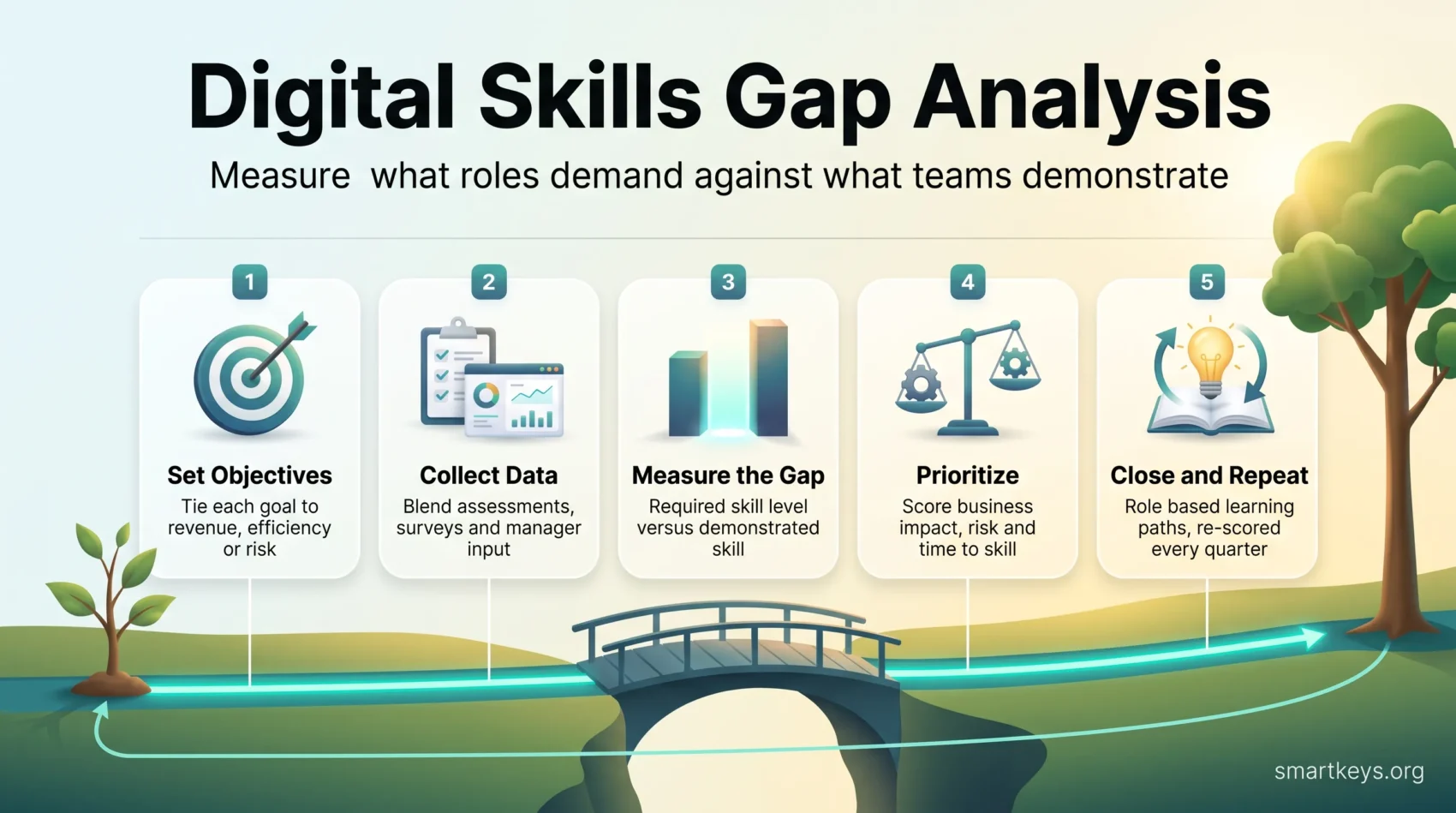
Digital Skills Gap Analysis: A Seven-Step Method
Begin by defining what success looks like, then work backwards.
Step 1: Set two to four objectives
Map each objective to revenue, efficiency or risk reduction. “Improve digital skills” is not an objective. “Cut time-to-competence for new support agents from 9 weeks to 5” is.
Step 2: Collect the right data
Blend quantitative assessments with surveys, interviews and manager input. Paired evaluations that compare importance ratings against observed levels reliably surface shortfalls in collaboration, problem-solving and safety that self-assessment alone hides.
Step 3: Compare demand against demonstrated competency
Score required proficiency by role, then score what people demonstrate. The delta is your gap. Keep the scale short. Four levels is plenty.
Step 4: Prioritise with a scoring model
Not every gap deserves a budget. Score each one:
| Factor | Question to ask | Weight |
|---|---|---|
| Business impact | What stalls or leaks money while this gap exists? | High |
| Risk exposure | Does this create a security, privacy or compliance liability? | High |
| Time-to-skill | Weeks or quarters to reach working competence? | Medium |
| Population size | How many people does closing it actually help? | Medium |
| Build vs. buy | Faster to train internally or hire the capability? | Low |
Quick wins in the top-right of that matrix fund the longer bets. That sequencing matters more than the scoring precision.
Step 5: Build role-based profiles and pathways
List expected competencies by level, then show people the route from where they are to the next step. A gap analysis without a visible pathway reads as criticism.
Step 6: Choose the delivery mix
Match method to gap type. Short-format learning works well for tool skills and refreshers, and our microlearning strategy guide covers how to keep it from becoming noise. Deeper capability needs projects and coaching.
Step 7: Re-run it
With 39% of core skills shifting inside five years, an annual cadence is too slow. Re-score the top ten gaps quarterly and refresh the full map once a year.
Tools and Data Sources That Make Findings Actionable
Combine platform data with frontline feedback. Scores alone tell you what is low. Conversations tell you why.
The quantitative layer
Assessment platforms, a learning management system (LMS) or learning experience platform (LXP), and an analytics dashboard give you baselines and progress. Structure the data model so scores, completions and on-the-job artefacts feed one view rather than three disconnected reports. Dedicated workforce analytics tools make that consolidation far less painful than spreadsheet stitching.
Where you want to model future demand rather than describe current state, predictive analytics in workforce planning is the right lens.
The qualitative layer
Pulse surveys, manager interviews and short focus groups uncover blockers that numbers miss: a tool nobody trusts, a process that punishes asking for help, a licence the team never received.
- Build dashboards that show adoption and proficiency by team, not just enrolments.
- Put insights into manager workflows so action follows without extra overhead.
- Measure whether closing a gap actually improved delivery. If not, you measured the wrong gap.
Designing Solutions That Actually Close Gaps
Favour repeatable, role-based learning people can apply the same week. Mix short modules with hands-on practice so progress is visible fast.
Blended paths by role and level
Combine self-paced modules, instructor-led workshops and lab time. Learners should practise on real projects, not sandboxed toy problems. AI-powered learning platforms now handle much of the sequencing and adaptive pacing that used to eat L&D capacity, and EdTech for corporate training covers how to evaluate the wider vendor landscape.
Accountability rhythms
Set milestone reviews and short manager check-ins. Give managers a one-page playbook with talking points. Most programmes fail at this layer, not at content quality.
Link learning to mobility, not just completion
Tie demonstrated competence to project opportunities and promotion. When people see a clear route, adoption rises and turnover falls. An internal talent marketplace makes the route visible instead of hypothetical, and a deliberate cross-training strategy turns single points of failure into bench depth.
For people further into their careers, the framing matters. Our guide to mid-career retraining covers what works when someone has twenty years of expertise and a rapidly changing toolset.
Experiential Learning, Collaboration and Mentorship
Hands-on practice turns abstract concepts into habits. Embed short projects and labs so learning happens inside the work.
Projects, labs and simulations
Use sandboxes and simulations for generative AI, data analytics and cybersecurity, with timely feedback from managers or mentors. Given that AI literacy is now an EU compliance requirement, keep records of who completed what and when.
For data specifically, a structured data literacy program reaches far more people than an analyst bootcamp ever will, and it is usually the highest-leverage baseline investment.
Knowledge-sharing rituals
Run lunch-and-learns, demos and walkthroughs that spread expertise and break silos. To make those exchanges scale beyond a single session, peer learning platforms capture what your experts explain and keep it searchable.
Mentorship and reverse mentorship
Mentoring delivers targeted feedback. Reverse mentoring, where early adopters coach senior leaders, closes specific gaps unusually fast, especially around AI tooling. Our guide to virtual mentorship in remote teams covers how to run it without heavy admin.
“Make learning part of the job and reward the people who lift the whole team.”
Governance, Change Management and Scaling
Governance is what turns a successful pilot into a repeatable programme. National efforts like Singapore’s SkillsFuture show what coordinated structure achieves at scale; the same logic applies inside a company.
A skills council with real decision rights
Form a cross-functional council that sets standards and owns vendor choices. Give HR, L&D, IT and line managers explicit roles. Make it the single source for policy so you stop duplicating content across departments.
Phased rollout and buy-in
Phase the rollout, test the messaging, collect feedback early. Equip leaders with simple talking points that tie training to business outcomes rather than to headcount development budgets.
Where gaps expose continuity risk, for example one person holding a critical capability, feed the findings straight into your workforce contingency planning.
“Start small, prove value, then scale with standard playbooks.”
Measuring Progress and ROI
Use a compact set of indicators. Ten metrics nobody reads beat none, but four that drive decisions beat all of them.
Leading and lagging indicators
Leading: participation, completion, practice sessions, tool adoption. These predict future performance and let managers intervene early.
Lagging: output, cycle time, defect rates, incident counts, internal mobility. Together they show whether training turned into better performance and lower risk.
- Define KPIs that map to value: adoption, proficiency by role, productivity gains, fewer incidents.
- Collect participation, completion and on-the-job artefacts alongside business outputs.
- Quantify return by linking skill uplift to faster delivery and reduced support cost.
- Track at individual, team and function level to spot where the bottleneck really sits.
For a full framework on the return side, see our guide to measuring upskilling ROI.
Iterate the cadence
Run monthly or quarterly measurement cycles so metrics feed the next wave of focus areas. Put competencies on the dashboard, not just content consumption. Otherwise leaders see activity and mistake it for capability.
Future-Proofing in the Age of AI
With 85% of employers planning to prioritise upskilling and 63% blocked by skills gaps today, the organisations that pull ahead are the ones that treat capability as infrastructure.
Build T-shaped talent
Pair broad literacy with depth in a priority area such as AI, data or security. T-shaped people move between projects without a three-month ramp, which is what actually creates agility.
Scan continuously for emerging roles
Set a regular rhythm for spotting new roles and technologies, then update role profiles and curricula. The broader picture of upskilling and reskilling for future jobs is a useful companion when you rebuild your skill map.
- Align learning to transformation roadmaps so change is planned, not reactive.
- Map adjacent capabilities to boost internal mobility and cut hiring delays.
- Run lightweight analysis often to recalibrate early rather than dramatically.
“Celebrate demonstrated expertise, not certificates. The distinction shapes your whole learning culture.”
Conclusion
The evidence in 2026 points one way. Europe will miss its 2030 skills target on current trends, employers name skills gaps as their number one barrier, and AI literacy has crossed from good practice into legal duty.
None of that requires a bigger training budget. It requires a sharper one. Run the analysis, score the gaps against impact and risk, fund the top three, and measure whether delivery actually improved.
Then do it again next quarter. The organisations that treat this as a loop rather than a project are the ones whose transformation plans survive contact with reality.
Found this useful?
Make SmartKeys a preferred source on Google, and our articles will surface more often in your Top Stories, AI Overviews, and AI Mode.
Add as Preferred Source