Digital literacy is the difference between owning software and getting value from it. Almost every company now runs on cloud tools, shared documents and AI assistants, yet the skill to use them well is spread unevenly across the workforce. That gap shows up as slow processes, duplicated work, avoidable security incidents and decisions made on instinct rather than data.
The bar has also moved. Handling files and email was once enough. In 2026 a digitally literate employee is expected to judge whether an AI-generated answer can be trusted, understand where company data travels, and choose the right tool without being told. A serious digital literacy program is no longer a nice extra; it is what makes the rest of the technology budget pay off.
Key Takeaways
- Digital literacy now includes judging AI output, not just operating software.
- 92% of US jobs require digital skills, yet around a third of workers have low or no digital skills.
- 60% of EU adults had at least basic digital skills in 2025, against an 80% target for 2030.
- Employers expect 39% of workers’ core skills to change by 2030.
- EU employers have had a duty to ensure AI literacy among staff since February 2025.
- Programs work when tied to real tasks and audited, not delivered once and forgotten.
Understanding Digital Literacy
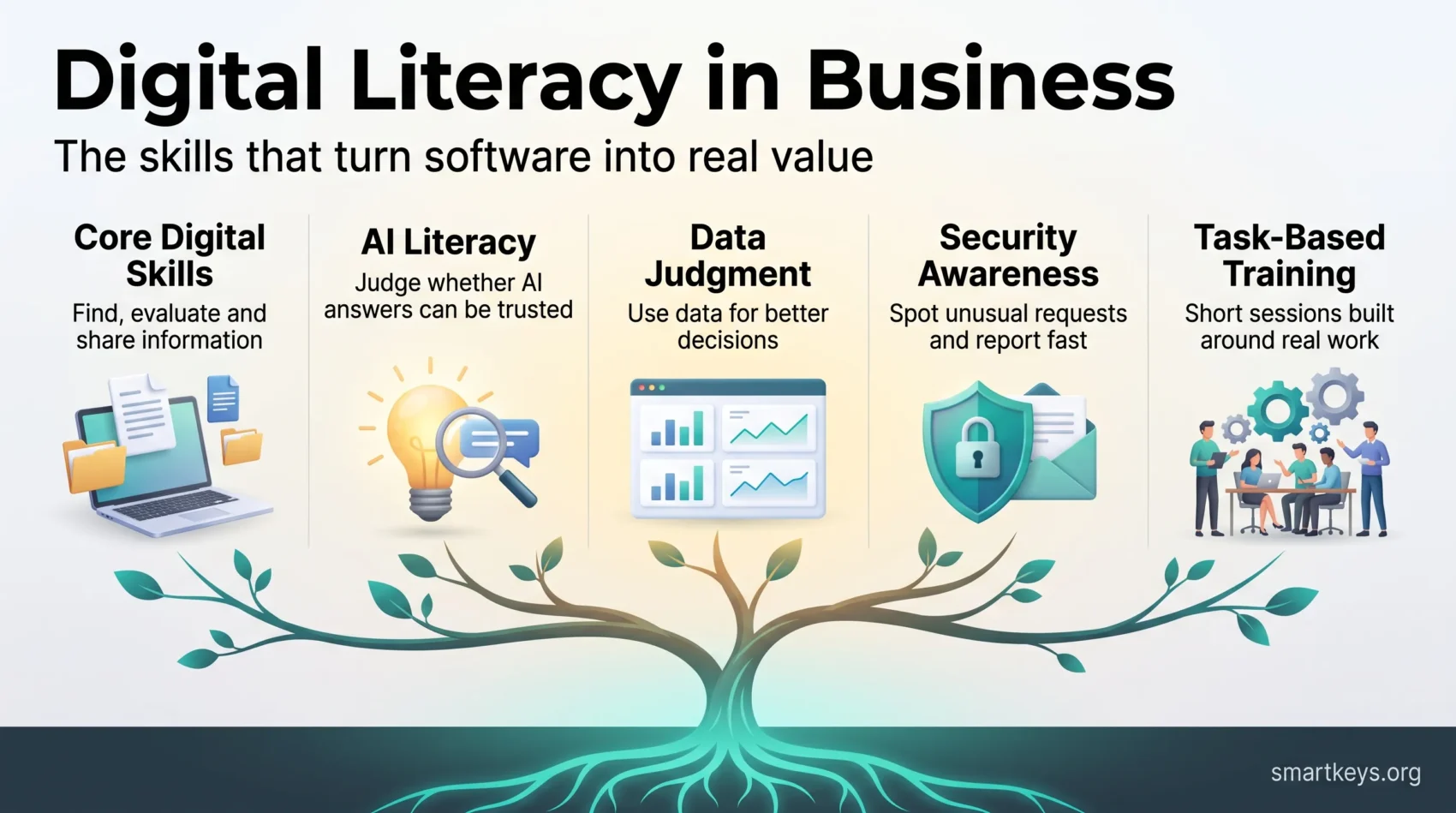
Digital literacy is often reduced to software proficiency, which undersells it. The larger part is judgment: deciding whether a source is reliable, whether a number means what it appears to mean, and whether a task belongs in a spreadsheet, a database or an automation.
Definition of Digital Literacy
Digital literacy means having the skills to find, evaluate, manage, create and share information using digital tools. It runs from basic browsing and file management through collaboration platforms and data handling to specialist work such as querying a dataset or configuring an automation. Useful digital skills training covers all three layers rather than stopping at the first. The practical test is simple: can someone complete an unfamiliar task with an unfamiliar tool, without waiting for a colleague to walk them through it?
Why the Bar Keeps Rising
In its Future of Jobs Report 2025, the World Economic Forum found that employers expect 39% of workers’ core skills to change by 2030, with AI and big data, networks and cybersecurity, and technological literacy growing fastest. That is down from 44% in the 2023 edition, so the churn is slowing, but the same report still expects 59% of workers to need some form of training by 2030. Our guide to upskilling and reskilling in 2026 looks at how companies budget for that, and education and future jobs covers which credentials hold their value.
What Digital Literacy Does for Business Growth
The business case rarely rests on one dramatic number. It rests on friction removed from dozens of daily tasks, which is harder to measure than to feel.
Impact on Operational Efficiency
Employees with strong digital skills reach for the right tool faster, make fewer errors and need less support from colleagues and IT. They also stop recreating work that already exists somewhere in the system, one of the quietest costs in most organizations.
Gains compound where teams share a standard. When everyone knows how the CRM is structured, where files live and which channel is for what, coordination stops eating the day. That is also why tool sprawl hurts: each platform adds a literacy tax nobody budgets for. Our overview of digital transformation in 2026 covers where that spending returns something.
Better Decisions From the Same Data
Most companies already collect more data than they use, and the constraint is interpretation rather than collection. Employees who can read a dashboard, spot a broken metric and ask what a sample actually represents turn existing reporting into decisions, with no new spend on tooling.
Basic statistical literacy also protects against the opposite failure, where a confident chart drives a bad call. If you are choosing reporting tools to support it, our comparison of business intelligence tools is a reasonable starting point.
AI Literacy Is the New Baseline
The biggest change to workplace digital literacy since 2023 is that AI assistants moved from novelty to routine, creating a new and unevenly held skill: knowing when to trust the output.
AI Use Has Outrun AI Training
Gallup’s workplace survey conducted between 30 October and 14 November 2025 found that 46% of US employees used AI at work at least a few times a year, 26% used it weekly or more and 12% daily. Only 38% said their organization had integrated AI technology at all, which tells you how much of this is happening without a plan behind it. Staff are pasting company information into unvetted tools and accepting answers they cannot verify. Practical AI literacy means teaching people to check sources, recognise plausible-sounding errors and understand what happens to the text they submit. Our guides to AI and automation at work and AI-powered assistants cover where the tools genuinely help.
What the EU AI Act Requires
For companies operating in the EU this is no longer only good practice. Article 4 of the EU AI Act has applied since 2 February 2025 and requires providers and deployers of AI systems to ensure a sufficient level of AI literacy among their staff and among contractors operating those systems for them. The obligation is deliberately outcome-based: no prescribed course or certificate, with measures expected to match the roles, systems and risk involved. Member State enforcement and penalty regimes apply from 3 August 2026, which makes documenting what you taught, and to whom, worth doing now. Our summary of AI regulation in 2026 sets out the wider timetable.
The Digital Skills Gap in 2026
The gap is well documented on both sides of the Atlantic, and wider than most internal assumptions allow for.
Where the Gap Actually Sits
Research published by the National Skills Coalition with the Federal Reserve Bank of Atlanta found that 92% of US jobs require digital skills, while roughly one in three workers has low or no digital skills. In Europe, Eurostat reported that 60% of people aged 16 to 74 had at least basic overall digital skills in 2025, against the Digital Decade target of 80% by 2030. Those numbers describe a structural gap, not a backlog one campaign will clear, and they explain why the wage signal is so strong: PwC’s 2026 Global AI Jobs Barometer put the average wage premium for AI skills at 62%, up from 57% a year earlier. Our analysis of how workers are adapting to job automation looks at which roles are most exposed.
Hybrid Work Raised the Floor
Distributed work made digital literacy non-optional, because the informal channel for solving problems disappeared. Stanford’s Survey of Working Arrangements and Attitudes put around a quarter of US paid full days as worked from home in May 2026, a pattern that has held steady rather than reversed. When you cannot lean over a desk, everything routes through written communication, shared documents and calls. Employees who struggle with those tools do not just work more slowly; they become harder to include. Digital collaboration tools help teams work across locations, but only when everyone can actually use them. Our guides to how remote work reshaped the workplace and remote onboarding and training cover how to close that gap early.
Digital Productivity and Its Benefits
Digital productivity is what literacy looks like once it reaches daily work: fewer manual steps, less rework, attention spent on judgment rather than mechanics.
Getting More From Tools You Already Pay For
Most organizations pay for capability they never switch on. Spreadsheet functions that replace an afternoon of copying, templates that end formatting arguments, shared inboxes that stop messages disappearing into one person’s account: none of it is advanced, and all of it is routinely unused. Auditing your existing stack before buying anything new is usually the cheapest productivity project available. Low-code platforms go further, letting non-technical staff build the small internal tools that would otherwise sit in an IT backlog for months.
Reducing Cognitive Load
Every manual workaround occupies working memory. Remembering to copy a figure between two systems, or which of four files is current, consumes attention that could go to the task itself. Automating those steps frees capacity rather than just saving minutes, and the effect is cumulative: a team that has removed a dozen small frictions is not marginally faster, it is working on different problems. AI collaboration tools can absorb some of that coordination overhead, and the link between technology and job satisfaction shows why the tooling employees are given matters more than it looks.
Cybersecurity Awareness as Digital Literacy
Security awareness is not a separate subject bolted onto digital literacy. It is the same skill applied to risk: knowing what a request should look like, and noticing when one does not.
Why Online Safety Is Everyone’s Job
The 2026 Verizon Data Breach Investigations Report found that exploitation of software vulnerabilities became the leading initial access route for breaches, at 31%, overtaking stolen credentials for the first time in the report’s history. Credential abuse still appeared somewhere in 39% of breaches, and third parties in 48%. Patching is an IT job. Recognising a pretext, questioning an unexpected payment request and reporting a mistake quickly are not: those depend on ordinary employees having enough context to be suspicious. Our guide to cybersecurity for remote work covers the controls that support it.
Practices Worth Teaching
Keep the list short enough that people remember it under pressure:
- Passwords and passkeys: use a password manager, enable multi-factor authentication, stop reusing credentials.
- Phishing and pretexting: treat urgency and secrecy as warning signs, verify unusual requests through a second channel.
- Updates: apply system and application updates promptly, given how much current risk runs through unpatched software.
- Data handling: know which information may not be pasted into external tools, including AI assistants.
- Reporting: make it safe to report a suspected mistake immediately, because delay turns an incident into a breach.
Handling employee and customer data correctly is a compliance question too. Our overview of data privacy at work covers what the current rules require.
Digital Dexterity: Adopting Tools Without Chaos
Digital dexterity is the organizational version of digital literacy: how quickly a company absorbs a new tool and makes it routine. The failure mode is familiar. A tool is bought, announced, briefly trained and then quietly abandoned while the old process continues underneath.
Adoption works better when a small group uses the tool for real work first, documents what it learned, and the rollout follows that evidence rather than a vendor’s timeline. Be explicit about what the new tool replaces: if nothing is retired, you have added a platform rather than solved a problem. Once a workforce is comfortable, improvement starts coming from inside, because the people closest to a process can see the wasted step.
Building a Workplace Digital Literacy Program
A digital literacy program is only as good as its connection to real work. Generic courses produce completion rates, not capability.
Internal Training That Sticks
Start from tasks rather than tools. Build short sessions around the jobs people struggle with: cleaning a data export, running a recurring report, using the AI assistant on a document without leaking anything sensitive. Short and frequent beats one long workshop, and a named colleague to ask afterwards matters more than the material. Cover the AI layer explicitly, including what may and may not be shared with external services. AI-powered learning platforms can target training at the gaps that actually exist, and our guide to HR trends in 2026 covers how learning budgets are being restructured around this.
Auditing Digital Skills
Assess capability by observing work, not by asking people to rate themselves. Self-assessment errs in both directions: confident staff who have never been corrected, and capable staff who assume everyone else knows more.
A workable audit asks each team which tasks take longer than they should and which tools they avoid. The answers point straight at the training that will pay back, and repeating it annually shows whether anything changed. Tracking that alongside employee engagement helps, since frustration with tools surfaces there first.
Digital Literacy Business: When to Bring In Outside Help
External help is worth paying for in specific situations, not as a default.
What Consultants Actually Add
Outside specialists are most useful when a company lacks a reference point: it does not know what good looks like, or which of several plausible approaches fits its size and sector. They also absorb the politically awkward work, such as recommending that a well-liked internal system be retired. What they cannot replace is internal ownership: if nobody inside owns the program, it stops when the engagement does.
Judging the Investment
Set the measure before the project starts, and make it operational rather than abstract: time to complete a recurring process, ticket volume for a given tool, error rates in a specific workflow. Then ask any prospective partner what they will hand over so your team can run the program without them. If the answer is thin, you are buying a dependency rather than a capability. Our look at future work trends covers which skills are worth building in-house for the longer term.
Conclusion
Digital literacy has quietly become the constraint on most technology investment. Companies buy capable tools and get a fraction of the value, because the skills to use them well were never deliberately built. The evidence is consistent: most jobs require digital skills, a substantial minority of workers lack them, and the definition keeps expanding to include judgment about AI output.
The response need not be expensive. Audit what your teams struggle with, train against those tasks, teach the security and AI-handling rules explicitly, then check a year later whether anything improved. That is a smaller commitment than most digital transformation programs, and usually what decides whether the rest of them work.
Found this useful?
Make SmartKeys a preferred source on Google, and our articles will surface more often in your Top Stories, AI Overviews, and AI Mode.
Add as Preferred SourceFAQ
What is digital literacy and why does it matter for businesses?
Digital literacy is the ability to find, evaluate, manage, create and share information using digital tools, and to judge whether what those tools produce can be trusted. It matters because it decides how much value a company gets from software it already pays for. Research published by the National Skills Coalition with the Federal Reserve Bank of Atlanta found that 92% of US jobs require digital skills while roughly one in three workers has low or no digital skills. That gap shows up as slow processes, duplicated work and avoidable security incidents.
How do we build a digital literacy program that people actually use?
Start from tasks rather than tools. Ask each team which jobs take longer than they should and which tools they quietly avoid, then build short sessions around those tasks: cleaning a data export, running a recurring report, drafting with an AI assistant without exposing confidential material. Short and frequent beats one long workshop, and a named colleague people can ask afterwards matters more than the course material. Cover data handling and AI rules explicitly, then repeat the audit annually.
Does AI literacy count as digital literacy now?
Yes, and it is the fastest-moving part of it. Gallup’s survey conducted between 30 October and 14 November 2025 found 46% of US employees using AI at work at least occasionally and 26% using it weekly or more, while only 38% said their employer had integrated AI at all. Much workplace AI use is therefore happening without guidance. Practical AI literacy means knowing how to check a source, recognise a confident but wrong answer, and understand what happens to information submitted to an external tool.
Is AI literacy training legally required in the EU?
Article 4 of the EU AI Act has applied since 2 February 2025 and requires providers and deployers of AI systems to ensure a sufficient level of AI literacy among their staff, including contractors operating the systems on their behalf. The duty is outcome-based rather than prescriptive: there is no mandated course or certificate, and measures should match the roles, systems and risk involved. Member State enforcement and penalty regimes apply from 3 August 2026, so documenting what was taught, and to whom, is worth doing now.
How does cybersecurity awareness fit into digital literacy?
It is the same judgment applied to risk: knowing what a normal request looks like and noticing when one does not. The 2026 Verizon Data Breach Investigations Report found exploitation of software vulnerabilities became the leading initial access route at 31%, overtaking stolen credentials for the first time, while credential abuse still appeared in 39% of breaches and third parties in 48%. Patching is an IT responsibility, but recognising a pretext, verifying an unusual payment request through a second channel and reporting a mistake quickly depend on ordinary employees having enough context to be suspicious.
When is it worth hiring outside help for digital transformation?
Bring in external specialists when your organization has no internal reference point for what good looks like, when several plausible approaches exist and you cannot judge between them, or when the work involves awkward recommendations such as retiring a well-liked internal system. Consultants are a poor substitute for internal ownership: if nobody inside owns the program, it stops when the engagement does. Set an operational measure before the project starts, such as time to complete a recurring process, and ask what will be handed over so your team can run it without them.