Low-code platforms let people build working software with visual tools and very little hand-written code. That matters most for the people who are not developers: the operations lead who needs a request form, the HR coordinator tracking onboarding, the finance analyst tired of a spreadsheet that four people edit at once. They know the process better than anyone in IT does, and low-code gives them a way to turn that knowledge into an application.
Gartner’s November 2025 forecast puts the low-code development technologies market on a path to $58.2 billion by 2029, growing at a compound annual rate of 14.1 percent. The interesting question in 2026 is no longer whether non-technical staff will build applications. They already do. The question is which of those applications survive contact with real users, real data and a real security review.
Key Takeaways
- Low-code platforms let non-developers build working applications through visual editors, templates and prebuilt connectors.
- Gartner forecasts the low-code development technologies market will reach $58.2 billion by 2029, a 14.1 percent compound annual growth rate.
- Gartner also predicted that by 2026, developers outside formal IT teams would make up at least 80 percent of the low-code user base.
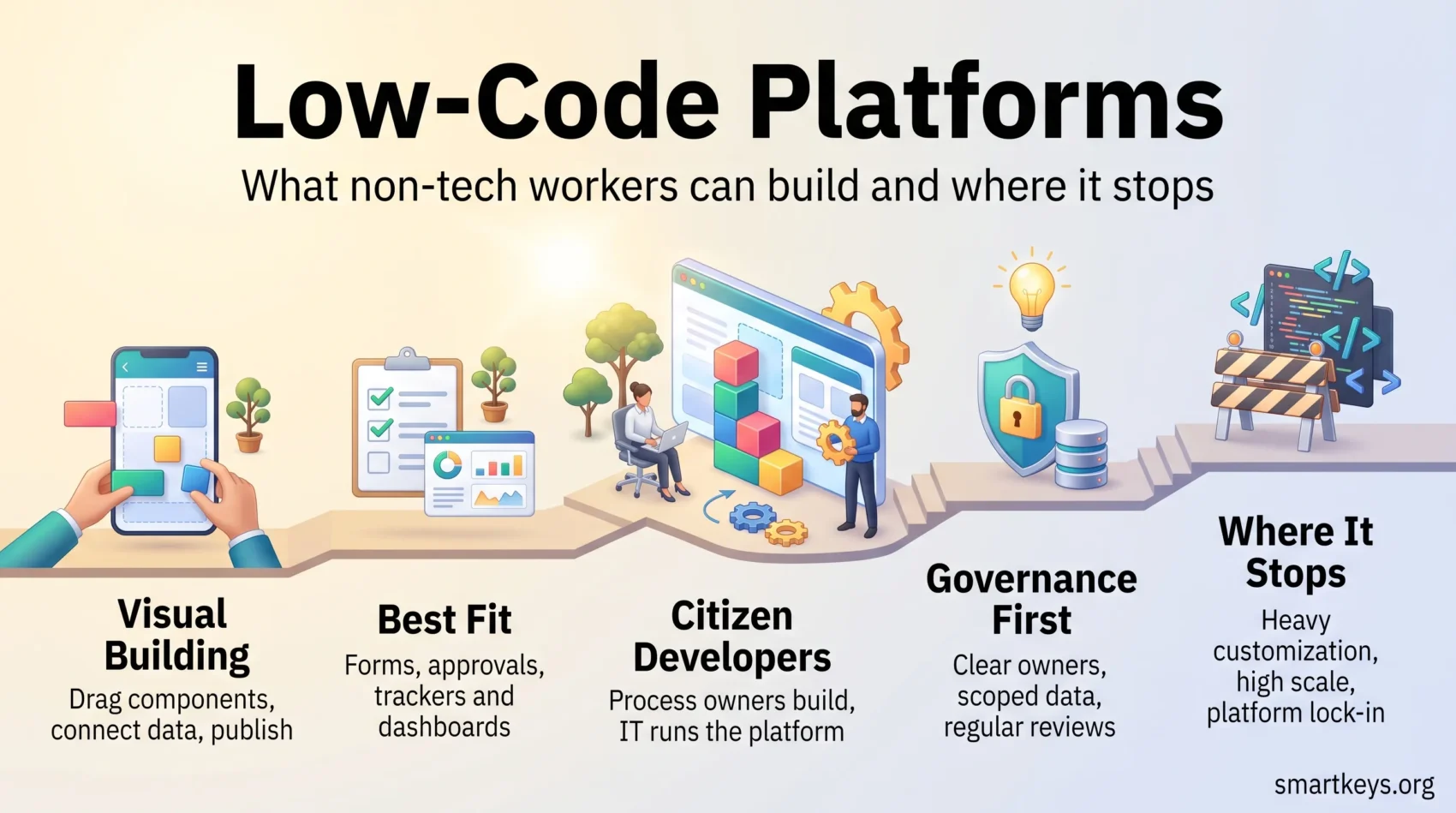
- The strongest fit is narrow, rule-based internal work: forms, approvals, trackers and simple dashboards.
- Governance is the deciding factor. Without ownership rules, data-access limits and a review path, citizen-built apps become shadow IT.
What Low-Code Platforms Actually Do
Low-code platforms replace most hand-written code with a visual development environment. You drag components onto a canvas, connect them to a data source, set rules for what happens when someone clicks or submits, and publish. The platform generates the underlying application, handles hosting and, in most cases, produces a mobile view without extra work.
Three capabilities do the heavy lifting. Prebuilt connectors link the app to systems you already run, from a CRM to a spreadsheet to a database. A visual logic builder handles conditions and approvals without scripting. Templates give you a starting point that already works, so the first version takes hours rather than weeks.
None of this removes the need for professional developers. It changes what they spend their day on. Instead of writing a fourth intake form this quarter, they set the platform’s guardrails, build the connectors that citizen developers reuse, and take over the applications that outgrow the visual layer. That division of labour is the point, and it is also what most low-code programmes get wrong when they skip it. Companies already investing in broader digital transformation programmes tend to fold low-code into that effort rather than run it separately.

Low-Code vs No-Code: Where the Line Sits
The two terms get used interchangeably, and the distinction is genuinely useful when you are choosing a tool.
No-code platforms assume the builder writes nothing at all. Everything happens through a visual interface. That makes them fast and approachable, and it caps what you can build: when a requirement falls outside the platform’s supported patterns, there is no escape hatch. For a form that routes to two approvers, that limit never bites. For anything with unusual logic, it bites immediately.
Low-code platforms leave the escape hatch open. Most of the app is visual, but you can drop into an expression language, a script step or a custom component when you need to. That flexibility costs something: someone on the team needs enough technical confidence to use it, and licensing is usually higher.
A practical rule works better than a definition. If the process is stable, rule-based and lives inside one or two systems, start with no-code. If it spans several systems, has exceptions that matter, or will need to change often, choose low-code and involve IT from the first sketch. Teams that already run automation across business processes usually find they need both.
How Low-Code Changes the Work of Non-Technical Staff
The value is not that anyone can now “build software.” It is that the distance between noticing a problem and testing a fix collapses.
From Request Queue to Working Prototype
In the old pattern, a team writes a requirements document, joins an IT backlog, waits, and receives something that answers last quarter’s question. With low-code, the person who owns the process builds a rough version, uses it for a week, and finds out what was wrong with their own assumptions before anyone commits engineering time.
That is the honest case for citizen development: better requirements, discovered faster. The prototype itself is often disposable. What it produces is a specification grounded in real use rather than in a meeting.
Who Actually Becomes a Citizen Developer
Citizen developers are employees outside IT who build applications with tools their organisation sanctions. In practice they cluster in operations, HR, finance and sales support, where the work is process-heavy and the pain is specific.
Gartner forecast that by 2026, developers outside formal IT teams would account for at least 80 percent of the low-code user base, up from around 60 percent in 2021. Whether the exact figure lands is less important than the direction, which every platform vendor’s roadmap now assumes. Supporting these builders means treating it as a capability to develop, not a licence to hand out: pair them with a technical mentor, give them a sandbox, and make the review step routine rather than punitive. Mapping your digital skills gap first tells you where those builders already are.
Where Low-Code Delivers, and What It Costs
Two benefits hold up consistently. The rest depend heavily on what you are building.
Speed on Narrow, Rule-Based Work
For a form, an approval chain, an asset tracker or a simple operational dashboard, a competent builder can go from blank canvas to something colleagues are using in days. The gain comes from three places: no environment setup, no boilerplate, and no handoff between the person who understands the process and the person writing the code.
Speed claims in vendor marketing tend to describe this narrow case and then present it as a general rule. Treat any “ten times faster” number as a statement about greenfield internal tools, not about your integration-heavy customer portal. If rule-based workflows and fast prototypes are the reason you are looking at low-code, our deep dive on low-code business process automation and rapid prototyping shows which processes pay back first and what AI really adds there.
Cost, Honestly Accounted
Low-code shifts cost rather than removing it. You save engineering hours on small applications and reduce the backlog pressure that pushes teams toward unsanctioned tools. Against that, per-user or per-app licensing scales with adoption and can become the largest line item once a platform succeeds. You also take on platform lock-in, because visual application logic rarely exports anywhere useful.
The programmes that stay affordable price the whole picture before rollout: licences at projected adoption, the platform team’s time, training, and the eventual cost of rebuilding the two or three applications that outgrow the tool. Applying the same discipline you would to cloud cost management avoids the surprise renewal.

Spreading Development Beyond the IT Department
When more people can build, the mix of problems that get solved changes. Small, unglamorous, department-specific frictions finally get attention, because the person who feels them no longer has to persuade anyone that they are worth a sprint.
Departments Solve Their Own Small Problems
Finance builds the reconciliation checklist it has been running in email. Facilities replaces the maintenance request spreadsheet. HR turns an onboarding document into a tracked workflow. None of these would ever reach the top of an engineering backlog, and collectively they consume a real share of a team’s week.
What Changes for IT
IT moves from building everything to running a platform. That means owning connectors, environments, data-access policy and the promotion path from sandbox to production. It is a different skill set and a real workload, and it is the part most often left unfunded. A platform with no owner produces exactly the shadow IT problem it was meant to solve. Some organisations formalise this through an automation centre of excellence that sets standards once and reuses them.
Low-Code and the AI Wave
Every major platform now offers natural-language app generation and AI agents that act inside workflows. This is the biggest change in the category since 2023, and it deserves a sceptical read.
Generation Is Easy, Verification Is Not
The 2025 Stack Overflow Developer Survey found that 84 percent of developers use or plan to use AI tools, yet only 32.7 percent trust the accuracy of the output. The most common complaint, reported by 66 percent, was AI solutions that are “almost right, but not quite.”
Professional developers can spot that gap. A citizen developer generating an app from a prompt often cannot, and an approval flow that is almost right routes an exception to the wrong person for months before anyone notices. AI lowers the effort of producing something; it does not lower the effort of confirming it is correct. Organisations drafting generative AI usage guidelines should cover app generation explicitly, not just chat and writing.
Agents Raise the Governance Stakes
An AI agent embedded in a workflow takes actions rather than suggesting them, which means a citizen-built app can now write to systems on its own. Ask what the agent is permitted to touch, what it logs, and who reviews those logs, before the first one reaches production. The same questions sit at the centre of any serious AI governance model, and for applications touching employee or customer data, EU AI Act obligations apply regardless of who built the app.
Integration Decides the Outcome
Most low-code projects that stall do not stall on the interface. They stall where the app has to meet a system that predates it.
A prebuilt connector to a mainstream SaaS product usually works as advertised. A connector to a legacy ERP, a bespoke internal service or anything requiring unusual authentication is where the visual layer runs out and someone has to write real code. Sequencing matters: prove the hardest integration first, before you invest in screens.
Field-level permissions are the second trap. A connector that grants access to a whole table lets a well-meaning builder expose salary or customer data through an app that was never reviewed. Constrain access at the source, not in the app. This is ordinary data governance work, and low-code makes it more urgent rather than less. Teams running many integrations often move this layer into a dedicated iPaaS integration platform so the rules live in one place.
Getting Real Productivity Out of Low-Code
The productivity gain from low-code is real but conditional. It shows up when the same components get reused, when builders are supported, and when the portfolio is pruned. It disappears when every department starts from scratch and nothing is ever retired.
Reuse is the lever most organisations ignore. A shared library of approved connectors, layouts and logic blocks turns each new app into an assembly job. Without it, the tenth app costs as much as the first.

Measurement should be equally plain. Count the applications in active use, the hours the process took before and after, and the number of apps retired. Those three numbers tell you more than any vendor benchmark, and they are yours rather than an average of someone else’s estimates. The same discipline you would apply to any other digital workflow project applies here.
Pruning closes the loop. Applications built for a project that ended, or by someone who has left, accumulate quietly and keep holding data access. An annual review that retires them is unglamorous and pays for itself.
Where Low-Code Runs Out
Knowing the boundary is what separates a working programme from an expensive one.
The Limits Worth Planning For
Recurring constraints include:
- Heavy customisation eventually costs more in workarounds than custom code would have
- Performance under high concurrency or large data volumes is hard to tune from a visual layer
- Version control, testing and staged releases are weaker than in a normal engineering workflow
- Exporting application logic to another platform is rarely practical, so switching means rebuilding
- Licensing costs scale with success, not with value delivered
Plan the exit before you need it. Decide in advance which criteria trigger a rebuild in code, such as external users, regulated data or a load threshold, and name them in your standards.
Security and Scale
The security risk in low-code is rarely the platform itself. Enterprise platforms are hardened. The risk is what an unreviewed app is permitted to reach.
Four controls cover most of it: environments separated so nothing reaches production unreviewed, credentials held by the platform rather than pasted into apps, data access scoped at the source, and an inventory that records who owns each application. Fold citizen-built apps into your normal security review process rather than treating them as a separate category, and use your existing risk management framework to decide which ones deserve a deeper look.
Making It Work in Practice
The organisations that get value from low-code treat it as a programme, not a licence purchase.
Start Narrow and Publish the Rules
Pick one department with a clear, painful, rule-based process. Build it, measure it, and write down what you learned as standards: which data is off limits, which apps need review, who owns an app when its builder changes role, how something gets retired. Publish those rules before you expand. Standards written after a sprawl are enforcement; standards written before it are guidance.
A clear policy on employee-built applications saves a great deal of retroactive cleanup.
Support the Builders
Training that stops at the tool’s interface produces apps that work and cannot be maintained. Teach the surrounding practice: naming, documentation, what to do when a connector changes, when to ask for help. A short weekly office hour with a developer resolves more problems than a full course, and it keeps builders connected to the people who will inherit their work. Feeding this into a wider upskilling effort also gives participants something portable, and improving general digital literacy across the business raises the quality of every app that gets built.
Recognition matters more than most leaders expect. People build these tools on top of their actual job. If the only feedback is a governance review, the second app never gets built.
Conclusion
Low-code has settled into a clear role. It is very good at narrow, rule-based internal applications built by the people who own the process, and it is a poor fit for complex, high-scale or heavily customised software. Gartner’s $58.2 billion forecast for 2029 reflects steady adoption rather than a coming replacement of software engineering.
For non-technical workers, the shift is real and worth taking seriously. The constraint is no longer whether they can build something. It is whether the organisation has decided who owns it, what data it may touch, and when it gets retired. Companies that answer those three questions before scaling get a genuinely faster path from problem to working tool. Those that skip them get a large number of small applications nobody wants to maintain, which is a slower path than the backlog they were trying to escape. For the bigger picture around these tools, the wider shift in how workplaces are organised gives the surrounding context.
Found this useful?
Make SmartKeys a preferred source on Google, and our articles will surface more often in your Top Stories, AI Overviews, and AI Mode.
Add as Preferred Source