Most companies now have an agent somewhere in production. Far fewer have one that pays for itself. That gap — not the technology — is what this playbook is built to close.
You’ll get a practical path to upgrade daily operations: how to pick the right process, design the agent, pilot it safely, and scale it without losing control of cost or compliance.
Start small, measure in plain business terms, and expand only when the numbers hold.
What changed in 2026 — and why it matters for your rollout
If your mental model of agentic AI is from 2024, three things have moved.
Embedding is now the default. Gartner expects roughly 40% of enterprise applications to ship with task-specific agents by the end of 2026, up from under 5% in 2025. You will inherit agents through your existing vendors whether or not you build any yourself.
The scaling gap is the real story. McKinsey’s late-2025 State of AI survey found 88% of organizations using AI in at least one function and around 62% experimenting with agents — but only about 23% scaling an agentic system anywhere. Gartner separately expects a large share of agentic projects to be cancelled before the end of 2027. Enthusiasm is not the constraint. Evaluation, observability, and governance are.
The plumbing settled. Two open protocols now carry most production traffic: the Model Context Protocol (MCP) for agent-to-tool connections and the Agent2Agent protocol (A2A) for agent-to-agent coordination. Both sit under the Linux Foundation, and A2A passed 150 supporting organizations in its first year with integrations across Google, Microsoft, and AWS. Building on a proprietary connector layer in 2026 is a choice you have to justify.
Key takeaways
- Follow a staged playbook — assess, design, pilot, scale — so agent-led automation proves itself before it spreads.
- Treat evaluation and observability as build requirements, not phase-two nice-to-haves. They are the top blockers to production.
- Measure resolution time, accuracy, cost per resolved case, and satisfaction. Skip vanity metrics.
- Keep deterministic rules where inputs are stable; add adaptive components only where variability actually costs you money.
- Standardize on MCP and A2A so tools and agents stay portable across vendors.
What you’ll learn in this playbook
This guide is written so you can jump to what matters for your role. Whether you run operations, own IT, lead a data team, or set strategy, you’ll find both the quick win and the longer arc.
Who this guide is for and how to use it
Use it as a repeatable reference. Start with the fundamentals, follow the design steps, then apply the patterns to your own workflows.
- You’ll see which agent types suit which tasks, so you avoid over-engineering a problem a scheduled script could solve.
- You’ll learn the core capabilities — reasoning, planning, tool use, memory, learning — and where each one actually earns its cost.
- You’ll get a governance and KPI frame you can take to a steering committee without hand-waving.
AI agent workflows vs. traditional automation
Rule-driven automation is excellent at steady, repeatable work. It struggles the moment conditions shift. You need a different approach for cases that require planning, tool use, and iterative problem solving.
From RPA rule-following to multi-step reasoning
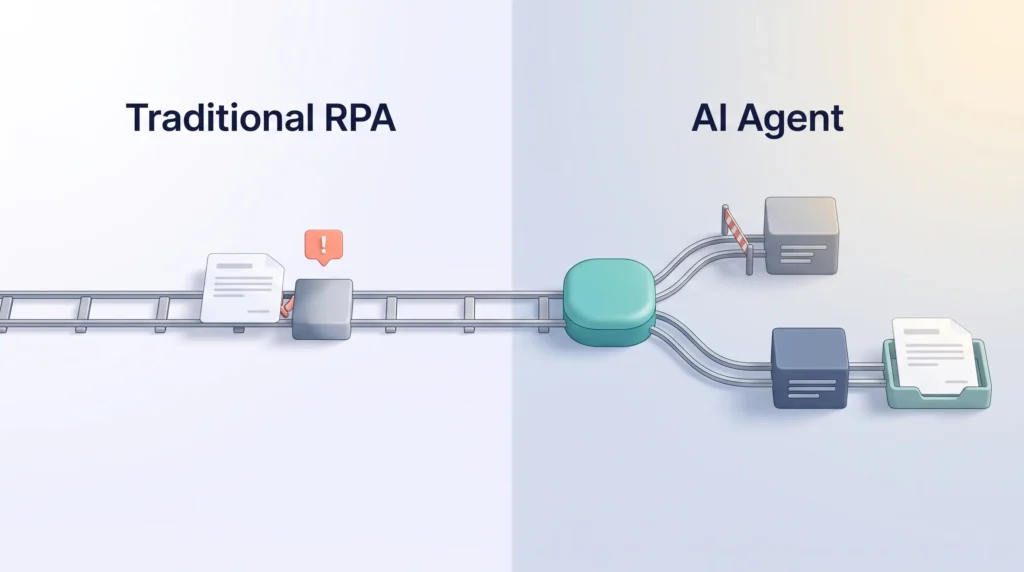
Traditional RPA follows predefined rules and decision trees. It excels at high-volume, standard cases — and it breaks when a form field moves or an upstream schema changes. Every exception becomes a maintenance ticket.
Agents decompose a problem into steps, call external tools, and revise the plan as new information arrives. A commonly cited example: a system whose web search API fails mid-task falls back to a different source and finishes the job without human rescue.
That difference is a spectrum, not a switch. Our overview of business automation trends from RPA to AI integration maps where most organizations sit on it today.
Real-time adaptability and unexpected conditions
Adaptive systems combine language understanding with a model of the current situation. They detect outages, schema drift, or rate limits and choose an alternate path.
- Contrast static rules with reasoning that plans, tests, and revises.
- Use problem decomposition and dynamic tool selection to cut escalations.
- Keep rules for the predictable steps. Our task automation playbook covers that deterministic layer in detail.
The core building blocks of agentic workflows
Mix models, data, and tools deliberately. Start by mapping the components and where each one touches your existing processes.
Models and language understanding
Model choice drives output quality, determinism, and cost — usually in that order of visibility and the reverse order of surprise. Temperature and reasoning-effort settings control creativity versus repeatability.
Pick models per task: higher temperature for exploratory drafting, low temperature for precise outputs and verifiable actions. Route cheap, high-volume steps to a small model and reserve the expensive one for genuine reasoning. Managing that portfolio across teams is its own discipline — see our guide to LLM ops strategy.
Tools, integrations, and the interoperability layer
Pair agents with tools — APIs, vector search, external datasets — so they fetch current information and write back to your systems.
In 2026 that connection layer has a default answer. MCP standardizes how an agent reaches a tool or data source; A2A standardizes how agents delegate to one another across vendors and frameworks. Frameworks such as LangChain, LangGraph, CrewAI, AutoGen, Google ADK, and watsonx Orchestrate all speak one or both.
Feedback, prompts, and multi-agent patterns
Design human-in-the-loop checkpoints and automated critics to hold accuracy without slowing resolution. Apply prompt patterns — zero-shot, few-shot, chain-of-thought, self-reflection — to raise reliability on hard cases.
Split work across roles (planner, researcher, executor, verifier) so specialized agents share context instead of duplicating effort.
- Connect to Spark, BigQuery, or Snowflake for governed data access.
- Persist context and intermediate output so runs are debuggable and reusable.
- Attach guardrails, validators, and approval steps wherever you need a hard guarantee.
How AI agents think and act: the perception-planning-action loop
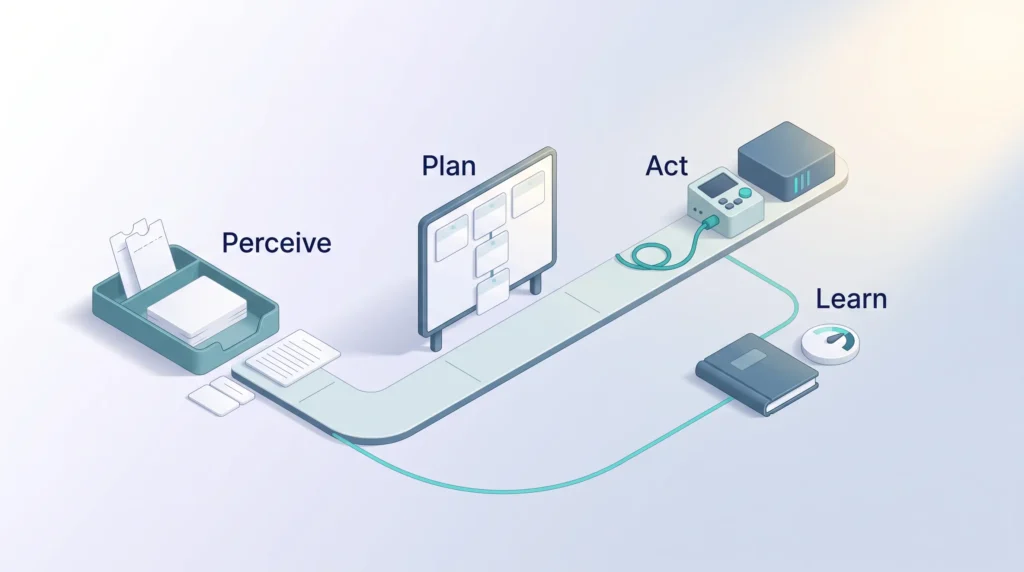
The loop turns raw input into auditable output. Understanding it is what lets you debug an agent instead of restarting it.
Perception and input processing
Perception modules normalize inputs from text, logs, tickets, or sensors, then apply parsing and classification to extract intent.
Retrieval-augmented generation (RAG) grounds responses in product docs, past cases, or a knowledge base. That cuts hallucination risk and keeps answers tied to sources you can point at.
Decision-making and planning
Planning weighs goals, constraints, and hard rules to produce a stepwise plan. Use a model for open-ended reasoning and a rule engine for constraints that must never bend.
Design plans that revise when new signals arrive, while keeping explicit decision checkpoints. Adaptability without checkpoints is just drift.
Action execution, monitoring, and recovery
Actions include answering a user, updating a record, triggering a downstream workflow, or calling another system.
Structure execution with retries, exponential backoff, and compensating actions so partial failures don’t leave your data inconsistent. Log every decision, latency, and error pattern as it happens — you cannot reconstruct this after the fact.
Learning and adaptation
Capture feedback — user ratings, success metrics, error types — and route it into a review loop. Reinforcement learning can refine policies where you have enough signal to justify it.
Track outcomes over time so you can detect drift, retune, and explain why behavior changed. A clean example path runs intake → plan → tool calls → verification → output, with a log line at each hop.
Types of AI agents and when to use them
Different agent types suit different operational realities. Before building, map your environment: predictable, partially observable, or fast-changing? That map tells you which class to pick and, more usefully, which ones to skip.
Simple and model-based reflex agents
Simple reflex designs follow condition-action rules. Best where inputs are unambiguous and latency matters — safety interlocks, threshold alerts, straightforward routing.
Model-based reflex variants keep an internal world model to infer hidden state. Use them for partially observable systems like network monitoring or inventory tracking.
Goal-based and utility-based agents
Goal-based agents plan steps toward a defined objective. Choose them where actions have predictable effects and search or planning produces reliable outcomes.
Utility-based agents rank options against a utility function. Ideal when you must trade off cost, latency, and user value rather than optimize a single number.
Learning and hierarchical agents
Learning agents improve from feedback and cope with data drift. Typical fits: recommendation flows and service desks whose case mix keeps evolving.
Hierarchical designs split work into tiers so subtasks run independently but coordinate — the pattern behind large orchestration systems and automated warehouses. If physical execution is part of your picture, our guide to robotics automation covers the operational side.
- Match the type to environment predictability, observability, and memory needs.
- Use reflex designs for speed and transparency; model-based when observations are partial.
- Choose goal or utility agents for planning and trade-offs; learning or hierarchical where behavior must evolve.
- Hybrids are normal — a goal planner delegating to reflex executors balances safety and performance well.
Key capabilities that set agentic workflows apart
Modern agents observe, reason, and act with limited supervision. That is the shift from scripted replies to a process that absorbs change instead of breaking on it.
Autonomy means the agent sets sub-goals, chooses tools, and orders steps without a prompt for each one. Reasoning means it weighs context and evidence rather than matching keywords.
Environment awareness and safe tool use
Instrument the environment so agents detect rate limits, schema drift, or outages — and can pause safely rather than retry into a wall.
Design permissioned tool scopes, input validation, and output checks so no action can damage a production system. Add loop guards and termination rules; an agent stuck in a critique-revise cycle burns budget silently.
Ethics, transparency, and continuous learning
Embed bias checks and readable rationales so users can trust and challenge decisions. When confidence is low or stakes are high, escalate to a human by default.
Keep audit trails so you can explain why an output changed. If your decisions touch customers, credit, or hiring, explainability is a requirement rather than a feature — our guide to explainable AI goes deeper on making that work in practice.
Business value in 2026: adoption, efficiency, and the scaling gap
Read adoption numbers with their definitions attached. One survey counts any pilot; another counts only production agents with real tool access. That single choice swings headline figures by tens of points.

What the data actually signals about readiness
The honest 2026 picture is broad adoption with shallow deployment. Most organizations are using agents somewhere. Fewer than a quarter are scaling one. ServiceNow’s maturity work found a similar split: a majority claiming agentic AI use, single-digit percentages making real progress on autonomous multi-step workflows.
The practical implication: your competition is mostly still piloting too. A disciplined rollout is a genuine advantage, and stakeholders now expect measurable wins in months rather than years. Set baselines for error rate, cycle time, and throughput before you start.
Continuous operation, accuracy gains, and cost impact
Agentic workflows enable round-the-clock coverage, cut manual error, and compress time-to-resolution. You’ll see fewer reworks, faster approvals, and lower escalation rates.
- Quantify value from 24/7 coverage and reduced handle time.
- Map cost drivers — model tokens, tool calls, vector queries, storage — so budgets track observed usage instead of a forecast.
- Identify repetitive work where agents free people for higher-value tasks. Our piece on AI augmentation covers the augmentation-versus-replacement framing your team will ask about.
Frame rollouts in phases with crisp baselines and short pilots, so learning reduces risk and investment grows only as performance holds.
AI agent workflows in action: practical use cases
Below are focused examples you can map to your own teams. Each shows stepwise actions, clear outputs, and where to pilot first.
Customer support and IT service desks
Customer-facing agents ask targeted questions, run diagnostics, and adapt until the issue resolves — the clearest verified ROI category so far.
In IT support, the workflow gathers clarifying details, checks logs, calls monitoring APIs, and retries with backoff when a step fails. Every result is logged, so the team accumulates a searchable library of fixes.
Data integration assistants that plan, map, and recover
Data-focused agents analyze sources, propose mapping plans, and catch mismatches during ingestion.
They handle API rate limits, apply exponential backoff, and re-map schema changes to keep pipelines running. Over time the system learns the recurring patterns and manual remapping drops.
Finance, supply chain, fraud, marketing, and recruiting
- Finance: reconcile transactions, route approvals, and prepare close-cycle checks — see finance automation trends for what teams are actually shipping.
- Supply chain: forecast demand, optimize routes, and react to partner disruptions.
- Fraud detection: scan transactions, flag anomalies, and assemble triage packets for investigators.
- Marketing: segment audiences, generate offers, and measure responses to refine the next action.
- Recruiting: screen applications and schedule interviews — with a human decision gate, since hiring tools sit in the EU’s high-risk category.
Industry-specific agents often beat general-purpose ones on accuracy because the domain constraints are baked in. Our overview of vertical AI solutions covers when that trade-off pays.
How to start: pick one simple, high-impact process — first-contact troubleshooting, or a single data mapping — and run a short pilot. Then build a backlog ranked by impact, complexity, and stakeholder readiness.
Design patterns that boost reliability and output quality
These templates force planning, structured outputs, and clean handoffs. They are what make an implementation testable rather than merely impressive.
Planning-first, structured outputs, and function calling
Require a plan before any action so decisions are explicit and reviewable. Standardize outputs into machine-readable formats and use function calling or MCP tool definitions for precise, typed tool use.
Self-reflection, critique-revise loops, and delegation
Have the system review its own output and revise once — then stop. Combine that with role splits (planner, executor, verifier) to raise accuracy without unbounded cost.
Guardrails against loops and unsafe actions
Set max turns, state checks, and termination rules. Validate preconditions and postconditions before any production write. Persist intermediate state so failures are diagnosable.
- Parameterize steps for latency, cost, and accuracy trade-offs.
- Audit outputs against ground truth and log every discrepancy.
- Build a reusable pattern library so the second rollout is faster than the first.
Tooling and frameworks to build, run, and orchestrate agents
Tooling choices decide how fast you get from prototype to reliable production. Pick platforms that match your governance, data access, and observability needs.
Agent frameworks
LangChain, LangGraph, CrewAI, AutoGen, and Google’s ADK provide building blocks for tool abstraction, memory, and graph orchestration. Prefer ones that speak MCP and A2A natively so you keep the option to swap layers later.
Enterprise SDKs and secure platform integration
Microsoft Semantic Kernel, IBM’s BeeAI, and watsonx Orchestrate matter when you need enforced scopes, approval flows, and audit trails across corporate systems.
Data and workflow stack
Connect Spark, BigQuery, or Snowflake for retrieval, joins, and feature pipelines that ground decisions in real data. Modern business intelligence tools increasingly ship their own agentic layer, which may cover part of your need without a build.
Layer RPA for the deterministic steps, and use schedulers or event buses to trigger workflows on time or on signal.
Choose tools that make operations visible: trace calls, log decisions, and measure outcomes.
- Compare frameworks on memory and tool abstractions, not demo polish.
- Define a tool registry with scopes and approval flows.
- Host models behind a gateway to manage versions and cost centrally.
- Align dev, staging, and prod with config management.
- Build dashboards showing tool calls, actions, and system health.
Implementing AI agent workflows step by step
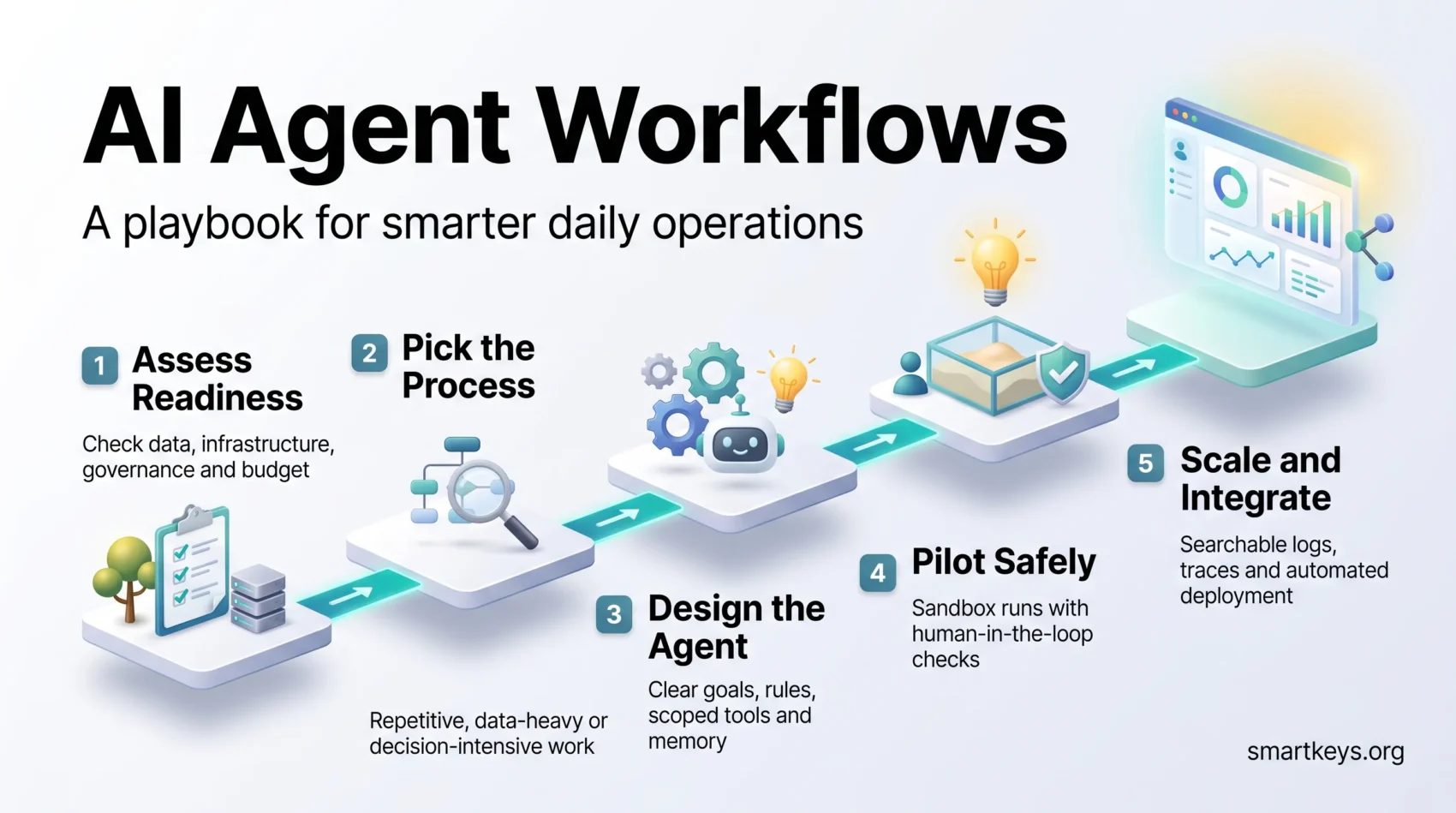
A practical rollout starts with a short readiness review covering data access, infrastructure, and governance. That is what keeps early surprises from killing the pilot.
1. Assess readiness
Check data availability, infrastructure capacity, governance rules, and budget alignment. Map the gaps and assign owners so fixes happen before build starts.
2. Identify candidate processes
Shortlist work that is repetitive, data-heavy, or decision-intensive — especially where branching logic or variable inputs cause delays today.
3. Design the agent
Define clear goals, explicit rules, scoped tools, a memory approach, and tested prompts. Draft the plan as short, machine-friendly steps so outputs stay predictable.
4. Pilot safely
Use sandboxes and human-in-the-loop controls for early runs. Track accuracy, handle time, deflection, and output quality, and define escalation paths for edge cases before you need them.
5. Scale and integrate
Build observability with searchable logs and traces so you can follow any decision end-to-end. Add CI/CD for prompts, configs, and integrations to reduce deployment risk.
- Document information flows, dependencies, and known failure modes.
- Plan change management so users know what changed and how to give feedback.
- Iterate on learning loops and rules until reliability is ready for critical paths.
Risk management, governance, and compliance
Governance is what lets agents take on more decisions safely. Start by naming owners, defining scopes, and documenting where automation may and may not act.
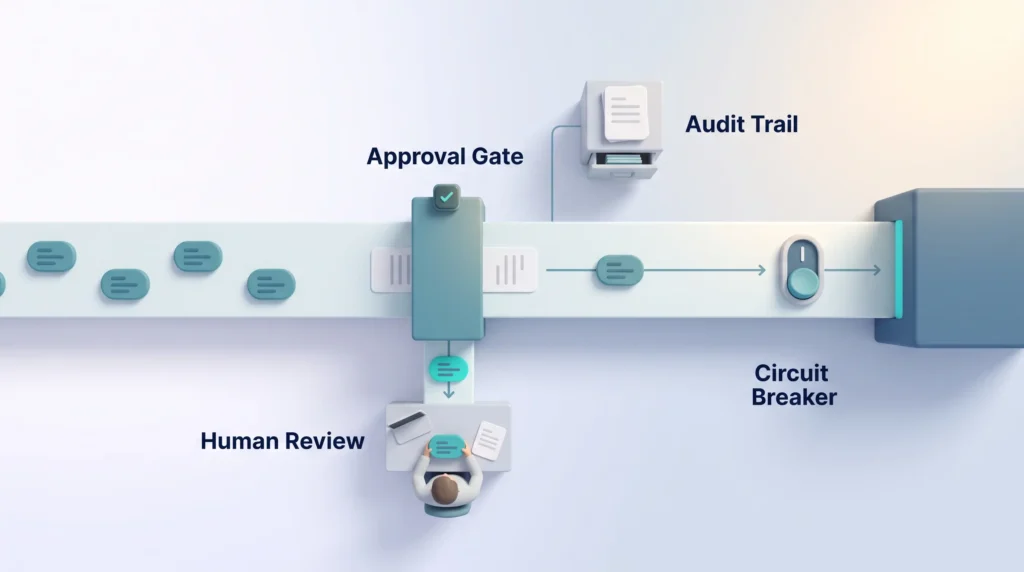
Human oversight, audit trails, and incident response
Keep humans in the loop where it counts. Formalize approval gates and on-call roles. Capture an audit trail for every decision, tool call, and data change.
Define incident playbooks covering detection, containment, rollback, and postmortem. A structured risk management framework gives you a place to hang all of this rather than inventing it per project.
The regulatory timeline to plan against
If you operate in or sell into the EU, two dates matter. The AI Act’s Article 50 transparency obligations — telling people they are interacting with an AI system, labeling synthetic content — apply from 2 August 2026. The Digital Omnibus on AI, in force since late July 2026, deferred the high-risk obligations for standalone Annex III systems (hiring, credit scoring, biometrics) to 2 December 2027, and to 2 August 2028 for AI embedded in regulated products.
The deadline moved; the work did not. Documentation, risk classification, and human-oversight design still take longer than the calendar suggests, and stale compliance guidance is now a bigger risk than the rules themselves.
Cost control: compute, tokens, and architecture
Monitor model tokens, vector queries, and tool executions so budgets stay predictable. Cache context and reuse responses to cut redundant model calls.
Set quotas, circuit breakers, and spend alerts. Batch queries and cap long-running processes — an unbounded agent loop is the most common way pilots blow their budget.
Interoperability and legacy integration
Assess legacy connectors and define adapters with explicit contracts to avoid brittle dependencies. Add loop detection, timeouts, and circuit breakers for when external systems degrade.
Validate inputs and outputs, segment environments so agents act only within authorized scopes, and keep a fast rollback path for prompts, tools, and configs.
Transparent logs and clear escalation paths make it easier to learn while keeping risk low.
Measuring success: KPIs and ROI
Start with a small set of KPIs that reflect how the process actually performs. Clear metrics prove value fast and tell you where to invest next.
Operational metrics
Track input-processing accuracy, routing decisions, and successful action-execution rates to find the weak link. Measure time-to-resolution and throughput to see where cases pile up.
- Time-to-resolution: median and tail times for common cases. The tail is where the story is.
- Accuracy: classification and output correctness against ground truth.
- Deflection and throughput: reduction in manual work and completed cases per hour.
- Cost per resolved case: the single number that survives contact with a CFO.
Business outcomes
Attribute savings by mapping reduced labor and fewer escalations to real money. Capture satisfaction and conversion lift to show customer and revenue impact.
Use cohort analysis to compare pre/post results while controlling for seasonality and case mix.
Learning efficiency
Monitor feedback velocity, model utilization, and cache hit rates to balance latency, quality, and spend. Run A/B tests on prompts, steps, and tools.
- Track process health — bottlenecks and failure modes — to prioritize the fixes with the biggest return.
- Standardize reporting so leadership sees consistent outcomes and the actions taken.
- Add short survey questions to capture perceived helpfulness and clarity of output.
Conclusion
Here is the short version of moving from experiment to reliable operations.
Agents make workflows adaptable, which keeps work moving when conditions change. Use the patterns above to pick applications and prove value fast.
Design clear pilot steps, measure time and accuracy, and add governance so leaders can sign off. Match tools and data platforms to your existing systems so execution stays auditable. Answer stakeholder questions with cost and risk benchmarks rather than vendor claims.
The 2026 data is unusually encouraging for anyone willing to be methodical: almost everyone is experimenting, and very few are scaling well. Discipline is the differentiator.
Final step: start small, measure results, and expand to the next use case only once the numbers hold.
Found this useful?
Make SmartKeys a preferred source on Google, and our articles will surface more often in your Top Stories, AI Overviews, and AI Mode.
Add as Preferred Source