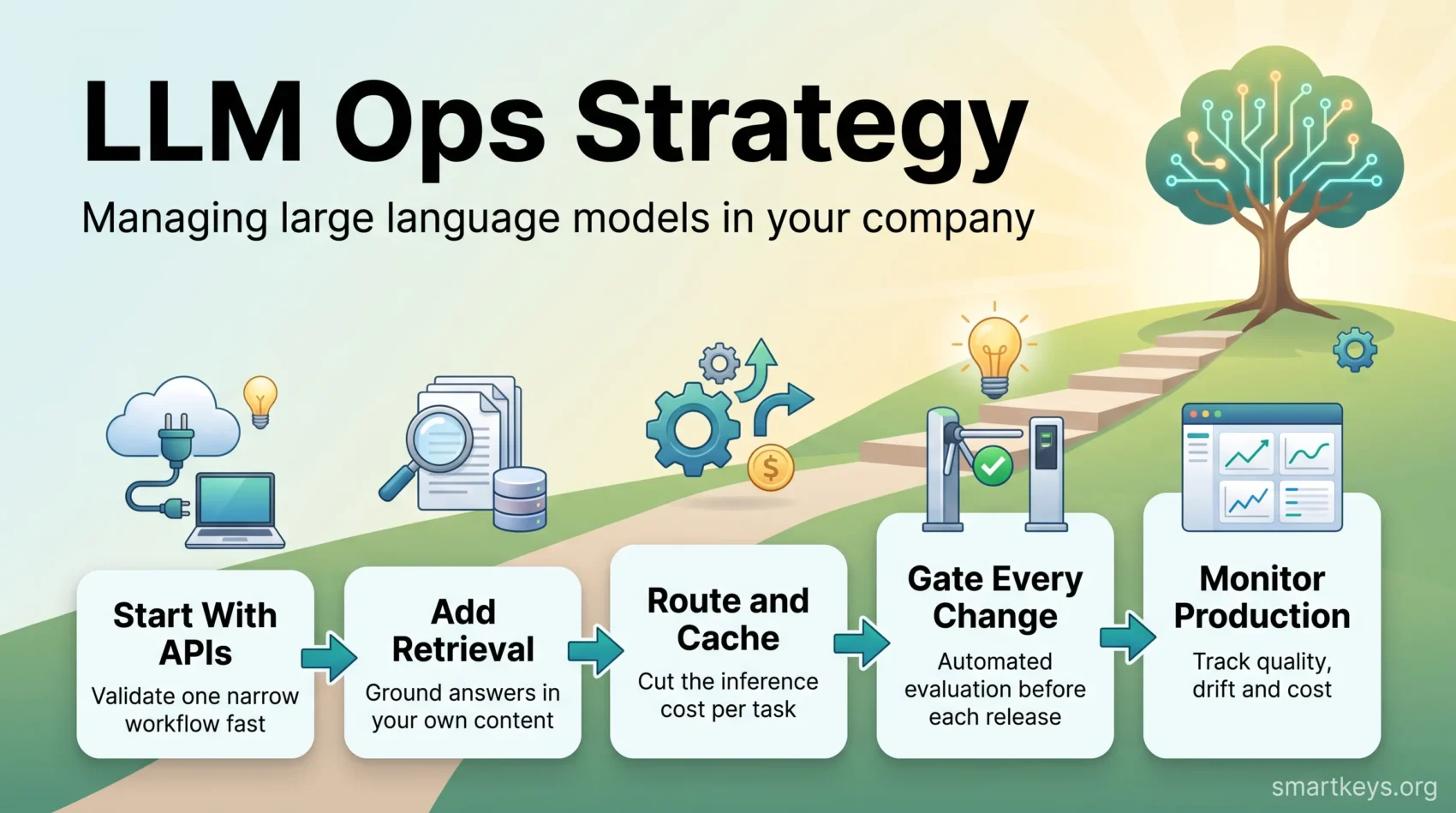
Almost every large company now runs a language model in production. Far fewer can prove it pays. Industry surveys put production LLM deployment at roughly 85 to 90 percent of large enterprises by mid-2026, up from about 65 percent a year earlier. Yet IBM’s CEO research still finds only about a quarter of AI initiatives delivering the return that was promised.
That gap is an operations problem, not a model problem. LLM ops — or LLMOps — is the discipline that closes it: the practices you use to build, evaluate, deploy, monitor, and govern language models so they behave predictably once real users touch them.
This guide gives you the 2026 version of that playbook. You’ll get the decision logic for APIs versus fine-tuning versus retrieval, the cost levers that actually move your bill, the evaluation and observability standards the market has settled on, and the compliance dates that became real this August.
Key Takeaways
- Production is normal now; ROI is not. Treat measurement as the differentiator, not deployment.
- Inference is your cost centre, not training. Routing, caching, and model sizing move the bill more than anything else.
- Start with hosted APIs, add retrieval next, and reserve fine-tuning for volume and behaviour you can’t prompt your way to.
- Instrument on day one using OpenTelemetry’s GenAI conventions so your telemetry survives a vendor switch.
- EU AI Act transparency duties applied from 2 August 2026, even though high-risk obligations moved to December 2027.
- Automated evaluation gates in CI are what let you ship prompt and model changes without a rollback culture.
What an LLM ops strategy means in 2026
An LLM ops strategy is the operating model that connects a language model to a measurable business outcome — and keeps it connected as models, prompts, and data change underneath you.
It covers five loops that never stop running: data and retrieval, adaptation, evaluation, serving, and monitoring. Skip any one of them and the others degrade quietly.
The market context has shifted sharply. Gartner reported that around 80 percent of enterprise applications shipped or updated in early 2026 embed at least one AI agent, up from roughly a third two years earlier. Meanwhile, most enterprises now run several frontier models concurrently rather than betting on a single vendor — a hedge against pricing changes, capability gaps, and availability.
From pilots to production: aligning models with business outcomes
Tie every initiative to a number before you build. Support deflection rate, hours saved per analyst, cost per resolved ticket, or first-draft acceptance rate all work; “improve efficiency” does not.
Median time-to-value across enterprise deployments now sits at roughly five months, with sales-facing use cases paying back faster and finance or operations use cases slower. That gives you a realistic budget horizon for a pilot — and a reason to kill one that drifts past it.
Structure ownership early. Name an accountable owner with budget authority, define an SLA, and write down who approves a prompt change. Most stalled programmes fail on that governance layer, not on model quality. Our guide to building a comprehensive AI governance policy covers the roles and approval paths in more depth.
Why the ROI gap persists
Three patterns explain most of it.
Unowned pilots. A proof of concept with no operating budget never gets the monitoring or evaluation work that would make it production-safe.
Unmeasured quality. Teams ship prompt changes without a regression suite, then discover the drop weeks later through customer complaints.
Unbounded scope. Open-ended assistants are far harder to evaluate than a single workflow with a binary success criterion. The organisations scaling successfully tend to scope narrowly first — a pattern we also see in broader AI augmentation programmes.
LLMOps vs. MLOps: the differences that shape your approach
The core distinction is that you are adapting someone else’s pre-trained foundation rather than building a model from scratch — and that changes your costs, your timelines, and your risks.
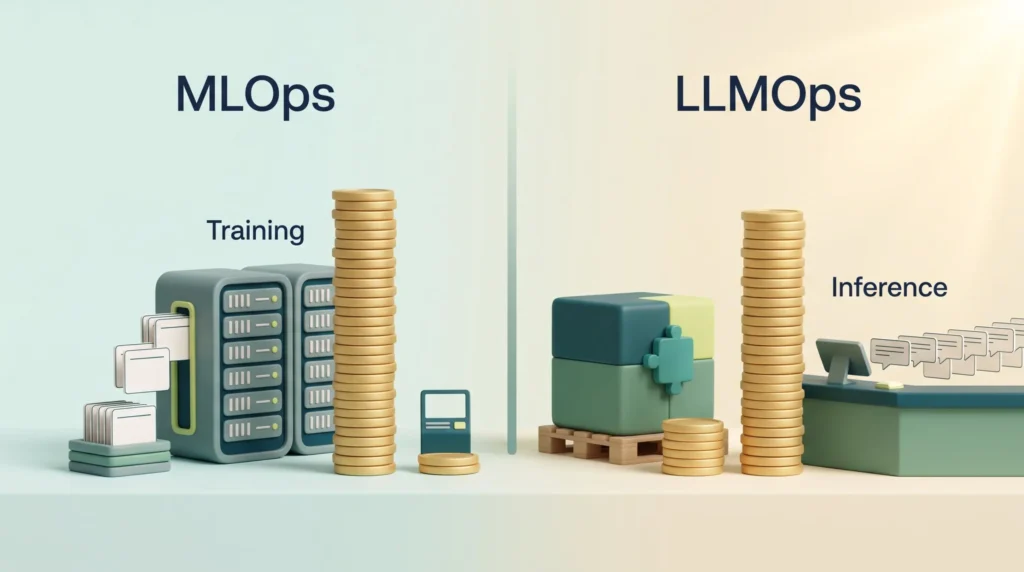
Data and development workflows. Classical MLOps centres on feature engineering, labelled datasets, and repeated training runs. LLMOps centres on prompt design, retrieval quality, and adaptation. You iterate in hours, not weeks, which makes version control of prompts and datasets more important, not less.
Cost profiles. In traditional machine learning, training dominates spend. With language models, inference dominates. Output tokens typically cost two to five times what input tokens cost across the major providers, so response length is a budget decision, not just a style choice.
Evaluation and governance. Accuracy is not enough. You need checks for hallucination, toxicity, prompt injection, and retrieval relevance — plus lineage for the data that fed the answer. If you’re formalising this, our AI ethics framework and data governance strategy guides pair well with what follows.
“Operational choices — foundation selection, monitoring, and guardrails — determine whether models are reliable in production.”
Designing your LLM ops strategy
Design starts with a use case narrow enough to evaluate and valuable enough to fund.
Define use cases, KPIs, and performance requirements
Pick two or three candidates — support triage, document summarisation, internal search, or code assistance are the highest-penetration categories — and score each on data availability, tolerance for error, and volume.
For each one, write down four numbers before development starts:
- Quality target: task success rate or human acceptance rate, measured on a fixed test set.
- Latency ceiling: p95, not average.
- Cost per task: tokens in, tokens out, plus retrieval and embedding costs.
- Safety floor: maximum acceptable rate of unsafe or unsupported outputs.
Cost per task deserves special attention. It is now one of the primary production metrics teams track alongside quality and latency, because per-token prices keep falling while total bills keep rising — usage grows faster than prices drop.
Select your operating model: API, adapt, or train
Three levels, in order of cost and control:
Hosted API. Fastest validation, no infrastructure, highest per-token price. Correct for almost every first deployment.
Retrieval and fine-tuning on open or hosted weights. Better domain fit, lower unit cost at volume, more operational work. Open-weight models served through inference providers can be an order of magnitude cheaper per token than frontier models for classification, summarisation, and high-volume chat — with a real quality gap on hard reasoning and multi-step agent work.
Full training. Rarely justified. Reserve it for cases where no available foundation can be adapted to your requirement.
Data residency often decides this more than cost. If you operate under strict localisation rules, review our overview of data localization laws before you pick a serving location.
Build for scale: platforms, cloud choices, and integration patterns
Plan the boring layer early: container orchestration, CI/CD, secrets handling, a vector store, and a gateway in front of every model provider.
The gateway matters more than teams expect. It centralises rate limiting, cost attribution, failover between providers, and logging — and it’s what makes a multi-model strategy operationally survivable. If you’re weighing where the workload sits, our hybrid cloud strategy guide covers the on-premises trade-offs.
Tool access has also standardised. A majority of enterprises running agents have adopted the Model Context Protocol or an equivalent standardised tool layer, which makes tool integrations portable across model vendors instead of hard-wired to one.
Data preparation: quality, diversity, and pipelines
Treat data as a product: collect with intent, clean consistently, and measure how each change affects output quality.
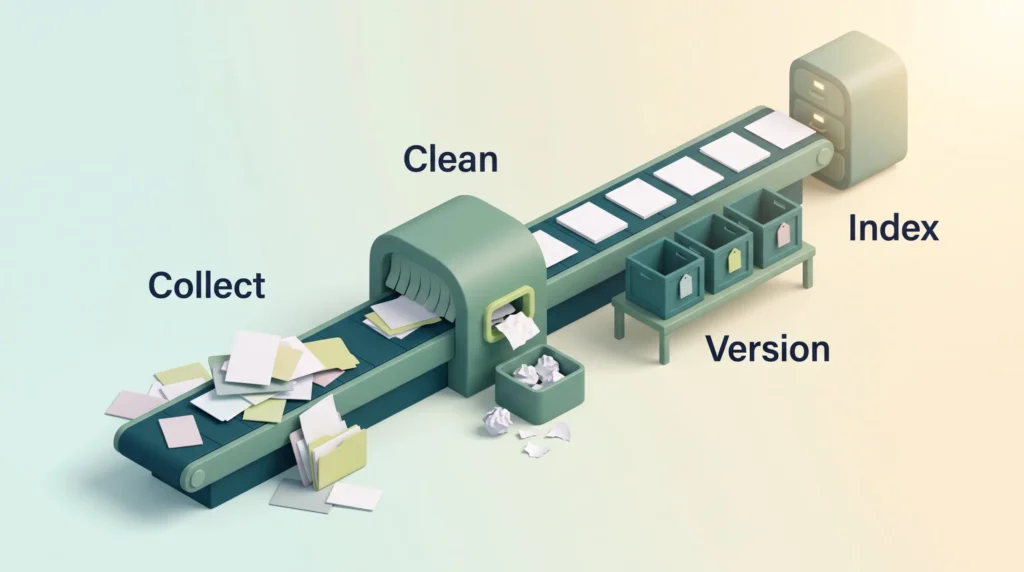
Collection and cleaning. Build pipelines that deduplicate, strip boilerplate, normalise formatting, and remove personal data you don’t need. For retrieval systems, chunking strategy and metadata usually affect answer quality more than model choice does.
Bias reduction and coverage. Make sure your samples cover the dialects, phrasings, and edge cases your real users produce. Thin coverage shows up as confident wrong answers for underrepresented groups.
Versioning. Version every dataset, prompt, and index with Git LFS or DVC, and log experiment runs in MLflow or Weights & Biases. Without this you cannot answer the question “what changed?” — which is the only question that matters during an incident.
“Version every dataset and artifact so you can reproduce results and roll back when needed.”
- Automate preprocessing in CI so the pipeline is reproducible, not tribal knowledge.
- Set quality gates before adaptation to keep noisy data out of training runs.
- Schedule re-embedding so your index doesn’t silently age out of sync with the source.
Watch for drift. Real usage diverges from your test set within weeks. Close the loop by sampling production cases back into your evaluation data.
Model selection and adaptation: proprietary vs. open weights
Your choice between a hosted vendor and open weights determines how much customisation and infrastructure you take on.
Enterprise API spend has consolidated around a handful of frontier providers, while open-weight models hold a smaller but strategically important share — concentrated in cost-sensitive, high-volume, and sovereignty-constrained workloads. Most mature teams run both: a frontier model for hard reasoning, a small or open model for the long tail.
Prompt engineering foundations
Structure beats cleverness. Use versioned templates, keep few-shot examples current, constrain output format explicitly, and cap context. Test changes against a fixed evaluation set rather than by eyeballing three examples.
Prompt caching is now a first-class cost lever: providers discount repeated prefixes heavily, so a stable system prompt is cheaper than a dynamically assembled one.
Fine-tuning strategies and when to skip them
Fine-tune when you need consistent format, tone, or task-specific behaviour that prompting cannot hold reliably. Don’t fine-tune to teach the model facts that change — that’s a retrieval problem.
Parameter-efficient methods such as LoRA have made experiments cheap enough to run before committing budget. Note that inference on a fine-tuned model typically costs more than the base rate, so the payback comes from shorter prompts and a smaller model, not from the tuning itself.
Use held-out validation sets and automated checkpoints to catch overfitting and capability regression early.
RAG and embeddings: retrieval as the default
Retrieval-augmented generation remains the highest-leverage pattern for grounding answers in current, proprietary content. Combine embeddings with a vector database, tune your retrieval depth, and measure retrieval relevance as its own metric — a good model with bad retrieval produces confident nonsense.
Context waste is the hidden multiplier here. If you send 50,000 tokens of context and only 5,000 are relevant, you’re paying roughly ten times what a tighter pipeline would cost.
“Balance cost, latency, and control when you map model size and quantization choices to deployment needs.”
Evaluation and quality assurance you can trust
Measurement should span automated metrics, human judgement, and production signals. Any one alone will mislead you.
Metrics beyond accuracy
Combine three layers. Reference-based scores such as BLEU or ROUGE where you have gold answers. Reference-free scoring, where a judge model rates coherence, groundedness, and safety at scale. And task-level outcomes — did the ticket get resolved, did the human accept the draft.
Public benchmarks are useful for shortlisting models and useless for predicting performance on your data. Build a small, honest internal evaluation set instead; a few hundred well-chosen cases beat any leaderboard.
Human-in-the-loop review and CI gates
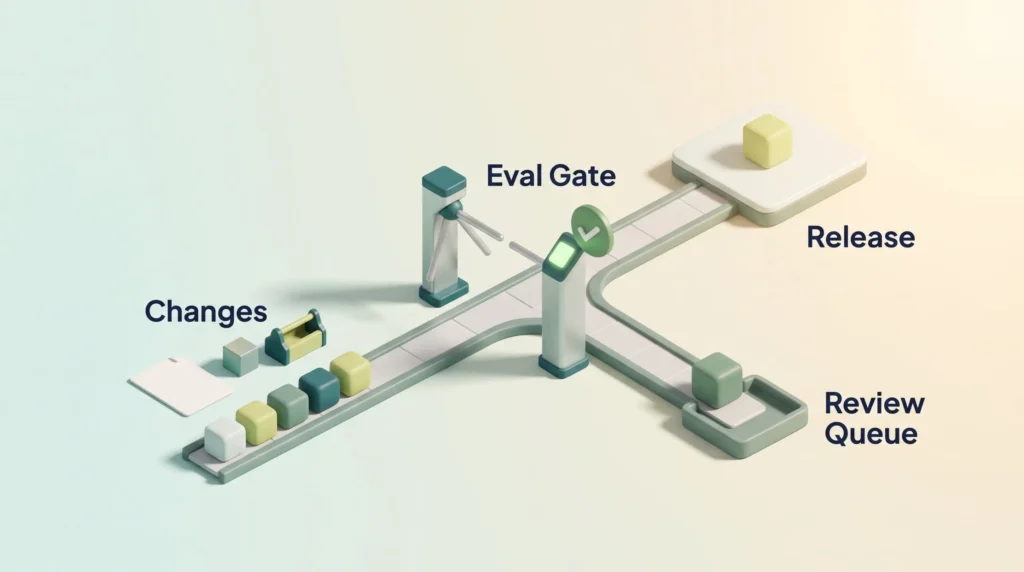
Pair automated scoring with structured human review for brand, tone, and safety. Reviewers should rate outputs against a written rubric and flag failures into a queue that feeds your test set.
Then automate the gate. Running evaluations on every prompt, model, or tool change before deployment is what separates teams that ship weekly from teams that ship and roll back. Many organisations still don’t do this, and it shows up as unexplained quality drops after routine updates. For customer-facing deployments, our review of AI chatbots in customer support covers the failure modes worth adding to your suite.
“Calibrate acceptance thresholds and automate evaluations in CI so updates meet your standards before release.”
Deployment and integration into production systems
Match serving patterns to demand shape and cost targets.
Serving patterns: online, batch, and hybrid
Online inference fits interactive use where latency is visible to a user. Batch suits classification, enrichment, and back-office jobs — and providers discount it heavily. Hybrid routing sends easy requests to a small model and escalates only hard ones.
That routing layer is usually the single biggest cost saving available. A classifier deciding which model handles a request can cut spend substantially without a visible quality change.
Containerization and orchestration
Containerise inference services and deploy on Kubernetes for horizontal scaling. Add health checks, autoscaling, circuit breakers, idempotent APIs, and retry policies with backoff so upstream systems stay protected during provider outages — which do happen.
Cost and latency optimization
The levers, in rough order of impact: prompt caching, request routing, output length limits, batching, quantisation, and distillation. Track the effect of each one against your cost-per-task metric rather than assuming.
If cloud spend is already a board-level topic at your company, the discipline transfers directly from FinOps best practices and cloud cost optimization.
- Use canary or blue/green rollouts for model, prompt, and retrieval changes alike.
- Document SLOs for latency, error rate, and throughput, and alert on them.
- Keep a fallback path — a smaller model or a cached response — for provider degradation.
Monitoring, observability, and continuous improvement
Observability for language models is now a solved standards problem — the work is in adopting it.
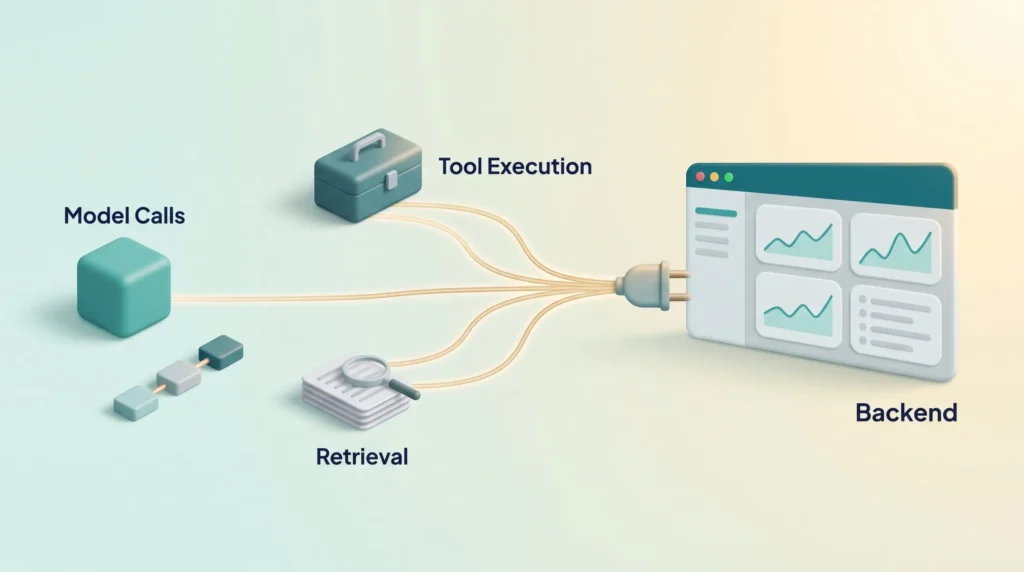
Instrument with the GenAI conventions
OpenTelemetry’s GenAI semantic conventions define standard gen_ai.* attributes for model calls, agent steps, retrieval, and tool execution. Using them means your traces work with any compatible backend instead of locking you into one vendor’s proprietary format — a real risk given how fragmented LLM observability tooling became.
Two practical notes. Store prompt and completion content in span events rather than span attributes, since attributes are indexed and size-limited, and full prompts frequently contain personal data. And pin your convention version: the spec is still moving, and newer attributes such as reasoning-token counts will silently return empty if your dashboards query old names.
Detecting drift, hallucinations, and toxicity
Instrument prompt-completion pairs, token usage, retrieval hit rates, and latency so you can separate an infrastructure problem from a model problem. Alert on sudden shifts in refusal rate, groundedness scores, and out-of-distribution inputs — these move before your business metrics do.
- Set thresholds for toxicity, retrieval failure, and quality regression, and route them to on-call with runbooks.
- Keep a change log linking incidents to prompt, model, or index versions.
- Sample real traffic continuously into a review queue, not just after complaints.
User feedback loops
Collect explicit ratings and implicit signals — edits, regenerations, abandonment — and feed them into your evaluation set. Validate fixes in staging against replayed production traffic before release. This is the loop that turns a static deployment into a system that improves.
Security, compliance, and responsible AI
Controls belong in the design, not in a pre-launch review.
Data protection, access control, and encryption
Encrypt at rest and in transit for training artifacts, indexes, and logs alike — observability backends are a commonly overlooked store of sensitive prompt data.
Apply role-based access control and least privilege to models, indexes, and prompt repositories. Anonymise or pseudonymise inputs where the use case allows. Secure your CI/CD with secrets management, image scanning, and scoped build roles, and keep audit trails versioned for models, prompts, and data.
Prompt injection deserves specific treatment: constrain what tools a model can call, validate tool arguments, and never let retrieved content carry privileges. Broader guardrails belong in a written policy — see our generative AI usage guidelines for a template.
What actually applies: the EU AI Act, GDPR, and US rules
The regulatory picture changed materially in 2026, and the headlines were misleading.
The Digital Omnibus on AI (Regulation (EU) 2026/1744) entered into force on 27 July 2026. It deferred high-risk obligations for standalone Annex III systems from August 2026 to 2 December 2027, and for AI embedded in regulated products to 2 August 2028.
But 2 August 2026 still landed. Article 50 transparency duties applied from that date: you must disclose when users are interacting with an AI system and mark generated or manipulated content in machine-readable form. Generative systems already on the market before that date have until 2 December 2026 to meet the marking requirement. Obligations for general-purpose AI model providers have been running since August 2025 and were untouched, as was the Article 4 AI literacy duty.
If you integrate a GPAI model through an API without extending its general-purpose character, the provider obligations sit with the model vendor, not with you — but the transparency and literacy duties still reach you as a deployer. Our dedicated guides to EU AI Act compliance and the wider AI regulation landscape for 2026 go deeper on classification and documentation.
For GDPR, CCPA/CPRA, and HIPAA, the operational requirements converge: document data flows, minimise retention, support deletion and access requests, and confirm that your model vendor’s contract covers processing obligations and breach notification. Where residency is strict, self-hosting or an EU-hosted inference provider is the cleaner answer. Keep an eye on the wider data privacy trends shaping 2026 as enforcement matures.
“Regular audits, transparency reporting, and fairness checks provide evidence that your model meets ethical and regulatory expectations.”
Tools and platforms to operationalize your models
A compact stack beats a broad one. You need five things, and you can buy or build each.
- Prompt and version management so changes are reviewable and reversible.
- An evaluation suite combining reference-based scoring, judge models, and human review.
- An experiment tracker — MLflow or Weights & Biases — tied to dataset versions.
- A gateway for routing, rate limits, cost attribution, and provider failover.
- An OpenTelemetry-compatible observability backend for traces, metrics, and events.
Wire evaluation into CI/CD so safety checks and quality gates run automatically on every change. And resist the urge to add a sixth category before the first five are actually used — tool sprawl is its own tax, as we’ve covered in work tech overload.
If you’re leaning toward open weights for parts of the stack, the strategic trade-offs are worth reading in our open-source strategy guide.
“Define SLOs and model performance thresholds in tooling so regressions trigger alerts and runbooks immediately.”
Your implementation roadmap, step by step
Three levels, with explicit graduation criteria between them.
Level one: hosted APIs for fast validation (weeks 1–8)
Integrate a hosted API behind a gateway. Ship one narrow workflow with a binary success criterion and a human checkpoint. Instrument from the first request.
Graduate when: you have a stable evaluation set, a measured cost per task, and a quality number a stakeholder trusts.
Level two: retrieval and adaptation (months 3–9)
Add retrieval to ground answers in your own content. Introduce routing between a large and a small model. Fine-tune only where evaluation shows prompting has plateaued.
Graduate when: retrieval relevance is measured, CI evaluation gates are enforced, and unit economics work at projected volume.
Level three: specialised serving and training
Self-host or train only when residency, latency, cost at scale, or a genuinely unavailable capability forces it. Expect meaningful engineering and GPU commitment.
Exit criteria: proceed only if adapted models demonstrably fail your performance, compliance, or integration requirements.
“Maintain consistent practices — prompt governance, monitoring, and evaluation — so each stage scales without rework.”
Conclusion
The differentiator in 2026 is no longer having a model in production — it’s being able to prove what it’s worth.
Pick one high-value workflow. Define the four numbers. Instrument with open standards. Gate every change with automated evaluation. Then scale the pattern, not the pilot.
Do that, and the loop compounds: production signals sharpen your evaluation set, a better evaluation set makes changes safer, and safer changes let you ship faster than teams still debating model choice. For the wider organisational context, our guide to business automation trends shows where LLM workflows fit alongside existing automation.
Found this useful?
Make SmartKeys a preferred source on Google, and our articles will surface more often in your Top Stories, AI Overviews, and AI Mode.
Add as Preferred Source