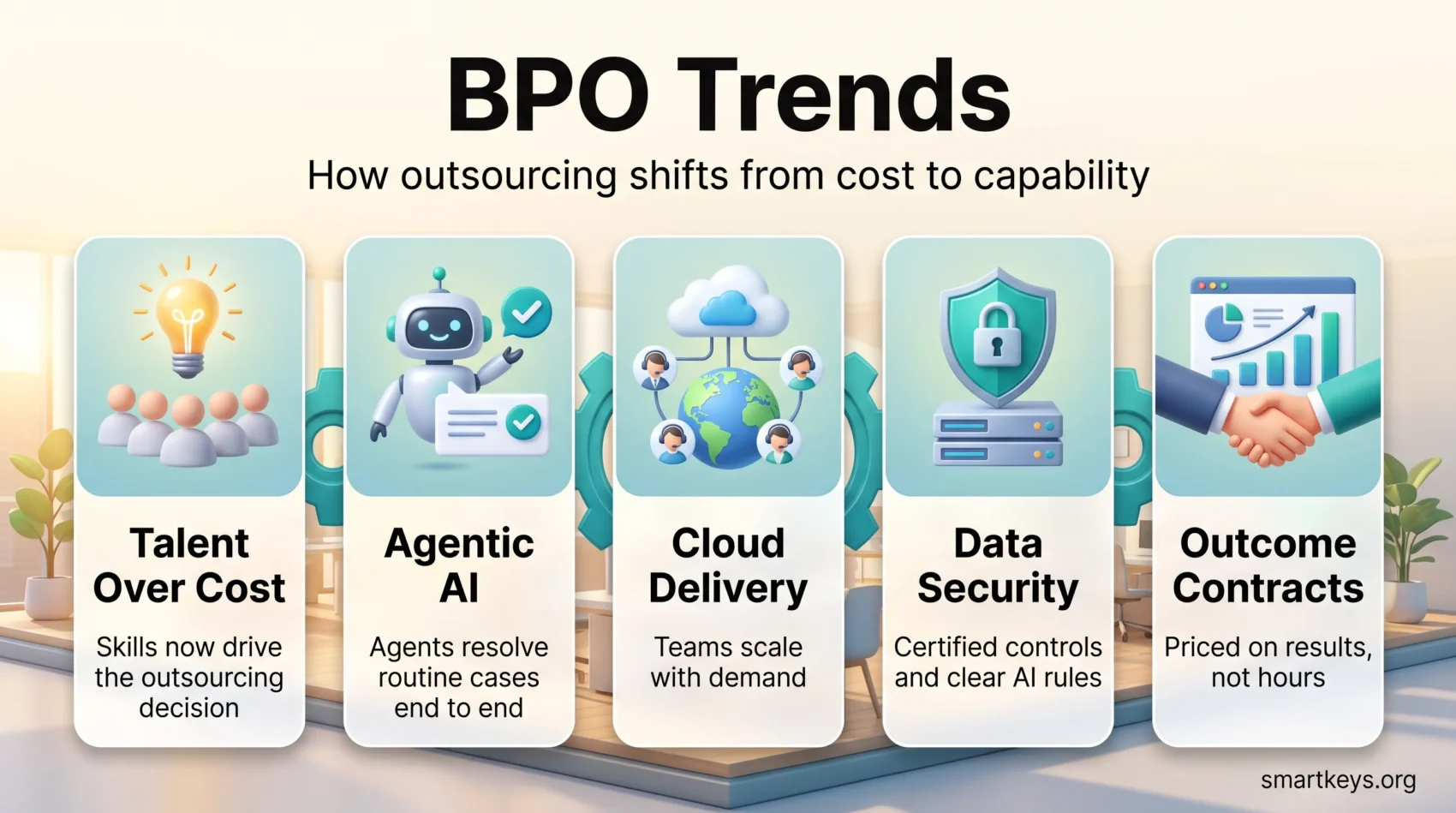
Business process outsourcing has stopped being a pure cost play. Companies still hand customer support, finance and back-office work to external providers, but the reason has shifted: access to skills, faster delivery and technology they cannot build in-house. Deloitte’s Global Outsourcing Survey 2024 found that only 34% of organisations now name spend optimisation as their main motivation, down from 70% in 2020, while 42% point to better access to talent.
That shift is what makes the current BPO trends worth tracking. AI is rewriting what a service desk actually does, data protection rules are tightening on both sides of the contract, and buyers increasingly judge providers on outcomes rather than hourly rates. This guide covers where the market stands in 2026, which technologies are genuinely changing delivery, and what to check before signing.
Key Takeaways
- The global BPO market is worth roughly $358.6 billion in 2026 and is forecast to reach $695.8 billion by 2033 (Grand View Research).
- Cost cutting has slipped behind talent access as the leading reason to outsource.
- AI adoption is near universal in intent, but measured savings still lag the promises.
- Data protection and AI regulation now shape vendor selection, not just legal review.
- Onshore delivery leads by revenue, while nearshore and offshore models compete on skills as much as price.
- Sustainability has moved into RFPs as data centre energy demand climbs.
What Business Process Outsourcing Covers
Business Process Outsourcing (BPO) means contracting an external provider to run a defined business function instead of staffing it internally. The scope is broad: back-office work such as accounting, payroll, IT support and data processing, and front-office work such as customer service, technical help desks and sales support.
Companies of every size use it. A ten-person startup might outsource bookkeeping; a global insurer might outsource claims processing across three continents. What they share is a decision to buy a capability rather than build it — and increasingly, to buy access to the AI tooling that now sits inside business operations without funding the platform themselves.
The classic advantages still hold: lower fixed costs, faster scaling, round-the-clock coverage across time zones, and more internal attention for whatever the business actually competes on. What has changed is that providers are expected to bring automation and analytics to the table, not just headcount.
How the BPO Industry Evolved
Early outsourcing was arithmetic. Move repetitive administrative work to a lower-cost location, book the saving. Manufacturers led, then IT and customer support followed as telecommunications made distance cheap.
The second phase was geographic specialisation. India built scale in IT and finance; the Philippines became the centre of gravity for voice-based customer service. That industry is still growing: IBPAP reported that Philippine IT-BPM export revenues passed $40 billion in 2025, up about 5% year on year, with the sector accounting for roughly 8% of national GDP and projected to employ around 1.97 million people by the end of 2026.
The third phase, the one we are in now, is technological. Providers compete on how much of a process they can automate, how well they can instrument it, and what they can prove about security. Deloitte found 92% of organisations are using or planning to use AI in service delivery and 83% expect their vendors to bring AI capability. The same survey is blunt about results: fewer than half report productivity gains and only 25% see cost reductions in vendor services. Ambition is running ahead of measurable return, which is exactly where careful buyers can negotiate.
The BPO Market in 2026
Grand View Research puts the global BPO market at $328.4 billion in 2025 and $358.6 billion in 2026, with a forecast of $695.8 billion by 2033 at a 9.9% compound annual growth rate. That is healthy growth for a mature services category, and it is not evenly distributed.

A few structural points from the same research stand out. North America accounted for 37.4% of revenue in 2025, so the buying side remains concentrated even where delivery is not. Finance and accounting held a 21.4% revenue share, making it the largest single service line. IT and telecommunications is the biggest end-use sector. Customer services is expected to grow fastest, at an 11.2% CAGR across the forecast period — which is notable given that customer service is also the function AI is reshaping hardest.
Onshore outsourcing dominated as the largest delivery type. That surprises people who still equate BPO with offshore call centres, but it reflects work that cannot easily leave a jurisdiction: regulated financial processes, healthcare records, public sector contracts. Nearshore delivery sits between the two, trading some cost advantage for overlapping working hours and closer alignment with data localisation requirements.
BPO Trends Shaping 2026 and Beyond
Three forces are doing most of the work: automation that handles whole cases rather than single steps, cloud infrastructure that makes delivery portable, and a compliance environment that raises the cost of getting security wrong.
AI-Powered Automation and Agentic AI
The interesting shift is from assistive AI to agentic AI — systems that take a customer request, work through the steps and close it without a human in the loop. Gartner predicts that by 2029 agentic AI will autonomously resolve 80% of common customer service issues without human intervention, and associates this with a 30% reduction in operational costs.
Treat that as a direction of travel rather than a delivery date. The practical version in 2026 is narrower: agents handling password resets, order status, refunds within policy, and routine tier-one triage, while humans take exceptions and anything with emotional or financial weight. Providers that have built structured AI agent workflows around clear escalation rules are getting results; those that bolted a chatbot onto an unchanged process are not.
Predictive analytics is the quieter win. Forecasting call volumes, spotting accounts likely to churn and routing work by predicted complexity are all unglamorous applications that pay back reliably.
Robotic Process Automation
RPA remains the workhorse for rule-based tasks: moving data between systems that will never have a proper API, reconciling records, generating standard documents. It is deterministic and auditable, which is why it survives in regulated processes where a language model would be hard to defend.
The current pattern is combination rather than replacement. An AI layer reads an unstructured email or document and decides what needs to happen; RPA executes the transaction in the legacy system. Mature buyers govern this centrally rather than letting each team build its own bots — the logic behind an automation centre of excellence.
Emerging Technologies Driving BPO
Cloud Computing in Outsourcing
Cloud infrastructure is what makes modern BPO portable. A provider can stand up a delivery team in a new country in weeks because the contact centre platform, the case management system and the analytics stack are all services rather than installations. The practical benefits are familiar:
- Scalability: capacity moves with seasonal demand instead of being sized for the peak.
- Cost structure: consumption-based pricing, which needs active management to stay efficient.
- Shared data: client and provider work from the same records in real time.
The catch is that consumption pricing drifts upward without discipline. Whoever owns the cloud bill in the contract should also own the FinOps practices that keep it under control. Where regulation or latency keeps some workloads on-premises, a hybrid cloud strategy is usually the honest answer, and the broader cloud computing trends of 2026 point the same way. As digital transformation advances in regulated sectors, cloud remains the foundation the rest of the delivery model sits on.
Integration of AI Solutions
Beyond automating transactions, AI is changing what providers can tell clients about their own customers. Three applications are doing real work:
- Conversational agents: handling routine contacts end to end and summarising the rest for human agents.
- Feedback analysis: reading every ticket and survey instead of a sample, which is the basis of voice-of-customer analysis at scale.
- Personalisation: tailoring responses and offers to history rather than segment averages.
The pattern across all of these is augmentation rather than replacement: the volume of routine work falls, and the work that remains is harder.
Remote and Distributed BPO Delivery
The pandemic proved that customer service does not require a building, and the industry never fully went back. Most large providers now run hybrid models: distributed agents for flexibility and resilience, secure sites for work that regulators or clients insist on containing.
The upside is a wider talent pool and a delivery footprint that is not hostage to one city’s power grid or transport network. That resilience argument has become a formal part of vendor evaluation, and it belongs in workforce contingency planning rather than in a slide about employee happiness.
The costs are real too. Distributed agents are harder to supervise, harder to coach and easier to lose. Endpoint security becomes a live problem when the endpoint is a home network, which is why cybersecurity practices for remote work now sit in outsourcing contracts rather than in an IT appendix. Flexible staffing models sit alongside this, with on-demand workforce strategies covering seasonal peaks that a fixed team cannot absorb.
BPO Trends: Data Privacy and Security
Handing a process to a third party means handing over the data that process runs on. That makes security a commercial question, not a technical footnote.
That is why strong cybersecurity belongs in the vendor conversation from the first meeting. IBM’s Cost of a Data Breach Report 2025 put the global average cost of a breach at $4.44 million, down from $4.88 million the year before — the first meaningful decline in years, which IBM attributes largely to faster detection and containment. The report also flags a new exposure: organisations with high levels of shadow AI, meaning unsanctioned AI tools used by staff, saw around $670,000 added to the average breach cost. Among organisations that suffered an AI-related incident, 97% lacked proper AI access controls, and 63% had no AI governance policy at all.
For a BPO relationship, that last figure is the one to act on. If your provider’s agents are pasting customer data into consumer AI tools, your governance gap is now their behaviour.
The Compliance Landscape in 2026
The regulatory perimeter around outsourced work keeps widening. The frameworks that most often appear in BPO contracts include:
- General Data Protection Regulation (GDPR), where penalties can reach 4% of global annual turnover
- California Consumer Privacy Act (CCPA) and its US state-level successors
- HIPAA for healthcare data
- Gramm-Leach-Bliley Act (GLBA) for financial services
- ISO/IEC 27001:2022 and SOC 2 as evidence of controls
- NIST Cybersecurity Framework as a common reference model
The EU AI Act adds a further layer. Obligations for general-purpose AI providers applied from 2 August 2025, and the majority of the Act’s rules become applicable from 2 August 2026, with enforcement beginning at that point. If a provider uses AI in your customer interactions or in hiring their own staff, that is now a contractual question. Automating the evidence-gathering side of this is what RegTech tooling is for.
Technological Solutions for Cybersecurity
Credible providers can show, not just assert, their controls. What to ask for:
- Encryption in transit and at rest, with key management you can inspect
- Multi-factor authentication and least-privilege access, enforced for subcontractors too
- Current ISO 27001 and SOC 2 reports, with the scope statement attached
- A named policy on which AI tools agents may use with client data
- Breach notification timelines written into the contract, not the sales deck
Broader cybersecurity trends for businesses apply here in full: the outsourced perimeter is simply part of your perimeter.

Sustainability in Business Process Outsourcing
Sustainability questions now appear in outsourcing RFPs, and the driver is straightforward: outsourced work runs on data centres, and data centres are consuming more power. The IEA projects that data centre electricity consumption will roughly double from about 485 TWh in 2025 to around 950 TWh by 2030, reaching roughly 3% of global electricity demand.
For BPO buyers, that translates into a few concrete asks: where the provider’s infrastructure is hosted, what its energy mix looks like, and whether it reports emissions in a form you can consolidate. Providers that have done this work can answer in numbers; those that have not will talk about values. Carbon neutrality roadmaps and the wider climate tech landscape are useful context when setting those expectations.
There is an operational dividend as well. Consolidating workloads, retiring redundant systems and moving off ageing hardware tend to cut both emissions and cost, which is a rare alignment.
Specialized Services and Global Capability Centers
The generalist provider that does a bit of everything is losing ground to specialists. Buyers increasingly want a partner that already understands medical billing codes, mortgage servicing rules or marketplace disputes, because domain knowledge is what remains scarce once automation absorbs the routine work.
Specialisation shows up most clearly in:
- Customer support and technical help desks, where product depth matters
- Finance and accounting, the largest service line by revenue
- Regulated data handling in healthcare, insurance and financial services
- Data annotation and quality assurance for AI systems, a service line that barely existed a decade ago
Running in parallel is the global capability centre model, where a company builds its own offshore delivery arm instead of contracting one. IBPAP has pointed to GCCs as a central part of the Philippines’ positioning as an IT-BPM hub. For large buyers, the choice is no longer outsource-or-not but which processes belong to a vendor, which belong to a captive centre, and which stay at headquarters.
Strategic Partnerships and Growth in BPO
The commercial model is following the same logic. Transaction-based pricing rewards volume, which is precisely the wrong incentive when the goal is to automate volume away. Outcome-based contracts — priced on resolution rates, cycle times or customer satisfaction — align both sides better, though they demand measurement discipline neither party can fake.
Good partnerships in 2026 tend to share three characteristics: joint access to the same performance data, an explicit agreement on who owns automation gains, and a security posture treated as shared rather than delegated. Where technology is part of the value, the same governance questions arise as in any platform decision, from the service desk software upward.
For a longer view of how technology shifts business models, our analysis of blockchain adoption in business covers similar ground: adoption follows proven value, not announcements. The parallel evolution of customer service in 2026 is worth reading alongside this one, since it is the front line where most BPO change becomes visible. On the back-office side, finance automation trends explain why F&A remains the largest outsourced function.
Conclusion
BPO in 2026 is a growing market being reshaped from the inside. The headline number — roughly $358.6 billion, heading toward $695.8 billion by 2033 — tells you demand is intact. The more useful signals are underneath it: cost is no longer the main reason buyers outsource, AI adoption is near universal in intent but uneven in results, and security and regulatory posture now decide contracts that used to turn on price.
The practical implication for anyone evaluating a provider is to ask for evidence rather than positioning. What has actually been automated, and what did it save? Which controls are certified, and what is in scope? How is AI use governed on the delivery floor? Providers that can answer those questions in specifics are the ones worth a long-term partnership.
Found this useful?
Make SmartKeys a preferred source on Google, and our articles will surface more often in your Top Stories, AI Overviews, and AI Mode.
Add as Preferred Source