Healthcare is being rebuilt on digital infrastructure, and the pressure driving that rebuild is mostly financial. CMS projects US health spending at roughly $5.9 trillion in 2026, about 18.6% of GDP, with spending growing about 5.2% a year on average through 2033. Systems facing that curve cannot hire their way out of it, so they are turning to digital healthcare solutions to absorb work that people currently do by hand.
The basics are already in place. Electronic records are effectively universal, telehealth has survived its policy cliff, and artificial intelligence has moved out of the pilot phase in most large health systems. What separates organizations now is not whether they have the technology, but whether their data, governance and workflows let them use it.
This guide walks through the building blocks of a healthcare digital transformation strategy in 2026, from EHR and telemedicine adoption to AI: what is deployed, what it delivers, what it costs in privacy and security risk, and which rules apply.
Key Takeaways
- US health spending is projected at about $5.9 trillion in 2026, roughly 18.6% of GDP (CMS).
- More than 99% of US non-federal acute care hospitals had a certified EHR as of 2024 (ASTP/ONC).
- Medicare telehealth flexibilities were extended through 31 December 2027.
- 75% of US health systems now run at least one AI application, up from 59% a year earlier.
- 710 large health data breaches were reported to OCR in 2025, affecting over 61 million people.
Why Digital Transformation Matters Now
Digital transformation in healthcare means replacing paper, phone calls and manual handoffs with connected systems that carry clinical and administrative information end to end. It is a workflow and governance project as much as a technology one, which is why the same software produces very different results in two hospitals of the same size.
What the Term Actually Covers
The scope runs from the electronic record at the centre to everything that feeds it: scheduling, billing, imaging, remote monitoring devices, patient portals and analytics. The general pattern is familiar from other sectors, and the underlying playbook is the same one described in our guide to digital transformation trends across industries. Healthcare simply carries stricter safety and privacy constraints.
Where the Pressure Comes From
Three forces push adoption. Cost growth outpaces revenue for most providers. Clinical staffing is tight, so any hour returned to a clinician has real value. And patients now compare healthcare interfaces with consumer apps, not with other hospitals. Investors have noticed: the business case behind these shifts is set out in our overview of HealthTech trends and digital health opportunities.
The Core Building Blocks
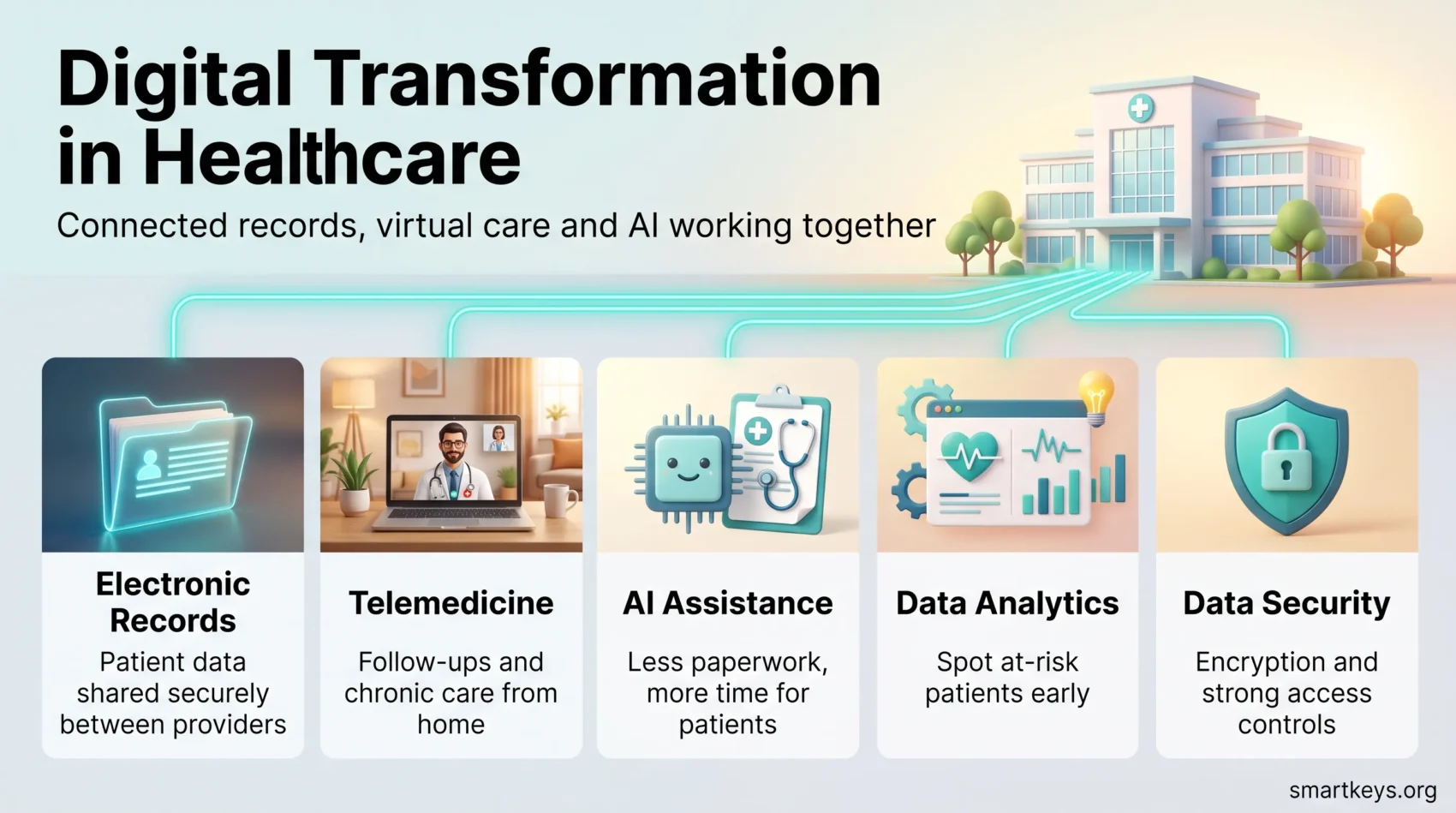
Four layers do most of the work: the record system, the exchange layer that moves data between organizations, virtual care, and the AI sitting on top of both.
Electronic Health Records and Interoperability
EHR adoption is finished as a story. According to ASTP/ONC, more than 99% of US non-federal acute care hospitals had adopted a certified EHR as of 2024. The live question is whether records move between organizations.
That part improved sharply. Health records exchanged through TEFCA, the national framework for data exchange, went from roughly 10 million in January 2025 to close to 500 million by February 2026, and HHS reported more than 1 billion records exchanged by 26 June 2026. The Social Security Administration joined in spring 2026 and reported disability claims processing accelerating by more than half.
Interoperability is what turns a record system into an asset. Without it, each organization holds a partial view, and every referral becomes a manual reconstruction of the patient’s history.
Telemedicine After the 2026 Policy Extension
Telemedicine spent years one deadline away from losing its funding. That ended, at least for now. The FY2026 spending package signed on 3 February 2026 extended Medicare telehealth flexibilities through 31 December 2027, keeping geographic flexibility, home as an originating site, audio-only visits where clinically appropriate, therapist eligibility, and the waiver of in-person requirements for behavioral health.
For providers, a two-year horizon is long enough to justify permanent staffing and equipment decisions rather than temporary ones. Telehealth works best for follow-ups, chronic condition management and behavioral health. It works poorly where a physical examination carries the diagnosis, which is why triage rules matter more than the video platform itself.
AI in Clinical and Administrative Work
AI in healthcare is now mainstream rather than experimental. In the 2026 Eliciting Insights survey of 120 health system executives, 75% reported using at least one AI application, up from 59% the year before, and half were running three or more. Clinical note-taking led adoption at 68%.
On the device side, the FDA had authorized more than 1,400 AI-enabled medical devices as of its March 2026 database update, with radiology accounting for the majority. These are regulated products with cleared indications, not general-purpose chatbots, and the distinction matters when you evaluate vendor claims.
The evidence on benefit is real but moderate. A JAMA study of about 1,800 clinicians across five academic medical centres, reported in April 2026, found ambient AI scribes saved 16 minutes of documentation time and 13 minutes in the record per eight hours of patient care. Gains were uneven across specialties, and after-hours record time did not fall. For a wider view of where these tools land, see our analysis of AI-powered assistants at work and the broader picture of AI in business operations.
What Digital Healthcare Solutions Actually Deliver
The returns show up in three places: how care is targeted, who can reach it, and how much administrative work sits between staff and patients.
Personalized Care Through Data Analytics
Healthcare data analytics lets clinicians build treatment plans around an individual rather than a population average, drawing on history, medication records, monitoring data and, in some specialties, genetic information. The practical benefit is targeting: identifying which patients need outreach this week rather than treating a whole cohort identically. The methods are the same ones used elsewhere, as covered in our guide to predictive analytics in business decisions.
Improved Access and Health Equity
Digital access is not automatic access. Remote consultations remove travel and time-off barriers for some patients, and create new ones for households without reliable broadband, a suitable device or the confidence to use either. Programmes that close gaps tend to pair virtual care with community partnerships, translated interfaces and a low-technology fallback. Programmes that assume a smartphone tend to widen the gap they were meant to close.
Administrative Relief for Clinical Staff
Documentation, prior authorization, coding and scheduling consume a large share of clinical time. This is where automation currently pays back fastest, because the tasks are rule-based, high-volume and low-risk when a human reviews the output. The realistic framing is minutes returned per encounter rather than transformation, which is exactly what the scribe evidence shows. The wider automation pattern is covered in our guide to hyperautomation in business operations.
Where Digital Transformation Runs Into Trouble
Most failures are not technical. They come from security exposure, workflow resistance and skills that were never budgeted for.
Data Privacy and Security
Digitizing records concentrates risk. In 2025, 710 breaches of 500 or more records were reported to the HHS Office for Civil Rights, exposing the protected health information of at least 61.5 million people. That was an improvement on 2024, when 289 million records were affected, largely because there were fewer very large incidents rather than because defences transformed.
The regulatory response is still pending. HHS published a proposed HIPAA Security Rule update on 6 January 2025 that would mandate multi-factor authentication, encryption of electronic protected health information at rest and in transit, an annually reviewed asset inventory and network map, six-monthly vulnerability scans and annual penetration testing. The final rule has slipped, with the current target set for July 2027. Waiting for the deadline is a poor strategy, since most of those controls are already standard practice. The general principles are covered in our guides to data privacy rules at work and cybersecurity for distributed teams, and the governance layer in our privacy compliance framework.
Resistance to Change in Clinical Settings
Clinical staff resist tools that add clicks without removing any. That is a rational response, not obstruction. Adoption improves when clinicians help design the workflow, when the old process is genuinely retired rather than run in parallel, and when someone measures whether the new system actually saved time. Skipping that measurement is how organizations end up with expensive software nobody trusts.
Skill Gaps Among Healthcare Professionals
Buying a platform does not create the capability to run it. Analytics, governance and AI oversight all require people who can interpret output and challenge it. Training budgets are usually the first casualty of an implementation overrun, which is why capability lags deployment by years. Practical approaches are set out in our guide to upskilling and reskilling programmes.
The Role of Healthcare Data Analytics
Healthcare data analytics is the layer that turns stored records into decisions about staffing, risk and intervention.
Using Data for Predictive Insights
Predictive models are used to flag patients at elevated risk of readmission or deterioration, to forecast demand for beds and staff, and to prioritize outreach. The value depends entirely on what happens after the alert. A risk score with no assigned owner and no intervention attached changes nothing, and alert fatigue makes the next model harder to deploy. Models also need monitoring for drift and bias after go-live, which is where explainable AI methods earn their place.
Data Management and Governance
Effective data management strategies decide whether analytics works at all. That means agreed definitions, tracked data lineage, controlled access and a single trusted source for each metric. Most analytics disappointments trace back to inputs, not algorithms. The structures involved are covered in our guides to data governance strategy, AI governance models and big data in practice.
Emerging Technologies in Healthcare
Beyond the record system, two categories are changing how often patients and clinicians are in contact.
Mobile Health Applications
Mobile health applications handle appointments, results, messaging, prescription refills and payments in one place. Their real contribution is reducing friction: fewer missed appointments, fewer phone calls, faster answers. They are not clinical tools in themselves, and portals with poor accessibility simply move a barrier rather than remove it.
Wearables and Remote Patient Monitoring
Wearable medical devices stream vital signs, activity and rhythm data between visits, which is most useful in chronic disease management, post-discharge follow-up and hospital-at-home programmes. The constraint is not sensor accuracy but capacity: continuous data only helps if a clinical team is resourced to act on it. Related infrastructure questions are covered in our guides to IoT in healthcare and wearable technology in the workplace.
The Rules That Apply and When
Regulation now shapes procurement timetables, so the dates matter.
In the EU, the AI Act phases in obligations by risk class. High-risk standalone systems listed in Annex III were originally due to comply from 2 August 2026, with that deadline extended to 2 December 2027. AI embedded in regulated products such as medical devices, covered by Annex I, moved from 2 August 2027 to 2 August 2028. Enforcement bodies are already reviewing risk management and post-market monitoring documentation ahead of those dates, so the extension is breathing room rather than a pause. Our EU AI Act compliance guide and overview of AI regulation cover the detail.
In the US, the FDA regulates AI-enabled devices through its existing clearance pathways, and HIPAA governs the handling of health information. Where AI touches hiring or workforce decisions inside a health system, separate state and city rules apply, as set out in our guide to AI hiring tools and the law.
What Comes Next
The next phase is less about new categories of technology and more about consolidating what has already been bought.
Where the Investment Goes
Spending is concentrating on data foundations, cloud migration and the integration layer between systems, because those determine whether anything built on top works. In the 2026 Eliciting Insights survey, more than half of the health systems that could quantify return on their AI deployments reported at least a 2x return, which also implies a substantial share could not quantify it at all. Measurement discipline is the differentiator. The platform choices behind this are discussed in our guide to cloud computing trends.
Collaboration Between People and Machines
Collaboration in healthcare works best when software handles volume and pattern recognition while clinicians handle judgement, context and accountability. Every deployment that has held up in practice keeps a human in the loop on clinical decisions, keeps an audit trail, and gives staff a route to challenge an output. The aim is to widen clinical capacity, not to remove the clinician from the decision.

Conclusion
Healthcare digital transformation has passed the adoption stage. Records are digital, exchange volumes are climbing fast, telehealth has funding certainty into 2028, and three quarters of US health systems are running AI in production. The open questions are quality questions: whether the data is trustworthy, whether the security controls match the exposure, and whether anyone is measuring what the technology returns.
Organizations that do well from here will be unglamorous about it. They will fix data foundations before buying more tools, implement the HIPAA Security Rule controls without waiting for the final rule, keep clinicians in the design loop, and hold every deployment to a measurable outcome. That is a slower path than the vendor pitch suggests, and it is the one that produces results worth keeping.
Found this useful?
Make SmartKeys a preferred source on Google, and our articles will surface more often in your Top Stories, AI Overviews, and AI Mode.
Add as Preferred Source