Vertical AI solutions are AI systems built for one industry and its specific jobs, rather than for everyone. A general chatbot can draft an email for anyone. A vertical AI tool for insurance reads a policy submission, checks it against underwriting rules, and writes a structured decision into the insurer’s own system. That difference, general versus job-specific, is the subject of this guide.
The timing matters. By 2026, almost every company has tried general AI tools, yet most struggle to turn that into measurable results. McKinsey’s August 2026 State of AI survey found that nearly nine in ten organizations use AI regularly in at least one function. Only 37% attribute any profit impact to it. Industry-specific systems that plug into real workflows are where many companies now look for that missing return.
This guide explains what vertical AI is, why it is gaining ground, how it is built, and how healthcare, legal, finance, customer service and field industries use it. Every figure is sourced.
Key Takeaways
- Vertical AI combines a general model with industry data, rules and integrations so it can do one job reliably.
- AI agents, software that plans and carries out multi-step tasks, are shifting value from systems that store data to systems that act on it.
- Adoption is broad but shallow: most companies use AI, far fewer have scaled agents or can show a return.
- Integration with existing systems is the top obstacle, so the winning approach is to connect first and replace later.
- Governance, human review and the EU AI Act’s transparency rules now shape every serious deployment.
What Vertical AI Solutions Are and How They Differ from Horizontal AI
Horizontal AI serves every industry with the same product. ChatGPT, Microsoft Copilot and GitHub Copilot are horizontal: useful to a lawyer, a nurse and a plumber alike, but expert in none of their fields.
Vertical AI takes the same underlying models and wraps them in what a specific industry needs: its vocabulary, its compliance rules, its document formats, and connections to the software it already runs on. A medical scribing tool needs to understand clinical terms, follow patient privacy law, and write into an electronic health record (EHR). A generic chatbot does none of that out of the box.
From general-purpose models to domain-specific applications
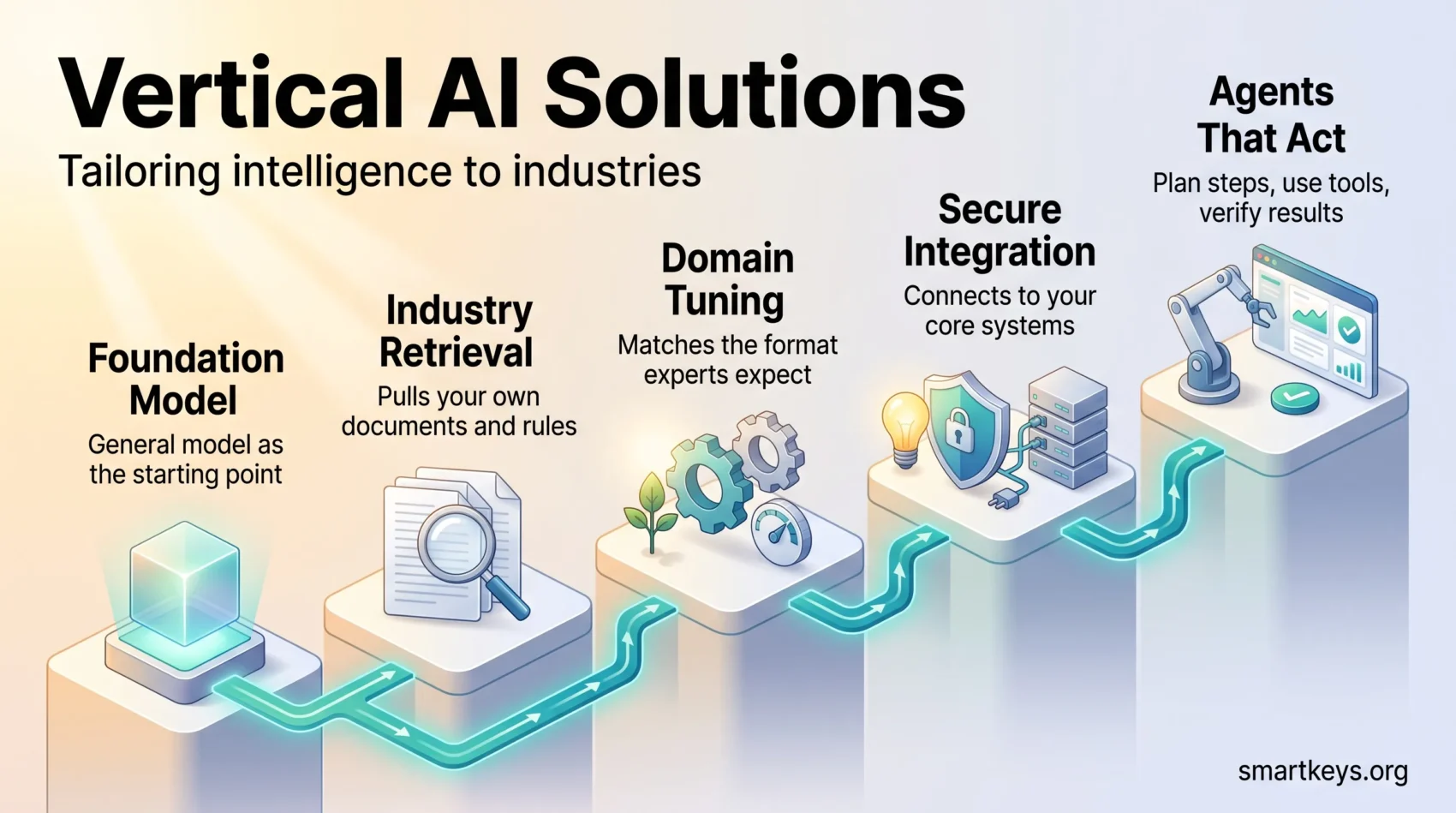
Most vertical AI products do not train a new model from scratch. They start with a foundation model, a large general model such as those from OpenAI, Anthropic or Google, and add three layers on top.
The first layer is retrieval. The system pulls the right internal documents, records or guidelines into the model’s context before it answers. This technique is called retrieval-augmented generation (RAG). The second layer is tuning: adjusting the model on examples from the field so its outputs match the format experts expect. The third layer is integration: secure connections that let the system read from and write to the CRM, EHR, claims platform or project database.
Agents: software that acts, not just answers
The newest layer is the agent. An AI agent is software that takes a goal, breaks it into steps, uses tools and other software to complete those steps, and checks its own work along the way. Instead of drafting a reply for a support rep, an agent reads the ticket, issues the refund within policy limits, and logs the outcome. For a practical introduction, see the guide to AI agent workflows.
Why Vertical AI Is Gaining Ground in 2026
Three forces explain the shift. General AI is everywhere but returns are scarce. Agents make action possible. And the labor budgets those agents can address dwarf software budgets.
Broad adoption, thin returns
McKinsey’s 2026 survey of 1,719 respondents across 97 countries found that only 6% of organizations qualify as AI “high performers.” Those are companies that attribute at least 5% of profit to AI and report significant value. Among large enterprises with more than $1 billion in revenue, 40% say they are scaling AI agents. Among smaller organizations the figure is 22%. Agents are most often scaled in IT, knowledge management and software engineering.
A survey by the venture firm White Star Capital of more than 90 portfolio companies, published in November 2024, showed the same pattern from the startup side. 96% had adopted ChatGPT or GitHub Copilot, 69% had built their own AI tools, and 52% had integrated AI into customer service. Yet 56% named integration with existing systems as their top obstacle. Broad access to general tools has not solved the industry-specific problem.
The labor budget is the prize
The venture firm NEA frames the opportunity in one comparison. Annual US labor spend is roughly $11 trillion, while the enterprise software market is about $450 billion. Software that stores information competes for the smaller number; software that completes work competes for the larger one. That is why investment now flows into industry agents.
Rules have caught up
Since 2 August 2026, Article 50 of the EU AI Act requires that people be told when they are talking to an AI system. AI-generated content must also be marked as such where technically feasible. The stricter high-risk rules for areas such as hiring and credit decisions were postponed to December 2027 under the EU’s Digital Omnibus package. The EU AI Act compliance guide for SaaS covers the deadlines and risk tiers in detail.
The Vertical AI Advantage: Precision, Efficiency and Defensibility
A general model knows a little about everything. A vertical system knows a lot about one thing, and that focus pays off in three ways.
Precision. When a model retrieves the actual underwriting manual, clinical guideline or contract playbook, its answers match how the business really works. Outputs become consistent enough to trust in regulated tasks, where a plausible but wrong answer is worse than no answer.
Efficiency. Vertical tools remove the manual steps around the AI, not just the writing inside it. Klarna’s assistant, for example, handled 2.3 million customer conversations in its first month, according to White Star Capital’s report. The gain came from resolving the whole conversation, not from drafting better sentences.
Defensibility. Proprietary data, industry integrations and feedback loops from real users are hard for a competitor to copy. White Star Capital names this as the main reason vertical AI companies can hold their position against general platforms. NEA adds that once an agent owns a workflow, switching to a rival means retraining the whole process, which raises switching costs.
Where horizontal tools complement, not replace, vertical applications
None of this makes general tools obsolete. A realistic 2026 stack uses a general assistant for drafting and research, plus a vertical system for the two or three workflows that define the business.
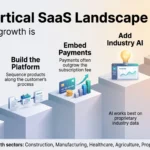
For a practical pairing playbook, see the vertical SaaS and remote work guide to learn how hybrid stacks accelerate outcomes while protecting your core platforms. The broader vertical SaaS landscape in 2026 shows which industries specialized vendors are targeting first.
Agents as the New Control Point: From Systems of Record to Systems of Action
A system of record stores data: the CRM, the EHR, the ERP. A system of action gets work done and then updates the record. NEA argues that the system of action is becoming the new control point in enterprise software, because whoever completes the task decides what reaches the database and when.
Today a sales rep takes a call and types notes into the CRM. With an agent in the loop, the call is transcribed, the next step is scheduled, and the CRM is updated automatically. The record still matters, but the value has moved to the layer that did the work.
Good implementations verify each step and log it so a human can audit what happened. Poor implementations skip the verification, which is where most failures come from.
Keep a human in the loop where it counts
Klarna’s story shows both the promise and the limit. After reporting that its AI assistant did the work of about 700 agents, the company announced in May 2025 that it would again recruit human customer service staff. CEO Sebastian Siemiatkowski said it was critical to be clear with customers that a human would always be available. The assistant still handles about two-thirds of inquiries, according to CX Dive. The lesson is not that the agent failed. It is that full automation of a customer-facing function trades away quality that customers notice.
Output-based pricing and access to labor budgets
When software does the work, it can be priced on the work. White Star Capital cites the legal AI company EvenUp, which bills for completed legal summaries rather than per user seat. NEA makes the same point: outcome pricing lets a vendor sell against the labor budget instead of the software budget. Compare it with the usage-based pricing models spreading across SaaS.
Data, Models and Integrations: The Core Stack Behind Vertical Applications
Curated data and tight integrations turn a general model into a dependable system. The model is often the easiest part to obtain. The surrounding stack is where the work is.
Unstructured and multimodal inputs
Most industry knowledge does not sit in clean tables. It lives in call recordings, PDF specifications, photos from a job site, sensor readings and chat logs. A vertical system has to accept these multimodal inputs (text, voice, images, video and sensor data) and turn them into something retrievable. That means transcribing audio, tagging documents with metadata, and linking every item to the customer or case it belongs to.
Example: a home services company transcribes each inbound call and links the transcript to the job record before any analysis runs.
RAG, fine-tuning, and when to specialize
Start with retrieval-augmented generation. It is fast to set up, easy to update when policies change, and keeps the model’s answers tied to documents you control. Move to fine-tuning when the output format or tone must be consistent across thousands of cases. Consider training your own model only when inference costs, data sensitivity or performance needs justify the spend.
NEA points to DeepSeek V3, which reportedly reached state-of-the-art performance on a training budget of under $6 million, as evidence that training costs have fallen. Its rule of thumb: companies whose annual inference bill exceeds that level should at least evaluate a proprietary model. For most companies, that threshold is still far away. The LLM Ops strategy guide covers how to run and monitor large language models in production.
Secure integrations into core systems
The integration layer reads from and writes to the EHR, CRM, underwriting or scheduling platform. In emergency services it connects to CAD (computer-aided dispatch). It needs strict access controls, staged data, limited credentials and a log of every transaction, so teams can debug outputs and meet healthcare-grade audit requirements when needed.
Many companies route these connections through an integration platform rather than building each one by hand. The guide to iPaaS and business integration explains how that layer works and why AI agents are increasingly routed through it. A clear data governance strategy decides which data an agent may see in the first place.
Practical Playbook: How to Implement Vertical AI Effectively
Pick one job your team repeats every day and build or buy a focused tool to speed it up. Start small so you can prove impact within weeks, then expand.
Start with a wedge
NEA identifies three common wedges, meaning first use cases that get a tool into a company. They are voice agents, semantic document search (search that understands meaning rather than exact keywords), and content generation. Each is narrow enough to measure and useful enough that people adopt it without being told.
Integrate first, replace later
Design a path that improves efficiency without forcing new tools on day one. White Star Capital found integration is the top hurdle at 56%, so compatibility with existing systems should weigh more than feature lists. For a practical market view and integration guidance, see the vertical SaaS market guide.
Human-in-the-loop, governance and reliability
Set confidence thresholds that route uncertain cases to a person. Add audit logs for anything regulated. Test against a labeled set of real cases before launch and again after every model update, because model behavior changes when providers ship new versions.
Gartner offers a useful warning here. In June 2025 it predicted that more than 40% of agentic AI projects would be canceled by the end of 2027, citing escalating costs, unclear business value and inadequate risk controls. Gartner also flagged “agent washing,” where vendors relabel chatbots or scripted automation as agents, and estimated that only about 130 of the thousands of self-described agentic AI vendors were genuine. A pilot with a defined metric, a defined owner and a defined stop rule avoids most of those outcomes.
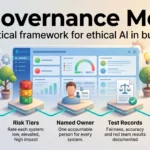
For a governance structure that scales beyond one pilot, see the AI governance model guide and the approach to building an automation center of excellence. Measure impact as time saved per case and error rate against the human baseline.
Industry Deep Dive: Healthcare, Life Sciences and Research Workflows
Healthcare was the first industry where vertical AI reached real scale. The core job, turning conversations into documentation, is repetitive, costly and disliked by clinicians.
Medical scribing, coding and treatment summaries in EHR workflows
Abridge, which NEA cites as a category leader, records the clinician-patient conversation and turns it into a structured note inside Epic, the most widely used EHR in the US. According to Fierce Healthcare, by June 2025 the company was working with more than 150 health systems and had raised a Series E at a $5.3 billion valuation. Institutions such as Johns Hopkins Medicine and Mayo Clinic were rolling it out to thousands of clinicians. The value is not the note itself but the after-hours charting it removes.
Domain-tuned models also help with medical coding and prior authorization, the insurer approval step before certain treatments. Retrieving the relevant guideline and suggesting a code reduces manual lookup. The final decision stays with a human in most deployments.
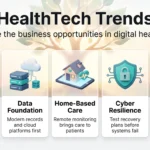
In research settings, the same approach speeds up literature triage and protocol drafting. For the broader picture of AI, telehealth and connected devices in the sector, see digital transformation in healthcare in 2026.
Legal and Financial Services: Automating Core and Supporting Functions
Legal and financial work is text-heavy, rule-bound and expensive. That makes it a natural fit for vertical AI, provided every output can be traced back to a source.
Contract review and regulatory research
Tools such as Harvey (legal research and drafting) and EvenUp (personal injury demand letters) take on associate-level review. They extract obligations, flag risky clauses and assemble citations. What makes them usable is the trail: a reviewer can see which clause, precedent or document produced each conclusion and verify it quickly.
Compliance, underwriting and fraud detection
In insurance, NEA notes that property and casualty underwriters spend only about 30% of their time on actual underwriting and roughly 40% on administrative tasks. An underwriting assistant that summarizes submissions, reconciles inconsistent documents and logs a structured decision attacks that 40% directly. Route high-risk clauses and edge cases to humans, and let agents handle the repeatable volume. The InsurTech trends guide shows how insurers are approaching this shift, and RegTech solutions cover the compliance automation side.
Customer Service, Sales and Service Operations You Can Automate Today
Customer service is where most companies start: the volume is high and the intents repeat.
AI assistants that resolve tickets, summarize chats and update CRMs
White Star Capital found that 52% of surveyed companies had integrated AI into customer service. Typical uses are summarizing conversations, drafting replies and posting updates to the CRM. The gains show up as shorter handle times and higher first-contact resolution.
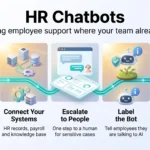
Klarna’s experience is the reference case. Its assistant handled 2.3 million conversations in its first month. Then customer feedback and the company’s own quality review led it to reinvest in human agents for complex or sensitive cases, while the assistant kept the routine two-thirds. That mix, automation for volume and people for judgment, is the model most companies now aim for. The guide to AI chatbots in customer service covers where automation pays off and what the EU rules require.
Voice agents that capture data and trigger workflows
NEA reports that voice agents land first in home services and public safety, where they transcribe calls, summarize intent and log the result into a CRM or dispatch system. Design voice flows to verify identity, capture the essential fields and make the human escalation path obvious to the caller. For the workplace side of voice tools, see voice AI assistants at work.
Construction, Public Safety and Home Services: Real-World Agent Applications
Field work produces messy inputs: thousands of pages of specifications, body-camera footage, and a phone that never stops ringing. Vertical AI turns them into searchable, auditable records.
Semantic document search and site support in construction
Trunk Tools, one of NEA’s examples, connects construction document systems such as Procore, SharePoint and Autodesk. Teams can ask a question in plain language and find the right page across plans and specs. That cuts rework caused by crews working from an outdated drawing.
911 ingestion, automated logging and report generation
Prepared began by letting emergency call centers receive video and text from callers, then added voice agents that log into computer-aided dispatch systems. Axon analyzes body-camera footage to draft police reports and runs its own dispatch and records software. In both cases the aim is a faster, traceable record of what happened.
Inbound and outbound voice agents for scheduling and dispatch
Home services vendors integrate with platforms such as ServiceTitan to answer calls, book technicians and run outbound follow-ups. These agents reduce hold time and improve technician utilization.
Build vs. Buy, Pricing and ROI: How Companies Choose the Right Platform
Choosing between building and buying depends on how unique your data is, how strict your control requirements are, and how fast you need results.
Buy when a vendor already serves your workflow with proven integrations and you have no data advantage worth protecting. Build when you own unique data, customers demand strict control, or the workflow is central to how you compete. Blend, the most common answer, by buying the platform and building the retrieval layer on your own data.
When to fine-tune vs. train your own model
Fine-tune for speed and lower cost when your application needs the general model to adopt a specific format or tone. Train your own model only when unique datasets, strict compliance or long-term cost justify the upfront spend. NEA’s guidance is to consider training when the inference bill exceeds what a training run would cost, with DeepSeek V3’s reported sub-$6 million budget as the benchmark.
Tool selection criteria
White Star Capital asked its portfolio companies what mattered most when choosing AI tools. Output quality led at 90%, followed by usability at 65%, price at 38%, reliability at 34% and user interface at 31%. Buyers in regulated industries should weight reliability higher than those startups did.
From seat-based SaaS to outcome pricing
Traditional SaaS sells seats. Outcome pricing sells verified work, such as a completed legal summary or a resolved ticket. It aligns the vendor’s revenue with your result, but it requires you to define and measure that result precisely. Compare the model with the broader shift described in AI in SaaS in 2026, where consumption pricing is changing what software costs.
Bottom line: model ROI on deployment time, measured efficiency gains and impact on revenue or cost, not on vendor projections. Involve procurement, security and legal early so the pilot does not stall at the contract stage. For the company-wide view, see how AI is transforming business operations in 2026.
Conclusion
Vertical AI solutions win where general tools stall: in the specific, repetitive, rule-bound work that defines an industry. A foundation model plus retrieval, tuning and secure integration becomes a system that completes tasks rather than one that only answers questions.
The evidence in 2026 is sober. Most companies use AI, few have scaled agents, and Gartner expects a large share of agent projects to be canceled. The companies that get a return pick a narrow wedge, integrate before they replace, keep humans in the loop where judgment matters, and measure against a real baseline.
Pick one workflow, pilot it quickly, prove the impact, and expand with a clear plan. Whether you buy, build or blend, the durable advantage sits in your own data, your integrations and the feedback loops you build around them.
Found this useful?
Make SmartKeys a preferred source on Google, and our articles will surface more often in your Top Stories, AI Overviews, and AI Mode.
Add as Preferred Source