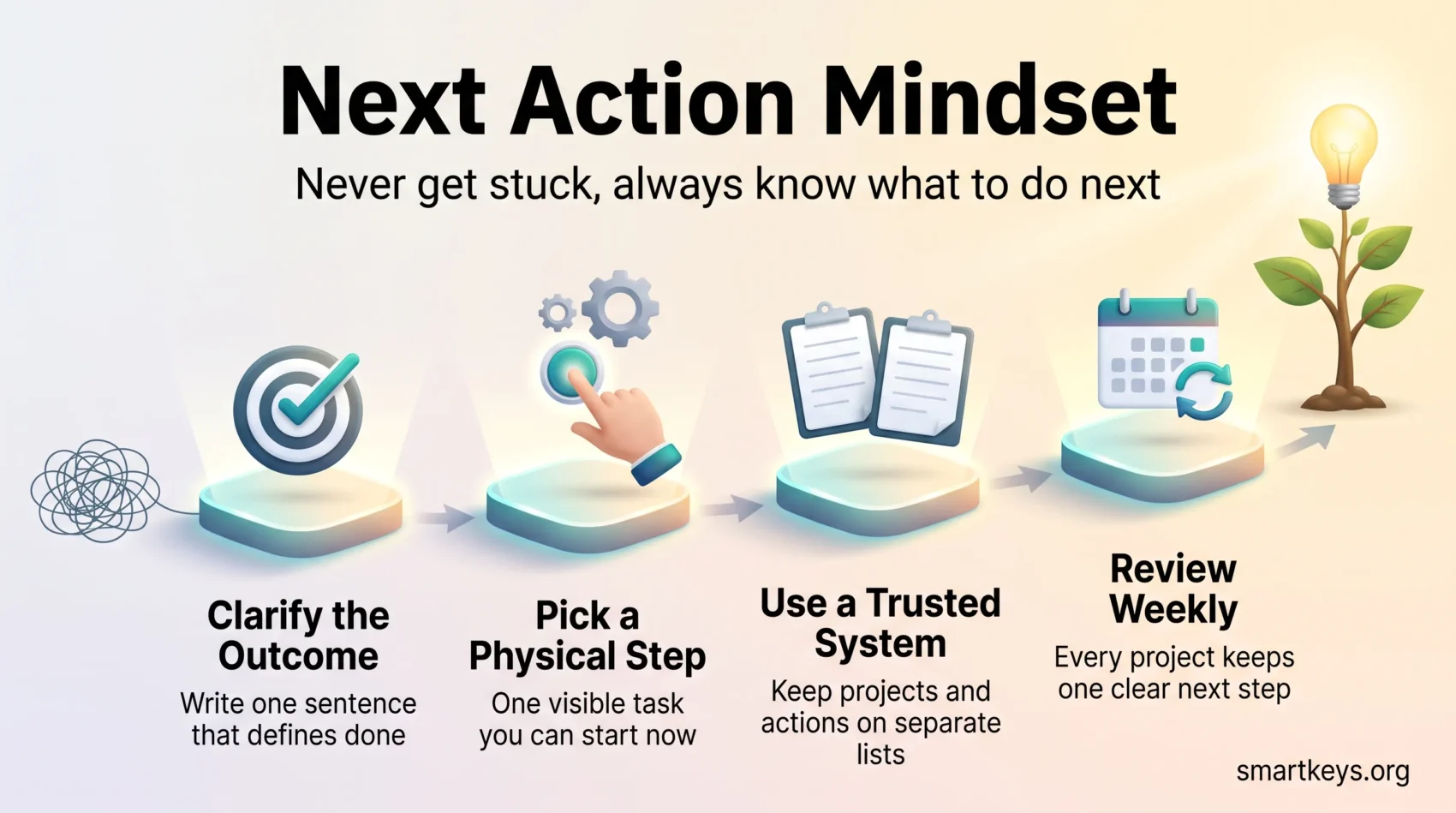
A next action is the single, concrete step you can take right now to move a project forward. You do not need every answer before you start. One clear, small step beats a vague intention every time.
Track projects and next actions on separate lists so the outcome you want stays distinct from the work that gets you there. With a trusted list of steps, your attention lands on what to do now instead of on everything still undone.
The idea comes from David Allen, author of Getting Things Done, and was later popularized by Josh Kaufman in The Personal MBA. Both make the same point: define one physical step, store it in a reliable system, and big work turns into steady progress.
Use this approach at work and at home. Whether you are planning a book, solving a stubborn problem, or clearing chores, one usable step lowers the friction of starting.
Key Takeaways
- Identify the one concrete step that helps you move forward now.
- Keep separate lists for projects and the steps that complete them.
- Small, visible steps build momentum and get things done.
- Apply the mindset to work, personal projects, or writing a book.
- Progress matters more than perfect planning; start with one clear move.
What a Next Action Is and Why It Works
When you name one visible, doable task, you turn a vague plan into instant momentum.
The definition is simple: a next action is the next physical, visible thing you can do to move a project forward. “Physical” means someone watching you could tell when it is done. “Call Jordan to confirm the launch date” qualifies. “Sort out the launch” does not.
David Allen’s process asks you to name the project, write a one-sentence outcome, capture the very next action, and store both in a system you trust. That short loop is the core of getting things done, and the next action is the smallest unit inside any task management routine.
Josh Kaufman uses the example of writing a book. “Write the book” is a project that can take years. “Draft the opening section for one hour” is a next action you can finish today. You avoid overwhelm by looking only at the step in front of you.
Why One Small Step Beats a Big Plan
The method works because it settles the part of your mind that keeps nagging about unfinished work.
Unfinished tasks keep intruding on your thinking. These are open loops: commitments your brain keeps rehearsing because they have no clear next step. In experiments published in the Journal of Personality and Social Psychology in 2011, E. J. Masicampo and Roy Baumeister found that making a specific plan for an unfulfilled goal reduced those intrusive thoughts. The goal did not need to be finished. It needed a plan.
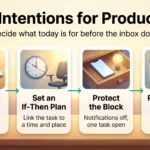
A next action is exactly that kind of plan. It also works like an “if-then” plan, which researchers call an implementation intention. An example: “When I sit down at my desk on Monday, I will call the vendor for a quote.” Peter Gollwitzer and Paschal Sheeran reviewed 94 studies of this technique in a 2006 meta-analysis and found a medium-to-large effect on goal achievement. Naming the step, and ideally the moment you will take it, makes follow-through far more likely.
The practical result is less procrastination. Much delay is the cost of deciding what to do, paid again every time you see a vague item. A next action pays that cost once.
How to Find Your Next Action, Step by Step
Begin with a short sentence that defines what “done” looks like for this project.
1. Clarify the outcome. Write one sentence that answers, “What needs to happen to mark this done?” This single line keeps the project focused and measurable. If you are not sure what belongs on the list, start with a quick brain dump of everything on your mind.
2. Choose a visible, physical task. Pick a tiny, concrete task you can complete now, such as “call vendor for quote.” Avoid vague verbs like “research” or “think.” If the step still feels fuzzy, shrink it until you could start within two minutes.
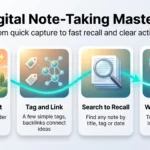
3. Record both the outcome and the task in a trusted system. Keep a project list in a note or on an index card, and your actions in a notebook or a GTD-friendly app. This separation stops planning from bleeding into doing. Writing things down the moment they appear is covered in our guide to capturing tasks.
“When you tie each task back to the outcome, progress becomes obvious and steady.”
- Organize by context (@Phone, @Computer), priority, or energy level so you pick the right item for the time you have. The Eisenhower Matrix helps if you have too many actions competing for the same hour.
- Use a quick selection method such as Mark Forster’s Autofocus: scan the list and act on whichever item stands out. That way you do not spend the morning re-ranking tasks.
- Review your lists at set times to clear completed items and confirm that each project still has one clear step. A weekly review is the usual rhythm.
For short wins, try the two-minute rule to clear simple items fast. For bigger steps, a time block on the calendar turns a next action into an appointment with yourself.
Putting Next Actions into Practice at Work and at Home
Turn broad goals into runnable steps so you can make progress during short blocks of time.
Work examples
Call the design team for the final product packaging mockup. That single task moves the project toward approval.
Schedule the stakeholder review for Tuesday at 2 p.m. A fixed meeting time lets people prepare and keeps the timeline steady.
Send the copywriter the brief and the deadline. Until that email goes out, nothing else on the campaign can start. Spotting the step that unblocks others is a fast way to prioritize.
Personal examples
Book the July 15 flight using miles. Booking now clears a big item fast.
Enroll in the online Python course by Friday. Registering locks in the commitment.
Steps like these fit into the gaps of a normal day; our guide to micro-productivity shows how to use ten spare minutes well.
Common mistakes to avoid
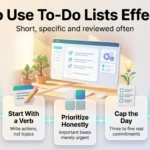
Avoid putting project names on your action list. “Website relaunch” is a project. Keep it on the project list and put only its next step, such as “email Sam the three homepage drafts,” on your action list. Our guide to using to-do lists effectively covers this split.
Ban vague verbs like “work on.” Use one precise task so you know when it is done.
Do not confuse a next action with the whole plan. You still need to break large goals into smaller steps; the next action is simply the first of those steps, kept visible. For multi-month efforts, see our guide to tackling big projects.
Short, concrete steps are also easier to estimate than large ones, which helps against the planning fallacy, the common habit of underestimating how long tasks take.
- Review your list each day to keep items fresh and to keep moving forward.
- Pick tasks that fit the available time and energy. If you want one anchor for the day, the daily highlight technique pairs well with a next-action list.
Conclusion
Close the gap between plan and progress by picking one clear, doable task for every project.
Define a next action for each active project and write it on your list. That single step makes starting immediate and removes the friction of deciding again each time you sit down. Keep projects and tasks separate, and review weekly so every project has one visible step you can complete now.
Do one action at a time, end each session by queuing the following step, and repeat. This simple playbook turns small moves into steady progress across all your projects.
Found this useful?
Make SmartKeys a preferred source on Google, and our articles will surface more often in your Top Stories, AI Overviews, and AI Mode.
Add as Preferred Source