Setting a daily intention takes about five minutes, and it changes one thing: you start the day having already decided what it is for. Instead of opening your inbox and letting the first message set your agenda, you name the outcome that matters and the way you want to work toward it.
An intention is not a to-do list and not a life mission. It is one plain sentence you write for yourself each morning, such as: “Today I finish the client proposal before lunch, and my phone stays in a drawer while I do it.”
This guide explains what daily intentions are, what the research actually supports, how to write one in five minutes, and what to do on the days it does not survive contact with reality.
Key Takeaways
- A daily intention names what you want today to produce and how you want to work, in one or two sentences.
- Goals describe a destination. Intentions describe today’s move toward it.
- The strongest evidence sits with if-then plans: deciding in advance when and where you will act.
- Writing a specific plan for an unfinished task also reduces how much that task keeps intruding on your thoughts.
- Five minutes in the morning is enough. Longer rituals are not better, they are just longer.
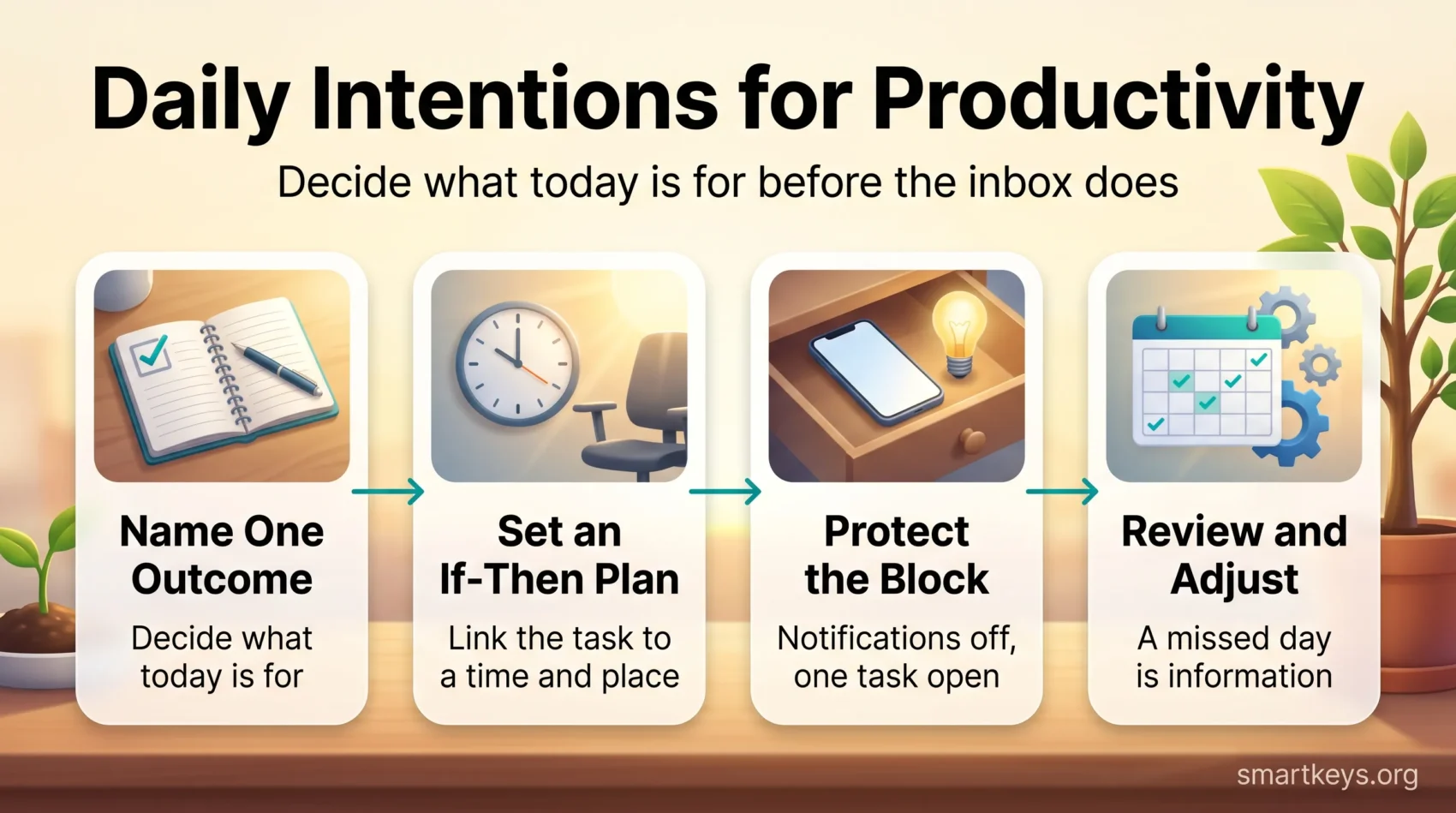
- A missed intention is information, not failure. Adjust the next one instead of dropping the habit.
What a Daily Intention Actually Is
A daily intention is a short statement, written at the start of the day, that says what you want the day to be about. It usually has two halves: the result you are aiming for, and the manner in which you want to work.
Compare three sentences about the same afternoon:
- Task: “Write the proposal.”
- Goal: “Win the client by the end of the quarter.”
- Intention: “Today I get the proposal to a first full draft, working in two uninterrupted blocks instead of picking at it between meetings.”
The task tells you nothing about how or when. The goal is too far away to act on this morning. The intention is the piece in between, and it is the piece most people skip.
That is also why intentions pair naturally with clear goal setting. Goals give the direction; intentions decide what you will do with the next eight hours.
Why a Daily Intention Changes Your Day
Most workdays are decided by whoever gets to you first. A message arrives, a colleague drops by, a notification lights up, and the morning is spent on other people’s priorities. An intention set before any of that gives you something to compare each interruption against. When you already know today is about the proposal, “can you look at this quickly?” becomes a decision rather than a reflex.

It also reduces the number of decisions you make under pressure. Choosing your most important work at 8:30, when you are calm, is a different act from choosing it at 15:00, when you are tired and three people are waiting on you. This is the same logic behind time blocking and behind the habit of tackling the hardest task first: move the hard choice to the hour when choosing is easy.
A third effect is quieter but useful. An intention gives you a way to end the day honestly. Either you did the thing you said mattered, or you did not, and you know why. That is a far more useful signal than a to-do list where nine small items are ticked and the one that counted is still open.
How Intentions Help When the Day Goes Sideways
No intention survives every day intact. Servers go down, clients call, children get sick. The point of writing one is not to guarantee the day, it is to make the recovery faster.
When you know what today was supposed to be about, you can tell the difference between an interruption that has to be handled now and one that only feels urgent. Without that reference point, everything arriving in your inbox looks equally pressing, which is one of the most reliable ways to end a busy day with nothing finished.
An intention also gives procrastination less room to operate. Putting off a vague task is easy, because there is no moment at which you are visibly not doing it. Putting off “the proposal draft, 9:00 to 10:30, at my desk” is harder to hide from yourself. If avoidance is your usual pattern, it is worth reading how to work on overcoming procrastination alongside this habit rather than expecting the intention alone to fix it.

Turning an Intention Into Focused Work
An intention only helps if it survives the walk from your notebook to your keyboard. The most reliable way to make that happen is to attach it to a specific moment.
Psychologists call this an implementation intention, which simply means an if-then plan: “If it is 9:00 and I am at my desk, then I open the proposal document and write the summary section.” The trigger does the remembering for you, so acting no longer depends on feeling motivated at the right second.
A workable version looks like this:
- Name one outcome for the day, not five.
- Attach it to a time and a place (“after my first coffee, at my desk”).
- Decide in advance what you will do when the predictable obstacle appears (“if a meeting request lands in that block, I move it to 14:00”).
- Decide what you will not do today, which is often more useful than another thing you will.
- Check in once at midday rather than constantly.
Protecting the block matters as much as planning it. An intention aimed at demanding work needs the conditions for deep work: notifications off, one task open, and a realistic length. Single-tasking during that window is not a nice extra, it is the whole point.
Connecting Intentions to Your Core Values
Intentions hold up better when they connect to something you actually care about. “Answer every email within an hour” rarely survives a difficult week. “Be the person on this team who gives clear answers” tends to, because it is tied to how you want to work rather than to a metric.
A few habits keep that connection alive:
- Write the intention down. A sentence in your head is a mood; a sentence on paper is a commitment you can check.
- Keep it visible. The top of your notebook page or a pinned note works better than an app you open twice a day.
- Include the how, not just the what. “Finish the report, without three late-night hours” is a different day from “finish the report”.
- Let it change. An intention that has been copied unchanged for two weeks has stopped being a decision.
- Review the pattern weekly. A short weekly review shows which intentions you keep writing and never meet.
That last point is where most of the value sits. One missed intention tells you very little. Five in a row that all involve the same avoided project tell you something you probably already suspected.
What the Research Actually Shows
Plenty of articles attach impressive percentages to intention setting. Most of those numbers have no traceable source. The genuine evidence is narrower, and more interesting.
The best documented finding concerns if-then plans. In a study by Peter Gollwitzer and Veronika Brandstätter, published in the Journal of Personality and Social Psychology in 1997, 86 students were asked to write a report on how they spent their Christmas holidays. Students who were also asked to specify when and where they would write it submitted the report at a rate of 71%, against 32% in the group that received only the assignment.

That single result would not mean much on its own. It holds up at scale: a 2006 meta-analysis by Gollwitzer and Paschal Sheeran pooled 94 independent studies and found a medium-to-large effect of implementation intentions on goal attainment (d = 0.65). The caveat matters too. If-then plans help you act on a goal you already want. They do not create the wanting.
There is a second finding worth knowing. Research by E. J. Masicampo and Roy Baumeister, also published in the Journal of Personality and Social Psychology (2011), showed that unfinished goals keep intruding on unrelated thinking, and that writing a specific plan for them removes most of that interference. In other words, planning tomorrow’s task does not only make it more likely to happen. It also stops the task from occupying your attention tonight.
What you will not find is credible evidence for a fixed productivity percentage from “setting intentions” in general. If a figure like that appears without a named study behind it, treat it as marketing.
Building a Five-Minute Morning Routine
The habit fails when it becomes a ceremony. Five minutes, at the same point in your morning, is enough.
Start by looking at your calendar before you write anything. There is no sense in intending to spend the morning on deep work when a two-hour workshop already owns it. Then name the one outcome that would make today count, and the block of time you will give it.
Keep the list short. One main outcome and two smaller supporting items is a realistic day for most people. If you have ever written eight things and finished two, the problem was the list, not your discipline. The same restraint applies to building a to-do list that you can actually clear, and it is the reason breaking large goals into smaller steps works so well: a step you can finish today is a step you can plan today.
Choose your slot deliberately. Many people concentrate best in the first hours after waking, which is why an early block often beats an afternoon one, but this varies enough between individuals that it is worth testing rather than assuming. If your best hours are at 16:00, plan the intention there. Anchoring the habit to an existing morning routine makes it much likelier to stick than adding it as a free-floating new task.
A short method such as the Pomodoro Technique, which alternates focused intervals with brief breaks, gives the block a shape and a natural stopping point. Which method you pick matters far less than having one.
Tools That Support Intention Setting
Paper works. So does a note app. Tools help mainly by putting the intention where you will see it during the day, and by keeping yesterday’s version available so you can spot patterns.
What to Look For
- Task managers such as Todoist or Trello: useful when your intention needs to sit next to the actual tasks it covers.
- Flexible workspaces such as Notion or Asana: worth it if you want a daily template with the same prompts every morning. Our comparison of document and database tools covers how these differ in practice.
- Your calendar: the simplest option, and often the best, because the intention lands in the same place as the block of time it needs.
How to Fit a Tool Into Your Routine
- Pick one tool and stop evaluating others for at least a month. Switching apps is the most common way this habit quietly dies.
- Put the intention where you already look every morning, not in a separate app you have to remember to open.
- Keep a visible record of the last week or two, so the pattern is available when you review.
- Review and adjust weekly. If a tool needs more than a minute of upkeep a day, it is the wrong tool.
If you are still choosing, our overview of current productivity apps compares what the main options actually include.
Tracking Whether Your Intentions Stick
Tracking turns a vague sense of “this is going well” into something you can look at. It does not need to be elaborate: a tick next to the days you met your intention is enough to reveal a pattern within two or three weeks.
Tips for Useful Tracking
- Track one thing. Whether you set an intention, or whether you met it. Not both, and not six other habits alongside.
- Make it quick. If logging takes longer than ten seconds, you will stop.
- Record the misses too. A record that only shows good days teaches you nothing.
- Read it weekly, not daily. One day means nothing; ten days means something.
- Note the reason. Two words next to a missed day (“meeting overran”) is where the useful information lives.
Ways to Track
- Paper: a column in your notebook or a printed month grid. No setup, no notifications, no subscription.
- Color coding: marking met and missed days in two colors makes weeks readable at a glance. Our guide to color coding for organization covers how to keep such systems simple.
- Habit apps such as Streaks, Habitica, HabitNow or Way of Life: helpful if reminders and streaks motivate you, and a source of guilt if they do not. See our guide to choosing a habit tracker before you commit to one.
- A short written log: one line a day. If you already keep a productivity journal, the intention belongs at the top of the same page.
Whatever you choose, treat streaks with care. A broken streak is a reason to write tomorrow’s intention, not a reason to conclude the habit has failed.
Intentions and the Line Between Work and Life
An intention does not have to be about output. Some of the most useful ones are about limits: “Today I stop at 18:00”, or “Today I do not open Slack after dinner.”
These work for the same reason work intentions do. The decision is made in advance, at a moment when you are not tired and nobody is waiting on you. At 18:00, with one more thing you could finish, you are in a poor position to decide whether to keep going. At 8:30 you were not.
Two things make this more likely to hold:
- Name the specific boundary rather than the feeling. “Laptop closed at 18:00” beats “have better balance”.
- Decide the exception in advance. “If a release is broken, I stay; otherwise I stop.” Without that, every evening becomes a fresh negotiation.
Our guide to setting boundaries at work covers the conversations that make such limits stick with colleagues, which is usually the harder half.
Where to Start Tomorrow
Daily intentions are a small habit with a specific job: to make sure the first decision of your workday is yours. They will not fix an impossible workload, and they are not a substitute for real prioritization when everything genuinely is urgent.
What the evidence supports is narrower and more dependable than the usual claims. Deciding in advance when and where you will act makes acting substantially more likely, and writing that plan down clears the task out of your head in the meantime.
So tomorrow morning, before the inbox, write one sentence: what today is for, and when you will do it. Then check at the end of the day whether it happened. That single loop, repeated, is the whole practice. If keeping it up is the part you struggle with, our guide to staying motivated through the workday goes into what helps when the habit gets dull.
Found this useful?
Make SmartKeys a preferred source on Google, and our articles will surface more often in your Top Stories, AI Overviews, and AI Mode.
Add as Preferred Source