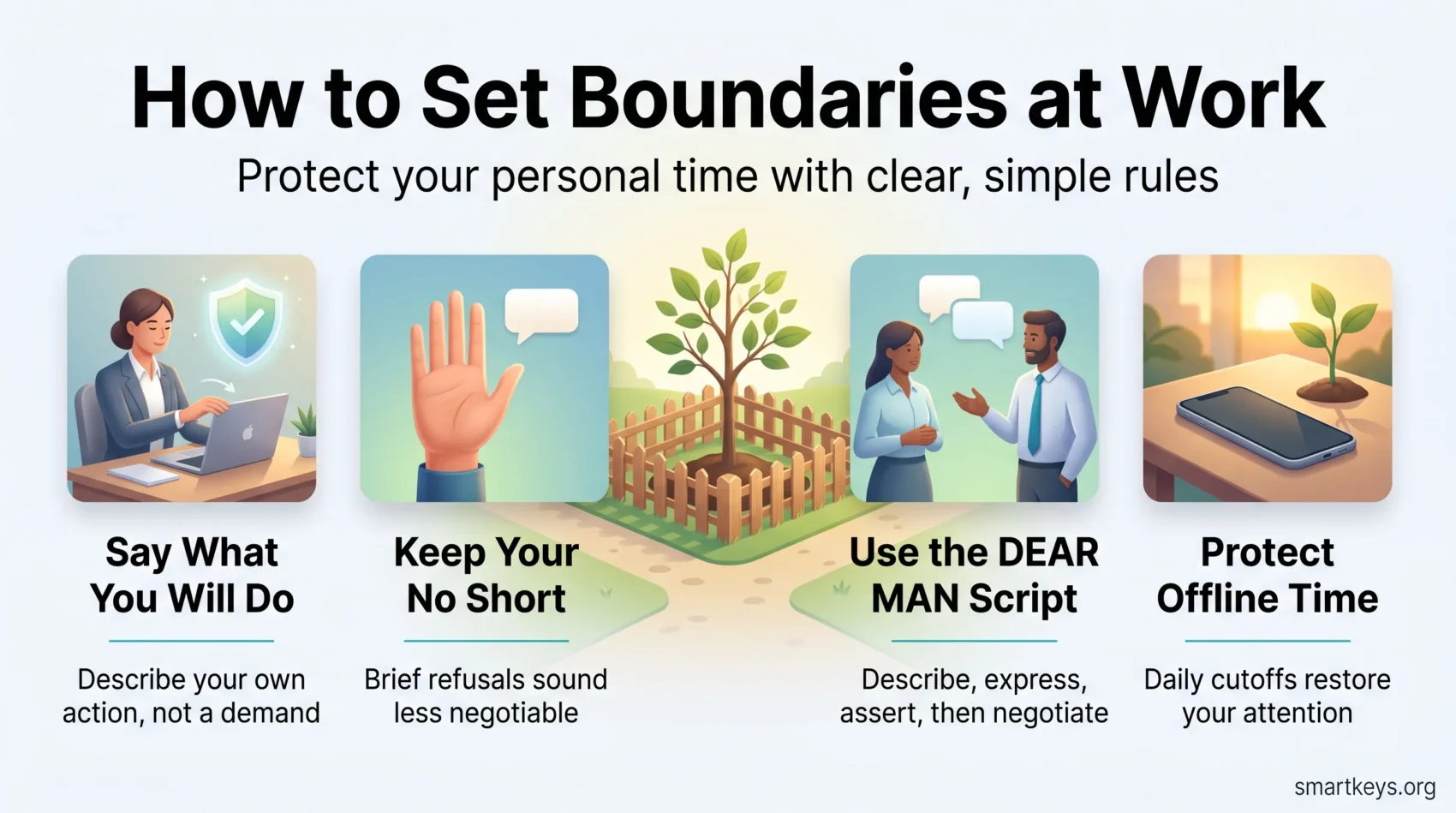
A boundary is a rule you set for your own behaviour, not a rule you impose on other people. “I stop answering messages after 6 p.m.” is a boundary. “Stop messaging me in the evening” is a demand. The first one you can keep on your own.
That difference matters at work. Most of the pressure on your time is not malicious. Colleagues message when it suits them, clients ask because asking is free, and family interrupts because you are there. Without a rule you decided in advance, every request gets answered on the spot.
This guide covers how to word a boundary so it lands, how to use a script called DEAR MAN at work, what the law now says about after-hours contact, and how to hold a limit at home without a fight. If you want the wider view first, our guide to where work-life balance is heading covers the trends behind all of this.
Key Takeaways
- State a boundary as what you will do, not what someone else must stop doing.
- Every yes spends attention you cannot get back, so decide in advance what to protect.
- Short refusals work better than long explanations, at work and at home.
- Protected offline time restores the attention focused work depends on.
- In Australia and France, employees have a legal right to disconnect after hours.
Why Protecting Personal Time Makes You Better at Work
Attention is the resource your work runs on, and it does not refill just because you are still at your desk.
Every Yes Costs You Something
Saying yes to a call or a “quick question” costs more than the minutes it takes. It costs the context switch and the time needed to get back into what you were doing. That is why a day of small agreements feels exhausting and produces little.
Treat your first working hour as an asset, not a leftover. Keep the phone out of reach until one real piece of work is done. A deliberate morning routine gives that hour a repeatable shape.
How Constant Availability Breaks Deep Work
Cognitively demanding work needs uninterrupted stretches. That is the core idea behind deep work, and the first casualty when you are reachable on four channels at once.
Constant availability is rarely a decision. It is usually an accident: notifications left on by default, a status light showing you are online, a habit of replying within seconds. Each is fixable, and managing work notifications deliberately removes most interruptions before they reach you.
Recurring negative conversations drain attention the same way. Ten minutes of complaining in the car park keeps you chewing on the problem afterwards.
“You will protect what you actually value. Everything else gets spent by default.”
The Three Rules That Make a Boundary Stick
Limits set with respect guide a relationship rather than control it. Three habits do most of the work.
Say What You Will Do, Not What Others Must Do
Use action language. “I am unavailable after 6 p.m.” describes your own behaviour, so it does not read as an accusation. Compare it with “you need to stop emailing me late”, which invites an argument about whether the emails were reasonable. Set one rule at a time. If people can repeat your boundary back in a sentence, it will survive a busy week.
Say No Briefly, Without a Long Defence
Long explanations sound negotiable, because each extra reason hands the other person something to argue with. “I cannot take that on this month” is complete. Add one alternative if it helps, then stop.
Our guide on how learning to say no boosts productivity has more wording you can borrow. If the request is really a workload problem, delegating it properly is the more honest answer.
Protect the Start and the End of Your Day
Two windows carry most of the value: the first hour of work and the last hour before bed. Block them and treat them as appointments rather than intentions. An evening routine makes the cutoff easier to keep, because there is a clear signal that work has ended. Expect some awkwardness at first. People adjust to a consistent rule far faster than an inconsistent one.
How to Set Boundaries at Work With DEAR MAN
DEAR MAN is a scripting tool from dialectical behaviour therapy (DBT), a structured form of talk therapy that teaches specific interpersonal skills. The letters stand for Describe, Express, Assert, Reinforce, then stay Mindful, appear Confident and Negotiate. You do not need to be in therapy to use it. It is simply a reliable order for a difficult conversation, and it starts with asking permission: a short “can I raise something?” lowers resistance more than any wording that follows.
Describe and Express
Open with a neutral observation, no judgement attached: “I have noticed that when we walk out to the cars, we usually end up talking about work problems.”
Then add one feeling statement: “I feel drained by that, because I am trying to switch off.” One sentence is enough. A longer emotional case shifts the conversation onto whether your feelings are justified.
Assert and Reinforce
State the request in a single sentence: “I would rather we talked about something else on the way out.” Follow it with the benefit for both of you: “We would both leave in a better mood.” Reinforcing is not flattery. It answers the unspoken question of why the other person should agree.
Mindful and Negotiate
Staying mindful means returning to your point rather than following every tangent. If the reply is a counterargument, acknowledge it briefly and repeat the request in the same calm words.
Then offer room to move. A five-minute venting slot, agreed in advance, is easier to accept than a blanket ban.
A Sample Script for Redirecting Constant Complaining
“Can I raise something? I have noticed our walk to the car usually turns into a list of everything wrong with the project. I feel drained by it. Could we swap it for one good thing from the day? If we slip back, I will change the subject.”
- Ask first: permission reduces defensiveness.
- Watch the delivery: a calm voice carries as much weight as the words.
- Rehearse: ready replies stop you improvising under pressure.
What the Right to Disconnect Actually Gives You
After-hours boundaries are no longer only a personal preference. Some countries now treat them as an employment right.
In Australia, the right to disconnect took effect for non-small-business employers on 26 August 2024 and for small business employers on 26 August 2025. It lets an employee refuse to monitor, read or respond to contact from an employer or a third party outside working hours, where that refusal is reasonable (Fair Work Ombudsman). France went earlier: since 1 January 2017, companies above a set headcount must negotiate the terms of the right to disconnect with staff representatives.
The point is not that you can ignore your job. It is that asking to switch off in the evening is a normal workplace conversation. Our guide to the right to disconnect covers how these rules work in practice. Where no such law applies, a team norm does the same job: written response-time expectations, plus one channel kept for genuine emergencies.
Distributed teams need this most, because no building empties out at six to mark the end of the day. Clear remote work habits and a shift toward asynchronous work protect evenings better than willpower does.
Protect Your Personal Time: Unplug, Rest and Recover
Deliberate offline time is what makes the focused time work. It is easier to defend once you treat it as part of the job, not a reward for finishing it.
Offline Blocks and End-of-Day Cutoffs
Pick one recurring offline block and one daily cutoff time. Turn off nonessential alerts, set Do Not Disturb during focused work, and leave a single channel open for real emergencies.
Two changes remove most of the remaining pressure. Batch your messages instead of checking continuously; email batching is the simplest version. And agree explicit expectations for chat, because instant messaging boundaries usually decide whether an evening stays yours. A team-wide focus time policy makes that protection official rather than personal.
Rest Is Not Something to Apologise For
Downtime is not the absence of work. It is the part of the cycle where attention recovers. Put it in the calendar and protect it like a meeting.
Short recovery matters as much as long. Regular short breaks hold up attention across a day, structured downtime gives the brain room to connect ideas, and consistent sleep outperforms almost every productivity technique going. If you are already running on empty, read burnout prevention and stress management rather than another scheduling method.
Try one new boundary for seven days. One rule kept for a week teaches you more than five abandoned on day two.
Boundaries at Home That Protect Your Workday
A chaotic morning at home follows you into your first meeting. Predictable household rules protect the first working block without raised voices.
Predictable Rules Beat Loud Ones
Young children are still developing impulse control, so adults supply the structure meanwhile. The job is to be consistent, not strict. Calm, specific phrasing does most of the work: “I will not let you pull the cat’s fur. Let’s practise soft hands.” A two-minute warning before a transition, followed through gently, prevents most of the resistance.
Say What to Do, and Keep the List Short
A stream of refusals gives a child nothing to act on. Name the behaviour you want instead: “toys stay in the tub”, “shoes by the door”. Then choose a few high-impact limits, such as screen time and bedtime, and apply them consistently. Acknowledge the feeling before you hold the line. “I know you are upset about this” costs nothing and defuses a lot.
Timers and visible checklists turn rules into habits, which is what eventually buys you an uninterrupted work block. Our guide for working parents covers the scheduling side, and home office setup covers the physical separation that makes a closed door mean something.
Setting Boundaries With Friends and Family Who Drain Your Energy
You are not obliged to absorb other people’s tension. When a conversation becomes the same complaint for the fifth time, a short, kind redirect ends the loop without ending the relationship.
Keep the pivot simple: “I am not up for talking about this tonight. How did the trip go?” If the topic returns, leave the conversation rather than repeating yourself. For late-night messages, one clear reply beats a slow fade: “I am with my family this evening and will not be on my phone. Let’s catch up at the weekend.” Short replies are not cold. They teach people how you operate.
- Have two or three prepared lines ready so you are not composing them while tired.
- Decide in advance what you will do if someone ignores the limit, then do it.
- Assume good intent in your wording while still holding the line. The two are compatible.
Protecting your evenings shapes the next working day, a link explored further in our piece on remote work and mental health.
Start With One Boundary This Week
Pick one thing to protect: your first working hour, your evenings, or one recurring conversation. Write the exact sentence you will use, then use it word for word the first three times. Improvising under pressure produces the long, apologetic explanations you were trying to avoid.
It will feel awkward at first, which is normal rather than a sign it is going badly. People adjust to consistency, and within a few weeks a boundary becomes simply how you work.
Found this useful?
Make SmartKeys a preferred source on Google, and our articles will surface more often in your Top Stories, AI Overviews, and AI Mode.
Add as Preferred Source