A successful morning routine is not a personality test and it is not a productivity hack you either have or lack. It is a small set of decisions you make once, then stop making every day. That is the whole mechanism: the fewer choices your first hour demands, the more attention is left for the work that actually matters.
This guide covers ten morning routines worth trying, what the research does and does not support about each, and how to build a version that survives a real week rather than an ideal one.
Key Insights
- 30.5% of US adults slept less than seven hours a night in 2024, according to the CDC’s National Center for Health Statistics.
- Sleep timing matters as much as sleep length: a 2021 JAMA Psychiatry analysis linked a one hour earlier sleep midpoint to a 23% lower risk of major depression.
- Hitting snooze is less harmful than its reputation suggests. A 2024 Journal of Sleep Research study found 30 minutes of snoozing did not worsen sleep or morning cognition.
- Exercise timing is largely a preference question. A 2023 randomized trial in Obesity found no meaningful weight-loss difference between morning and evening training.
- Mild dehydration measurably affects mood and attention, which is why a glass of water on waking is one of the cheapest wins available.
- Preparation the night before removes decisions from the morning, when willpower and time are both scarce.
- Consistency beats elaboration. A short routine you repeat daily outperforms a 90 minute ritual you abandon in week two.
Morning Routines Explained in 6 Minutes (Video)
Prefer to watch? In just 6 minutes, this video shows you which morning habits actually work, which ones are myths, and how to build a routine that fits your day.
Why Morning Routines Work
Effective morning routines do one useful thing above all others: they convert decisions into defaults. Deciding whether to exercise, what to eat and what to work on first costs attention every single time. A routine settles those questions in advance, which is why a structured first hour tends to feel calmer even when it contains more activity.

The second effect is momentum. Finishing something small and concrete before the day’s demands arrive gives you evidence that the day is going your way. That is not a mystical claim: it is the same reason breaking large goals into smaller steps keeps projects moving. Early completion builds self-efficacy, your belief that effort will produce a result, and self-efficacy is one of the better predictors of whether you persist when work gets hard.
Third, mornings are usually the least contested part of the day. Meetings, messages and other people’s priorities have not arrived yet. If you want a protected block for deep work, the hour after you get up is often the only one nobody else is bidding for.
What the evidence does not support is a single correct routine. Claims that early risers earn more, or that a specific 60 minute sequence produces specific gains, do not hold up when you look for the underlying study. Treat published routines as a menu, not a prescription.
How Sleep Shapes Your Morning Performance
Nothing in your morning routine compensates for a short night. The CDC’s National Center for Health Statistics reported that 30.5% of US adults slept less than seven hours in a 24 hour period in 2024, with the highest rate among adults aged 50 to 64. Insufficient sleep reduces attention, slows reaction time and makes emotional regulation harder, all of which show up as a rough morning regardless of what you do after the alarm.
Timing matters alongside duration. A 2021 Mendelian randomization study published in JAMA Psychiatry found that a sleep midpoint one hour earlier was associated with roughly a 23% lower risk of major depressive disorder. That is an association from genetic data rather than proof that setting an earlier alarm treats depression, but it does suggest sleep schedule is worth taking seriously rather than treating as a residual.
A few practical sleep habits are worth protecting:
- Keep a consistent bedtime and wake time, including at weekends. Your body responds to regularity more than to any single early night.
- Keep the bedroom cool and dark. Most sleep guidance points to the mid-60s Fahrenheit, roughly 18 to 19 degrees Celsius.
- Move screens and stimulating work out of the last hour before bed. A short evening routine does more for your morning than an earlier alarm does.
- Treat caffeine as having a long tail. An afternoon coffee is still active in your system at bedtime.
If you are consistently exhausted, fixing sleep is the highest-leverage change available, and sleep quality feeds directly into daytime output. Everything below assumes you are not fighting a chronic deficit.
Top Morning Routines for Enhanced Productivity
Creating a productive morning starts the night before. The morning is a bad time to make decisions: you are groggy, you are often rushed, and the cost of a wrong choice compounds across the day. Move as many decisions as you can to the previous evening.
1. Get Ready the Night Before
Laying out clothes, packing a bag, prepping breakfast and writing tomorrow’s short list all take five minutes in the evening and save considerably more in the morning. The point is not the time saved. It is that you wake into a decided day rather than an undecided one.
Keep the list short. Three items is usually right, and the 1-3-5 rule gives you a workable shape if you want more structure. A list you can finish is a list you will trust tomorrow.
2. Decide What to Do About the Snooze Button
The advice to never snooze is more confident than the evidence. A 2024 study in the Journal of Sleep Research examined habitual snoozers and found that 30 minutes of snoozing did not worsen sleep quality or morning cognitive performance, and in some tests participants did slightly better on waking. Snoozing did shorten total sleep slightly.
The useful conclusion is not “snooze freely” but “stop treating snoozing as a moral failure”. What consistently helps is a stable wake time and a reason to get up. If snoozing has turned into 45 minutes of half-sleep and a rushed start, move the alarm across the room and give yourself a first action you actually want to do. If ten minutes of dozing helps you wake up civil, the research does not say you are sabotaging your day.
If you do want to move your wake time earlier for good, shift it gradually. Set the alarm two minutes earlier every three days until you reach the time you want. Jumping straight to 45 minutes earlier usually just costs you 45 minutes of sleep, because your bedtime does not move with it.
3. Get Light and Movement Early
Daylight is the strongest signal your body clock receives. Getting outside shortly after waking, even for a few minutes, helps anchor your sleep timing and tends to make the following evening’s bedtime easier to hit. A short walk combines this with movement, which is worth more first thing than most people expect.
Hydration: The Simplest Morning Win
You wake up mildly dehydrated after six to eight hours without fluid, and mild dehydration is one of the few things with a clear, measured effect on how you feel. Controlled studies have found that even small fluid deficits affect mood, perceived effort and sustained attention in healthy adults. A glass of water on waking is not a metabolism trick, but it does remove a real and avoidable handicap.

Make it automatic rather than aspirational. Keep the glass or bottle where you will see it before you see your phone, and the habit stops requiring willpower after a week or two. This is habit stacking in its simplest form: attach the new behaviour to something you already do without fail.
Some practical notes on morning hydration:
- Fill the glass the night before and put it beside your bed or your kettle.
- Lemon or cucumber makes water more pleasant to drink, which is the only reason it helps. It is not a detox.
- Coffee counts toward fluid intake, but it is not a replacement for the first glass of water.
- If you sweat heavily overnight or train early, add a pinch of salt or an electrolyte tab. Most people do not need to.
Then comes the coffee, and one popular rule about it is worth a closer look. You have probably read that you should delay your first cup by 90 minutes because of your cortisol curve. There is no direct evidence for it. The University of Arizona’s Department of Psychiatry notes that little research sits behind the claim and that no study has established an optimal time. The theory concerns adenosine, a molecule that builds up while you are awake and makes you feel sleepy, and which is at its lowest right after you wake. That is plausible, not proven. Treat the delay as a preference to test for a week, not a rule you owe anyone.
Mindfulness and Meditation for Clarity
Setting aside a few quiet minutes before the day starts gives you something the rest of the day rarely offers: a moment where nothing is being asked of you. Meditation research is mixed in quality, but the consistent findings point toward modest improvements in stress and attention with regular practice, not dramatic transformation. Treat it as maintenance rather than a breakthrough, and it becomes much easier to keep up. A short daily sit beats an occasional long one, and even brief meditation sessions have measurable value.
4. Simple Breathing Exercises
If sitting still feels pointless, start with breathing instead. Two minutes of slow exhales, longer out than in, reliably shifts how activated you feel. It requires no app, no cushion and no belief system. Several structured breathing techniques exist, but the core instruction is simply to make the out-breath longer than the in-breath and repeat.
5. Set an Intention, Not Just an Affirmation
Affirmations get mixed results in the research, and they backfire for people with low self-esteem, who tend to reject statements that clash with what they believe about themselves. Setting an intention works better for most people because it is falsifiable: “I will finish the draft before my first meeting” is something you can actually check at lunchtime. Writing a daily intention takes under a minute and turns a vague good mood into a specific target.
Fuel Your Day with a Breakfast That Suits You
Breakfast advice is unusually noisy, partly because a lot of it originates with companies selling breakfast. What holds up is narrower than the headlines: eating in the morning helps if you are hungry, blood sugar swings make concentration harder, and meals built on protein, fibre and healthy fats keep you steadier than refined carbohydrates alone. These nutrients support cognitive function and steady energy through the morning.
Practical options that hold up until lunch:
- Oats with Greek yoghurt and berries
- Eggs with spinach on wholegrain toast
- Tofu scramble with vegetables
- Chia pudding made with milk or a fortified alternative
If you genuinely are not hungry in the morning, forcing breakfast has no clear benefit. The evidence for skipping breakfast being harmful in otherwise healthy adults is weaker than commonly claimed. What does hurt is skipping it, running on coffee and then crashing at eleven. Notice which pattern you are actually in, and let that decide rather than a rule you read somewhere. Tracking energy for a week using an energy management lens tells you more than any general guideline.
Exercise in the Morning: What Actually Matters
Morning exercise has one genuine advantage: it happens. Later in the day, work overruns, plans change and the session quietly disappears. If mornings are the slot you reliably protect, that alone is a strong argument.
What is not supported is the idea that morning training is metabolically superior. A 2023 randomized controlled trial published in Obesity compared morning and evening aerobic exercise in adults with overweight or obesity and found comparable weight loss in both groups, around 2.7 kg and 3.1 kg respectively, with no meaningful advantage either way. The researchers concluded there does not appear to be an optimal time to exercise. Consistency is the variable that moves results.
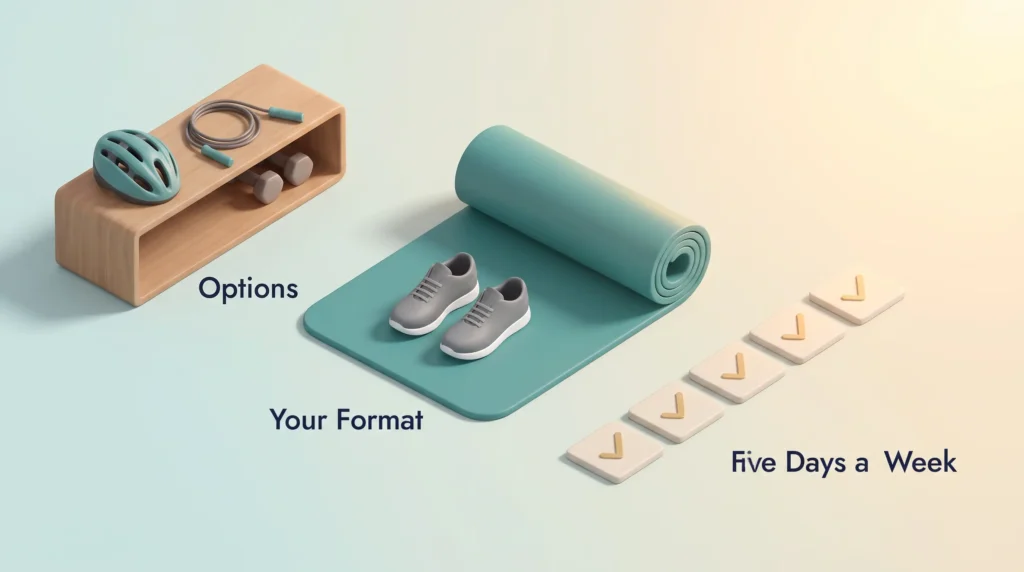
6. Choose the Format You Will Repeat
- Walking or jogging: the lowest barrier to entry, and easy to combine with morning daylight.
- Cycling: good for endurance and an easy commute substitute.
- Yoga or mobility work: useful if you sit for most of the day, and gentler on a stiff body first thing.
- Interval training: effective and time-efficient, though demanding on little sleep.
- Bodyweight circuits: no equipment, no travel, no excuse on a busy morning.
Start smaller than feels impressive. Ten minutes you do five days a week beats an hour you manage twice a month, and it is far easier to build on.
How Morning Routines Influence Daily Habits
A morning routine is a small system that makes other systems easier to run. Once the first hour is settled, the habits attached to it tend to stabilize too, which is why the morning is a good place to install a behaviour you have failed to establish elsewhere.
Three additions carry more weight than the rest:
- 7. Journal briefly. Five minutes of writing clears the mental queue and surfaces what is actually bothering you. Journaling for productivity works best when it is short and specific rather than expansive.
- 8. Name the day’s highlight. Pick the single thing that would make the day a success. The daily highlight technique is deliberately narrow, and that is why it works.
- 9. Delay your inbox. Opening email first hands your priorities to whoever wrote to you overnight. Even 30 protected minutes changes what the day is about. Time blocking makes that protection concrete.
Habits take time to settle, and the research on how long varies widely by person and behaviour. Expect weeks rather than days, and expect missed mornings. Building in flexibility is what keeps a bad Tuesday from ending the whole routine, and micro-habits are the most forgiving format when your schedule is unpredictable.
Whatever you add, keep a simple record of whether you did it. Marking a box on paper or in a habit tracker turns a vague sense of how the week went into something you can actually read. It also protects you from your own memory, which tends to over-weight the mornings that fell apart. Change one variable at a time, the order or the wake time or the length, so you can tell which change did the work.
Additional Morning Routine Ideas to Explore
Once the basics hold, these are worth testing one at a time:
- Ten minutes of reading: a slower, more deliberate input than a feed, and easier to sustain than it sounds.
- A short creative activity: sketching, an instrument, anything with no output requirement.
- Listen while you move: a podcast or audiobook during a walk or commute makes the habit more appealing without adding time.
- Practice gratitude journaling: naming two or three specific things works better than listing generic ones.
- Time outdoors: daylight, movement and a change of scene in one, and the easiest habit to attach others to.
- A phone-free first 30 minutes: the single change most people report as making the largest difference. A wider social media detox is optional; protecting the first half hour is not.
Add one at a time. Stacking five new behaviours at once is the most common way morning routines collapse in the second week.
10. Build the Routine That Fits Your Chronotype
The last routine is the one that makes the other nine work: match the plan to how you actually function. Chronotype, your natural tendency toward earlier or later timing, varies substantially between people and shifts with age. Forcing a 5 a.m. start on a genuine late type usually produces a shorter night rather than a more productive day.
If you are sharpest at 10 a.m., protect 10 a.m. rather than trying to manufacture a heroic dawn. The value of a morning routine is the structure and the protected attention, not the hour on the clock. Pair it with clear goals and a habit of weekly planning, and the routine has something to serve.
Three Templates You Can Copy
Most routines fail on arithmetic rather than on motivation. Writing the time budget down is what exposes the problem. Use these as starting points and change the numbers to fit your morning.

The full version, about 90 minutes
- 10 minutes: wake, water, daylight
- 20 minutes: movement
- 10 minutes: journal or read
- 20 minutes: breakfast
- 25 minutes: wash and dress
- 5 minutes: buffer
The family version, with margin built in
With children in the mix, plan for the interruptions rather than pretending they will not happen.
- 10 minutes: wake and stretch
- 10 minutes: quiet reading before anyone else is up
- 30 minutes: family breakfast
- 40 minutes: get everyone ready
- 10 minutes: buffer
The compressed version, 25 minutes
- 2 minutes: water and daylight
- 5 minutes: movement
- 3 minutes: write down the day’s one outcome
- 15 minutes: wash, dress, eat something with protein in it
Time your own version once before you commit to it. Most people underestimate what their morning actually takes by about ten minutes.
The five-minute version for bad days
Some mornings collapse. A short fallback is what keeps one bad day from ending the habit altogether. Drink a glass of water, open the blinds or step outside, and write one line naming the most important thing you have to do. That is the whole thing, and its purpose is continuity rather than benefit. Decide what your fallback looks like before you need it, and count running it as a success rather than a compromise.
Conclusion
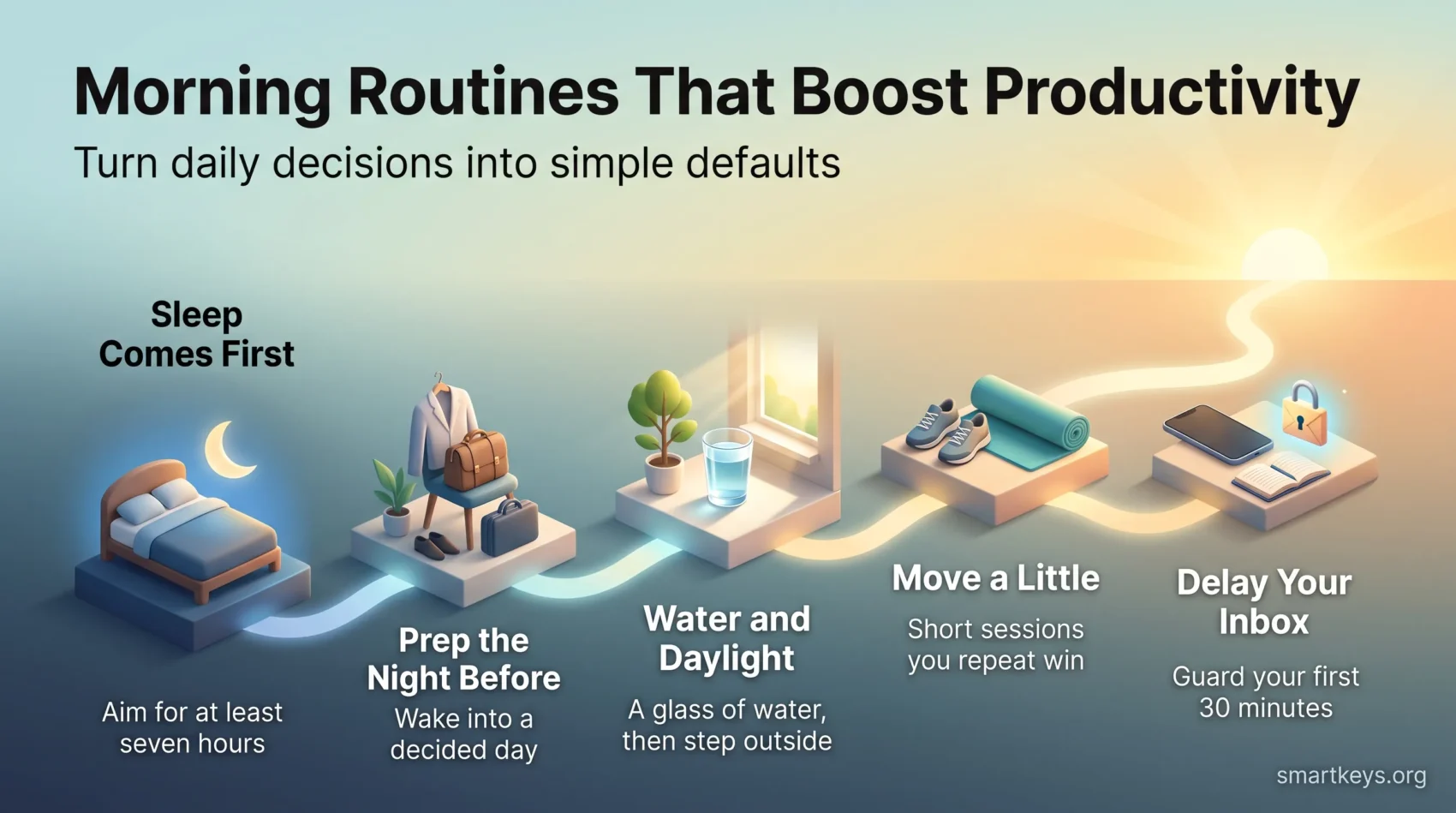
A morning routine is worth building because it removes friction, not because it is virtuous. Sleep first, since nothing else compensates for a short night. Then decide the night before, drink water, get some light, move a little and protect the first half hour from other people’s priorities.
Keep it small enough to repeat on a bad week. Drop anything you are only doing because you read about it. The routine that survives is the one worth having, and it will look different from anyone else’s.
Listen to the Podcast Episode
Found this useful?
Make SmartKeys a preferred source on Google, and our articles will surface more often in your Top Stories, AI Overviews, and AI Mode.
Add as Preferred Source