You can get more done by matching your hardest work to the hours when your brain is actually sharp. That is the whole idea behind energy management: stop treating every hour on your calendar as equal, and start scheduling around your natural highs and lows.
The concept goes back to Tony Schwartz and Catherine McCarthy’s 2007 Harvard Business Review article “Manage Your Energy, Not Your Time.” Nearly two decades later, the core argument still holds, and the science of body clocks behind it has become far more practical.
Here is what changed recently. The Wharton Neuroscience Initiative, led by Michael Platt and Elizabeth Johnson, worked with the consulting firm Slalom on neuroscience-informed scheduling: booking meetings around when the people in the room are naturally alert. Wharton has since published a free tool, When2DoWhat, that combines meeting type, each participant’s body clock and time zone to suggest better slots. One documented rollout at the pharmaceutical company Takeda reported improvements of 11 to 25 percent in employee experience scores (Wharton Executive Education, June 2026). Timing is moving from self-help advice to a scheduling practice companies actually run.
This guide shows how to map your energy curve in one week, protect your best hours, and scale the same logic to your team.
Key Takeaways
- Track your alertness for one week to find your real peak, trough, and recovery windows.
- Protect one 90-minute peak block per day for your single most important task.
- Move email, admin, and status updates into your afternoon trough.
- Schedule creative and analytical work at different times, because they peak differently.
- Evening types are a large minority; a blanket 9 a.m. deep work rule fails them.
- Teams that schedule around shared energy windows spend less time redoing work.
- Timing only pays off if you refill your energy: body, emotions, mind, and sense of purpose all count.
Why Aligning Tasks With Your Energy Peaks Actually Works
Two internal clocks shape how alert you feel. The first is your circadian rhythm, the roughly 24-hour cycle that decides when you feel awake and when you feel sleepy. Light sets it: morning daylight pulls it earlier, bright screens at night push it later.
Layered on top are ultradian rhythms, shorter waves of about 90 to 120 minutes that repeat throughout the day. Sleep researcher Nathaniel Kleitman first described them as the Basic Rest-Activity Cycle. They are why concentration tends to fade after an hour and a half, whatever the clock says.
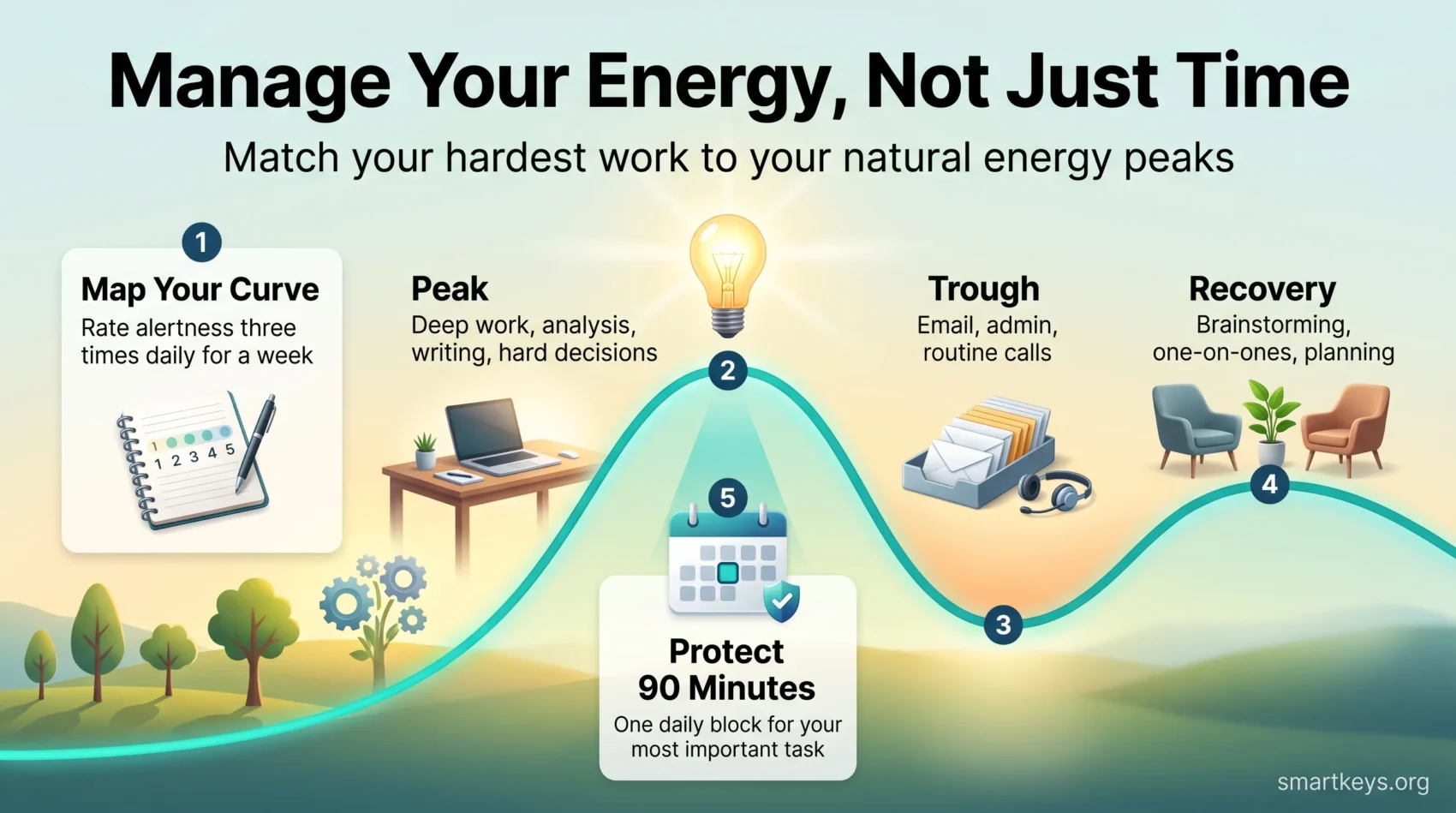
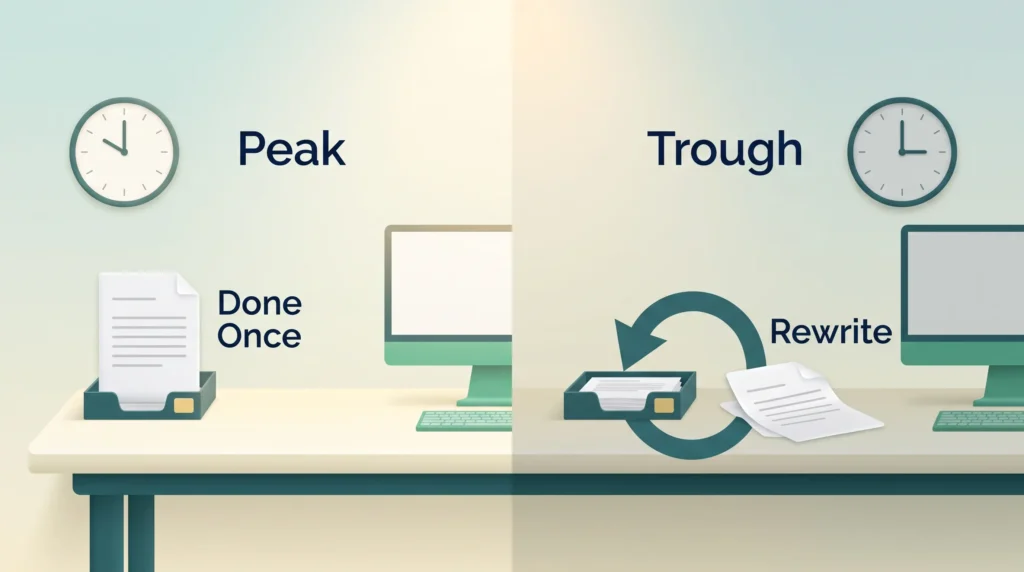
Together, these two produce a predictable daily shape: a peak, a trough, and a recovery window. Most people hit their sharpest analytical window in the late morning, dip in the early-to-mid afternoon, and get a second, softer lift in the early evening.
Here is what that means on a normal Tuesday. Write the client proposal at 10 a.m. and you finish it in one sitting. Write the same proposal at 3 p.m. and you produce something you have to rewrite tomorrow morning, which quietly eats the next day’s best hours. The real gain is not raw speed. It is work you do not have to do twice.
The task-to-energy matrix
- Peak: complex analysis, writing, strategy, hard decisions, difficult conversations. This is where your one deep work session belongs.
- Trough: email, expense reports, scheduling, file cleanup, routine calls.
- Recovery: brainstorming, one-on-ones, planning, learning, loose creative exploration.
One useful wrinkle: analytical work and creative work do not peak at the same time. Convergent thinking, narrowing options down to one right answer, benefits from your alertness peak. Divergent thinking, generating lots of options without judging them, often works slightly better off-peak, when your mental filter is looser. If you write and edit, that suggests a simple split: draft in the softer window, edit when you are sharpest.
Find Your Chronotype Before You Redesign Your Day
Do not copy someone else’s 5 a.m. routine. Your chronotype is simply your personal setting on that 24-hour clock: whether you naturally run early, late, or somewhere in between. It decides where your windows actually fall.
This is not a preference you can willpower away. A study of 1,293 employed adults in Poland, published in BMC Psychology in March 2026, found that evening types reported lower work ability than morning types, and that burnout explained roughly a quarter of that gap. The effect showed up in shift and day workers alike. The likely mechanism is social jet lag: a standing mismatch between the clock on the wall and the clock in your body, which costs sleep and builds up as fatigue. Forcing a night owl into a 9 a.m. deep work block is not discipline. It is friction, and over months it shows up as burnout risk.
The one-week energy audit
- Rate yourself three times a day. Mid-morning, mid-afternoon, and evening, score your alertness from 1 to 5 in a note or a spreadsheet.
- Log what you did. One line. “Wrote proposal.” “Cleared inbox.”
- Note the friction. Mark anything that felt harder than it should, and anything that left you with more energy than before.
- Check your free days. When do you naturally wake and sleep with no alarm? That is your strongest chronotype signal.
- Look for the shape. After five to seven days, the pattern is usually obvious.
If you would rather have a validated measure than your own observations, the Morningness-Eveningness Questionnaire (MEQ) is the standard instrument in body-clock research. It takes about five minutes and places you on a scale from strongly morning to strongly evening.
One caution: a genuine energy dip and simple sleep debt feel identical from the inside. If your whole curve is flat, rescheduling will not fix it. Start with sleep and recovery, then map your peaks.
Build the Schedule: Protect One Block, Then Expand
Start with a single recurring block, not a full redesign. Put a 90-minute appointment in your calendar inside your peak window, name it after your most important project, and treat it like a client meeting. If you cannot name the one task that belongs in it, that is a prioritization problem rather than a scheduling one.
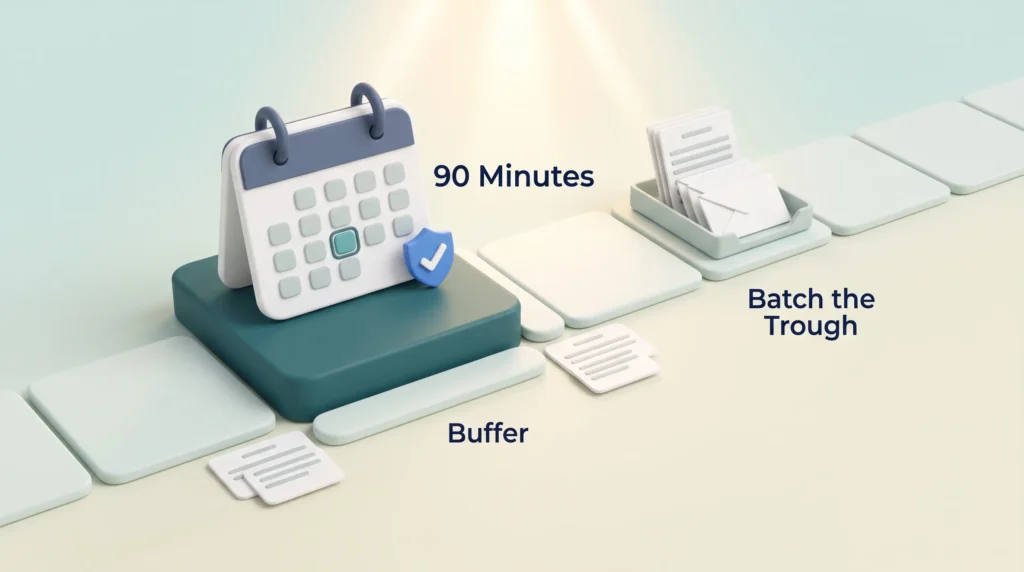
Ninety minutes is not arbitrary. It approximates one full ultradian cycle. Our guide to working with 90-minute cycles covers how to structure the block and the recovery that follows.
What to do with the rest of the day
- Batch the trough. Stack email, invoicing, and admin into one afternoon window instead of letting them leak across the day. Timeboxing works well here, because these tasks expand to fill whatever space you give them. If the dip is severe, our guide to the afternoon slump covers what helps and what does not.
- Guard the transition. Leave 15 minutes on either side of your peak block. Without a buffer, the block gets eaten by the meeting before it. Good calendar management keeps that buffer alive once other people can book you.
- Take the recovery break for real. A walk away from the screen restores more than scrolling does. Our guide to short breaks explains why the change of input matters more than the length.
- Match your schedule shape to your role. Makers need long uninterrupted stretches; managers run on shorter appointment blocks. The maker vs. manager schedule distinction explains why one calendar convention frustrates both groups.
- Do one thing at a time inside the block. Task switching erases most of the advantage you just built. Single-tasking is what makes the peak window pay off.
A sample day for a mid-morning peak
- 7:30-9:00: Light, movement, and a low-friction start. See our morning routine guide.
- 9:00-10:30: Protected deep work block. No Slack, no inbox.
- 10:30-11:00: Real recovery: walk, water, no screens.
- 11:00-12:30: Second focus block or high-stakes meetings.
- 13:30-15:00: Trough. Email, admin, routine calls, low-stakes syncs.
- 15:30-17:00: Recovery window. One-on-ones, planning, brainstorming.
Shift every row by two to three hours if you are an evening type. The sequence is the point, not the clock times.
Beyond Timing: The Four Sources of Energy
Your schedule decides when you spend energy. How much you have to spend is a separate question. Schwartz and McCarthy traced it to four sources: the body, emotions, the mind, and the spirit. Most people only notice one of them when it runs dry.
- Body: sleep, food, movement, and breaks set your physical baseline. A protected peak block cannot rescue a day that started on five hours of sleep and no breakfast. Regular meals, water, and a short walk between blocks keep your curve from collapsing early.
- Emotions: frustration and worry burn energy fast, even while you sit still. The original article suggests a simple reset: breathe out slowly for five or six seconds before a tense call. Also watch which tasks leave you drained and which leave you lifted, because that pattern belongs in your audit.
- Mind: constant interruptions drain focus faster than hard thinking does. One example from the article is checking email only twice a day, at fixed times. Clear instant messaging boundaries do the same job for Slack and Teams.
- Purpose: the authors call this the spiritual source. In plain terms, work you understand the point of costs less effort than work that feels pointless. Knowing why a task matters helps, and so does protecting time for the people and priorities outside work.
The authors turned all four into rituals: small, specific behaviors done at set times until they run on autopilot. Once a ritual sticks, it no longer needs willpower. Think of a walk after every focus block, a fixed email window, or a laptop that closes at 7 p.m.
Does it change results? In a pilot at Wachovia Bank described in the same article, participants beat a control group’s year-over-year growth in loan revenue by 13 percentage points over three months. Seventy-one percent said the program had a noticeable or substantial positive effect on their productivity and performance. Read those numbers with care. It was one company, the program came from the authors’ own consultancy, and part of the data was self-reported. Still, it suggests energy habits can move business results, not only how people feel.
Scaling Energy Management Across a Team
Individual peaks only compound when the team stops overwriting them. One person blocking 9 a.m. is fragile. Any colleague with booking rights can undo it. A shared norm is durable.
Wharton’s chronobiology work makes a specific argument here: when a meeting lands in someone’s trough, attention drops, people manage their reactions less well, and the discussion gets worse. In distributed teams the same people absorb that cost again and again, because the slot was chosen for a different time zone or a different chronotype.
Four changes that hold up
- Declare shared no-meeting hours. A team-wide focus time policy protects blocks far more reliably than individual willpower.
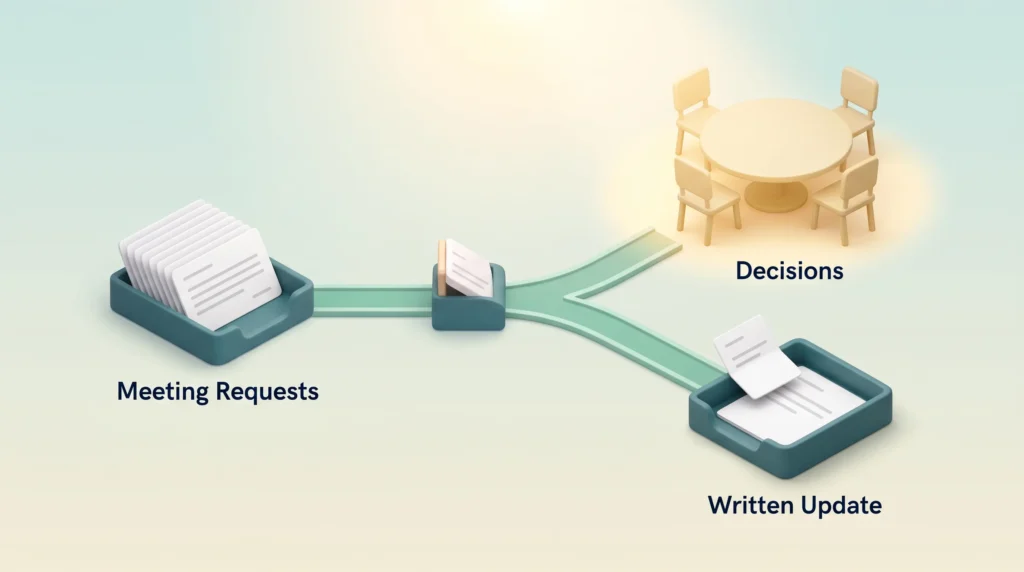
- Sort meetings by cognitive type. Decisions and hard conversations belong in shared peak or recovery windows. Status updates belong in the trough, or better still in a written update. That is the core of asynchronous work.
- Cut the meeting load first. Protecting peaks is impossible on a calendar that is already 70 percent booked. A meeting reduction plan usually has to come first.
- Rotate the burden. If your team spans time zones, rotate which region takes the awkward slot instead of defaulting to headquarters. Where the work allows it, follow-the-sun scheduling removes the shared call entirely.
Measure the outcome, not the hours. Two numbers are enough. Cycle time is how long a typical deliverable takes from start to done. Rework rate is how often finished work comes back for another round. Compare both before and after the change. If neither moves within a quarter, the policy is decorative and people are still booking over the blocks.
Common Mistakes That Undo the Gains
- Overbooking the peak. If every hour of your best window is committed, there is no slack for work to finish.
- Skipping recovery. Back-to-back focus blocks produce a cognitive hangover by mid-afternoon. The break is part of the method, not a reward for finishing.
- Treating the trough as broken. It is the right time for the tasks that would otherwise steal your peak.
- Ignoring light and evenings. Bright screens late at night push your clock later and flatten the next day’s curve.
- Redesigning everything at once. One block, one week, then adjust. Small, consistent habits compound; overhauls collapse.
Conclusion
Energy management is a scheduling decision, not a motivation problem. Map one week of highs and lows, protect a single 90-minute peak block for your most important task, and push email and admin into the trough where they belong.
The direction of the evidence is consistent: people work better when their hardest tasks sit inside their alert hours, and worse when their schedule fights their body clock month after month. Most calendars ignore this entirely, which is why the change is cheap to make.
Start this week. Run the audit, book one block, pick one small ritual for the source that feels weakest, and see what the following Friday looks like. To choose the methods that fit how you actually work, use our productivity style guide.
Found this useful?
Make SmartKeys a preferred source on Google, and our articles will surface more often in your Top Stories, AI Overviews, and AI Mode.
Add as Preferred SourceFAQ
What does “manage your energy, not just time” actually mean?
It means planning your day around when you are naturally alert, rather than treating all hours as interchangeable. You put demanding work such as analysis, writing and hard decisions inside your peak window, and move routine tasks like email and expenses into your trough. The practical payoff is less rework: a proposal drafted at your peak usually needs one pass, while the same proposal drafted in your afternoon dip often needs a rewrite the next morning. Nothing here asks you to work more hours. It only changes which hour each task lands in, so you can test it in a week.
How is energy management different from time management?
Time management asks how many hours you have and how to fill them, while energy management asks how much focus and stamina you bring to those hours. The difference matters because time is fixed, but energy can be rebuilt through sleep, breaks, movement, and work that feels meaningful. In practice the two work together. Time management gives you the calendar, and energy management decides which task goes into which slot. Someone who plans every minute but drafts their most important report in a mid-afternoon slump is managing time well and energy badly, and often ends up redoing the work.
How do I find my energy peak?
Track your alertness on a 1 to 5 scale three times a day for one week, and note in one line what you were working on each time. Also check when you naturally wake and fall asleep on days with no alarm, because that is the strongest signal of your body clock. After five to seven days the shape usually becomes obvious: one clear high, one clear dip, and a softer second lift later on. If you would rather have a validated measure, the Morningness-Eveningness Questionnaire takes five minutes and places you on a scale from strongly morning to strongly evening.
What is a chronotype and why does it matter at work?
Your chronotype is your personal setting on the 24-hour body clock: whether you naturally run early, late, or somewhere in the middle. It decides where your peak, trough and recovery windows actually fall, so a standard 9-to-5 suits some people and works against others. A study of 1,293 employed adults in Poland, published in BMC Psychology in March 2026, found that evening types reported lower work ability than morning types, and that burnout explained about a quarter of that gap. The pattern held for shift and day workers alike, which points to schedule mismatch rather than shift work itself.
Should creative work also go in my peak window?
Not necessarily. Convergent thinking, which means narrowing many options down to one answer, benefits most from your alertness peak. Divergent thinking, which means generating lots of raw ideas without judging them, often works slightly better off-peak, when your mental filter is looser and unusual associations get through. For anyone who writes, that suggests a simple split: draft in the softer window and edit when you are sharpest. Treat it as a hypothesis rather than a law, and check it against your own energy log before rebuilding your schedule around it.
Why 90 minutes for a deep work block?
Ninety minutes approximates one full ultradian cycle, the roughly 90 to 120 minute wave in alertness that sleep researcher Nathaniel Kleitman described as the Basic Rest-Activity Cycle. Working one cycle and then taking a genuine break is more sustainable than pushing straight through three hours, which usually ends in a mid-afternoon crash. The number is a sensible default, not a rule. If your attention reliably fades at 60 minutes, use 60. The point is to end the block while you still have something left.
What if my whole day feels like a trough?
A flat energy curve usually points to sleep debt rather than a scheduling problem, and the two feel identical from the inside. Fix the sleep baseline first: a consistent wake time, daylight early in the morning, and dimmer screens in the evening. Rescheduling around an energy curve that does not exist yet will not help, and it leaves people convinced the method failed. Give the sleep changes two or three weeks, then run the audit again. If the curve is still flat and you feel exhausted regardless of sleep, raise it with a doctor.
How do I protect a peak block when my calendar fills up?
Book it as a recurring appointment with the project name on it rather than leaving it blank, because colleagues will book over an unlabelled hold without thinking twice. Add a 15-minute buffer on each side so an overrunning meeting cannot eat into it. Then deal with the arithmetic: on a calendar that is already 70 percent booked, protecting focus time rarely survives a busy week, so total meeting load has to come down first. Telling your team which window you protect, and why, turns a personal preference into something they can plan around.