Prioritization is the skill that decides whether a busy day turns into progress or just noise. Most people do not fail because they work too little. They fail because the loudest task wins, and the loudest task is rarely the one that matters. This guide covers how to separate the two, which frameworks hold up in daily use, and how to keep your priorities honest when the workday keeps interrupting itself.
The pressure is measurable. Microsoft’s June 2025 Work Trend Index special report, based on Microsoft 365 telemetry, found that employees are interrupted roughly every two minutes during core working hours by a meeting invite, an email or a chat message, adding up to about 275 interruptions across a full day. The average worker receives 117 emails and 153 Teams messages on a typical weekday, and nearly half describe their work as chaotic and fragmented. In that environment, prioritization is the only thing standing between you and a day spent entirely on other people’s urgencies.
Key Takeaways
- Prioritization means deciding what not to do, not just ordering a list.
- Urgency hijacks attention: research shows people pick urgent low-value tasks over important high-value ones.
- The 80/20 pattern is a prompt to look for leverage, not a law of nature.
- Frameworks such as the Eisenhower Matrix, MoSCoW and ABCDE work best when you pick one and stick with it.
- Delegating and declining are prioritization decisions, not soft skills.
- Priorities decay, so a short weekly review matters more than a perfect system.
Understanding the Importance of Prioritization
Prioritization is less about ranking than about limiting. A list of twenty tasks with numbers next to them is still twenty tasks. A list of three commitments for today is a decision.
Start by knowing where your hours currently go, because most people guess wrong. A week of tracking usually reveals a gap between stated priorities and actual calendar entries, and a structured time audit is the fastest way to see it.
A written method also protects you from decision fatigue: you spend energy on the work rather than relitigating the order every morning. The Eisenhower Matrix sorts by urgency and importance; the Boulders, Big Rocks and Pebbles metaphor sorts by size, so the largest commitments get scheduled before small ones fill the gaps.
Breaking large projects into smaller units is part of the same discipline, since a vague objective cannot be prioritized at all. Learning to break large goals into workable steps turns an intimidating block into something you can slot into a real week. There is a wellbeing argument too: a clear plan removes the low-level anxiety of unfinished commitments and cuts the last-minute scrambles that turn ordinary weeks into stressful ones.
Clarifying Your Values and Goals
Effective prioritization depends on goal setting that goes beyond this week. Longer-term aims act as a filter: without them, every request looks equally reasonable. Start with a few honest questions:
- What do I want to be true about my work in two years that is not true now?
- Which commitments would I regret dropping, and which would I quietly be relieved to lose?
- Does anything on today’s list actually connect to the first answer?
Most people find the third question uncomfortable, which is the point. If you want structure for this step, adopting SMART goals gives you specific, measurable, achievable, relevant and time-bound targets, and our wider guide to goal setting covers when a learning goal beats an outcome goal. Once the goals are clear, protect the work that serves them: time blocking converts an intention into a calendar entry, which is far harder for other people to overwrite than a line on a list.

Assessing and Evaluating Your Tasks
With the goals set, evaluate what is on your plate. Get every open item out of your head and into one place first, because you cannot sort what you cannot see.
The MoSCoW technique labels each item Must, Should, Could or Won’t. Its real value is the fourth category: most systems let you defer indefinitely, while MoSCoW forces you to name what you are choosing not to do.
The Eisenhower Matrix splits tasks into four quadrants: urgent and important, important but not urgent, urgent but not important, and neither. The quadrant that changes people’s weeks is the second, because important work with no deadline is exactly what gets crowded out. Our guide to Eisenhower’s matrix in practice works through the sorting rules, and a broader comparison of task prioritization frameworks helps if you are choosing between methods.
Two small rules clear the underbrush. The two-minute rule says that if something takes under two minutes, do it now, because tracking it costs more than the task. The 4Ds approach gives every incoming item exactly four possible fates: do, defer, delegate or delete. Our guide to everyday task management covers how to run both without turning your list into a filing project.
Be careful with estimates while you sort. People systematically underestimate how long their own tasks will take, a pattern known as the planning fallacy. A priority list built on optimistic estimates collapses by Wednesday.
Applying the 80/20 Rule in Prioritization
The 80/20 rule, commonly called the Pareto Principle, is the observation that outcomes are usually distributed unevenly: a minority of inputs accounts for a majority of results. The name comes from Vilfredo Pareto’s work on the distribution of land ownership, and the label was later attached to management thinking by quality engineer Joseph Juran.

Treat the numbers as shorthand rather than measurement. Nobody has shown that exactly 80% of results come from exactly 20% of effort, and the ratio varies a lot by context. What holds up is the shape: a small share of your activities usually produces most of the value.
In practice, list what you actually did last month, mark the items that produced a visible result (revenue, a shipped deliverable, a decision unblocked), and give that group more calendar time. Low-impact does not mean optional, though. Compliance, maintenance and admin rarely produce visible wins, and skipping them is expensive. For the full method, including how to run a simple Pareto analysis on your own time, customers or defects, see our guide to applying the Pareto principle to your work. For the motivational side, see our guide on staying motivated through the workday.
Urgency vs. Importance: Finding the Balance
Urgent tasks demand action now. Important tasks change your position later. The two overlap far less often than the average inbox suggests.
The pull toward urgency is well documented. In five experiments published in the Journal of Consumer Research in 2018, Meng Zhu, Yang Yang and Christopher Hsee showed that people repeatedly chose tasks carrying artificial deadlines over objectively more rewarding tasks with no deadline attached. They named this the mere urgency effect and noted that it violates a basic rule of rational choice: participants picked options they knew paid less.
That finding reframes the problem. You are not simply badly organized when the urgent wins; you are responding to a cue designed to be responded to. The defense is structural rather than motivational: decide in advance what gets protected time, and make importance as visible in your system as deadlines already are.
Practical moves help. Give your most important task a calendar block before the day starts filling. Keep a not-to-do list alongside your task list so recurring temptations are named. Protect at least one stretch of focus time that does not move for anything short of a genuine emergency.
The Eisenhower Matrix is useful precisely because it makes this trade visible. Popularized by Stephen R. Covey in The 7 Habits of Highly Effective People, it draws on a distinction Dwight D. Eisenhower himself made between the urgent and the important, and it forces you to admit which quadrant a task belongs in before you start it.
Effective Prioritization Techniques
There is no single correct method. The best framework is the one you will still be using in six weeks, so try one at a time.
Eisenhower’s Urgent-Important Matrix
Sort every task by urgency and importance, then act: do the urgent and important, schedule the important but not urgent, delegate the urgent but not important, and delete the rest. It is strongest for people whose days are dominated by inbound requests, because it gives you a defensible reason to say no.
The ABCDE Method
Popularized by Brian Tracy, the ABCDE method grades each task from A for must-do down to E for eliminate, with the rule that you never touch a B while an A remains. It is quicker than a matrix and works well for a single day’s list. It pairs naturally with the eat the frog approach, which puts the hardest A task first.
MoSCoW and MIT
MoSCoW suits projects with stakeholders, because the Won’t column creates an explicit, shared agreement about scope. The Most Important Task method suits individuals: pick one to three MITs each morning and treat the rest of the list as optional. The Ivy Lee method’s six-task daily list is a stricter version of the same idea: write six tasks the evening before, rank them, and work through them strictly in order. If your problem is too many goals rather than too many tasks, the two-list method for cutting goals down to five applies the same filter to a whole year. For building the list itself, see our guide to using to-do lists effectively.
Prioritization Productivity: Strategies for Success
Frameworks sort tasks. These habits decide whether the sorting survives contact with a real week.
Identifying High-Impact Tasks
High-impact work usually has one of three signatures: it unblocks other people, it compounds over time, or it is expensive to reverse if done badly. Ask which of your current tasks would still matter in a month. Most will not, and that is useful information rather than a criticism of your job. Protect the work that survives that test with real concentration, which is why deep work blocks belong in the same conversation as prioritization.
Using Efficiency Tools to Streamline Your Process
Project management software, shared calendars and task trackers earn their place for one reason: they externalize the list so you are not spending working memory holding it. Any tool that does this reliably is good enough, and switching tools is rarely the improvement people hope for.
AI features now sit inside most of these products, drafting summaries, surfacing overdue items and suggesting an order of work. They are helpful for triage and unhelpful as a substitute for judgment, since a model cannot know which stakeholder matters this quarter. Our overview of AI in project management covers where the current tools earn their keep.
Learning to Delegate and Say No
Delegation is prioritization applied to other people’s time. Done well, it develops your team and frees you for work only you can do. Done badly, it hands over responsibility without context and produces rework.
The practical rule is to match the task to the person and hand over the outcome rather than the steps: what good looks like, when it is needed, what the constraints are, and which decisions the other person is free to make alone. Our guide to effective delegation covers the handover in detail.

Managers resist delegating for predictable reasons: a belief that explaining takes longer than doing, discomfort at losing visibility, or a habit of holding on to work they enjoy. The first is true once and wrong every time after. The second is better answered with a check-in schedule than by keeping the task.
Saying no is the other half. Every yes commits hours you have already promised elsewhere, and the cost is invisible at the moment you agree. A clear decline protects the priorities you already set; our guide to saying no without damaging relationships covers the wording.
- Delegate work that is repeatable, teachable, or better done by someone closer to it.
- Step back from tasks you enjoy but that are no longer part of your role.
- When declining, offer a specific alternative: a later date, a smaller scope, or a different owner.
Reviewing and Adapting Your Priorities Regularly
Priorities go stale. Projects change shape, deadlines move, and the list you wrote in January quietly stops matching reality. A short, fixed review keeps the system honest:
- Daily: choose one to three Most Important Tasks before opening your inbox.
- Weekly: clear the list, check what slipped and ask whether it slipped because it was hard or because it no longer matters.
- Monthly: compare where your hours went against the goals you set, and adjust one thing.
- Use time blocking or the Pomodoro Technique to give the resulting priorities a real slot in the day.

Watch for the small-task trap: clearing easy items produces a satisfying sense of progress that has little to do with output. Watch for the parallel-work trap as well: in a 2010 study published in Psychonomic Bulletin & Review, Jason Watson and David Strayer found that only about one person in forty, roughly 2.5% of their sample, could handle two demanding tasks at once without measurable loss. For everyone else, running tasks in parallel means switching between them and paying a cost each time, as our piece on the science of multitasking explains.
Conclusion
Prioritization is not a system you install once. It is a repeated decision about what deserves your finite attention, made in an environment that interrupts you every couple of minutes and rewards whatever shouts loudest.
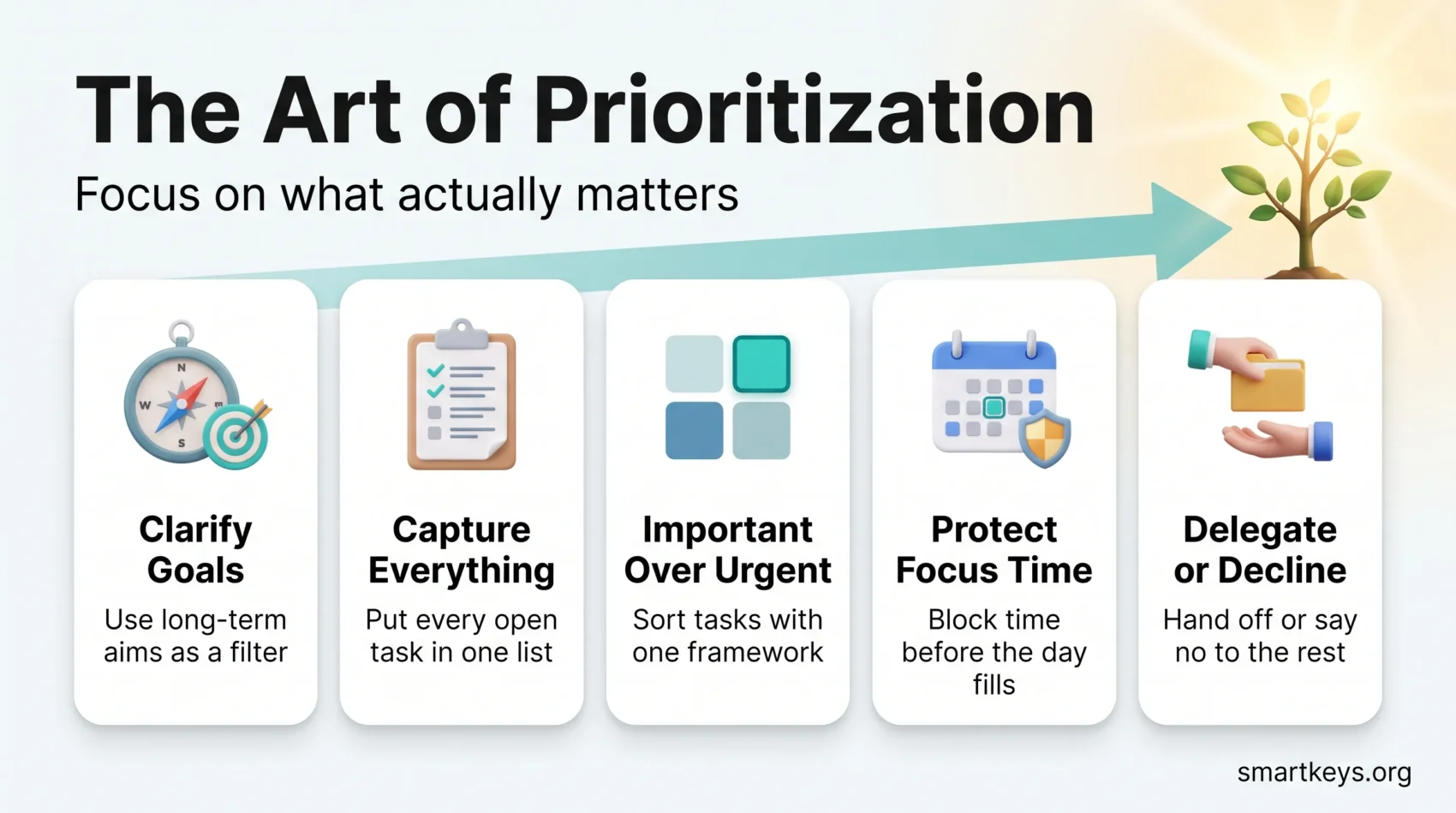
The mechanics are straightforward: know your goals, get everything into one list, sort it with a framework you will keep using, protect the important work with calendar time, and hand off or decline the rest. The difficulty is never the method. It is holding the line on Wednesday afternoon when three urgent requests arrive at once.
Start with one change. Pick three tasks tomorrow morning before you open your inbox, and see what still gets done by five o’clock. That single habit reveals more about your real priorities than any amount of list-making.
Found this useful?
Make SmartKeys a preferred source on Google, and our articles will surface more often in your Top Stories, AI Overviews, and AI Mode.
Add as Preferred Source