The “Eat the Frog” method has one instruction: do your hardest, most important task first, before the day fills up with everything else. That task is your “frog,” and everything else waits until it is done.
Most people know the feeling of reaching 4 p.m. having answered fifty messages and moved nothing that mattered. Eating the frog breaks that pattern by spending your freshest attention on the work with the highest payoff. This guide covers where the idea comes from, what the research does and does not support, how to pick your frog, and when the method is the wrong tool.
Key Takeaways
- “Eat the Frog” means finishing your single most important and most avoided task before anything else.
- Pick the frog by impact and resistance, not by urgency or by how loud the request was.
- The famous quote is almost certainly not Mark Twain’s. Brian Tracy turned it into a working method.
- No study tests the method directly. Support is indirect: procrastination, planning and single-tasking research.
- Deciding your frog the night before removes the morning decision, which is where it usually fails.
- “First thing” means your first block of protected focus time, not necessarily the morning.
Understanding the ‘Eat the Frog’ Concept
The concept is a prioritization rule disguised as a joke. Instead of ranking twenty tasks, you pick one and protect it. That choice does most of the work, because it forces you to decide what matters before the day decides for you.
Where the Phrase Really Comes From
The line usually quoted runs: “Eat a live frog first thing in the morning and nothing worse will happen to you the rest of the day.” It is almost always credited to Mark Twain, and that attribution does not hold up. Researchers at Quote Investigator found no instance of it in Twain’s published work, and traced versions back to the French writer Nicolas Chamfort, who died in 1794, decades before Twain was born.
The idea is old folk wisdom, not a documented insight from a famous author.
What Brian Tracy Added
The modern version comes from Brian Tracy’s book Eat That Frog!: 21 Great Ways to Stop Procrastinating and Get More Done in Less Time, first published in 2001 and now in its third edition. Tracy attached a procedure to the metaphor: identify the task with the biggest consequences, do it first, and finish it before moving on.
His second rule is the one people forget. If you have two frogs, eat the uglier one first. When two important tasks compete, start with the one you are avoiding hardest.

What is ‘Eat the Frog’ Strategy?
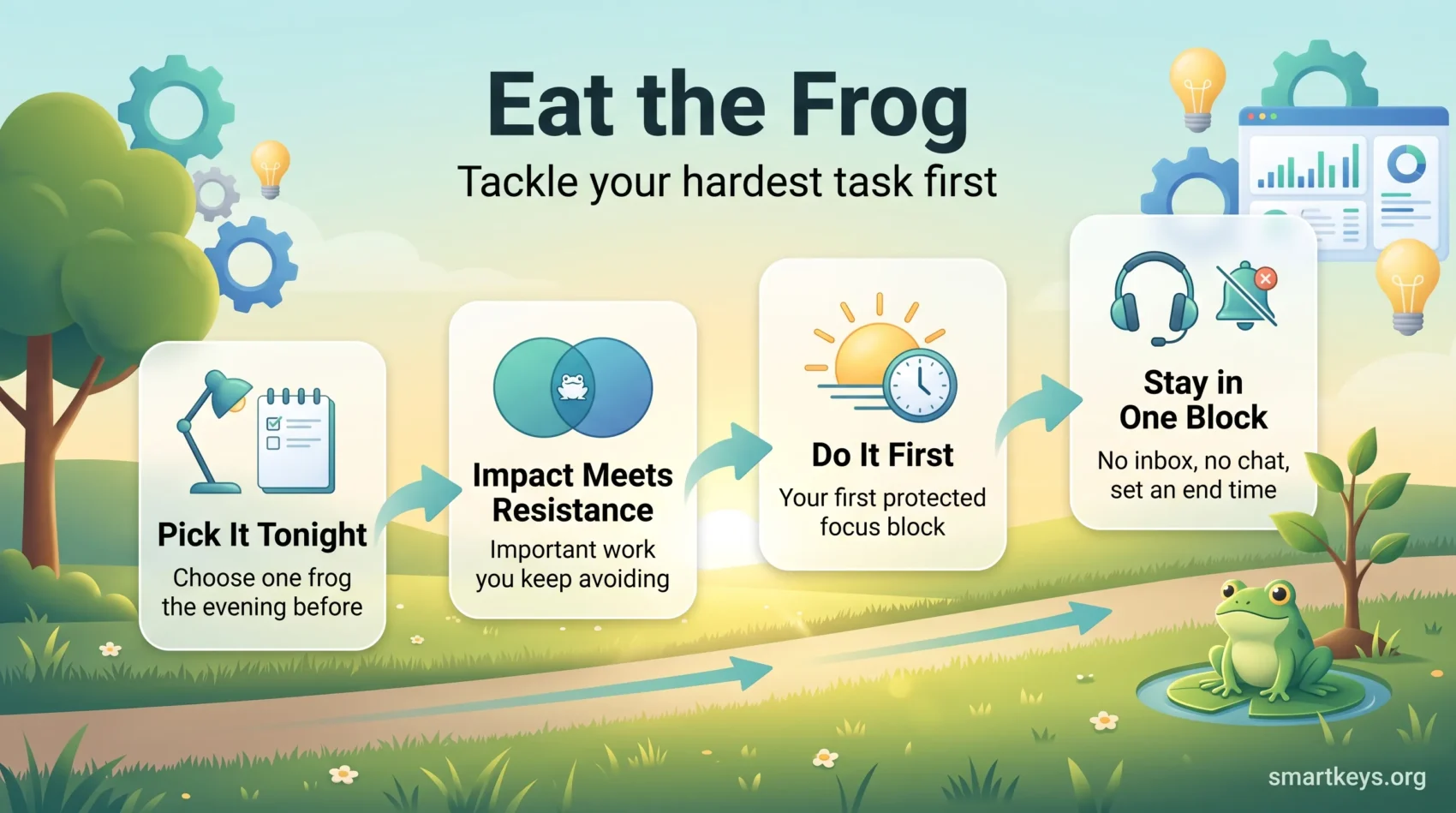
As a working method, the strategy has three parts: choose one task the day before, start it before you open anything else, and finish it in one protected block.
Defining Your ‘Frog’
Your frog is the task that scores high on two things at once: it moves a goal you care about, and you keep finding reasons not to start it.
That combination is the test. A task you dread but that changes nothing is a chore to delegate or drop. A task that matters but that you happily start is just work. The frog sits where importance and avoidance overlap.
Examples help more than the definition. For a freelancer, the frog is the difficult client conversation about scope or an unpaid invoice, not the invoice itself. For a team lead, it is the performance feedback that has been slipping for three weeks. For an analyst, it is the messy data model nobody wants to open.
Identifying High-Impact Tasks
High-impact tasks are the ones whose completion changes what happens next. Finishing them unblocks other people, closes a decision, or moves a number your goals depend on. A quick filter: ask what would still be different in a month if you finished this task today. If nothing would be, it is not a candidate.
This is where the Pareto principle earns its reputation. A small share of your tasks produces most of your results, and the frog is usually drawn from that share. Working through a to-do list in the order it was written is the opposite approach, and it is why long lists so often produce busy days with little to show.

Eat the Frog Productivity and Procrastination
Most productivity advice treats procrastination as a discipline problem. The research points somewhere else, and understanding that changes how you use this method.
Why Putting Things Off Feels Good in the Moment
Fuschia Sirois and Timothy Pychyl argued in a widely cited 2013 paper in Social and Personality Psychology Compass that procrastination is primarily short-term mood repair. You avoid the task because starting it feels bad now, and avoiding it feels better now. The cost lands on your future self, who has less time and the same unpleasant task.
That explains why “just be more disciplined” rarely works: the pull is emotional, not moral. It also explains why the frog method helps. By fixing the decision in advance, you shrink the window in which avoidance can start. There is no morning debate to lose, because the debate happened yesterday.
Building Resilience Against Avoidance
Repetition turns this from an act of willpower into a routine. The first few times, starting the frog takes real effort. After a few weeks the sequence carries you: you sit down, you know the task, and you begin.
Two habits reinforce that. Give the frog a defined slot rather than an open-ended morning, which is what timeboxing is for; sixty to ninety minutes is a common range, long enough for real progress and short enough to face. Then define the first physical action, not the goal. “Write the client email” is a task. “Open the draft and write two sentences” is a starting point, and the difference in how hard it is to begin is larger than it sounds.
A bounded block also protects the rest of your day, part of why this supports rather than damages work-life balance.

The Psychological Benefits of Eating Your Frog
The reported benefits are mostly about what an early win does to the rest of the day.
Momentum Early in the Day
Finishing a demanding task early removes it as a background worry. Unfinished important work intrudes on attention while you do other things, which is one reason a day spent avoiding a task often feels more tiring than a day spent doing it.
A second effect is easy to underrate: once the frog is done, the remaining tasks genuinely are easier, so the day gets lighter rather than heavier.
What the Evidence Does and Does Not Show
Be careful with claims made for this method. No published study tests “Eat the Frog” as such, and figures circulating online about percentage productivity gains do not trace back to any identifiable research.
What is supported is narrower and more useful. Deciding in advance when and where you will act is one of the best-evidenced tricks in behavioural science: Peter Gollwitzer and Paschal Sheeran’s 2006 meta-analysis of implementation intentions, covering 94 studies, found a medium-to-large effect on goal attainment (d = 0.65) from simply specifying the if-then plan in advance. Picking your frog the night before is exactly that kind of plan.
The other supported piece is the cost of splitting attention. Switching between tasks carries measurable time and error penalties, which is the case for doing one hard thing properly rather than three at once. Our guide to the science behind multitasking covers that evidence.
How to Choose Your Frog Effectively
Choosing badly is the most common way this method fails. People pick the loudest task rather than the heaviest, then wonder why the day went nowhere.
Distinguishing Between Urgent and Important Tasks
Urgent means someone wants it soon. Important means it changes an outcome you care about. The two overlap less than a busy inbox suggests.
The Eisenhower Matrix exists to separate them: sort by urgency and importance, and treat the important-but-not-urgent quadrant as the source of your frogs. Those tasks never announce themselves, and they quietly decide how your quarter goes. For more on ranking methods, see our guide to focusing on what actually matters.
Recognizing Resistance-Inducing Tasks
Resistance is a signal worth reading rather than overriding. When you reach for something easier, ask why: is the task unclear, or is it uncomfortable?
Those need different responses. Unclear tasks are not frogs yet, because you cannot start what you have not defined. Break them down until the first step is obvious, as our guide to breaking large goals into achievable steps describes. Clear but uncomfortable tasks are what the method was built for.
Time Management Benefits of Eat the Frog
The method’s real contribution to time management is that it removes a decision. You are not choosing what to work on at the moment you are least able to choose well, and it front-loads your best attention, spending your highest-quality hours where they produce the most.
There is a knock-on effect on the schedule. Once your frog has a fixed slot, everything else fits around it, which makes overcommitment visible early: if four meetings and your frog cannot coexist, you learn that at planning time rather than at 6 p.m. This pairs naturally with time blocking, where the frog becomes the first and most protected block of the day.

Eating Your Frogs: A Daily Habit
The method only pays off when it stops being a decision. As a one-off it is a good day. As a routine it changes what you get through in a quarter.
How Habitual Practice Enhances Efficiency
A repeated sequence removes the daily negotiation about what to start, which is most of the benefit. It also trains one specific skill: staying with a task while other things compete for attention. That is the muscle behind single-tasking, and it gets easier with use.
Planning Your Daily Tasks
Pick tomorrow’s frog before you finish today. Ten minutes at the end of the day is enough, and you start the next morning with the decision already made instead of an open list.
For a structured version, the Ivy Lee method is the closest relative: write six tasks for tomorrow in priority order and work them in order. The first item is your frog. Fitting it into a wider morning routine helps too, as long as the routine ends rather than replaces the work.
Combining Eat the Frog with Productivity Tools
No tool will make you start. What tools do well is hold the decision, so your frog is visible the moment you sit down.
Using Tools like Todoist and Asana
Task managers such as Todoist and Asana help here mainly with flagging and ordering. Mark one task per day as the frog, using a priority level, a label or the top slot in a dedicated list, and keep that marker reserved for exactly one task. The constraint is the point, and it disappears the moment you allow three frogs.
For teams, the same marker makes priorities legible, which reduces interruptions for whoever is deep in their hardest task. Our Asana review covers that in a shared workspace, and our overview of productivity apps compares the main options.
Where AI Fits In
AI planners can now scan deadlines, calendar load and past patterns to suggest your most consequential task. That is useful for surfacing candidates you had forgotten across a full project list.
Treat the output as a shortlist, not a verdict. An assistant sees your calendar, but not the conversation you have been dodging for a fortnight, and that is often the real frog.
Best Practices for Eating Your Frog
A few practices make the difference between trying this once and running it for a year.
Habit Formation for Long-Term Success
- Attach the frog to a fixed cue, such as sitting down with your first coffee, so it starts the same way each day.
- Choose it the evening before, without exception. This is the single highest-value rule in the method.
- Keep it to one task. Two frogs is just a to-do list.
- Review weekly. If the same frog has been postponed five days running, it is too big or too vague, not too unpleasant.
Doing this consistently is partly self-discipline, but mostly design. Make the right thing the easy thing to start.
Maintaining Focus During Frog Time
- Close the inbox and chat client. Our guide to managing work notifications covers how to do that without going dark on colleagues.
- Set an end time, not just a start time. A defined finish makes a hard task easier to begin.
- If you struggle to sit still for ninety minutes, run the block as shorter intervals. The Pomodoro Technique works well as scaffolding inside frog time.
- Keep a scrap sheet for stray thoughts, so anything that surfaces gets captured instead of chased.
The Role of Deep Work in the Frog Strategy
Frog time and deep work describe the same block from two angles: the frog names what you work on, deep work names the conditions it needs.
Fostering a Distraction-Free Work Environment
The requirements are unglamorous: no notifications, a closed door or headphones, a clear surface, and colleagues who know you are unavailable until a stated time. That last one is usually the weak link, and it is a communication problem rather than a focus problem. A calendar block labelled with a finish time solves most of it.
Maximizing Mental Resources for Difficult Tasks
Hard tasks need continuous attention, not fragments of it. Twenty uninterrupted minutes on a difficult problem is worth more than an hour broken into five-minute pieces, because each return costs time spent reloading where you were. That is the argument for doing the frog in one block, and why the method pairs badly with back-to-back meetings.
Challenges You May Encounter
The method is simple, which is not the same as easy. Three problems come up repeatedly.
Managing Overwhelm with Big Tasks
If the frog feels impossible rather than unpleasant, it is too big. “Write the annual report” is a project, and projects cannot be started.
Cut it down until the first action fits in one sitting: “pull last year’s figures,” “draft the summary section.” The frog becomes today’s slice, not the whole animal. Sizing targets well is a skill in itself, covered in our guide to goal setting.
Addressing Resistance to Change
Expect the first two weeks to feel worse than your old routine. You are moving your hardest work to the slot where you previously did your easiest, and that trade feels bad before it feels good.
Give it a month, and judge it on output rather than comfort. The question is not whether the mornings felt pleasant but whether the important things got finished.
When Morning Is the Wrong Time
The standard advice says to eat the frog first thing in the morning. Take that as a rule of thumb, not a law, because the research on matching demanding work to your body clock is less decisive than popular advice suggests. A 2023 study in Collabra: Psychology, pointedly titled “The Interplay of Time-of-day and Chronotype Results in No General and Robust Cognitive Boost”, found no reliable general advantage from working at your chronotype-matched hour. In other words, there is no strong evidence that everyone must do hard work at dawn.
What holds up is the structural argument rather than the biological one. Early in the day, fewer things have gone wrong and your schedule has not yet been rearranged by other people’s priorities. If your job puts that window at 2 p.m., run the method at 2 p.m. What matters is that the frog goes in your first genuinely protected block.
Some roles, such as support or on-call work, begin with urgency that cannot wait. There the frog goes into the first defensible gap, and the method bends around the job.
Conclusion
“Eat the Frog” is a small rule with a large effect: one important task, decided in advance, finished before anything else gets a claim on your attention.
Its strength is the sequencing, not the metaphor. It moves the decision away from the moment of weakness and protects your best hours for work that changes outcomes.
Treat it as a default rather than a doctrine. Pick one frog tonight, do it first tomorrow, and see what the day looks like. If the underlying issue is chronic avoidance rather than scheduling, our guide to overcoming procrastination goes deeper into why it happens and what helps.
Found this useful?
Make SmartKeys a preferred source on Google, and our articles will surface more often in your Top Stories, AI Overviews, and AI Mode.
Add as Preferred SourceFAQ
What is the ‘Eat the Frog’ method?
Eat the Frog means finishing your single most important and most avoided task before you start anything else. The “frog” is that one task: high impact, and the one you keep putting off. The rule is deliberately narrow. You pick one task, decide on it in advance, and complete it in a protected block before email, meetings or smaller jobs get a claim on your attention. Brian Tracy set out the method in his book Eat That Frog!, with a second rule for days with two candidates: start with the one you are avoiding hardest.
Did Mark Twain really say “eat a live frog”?
Almost certainly not. The saying is quoted everywhere as Twain’s, but researchers at Quote Investigator found no instance of it in his published writing and traced earlier versions to the French writer Nicolas Chamfort, who died in 1794, before Twain was born. The attribution attached itself to Twain later, as memorable lines often do. That does not weaken the method, which stands or falls on whether the sequencing works for you, but it is worth knowing before you quote it in a presentation.
How do I identify my ‘frog’?
Look for the task that scores high on two things at once: it moves a goal you care about, and you keep finding reasons not to start it. A useful test is to ask what would still be different in a month if you finished it today. If nothing would change, it is not your frog, however annoying it is. A task you cannot start because it is unclear is not a frog yet either. Break it down until the opening action is something you could begin in five minutes.
Is there research proving that Eat the Frog works?
Not directly. No published study tests the method by name, and percentage figures circulating online about gains from it do not trace back to identifiable research. The support is indirect but real. Gollwitzer and Sheeran’s 2006 meta-analysis of 94 studies found that deciding in advance when and where you will act has a medium-to-large effect on follow-through, which is precisely what choosing your frog the night before does. Research on task switching also shows measurable time and accuracy costs, supporting one protected block over scattered effort.
Does the frog have to be done in the morning?
No. “First thing” is best read as your first genuinely protected block, which is the morning for many people but not for everyone. The evidence for matching hard work to your body clock is weaker than popular advice suggests: a 2023 study in Collabra: Psychology found no general, robust cognitive boost from working at your chronotype-matched hour. The stronger argument for mornings is structural rather than biological. Early in the day, fewer things have gone wrong and fewer people need you. If your role makes that window 2 p.m., run the method at 2 p.m.
What do I do when the frog feels too big to start?
Treat that feeling as information: what you have is a project, not a task. “Write the annual report” cannot be started, but “pull last year’s figures” or “draft the summary section” can. Cut it down until the first action fits in one sitting, then make that slice today’s frog. A useful check is whether you can name the exact first physical action. If you cannot, you have not broken it down far enough. Postponing the same frog five days running is a sizing problem, not a willpower problem.
Why does eating the frog help with procrastination?
Because it removes the moment where avoidance usually happens. Fuschia Sirois and Timothy Pychyl argued in 2013 that procrastination is mainly short-term mood repair: you avoid a task because starting it feels bad now, and the cost lands on your future self. Deciding the frog the evening before means there is no morning debate to lose. You are not choosing between the hard task and the easy one at the point when the easy one looks most attractive. The choice was already made when you were calmer about it.