Self-discipline is the bridge between goals defined and goals accomplished. It is not a personality trait you either have or lack. It is a system you build, and in 2026 that system has to survive a workday that fights back.
The numbers explain why willpower alone keeps failing. Microsoft’s 2025 Work Trend Index found that knowledge workers are pinged by a meeting, email, or chat message roughly every two minutes, which adds up to about 275 interruptions in a single day. Research by Gloria Mark at UC Irvine puts the average time spent on one screen before switching at just 47 seconds, down from about two and a half minutes in 2004, and shows it takes over 23 minutes to fully return to a task after a real interruption.
Against that backdrop, waiting to feel disciplined is a losing strategy. What works is deciding in advance, shaping your environment, and repeating small actions long enough that they stop needing a decision at all. This guide blends timeless ideas from Plato and Marcus Aurelius with practical tactics you can start using today.
Key Takeaways
- Treat discipline as a repeatable system, not a character trait or a mood.
- Small daily actions compound faster than occasional heroic sprints.
- Environment design beats willpower: remove the trigger and you skip the fight.
- Habits take longer than the myth suggests: plan for months, not three weeks.
- If-then plans and light accountability keep you consistent without burning out.
Why Consistency Matters More Than Ever
Consistency turns small, daily choices into measurable progress. The problem is that the modern workday is engineered to interrupt exactly that.

The attention math has changed
A workday broken into 47-second fragments does not just feel busy. It quietly removes the conditions deep work needs. Add AI assistants, group chats, and a notification layer on nearly every app, and the default state of a knowledge worker is reactive.
That is why the answer is structural rather than motivational. Setting clear instant messaging boundaries and protecting stretches of dedicated focus time does more for your consistency than any amount of self-talk.
Align your workday with what you want most, not what you want now
Use a simple check before tasks, meetings, or breaks: does this move my highest-priority goal forward? If not, pause.
Jocko Willink frames it as choosing what you want most over what you want now. That single question cuts internal debate and protects your calendar.
- You trade scattered reasons to delay for a fast, repeatable decision rule.
- Small daily wins build self-trust, which is a far steadier fuel than motivation.
- Low-value work that merely fills time gets displaced by work that creates progress.
“Discipline equals freedom.”
When you work this way, your team can rely on your timelines. You also free up hours for the life you want without adding them to your workday.
What Self-Discipline Really Is and Why It Beats Motivation
Motivation is a feeling, and feelings fluctuate. Discipline is a structure that produces results whether or not the feeling shows up.
“Conquer self”: what Plato and Marcus Aurelius got right
Plato taught that the first and best victory is to conquer yourself. Marcus Aurelius wrote that you have power over your mind, not over outside events.
Both point at the same lever. You cannot control the interruptions, the market, or other people’s priorities. You can control what you decide in advance and what you do next.
Decide once, execute daily
Use a decide-once rule: pick one habit (for example, writing every weekday morning before email) and make it non-negotiable.
This is the core mechanism. Every rule you set in advance is a decision you never have to make again while tired, which is exactly when discipline usually fails. A next-action mindset does the same job at task level: you always know the single concrete step that comes next.
How long does building self-discipline actually take?
The “21 days to a habit” claim is folklore. A systematic review from the University of South Australia, published in early 2025 and covering 20 studies with more than 2,600 participants, found a median of roughly 59 to 66 days for a health habit to become automatic. Individual results ranged from 4 days to almost a year (335 days).
Two practical conclusions follow. First, do not quit at the three-week mark and conclude you lack discipline. Second, the researchers found that new habits added to a morning routine, and habits people actually enjoy, tended to stick better, which is a strong argument for building your keystone habit into a deliberate morning routine.
“Self-discipline is the bridge between goals defined and goals accomplished.”
Find Your Why: Motivation That Outlasts Your Mood
Purpose does not replace systems, but it makes them easier to maintain on bad days. Reframe discipline as ending the low-grade pain of procrastination rather than as a test of character.
Name the cost, then shrink it. Write down what putting this off actually costs you: the Sunday dread, the rushed quality, the apology email. Then pick one tiny action that reduces that cost a little each day. If the avoidance pattern runs deep, our guide to overcoming procrastination goes further into the triggers behind it.
Point the goal at other people. Serving your team, clients, or family makes follow-through feel less like an ego project and more like a commitment.
- Write a one-sentence why that connects your goal to a specific person.
- Keep a weekly ritual: one paragraph on how last week’s work helped someone.
- Anchor that why to one habit, so the daily action reminds you who benefits.
Start each morning with one prompt: what is the most important thing today that serves that purpose? Pairing it with SMART goals keeps the answer concrete instead of aspirational.
Design an Environment Where Procrastination Is Hard
The most reliable discipline hack is not trying harder. It is arranging your day so the tempting option requires more effort than the useful one.
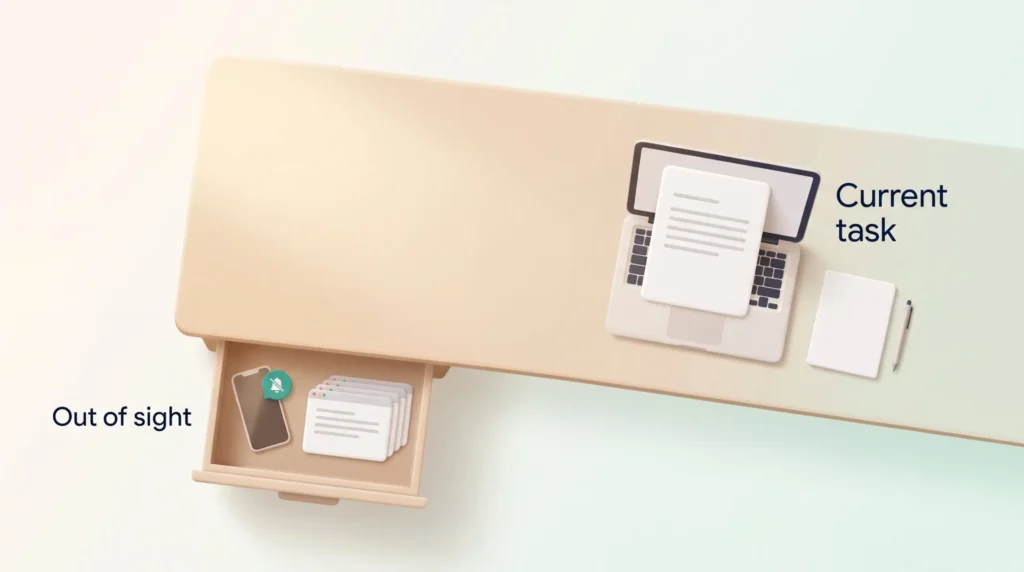
Out of sight, out of mind
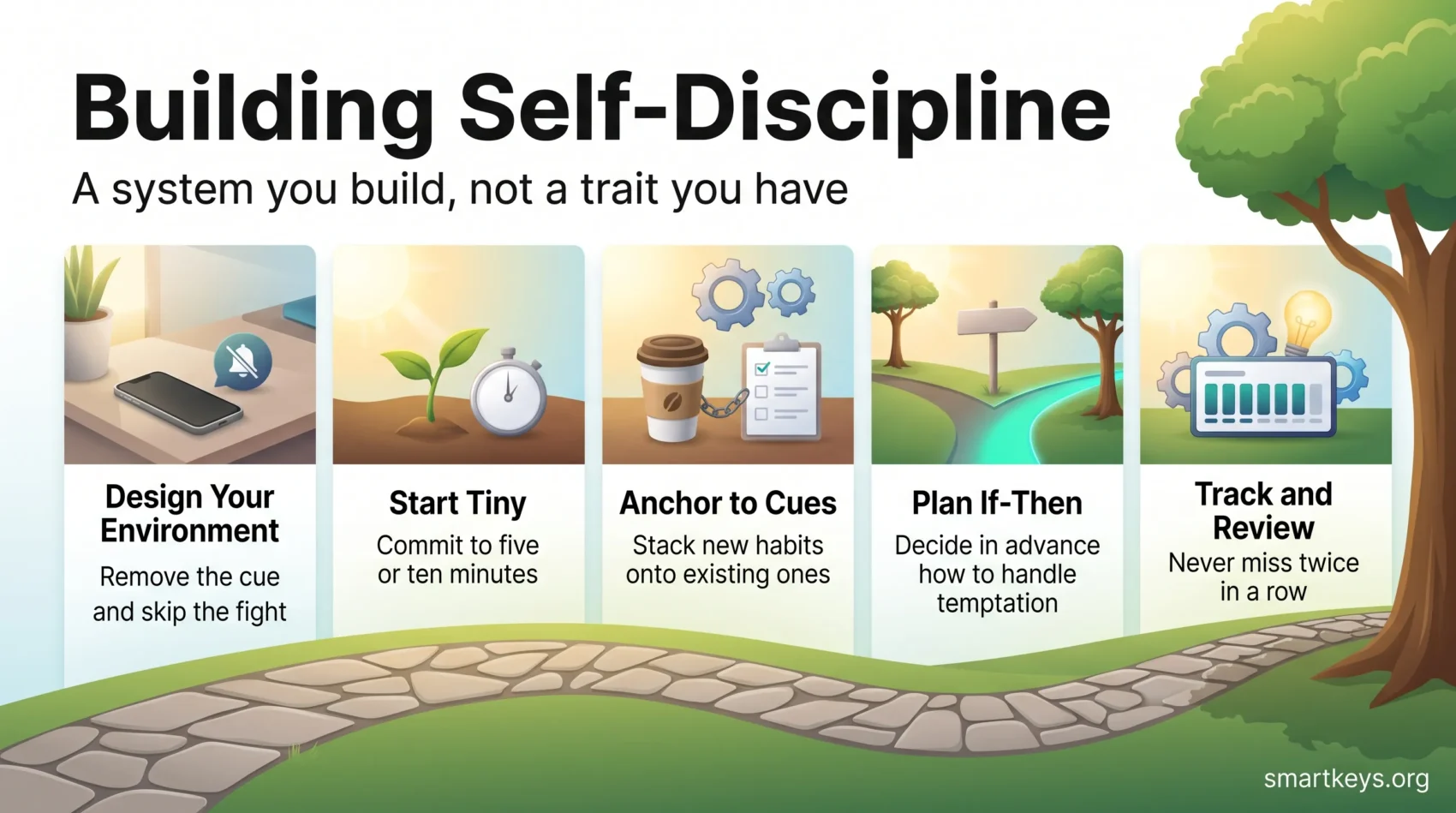
Remove the cue and you skip the fight entirely. Take distracting apps off your home screen, mute nonessential notifications, and close every tab that is not part of the current task.
- Set a phone rule: specific check-in times and Do Not Disturb as the default.
- Install website blockers so the decision is made before the urge arrives.
- Run a digital declutter once a quarter to cut the background noise your attention pays for.
- Keep the desk itself sparse. A clutter-free workspace removes dozens of micro-decisions per day.
Protect focus with energy-aware scheduling
Schedule demanding work when your energy is highest and save admin for natural dips. Many people notice a window of two to three hours each day when hard thinking feels easier. Guarding it is worth more than an extra hour of tired effort.
Track your focus windows for a week, then rebuild your calendar around them. Our guide to managing energy rather than time covers how to map those peaks, and a short evening shutdown routine clears the deck so tomorrow starts without friction.
“Prioritize and execute.”
Build Habits and Rituals That Make Action Automatic
Build tiny rituals that nudge you into action, so effort feels normal rather than heroic.
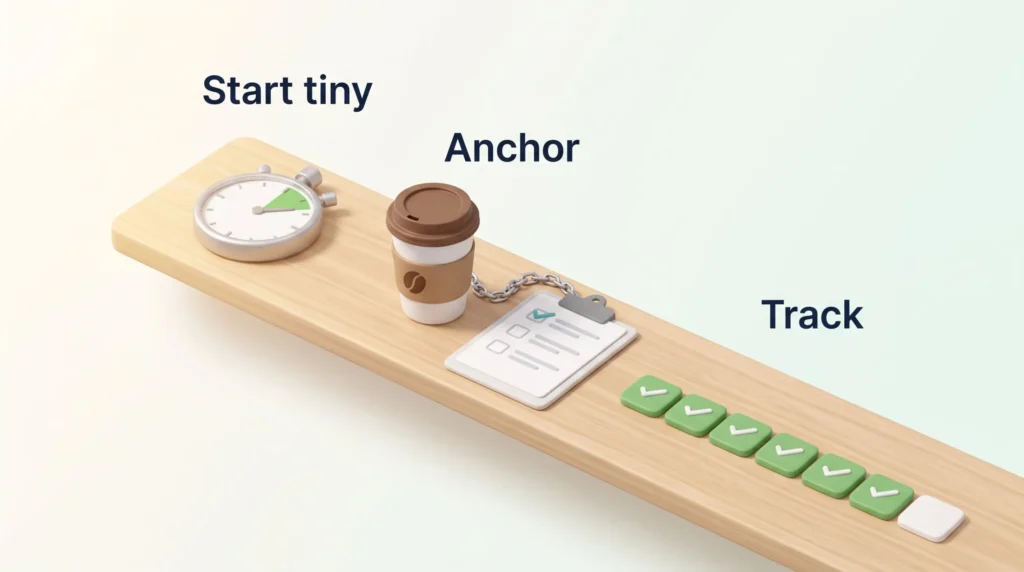
Start tiny: five to ten minutes, one step
Make the promise small enough that refusing feels silly. Commit to five or ten minutes, or a single step. Short openings reduce dread, and starting is almost always the hardest part. The two-minute rule works on this principle, and so do micro-habits: actions small enough to finish in about a minute, attached to something you already do. Our guide on how to build micro-habits for daily productivity walks through the setup step by step.
Eat the elephant one bite at a time
Break the goal into time-bound steps you can finish in one sitting, and mark each one on a visible list. Micro-habits are about behaviour you repeat; micro-goals are about outcomes you finish. If you want a method for sizing and scheduling those small outcomes, see our walkthrough on setting daily micro-goals you can finish today. For anything large enough to feel paralyzing, our approach to tackling big projects shows how to slice it without losing the thread. Putting the hardest item first, known as the eat-the-frog method, removes the dread before it can spread across the day.
Anchor routines to cues you already have
Attach the new habit to an existing one: after the first coffee, review the top task. This is called habit stacking, and it works because the cue already exists in your day. For ready-made combinations, browse these habit stacking examples for work and home.
- Start tiny: 5-10 minutes to begin.
- Micro-steps: something you can finish today.
- Anchor: tie the habit to a cue that already fires daily.
- Track: a simple habit tracker app or printable template makes the streak visible and worth protecting.
Train Your Willpower: Get Good at Discomfort
Urges are signals, not orders. Short timed challenges teach you that difference faster than any amount of reading about it.
Urge-surfing and the write-or-nothing rule
Write-or-nothing asks for a 10 to 15 minute commitment: either do the one task, or sit still and watch how your mind reacts. There is no third option, so there is nothing to negotiate.
Start with two minutes of slow box breathing to settle, then set the timer.
- Short bursts: ten minutes is enough to expose the urge.
- Surf it: name the urge, breathe, let it crest and fade.
- Log the win: date, minutes, one sentence. It is proof you can sit with discomfort.
Practice, not perfection
Treat willpower like training volume. Daily reps beat rare marathon sessions, and a completed small rep counts for more than a perfect session you skipped. On low-energy days, shrink the task, reset the timer, and take the single rep. Adding a brief mindfulness practice makes the urges easier to notice before they act on you.
“Discomfort is short. The habit is long.”
Execution Systems That Keep You on Track
A system removes guesswork, so you spend less time debating and more time finishing.
Interval training for focus
Start at 10 minutes on, 5 minutes off. Use a clear start cue and a visible timer so you always know whether you are working or resting. As your stamina improves, extend the blocks. The Pomodoro technique at 25 minutes is the common next step, and time blocking scales the same idea across the whole calendar.
Implementation intentions: if-then plans that pre-empt failure
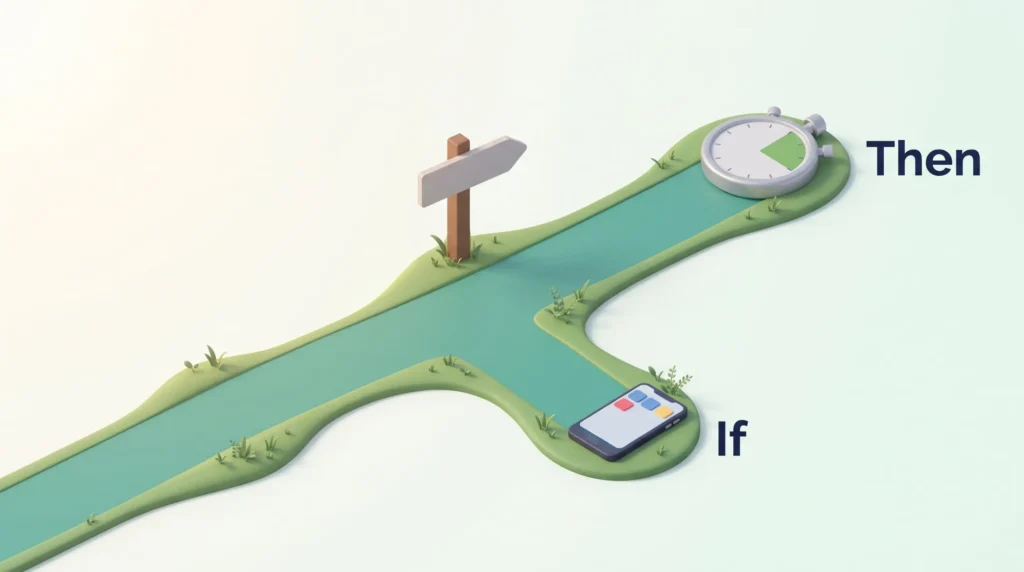
Write simple if-then plans for the derailers you can already predict. For example: “If I open social media during a work block, then I close the tab and restart a 10-minute timer.”
This is one of the best-evidenced tactics in behavioural science. A landmark meta-analysis by Peter Gollwitzer and Paschal Sheeran, covering 94 studies, found a medium-to-large effect on goal attainment. The reason is simple: the plan fires automatically instead of requiring a fresh decision in the moment. Pairing an unpleasant task with something you enjoy, known as temptation bundling, works on the same principle from the opposite direction.
Mentors and accountability
Recruit one peer or mentor who will give you blunt feedback, and align your weekly plan with your team so expectations are shared rather than assumed. For many people, a regular check-in with an accountability partner does more for follow-through than another app.
- Track minutes and completed tasks somewhere you will actually look.
- Log one learning per session, so the data tells you what to change.
- Celebrate small wins: mark the streak, close the loop, move on.
Run a weekly review: what worked, what slipped, which if-then plan needs a rewrite. Fifteen minutes here prevents weeks of quiet drift.
A four-week starter plan
| Week | Focus | Daily commitment |
|---|---|---|
| 1 | Remove friction | Mute notifications, clear the desk, pick one keystone habit |
| 2 | Anchor the habit | 10 minutes at a fixed cue, tracked on a visible streak |
| 3 | Add if-then plans | Write three plans for your most predictable derailers |
| 4 | Extend and review | Stretch blocks to 25 minutes, run your first weekly review |
After four weeks you will not be “done” (remember the 59-to-66-day median), but you will have a system that no longer depends on how you feel when the alarm goes off.
Four Mistakes That Quietly Break Consistency
- Starting too big. An hour a day sounds committed and collapses by week two. Ten minutes survives bad weeks.
- Changing several habits at once. Each one competes for the same limited attention. Sequence them instead.
- Treating one miss as failure. Missing once is noise. Missing twice in a row is the start of a new pattern. That is the line to defend.
- Optimizing the system instead of doing the work. Rebuilding your setup can feel productive while producing nothing. Watch for this productivity pitfall specifically.
Conclusion
End each day by naming one win and one clear first step for tomorrow. It takes ninety seconds and removes the hardest decision from your morning.
The loop is simple: clarify one goal, remove the temptations around it, take one small step today, and note what helped your focus. Repeat it long enough and the habit stops being something you do and becomes how you work. If you want a broader structure around it, our self-management framework connects these pieces into one accountable routine.
Discipline is not a trait you were issued or denied. It is an exercise, and like any exercise it responds to consistent, unglamorous reps.
Found this useful?
Make SmartKeys a preferred source on Google, and our articles will surface more often in your Top Stories, AI Overviews, and AI Mode.
Add as Preferred Source