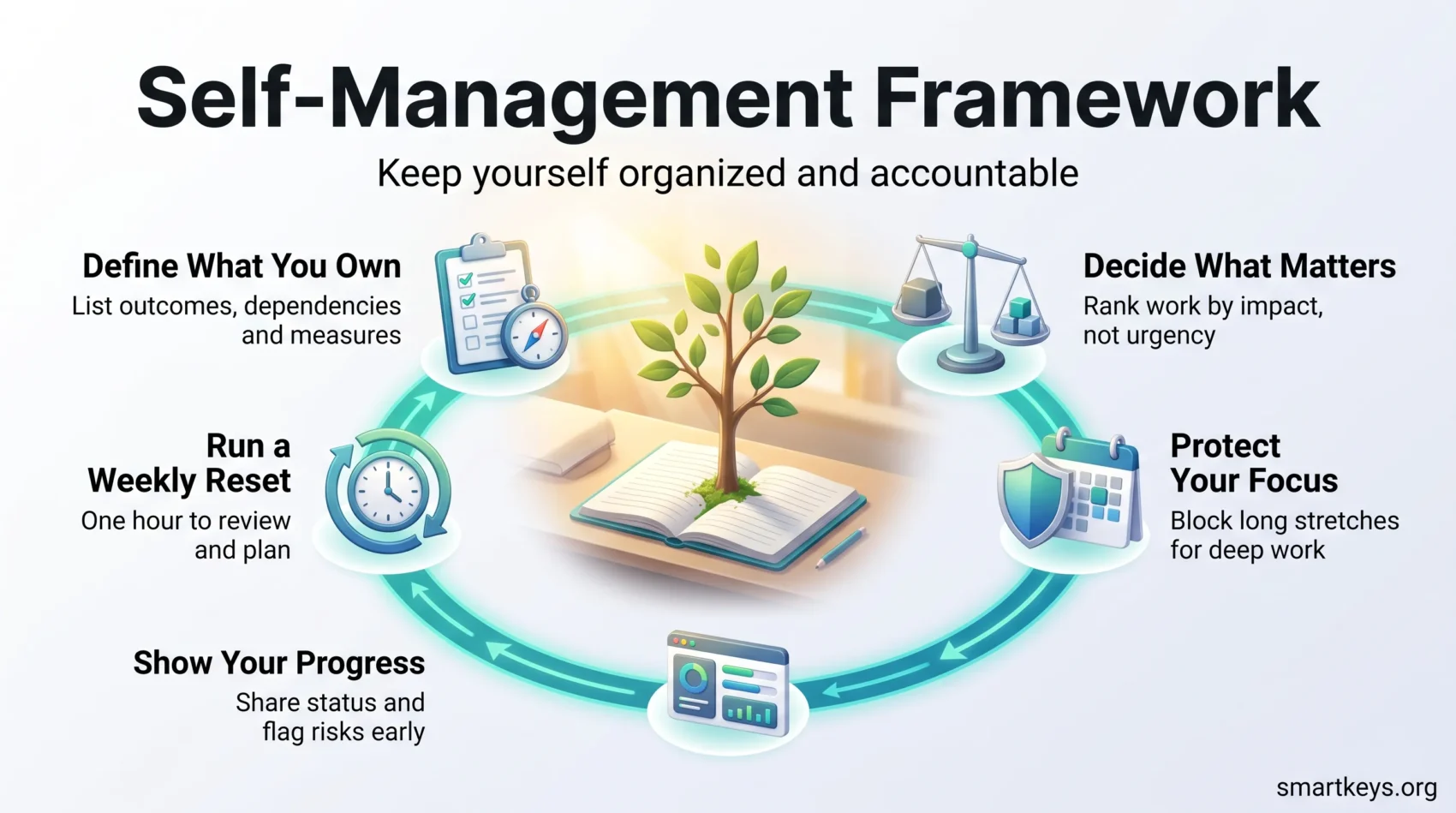
Self-management is the skill of turning what you intend to do into work that actually gets finished, without someone standing over you.
It is built from ordinary parts: knowing what you are responsible for, deciding what matters most today, protecting the hours you need for hard thinking, and telling other people where things stand. None of it is complicated. The difficulty is doing it every week, including the weeks when everything changes on Tuesday.
This guide walks the full loop. You get clear on your role, build the core skills of time, stress, adaptability and communication, turn goals into tracked outcomes, and close each week with a short reset. One rule holds it together: do what you said you would do. If you want a starting point for the goal part, our guide to setting goals you actually reach pairs directly with the framework below.
Key Takeaways
- Clarity first: you cannot manage work you have never defined.
- Focus over frenzy: one task at a time protects both quality and speed.
- Link goals upward: every daily task should point at a result someone is waiting for.
- One skill at a time: a single new habit per week sticks. Five at once do not.
- Show progress: short, regular updates are what buy you autonomy.
Why self-management matters more than it used to
Work moved, and the change is permanent enough to plan around. About 25% of paid full days in the United States were worked from home in May 2026, according to the Survey of Working Arrangements and Attitudes, a monthly survey of US workers run by the WFH Research team. Before the pandemic the figure was under 6%.
That statistic has a very practical consequence. When nobody can see your desk, the only evidence of your work is what you deliver and what you say about it. Self-management stops being a soft skill and becomes the mechanism by which your effort is visible at all.
Take a marketing coordinator running three campaigns at once. Nobody watches her open her laptop. What her team sees is whether the landing page went live on Thursday, and whether she flagged the missing legal review on Monday instead of Thursday afternoon. The second part is self-management just as much as the first.
Three things follow from this:
- You own the sequencing. Nobody is going to tell you which of your five open tasks to do at 9am. Choosing well is now part of the job.
- You own the early warning. A slipping deadline that surfaces on the day it is missed costs your team a scramble. The same slip raised a week earlier costs a five minute conversation.
- You own your recovery. Without a commute or an office closing time, the boundary between work and rest is one you have to draw yourself.
None of this requires more hours. It requires a repeatable way of deciding, working and reporting, which is what the rest of this guide sets out.
What self-management actually means
Most definitions start with emotional intelligence, which is the ability to notice what you are feeling and choose your response instead of reacting automatically. That sounds abstract, so here is the everyday version.
A request lands at 4:30pm and it is urgent, or at least the sender says so. The automatic response is to drop the report you are halfway through and switch. The self-managed response takes ten seconds longer: is this actually more urgent than the report, who is waiting on each, and can the new request wait until 9am tomorrow? Then you reply either way, so the sender is not left guessing.
That ten second pause is the whole skill in miniature. You noticed the pull, you applied a rule, and you communicated the outcome. Everything else in this article is a way of making that pause reliable rather than accidental.
Two things are worth saying plainly. First, this is learnable. It is a set of habits and checklists, not a personality type. Second, it is not the same as working harder or never asking for help. Someone who quietly struggles for three days rather than sending one question is managing themselves badly, not well.
Get clear on yourself first: role, dependencies and baseline
Before you optimise anything, write down what you are actually responsible for. Most people have never done this, and it is why their priorities feel arbitrary.
Map responsibilities, dependencies and measures
Take twenty minutes and write three short lists.
- Responsibilities: three to five recurring things you own. Not tasks, outcomes. “Weekly customer report is accurate and out by Tuesday noon” rather than “run reports”.
- Dependencies: for each one, who has to give you something, and by when. This is where most missed deadlines are actually born.
- Measures: one or two signals that show it is going well. On time delivery, error rate, a stakeholder who stops chasing you.
Then send the list to your manager and ask one question: is this the right order? The conversation takes ten minutes and settles months of quiet second-guessing.
Spot the patterns that get in your way
Three patterns account for most stalled work: putting things off, polishing past the point of value, and refusing to hand anything over. Each has a tell.
Procrastination usually shows up as a task that has been rewritten on your list four times without being started. Perfectionism shows up as a fourth revision nobody asked for. Refusing to delegate shows up as evening work on tasks a colleague could do in half the time.
Notice when they appear rather than judging yourself for having them. They cluster around ambiguity: unclear briefs, high visibility projects, work you have not done before. If you know that, you know when to slow down and ask a question instead of pushing through. Our guides to overcoming procrastination and delegating work without losing control go deeper on the first and third.
Rate your starting point
Score yourself honestly on three questions, from one to five:
- How much genuinely uninterrupted time did you get last week?
- When priorities changed, how quickly did you produce a new plan?
- How often did the people depending on you have to ask where something stood?
The lowest score is where you start. There is no benefit in improving all three at once.
The core skills, and what to do about each
These five skills carry most of the load. Treat them as separate practices with separate fixes.
Time management
Rank work by impact rather than by who asked most recently. The Eisenhower Matrix sorts tasks by urgency and importance in about two minutes, and heavier options exist if you need to compare projects rather than tasks: see our overview of task prioritization frameworks.
Then put the top item in your calendar rather than on a list. Time blocking works because a block is visible to other people and a list item is not. For incoming requests, a simple triage rule keeps the list short: our guide to the 4 Ds of time management covers do, defer, delegate and delete. Batch similar work so you switch context four times a day instead of forty, and see time management techniques for busy professionals for the wider toolkit.
Protecting focus
Cognitively demanding work needs stretches long enough to get into it. That is the case for deep work: fewer, longer blocks rather than an hour chopped into six pieces.
The practical enemy is the notification. Turning off badges and grouping alerts into two or three delivery windows removes most interruptions without making you unreachable, and our guide to managing work notifications sets out how to do it without annoying your team.
Stress and energy
Stress management at work is mostly boring logistics: realistic commitments, breaks that actually happen, and sleep. Short pauses between blocks restore more attention than pushing through, as covered in how short breaks restore focus, and sleep quality affects your judgement before it affects how tired you feel.
The load management side matters just as much. Saying no to the fourth project is a self-management skill, not rudeness, and saying no without damaging relationships and setting boundaries at work both cover how to phrase it. If you are already past the point of tiredness, the honest fix is a smaller workload, not a better productivity tactic.
Adaptability and decision-making
When priorities shift, the failure mode is stalling: waiting for certainty that is not coming. Fix it by deciding in advance what “enough information” means. Write down the two or three things you need to know, gather those, and choose.
Then set a review point. “We go with option A and check the numbers in two weeks” is a decision you can reverse cheaply, which makes it much easier to make on time.
Communication and organisation
State the goal, the deadline and the risk in that order, and keep it short. One task list, one calendar, one place for files. A personal kanban board is enough structure for most individual workloads and shows at a glance how much you have in progress, which is usually too much.
From goals to outcomes: align, plan, track
A goal that is not connected to a result somebody wants is a hobby. This section is about closing that gap.
Write goals that ladder up
SMART goals are specific, measurable, achievable, relevant and time-bound. The part people skip is relevant: name the team or company objective each goal serves. If you cannot name it, either the goal is wrong or you need to ask your manager what you are missing.
Plan backwards from the result
Start at the finished state and work back. List the milestones, then the resources and the risks, then the first three actions. Big goals stall because the first move is unclear rather than because the goal is too hard, which is the argument in our guide to breaking large goals into achievable steps.
Sequence what unlocks other work
Not all tasks are equal in the schedule. The ones that unblock other people should go first even when they are small, because a blocked colleague costs the team more than a delayed report costs you. Our guide to focusing on what actually matters covers the trade-offs in more depth.
Make progress visible
Track in one place, review weekly, and adjust with what you see rather than what you assumed in January. Visible tracking also does something quieter: it protects you from the feeling that a busy week produced nothing. One dashboard, one weekly look, no separate reporting ritual.
Self-management at work: showing your value every day
Reliability is built from small commitments kept in public, and it is worth more than an impressive plan.
Do what you say you will do
DWYSYWD is the shorthand: commit carefully, deliver on time, and raise risks the moment you see them. The last part is the one people get wrong. Flagging a problem early reads as competence. Flagging it late reads as a surprise, no matter how good the reason.
A useful default is a two sentence weekly update: where things stand, what is blocking you, what happens next. It takes three minutes and removes most of the reason anyone would check on you.
Ask for help at the right size
Asking for help is not a failure of self-management. Asking too late is. The useful version is specific and small: “I need fifteen minutes on the pricing logic” rather than “can we talk about the project”.
When you bring a problem upward, bring two options and the trade-off between them. That turns a request into a decision your manager can make in a minute.
Lead yourself in a hybrid setup
Distributed work rewards predictability. Set a cadence people can rely on, protect deep work blocks in a shared calendar, and write down agreements that cross time zones instead of leaving them in a call. Our guide to remote leadership skills covers the team-facing version of the same habits, and future leadership skills looks at where these behaviours are heading.
Composure matters most when the plan changes. Translating a shift into a concrete new plan, quickly and without drama, is the single behaviour that gets people trusted with bigger work.
Habits and tools that keep it running
Systems fail when they are too elaborate to maintain. Keep them small enough that you still use them in a bad week.
The weekly reset
Book one hour with yourself, same slot every week. Review what got done, what did not and why, then set the top three priorities for the coming week and put them in the calendar before anything else fills it. On chaotic days, a ten minute end-of-day checkout does the same job at smaller scale. Our guide to running a weekly review has a workable agenda.
Recovery as part of the system
Sleep, movement and a few minutes of quiet are not rewards for finishing. They are inputs. A short walk between two hard tasks is a scheduling decision, not a break from work.
Starting when you do not want to
When a task feels heavy, shrink the first step until it is almost trivial: open the document and write the heading. The two-minute rule works on the same principle for small tasks, and habit stacking helps if the problem is remembering to start at all.
Accountability you cannot quietly skip
Systems you maintain alone are easy to abandon. A standing check-in with a colleague, or an accountability partner outside your team, adds just enough social cost to keep the habit alive. It is also the cheapest fix available on the weeks when motivation is simply absent.
Your self-management playbook: what to do this week
Here is the whole framework compressed into four steps you can start today, without new software or extra meetings.

1. Agree what success looks like
Send your manager the responsibilities list from earlier and ask which two matter most this quarter. Clear expectations are what let you say no to everything else without a negotiation each time.
2. Practise one behaviour daily
Pick exactly one, for example a 90 minute focus block before your first meeting, and do it every working day this week. Mark it done on a calendar. One behaviour repeated beats five attempted.
3. Write a four line plan
Outcome, milestones, risks, next three actions. Then schedule the first action. A plan without a calendar entry is a wish.
4. Control what you can control
When you are stuck, ask what the smallest useful thing you could do in the next ten minutes is, and do that. Replace the pattern rather than fighting it: instead of putting it off, start small; instead of polishing, ship a rough version and ask for feedback.
Control what you can, propose options rather than problems, and make your progress visible.
Conclusion
Self-management is not a personality trait and it is not the ability to work longer. It is a loop: define what you own, decide what matters, protect the time to do it, and tell people where things stand.
The loop is measurable. Composure, adaptability and results all improve with deliberate practice, and the improvement is visible to everyone who depends on you.
Pick one thing before you close this page. Block ninety minutes for tomorrow morning, write your three responsibilities, or send a two sentence update to someone who is waiting on you. Small commitments kept in public are what the whole framework is made of.
Found this useful?
Make SmartKeys a preferred source on Google, and our articles will surface more often in your Top Stories, AI Overviews, and AI Mode.
Add as Preferred Source