Most goals do not fail because the plan was wrong. They fail quietly, in the week nobody asks about them. An accountability partner is the simple fix: one person who knows what you said you would do and checks whether you did it. No qualification, no subscription, just a standing appointment and an honest answer.
The idea has better evidence behind it than most productivity advice. In a study by psychology professor Gail Matthews at Dominican University of California, the most successful participants wrote their goals down, shared them with a friend and sent that friend weekly progress reports. Sharing alone helped. Sharing plus a weekly report helped more. That is the case for accountability partnerships in one sentence.
Key Takeaways
- An accountability partner is someone you report progress to on a fixed schedule.
- In the Dominican University study, 76% of participants who sent weekly updates to a friend reached their goal or got at least halfway, against 43% who only thought about their goals.
- The reporting rhythm matters more than the relationship. A vague “let us check in sometime” does nothing.
- Agree the rules first: what you report, how often, and what happens when you miss.
- Pick someone reliable and willing to be honest, not simply someone who likes you.
- Groups add variety and survive absences, but need a chair to stay useful.
- Free tools like stickK and Focusmate can carry the routine when no partner is available.
What an Accountability Partner Actually Does
The term sounds more formal than the arrangement is. Two colleagues who message each other every Friday with three lines about the week are running an accountability partnership.
A Working Definition
An accountability partner is someone you have told about a specific goal, who has agreed to ask about it at fixed intervals. Three parts make it work. The goal has to be specific enough to answer yes or no. The interval has to be fixed, not “whenever we speak”. And the partner has to be willing to notice when the answer is no.
Take a freelancer who wants to publish one case study a month. Told to nobody, that goal competes with client work and loses every time. Told to a partner who asks on the first Tuesday of the month, it becomes a deadline with a face attached. The work did not change; the visibility did.
The Main Types of Accountability Support
People fill this role in different ways:
- A friend or colleague: Easiest to arrange and free. Best when your goals are similar enough that you understand each other’s obstacles.
- A manager or mentor: Brings experience and can unblock problems you cannot solve alone.
- A paid coach: The most consistent option, because they have no reason to let a missed week slide. Also the most expensive.
- A peer group: Several people reporting to each other. Slower per person, but you get more perspectives on a stuck problem.
- An app: Reminders, streaks and financial stakes replace the human. Weaker on empathy, stronger on never forgetting.
No option is best: a partner who shows up beats a coach you cancel on.
What the Research Actually Shows
Accountability advice is full of confident percentages with no paper behind them. Three findings are worth knowing, because you can trace each to a source.
The Dominican University Goal Study
Gail Matthews recruited 267 people from businesses and networking groups and randomly assigned them to five conditions, from simply thinking about a goal up to writing it down, sharing it with a friend and sending weekly progress reports. Of the 149 who finished, 43% in the think-only group reached their goal or got at least halfway. That rose to 62% for those who wrote goals and shared their commitments, and to 76% for those who added weekly reports.
Two caveats are worth stating plainly: the sample was modest and self-selected, and the outcome measure mixed “achieved” with “halfway there”. Treat it as a direction rather than a precise multiplier. The direction is consistent, though. The more regular the reporting, the better the result.
Why Specific Plans Beat Good Intentions
Part of what a partner does is force you to name a next action, and that matters on its own. A meta-analysis by Peter Gollwitzer and Paschal Sheeran pooled 94 independent tests of implementation intentions, which are if-then plans of the form “if it is Tuesday at 9am, then I write the case study”. Forming one had a medium to large effect on goal attainment (d = .65).
A check-in produces these plans almost by accident. When someone asks “what will you have done by next Friday?”, a vague ambition has to become a dated action. If you want to build that habit deliberately, our guides to goal setting and setting SMART goals cover how to phrase objectives you can actually report on.
Where Money Changes Behaviour
Some partnerships add a stake: miss the target, pay a forfeit. Economists have tested this. In a field experiment by Xavier Giné, Dean Karlan and Jonathan Zinman, published in the American Economic Journal: Applied Economics, smokers in the Philippines could deposit their own money into an account they would forfeit if they failed a nicotine test six months later. Those offered the contract were 3 percentage points more likely to pass. That is a real effect from a serious study, and it is small. Money helps at the margin, but it does not replace wanting the outcome.
Why Accountability Works
The mechanism is less mysterious than the marketing suggests. Three things change once someone else knows.
A Deadline With a Face Attached
Work expands to fill the time available, an observation known as Parkinson’s Law. A check-in date creates an edge where none existed. You are not working harder because your partner is impressive, but because Thursday is now a real deadline instead of a soft intention.
Small Social Stakes, Consistently Applied
Telling one person you will do something is a mild commitment. Repeating that promise every week compounds it. Nobody enjoys reporting the same non-progress three weeks running, and that discomfort is enough to move most tasks off the bottom of the list.
Support When the Plan Goes Wrong
The underrated half of the arrangement is problem solving. A partner who has watched you miss the same target twice can often see the cause before you do: the goal was too big, the slot was wrong, or the task keeps colliding with your busiest day. If procrastination is the recurring pattern, naming it out loud is often the first step to fixing it.
How to Choose the Right Accountability Partner
The wrong partner is worse than none. A partnership that quietly dissolves looks like proof the method fails, when the real problem was the pairing.
The Qualities That Matter
Four traits do most of the work:
- Reliability: They turn up. Everything else is secondary, because a check-in that keeps getting rescheduled provides no accountability.
- Willingness to be honest: A partner who says “no problem, next week” every time is company, not accountability.
- Discretion: You will be describing things that went badly. That needs to stay between you.
- Comparable stakes: Someone chasing a goal of similar size will take yours seriously. A large mismatch turns the arrangement into one-way mentoring.
Shared subject matter is a bonus, not a requirement.
Where to Look
Start with people who already see your work: a colleague on another team, a former coworker, someone from a professional community. If nothing fits, industry Slack groups often run accountability channels, and coaches and mastermind groups sell the service outright.
Whoever you pick, run a trial. Agree to three check-ins, then decide together whether to continue. Ending a short experiment is easy; ending an open-ended commitment is awkward, so people avoid it and let the partnership rot instead.
Setting Up a Check-In That Survives Month Two
Most accountability partnerships die of vagueness. Settle the mechanics before the first meeting.
Agree the Rules First
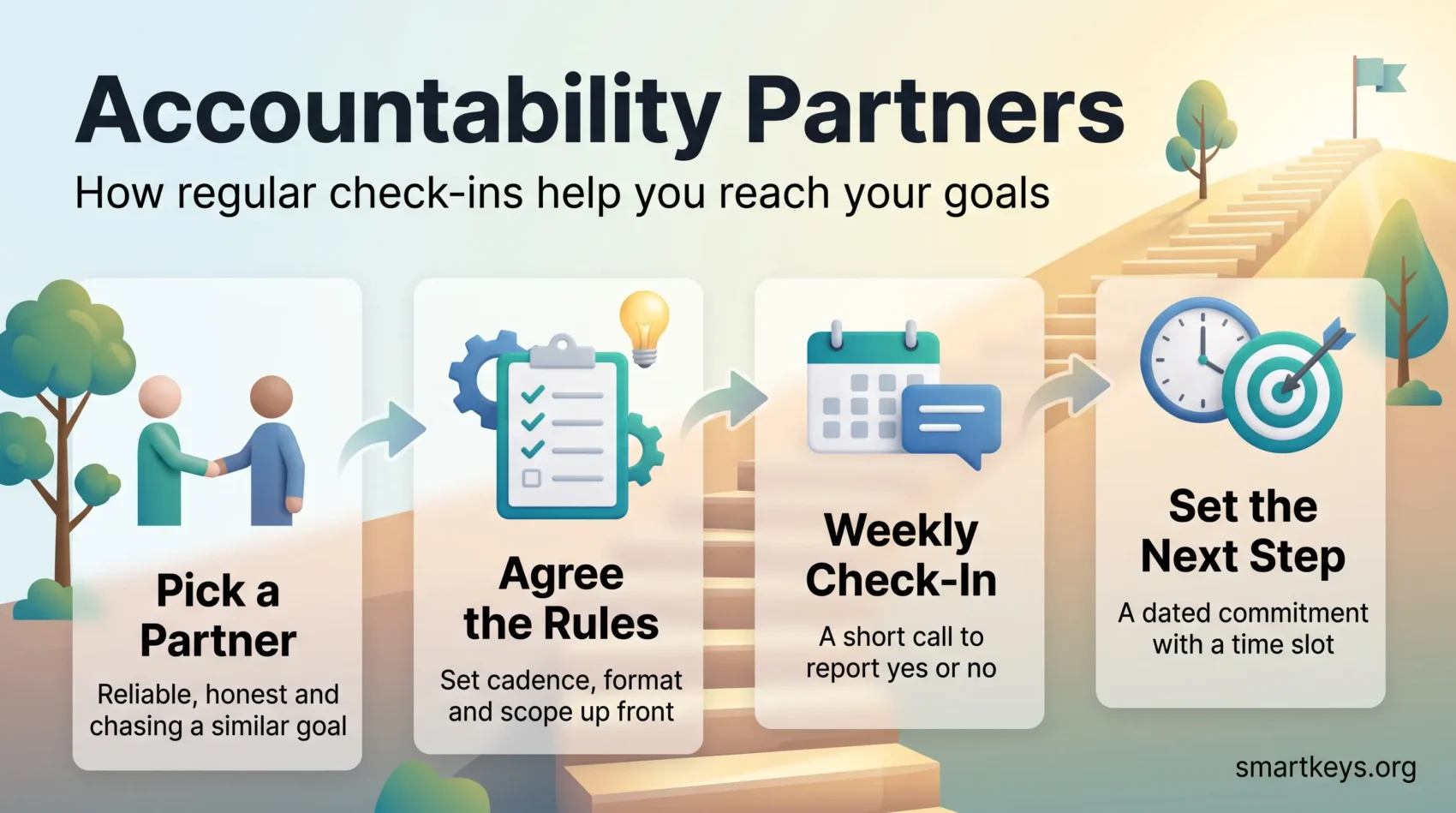
Decide four things and write them somewhere you both can see:
- Cadence: Weekly suits most work. Monthly is too slow to correct a bad habit; daily usually collapses within a fortnight.
- Format: A 15 minute call, a voice note, or three lines in a message thread. Shorter formats survive busy weeks.
- Scope: Name the specific goals you are reporting on. Two or three is plenty.
- A miss: Agree in advance whether a missed target gets a question, a new deadline or a forfeit.
A Check-In Agenda That Takes 15 Minutes
A repeatable structure keeps the meeting short and stops it drifting:
- What did you commit to last time, and did it happen? Yes or no first, explanation second.
- What got in the way? Name the obstacle, not the feeling.
- What is the commitment for next time, with a date and a time slot attached?
That third question is the one people skip, and it is the one that does the work. Pair it with a scheduling method that makes the slot real, such as time blocking, timeboxing or the Pomodoro Technique.
Keep a record. A shared document, a goal tracking template or a simple habit tracker gives you something to look back on when progress feels invisible. Many people fold the same review into a personal weekly review and a longer monthly review, so the partner conversation has a prepared answer waiting.
Accountability Groups
A group is the same arrangement with more people and more scheduling.
When a Group Beats a Single Partner
Groups survive absence: if one member disappears for a fortnight, the rhythm continues. They also bring several angles to a stuck problem. The trade-off is time. Five people reporting properly need close to an hour, and without someone keeping order the meeting turns into a conversation with no decisions. Groups of three to five work best. If you are weighing a paid program, our look at what productivity mastermind groups deliver and cost helps you judge one.
Common Group Formats
- Peer led: No leader, everyone reports in turn. Cheap and equal, but drifts unless someone timekeeps.
- Facilitated: A coach or rotating chair runs the agenda and makes sure quiet members are heard. More structure, more cost.
- Company internal: Peer groups inside an organisation, often run alongside learning or development programmes.
Rotate the chair if nobody is paid to run it: a group with no owner is a group with no agenda.
Tools That Support Accountability
Software does not replace a partner, but removes the friction that kills the habit.
Apps and Platforms
- stickK: Free commitment contracts built by behavioural economists at Yale. You set a goal, name a referee to verify it, and optionally stake money you lose if you fail.
- Focusmate: Books you into video co-working sessions with a stranger who is also working. Three sessions a week are free; unlimited sessions cost $8 a month billed annually or $12 billed monthly, as listed in September 2026. Our guide to structured co-working sessions shows how to run one and compares online and in-person options.
- Shared boards: A visible board makes commitments checkable without a meeting. A personal kanban board works well.
- Calendar tools: A recurring calendar invite is the least glamorous and most effective accountability tool there is.
Prices and free tiers change, so check the vendor page before committing.
Online Communities
With no obvious partner to hand, communities can supply one. Subreddits, Discord servers and professional Slack groups run threads where members post weekly commitments. Expect higher turnover than a one-to-one partnership, in exchange for finding someone quickly and free.
Where Accountability Partnerships Fail
Two failure modes account for most collapses, and both are fixable if you name them early.
Nobody Wants to Admit a Bad Week
The partnership stops working the moment reporting becomes performance. People describe effort instead of results, or quietly reschedule the call. Head this off by agreeing at the start that a “no” is a normal answer and the interesting part is what comes next. Some pairs make it explicit: every check-in, each person names one thing that did not go to plan.
Mismatched Goals and Effort
The other failure is imbalance. One person prepares, the other improvises. One wants direct challenge, the other wants encouragement. Neither preference is wrong, but unstated ones grate. Review the arrangement every few months: is this still useful, and is the cadence still right?
If your own preparation is the weak link, a short written habit helps. Productivity journaling or a note of daily intentions gives you something concrete to report rather than a reconstruction from memory.
Conclusion
Accountability partners work because they turn private intentions into commitments with a date and a witness. The research supports the direction clearly: written goals plus a person plus regular reporting beats good intentions. It does not support the tidy percentages that circulate online, and you do not need them to justify a weekly 15 minute call.
Start small. Pick one goal you keep postponing, find a reliable person, agree a fixed slot and try it for a month. Pair it with whatever keeps your week structured, whether that is time management techniques, micro-habits, habit stacking or protected blocks for deep work. When motivation dips, as it will, our guide to staying motivated covers what to do next, and the eat the frog method is a good default for the task you keep reporting as unfinished.
Found this useful?
Make SmartKeys a preferred source on Google, and our articles will surface more often in your Top Stories, AI Overviews, and AI Mode.
Add as Preferred Source