A monthly review is a fixed appointment with yourself, once a month, to look at what happened, work out why, and decide what to do next. It takes about an hour. Done regularly, it replaces the vague feeling of “this month went by fast” with a clear picture of what moved forward, what stalled, and which few changes are worth making.
A monthly review steps back far enough to see patterns. One missed deadline is noise. Three missed deadlines on the same type of project is a signal, and you only catch it when you look at a whole month at once. This guide gives you a four-part structure (wins, setbacks, lessons, plan) and a way to turn what you learn into a 30-60-90 day plan you will actually follow.
Key Takeaways
- Block one hour on a fixed date each month, ideally the last working day, and treat it like a client meeting.
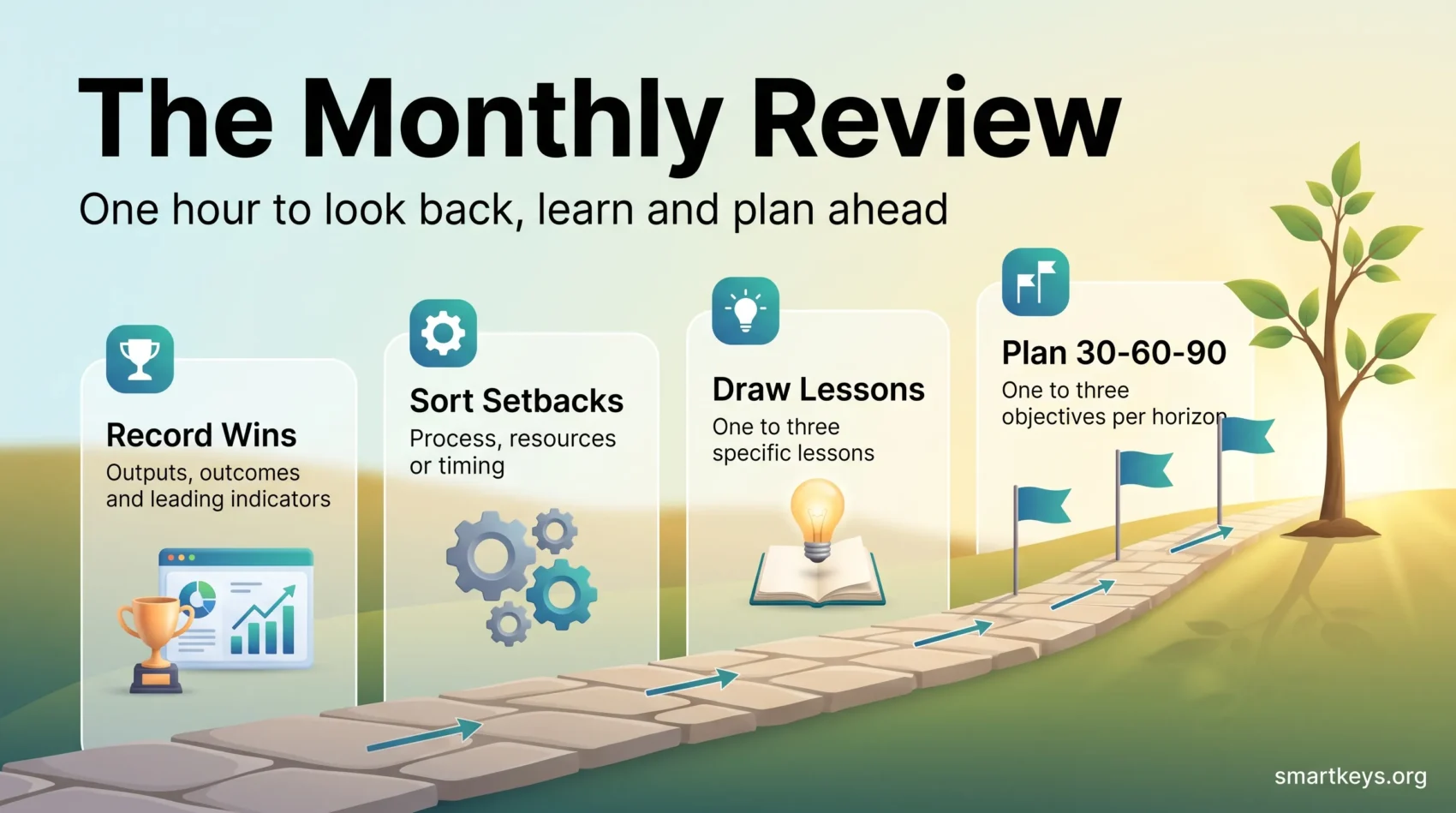
- Work through four parts in order: wins, setbacks, lessons, and the plan for next month.
- Judge progress by outcomes and leading indicators, not by how busy you were.
- Sort every setback into process, resources, or timing before you decide what to fix.
- End with a 30-60-90 day plan: one to three objectives per horizon, each with a measurable milestone.
What a Monthly Review Is and Why It Works
A monthly review is a structured look back at the past four weeks, followed by a short plan for the next four. It sits between two other habits. A weekly review clears your inbox and sets priorities for the coming days; an annual review looks at your bigger direction. The monthly review is the middle layer: close enough to the work to be specific, far enough away to spot trends.
Why the month? A study by Hengchen Dai, Katherine Milkman and Jason Riis (Management Science, 2014) found that people are more likely to start on goals right after a “temporal landmark” such as a new month. This “fresh start effect” gives you a natural moment to reset. A monthly review puts a plan behind that motivation instead of letting it fade by the third day.
It also clears your head. Unfinished goals stay active in your mind and compete for attention until you decide what to do about them; that nagging feeling is an open loop. A monthly review closes those loops in one sitting: each stalled item gets a next step, a new deadline or an honest decision to drop it.
Set Up Your Monthly Review in Four Steps
1. Choose a fixed date and protect it
The last working day of the month is the most common choice: the numbers are complete and the next month has not started yet. If your work runs in sprints or billing cycles, use the day after those close. Put the review in your calendar as a recurring one-hour block. If it is not on the calendar, something more urgent will always take its place.
2. Decide what the review covers
Cover the areas that matter to you: for most people that means work projects, skills and learning, health and energy, and one or two personal areas such as finances. Keep the list short. A review that covers ten areas in an hour covers none of them well.
3. Gather your inputs before you sit down
Useful inputs include your completed task list, your calendar, any personal productivity metrics you track, a habit tracker, and your weekly review notes. If you keep a productivity journal, skim the last four weeks of entries. Ten minutes of preparation saves thirty minutes of hunting.
4. Use the same template every time
A plain document with four headings (Wins, Setbacks, Lessons, Next Month) is enough, in a notes app, a spreadsheet or a paper notebook. If you like a visual overview, a productivity dashboard template can hold the numbers while the document holds the thinking. Name each month’s file consistently (“2026-09 review”) so entries sort cleanly across years.
Part One: Record Your Wins with Clear Signals
Finished work stops being visible, so most people underestimate what they did. Go through your task list and calendar and write down what actually shipped, closed or improved. Then sort each win into one of three types:
- Outputs: things you produced or delivered. A report sent, a feature released, a course module completed.
- Outcomes: things that changed as a result. A client renewed, a process got faster, a team conflict was resolved.
- Leading indicators: early signs that predict future results. More discovery calls booked, a faster reply rate from a partner, a habit kept for four straight weeks.
Outputs are easy to count; outcomes are what you are paid for. A month with many outputs and no outcomes is a warning sign, and you only see it if you separate the two.
Add the softer gains too: a skill you learned, a relationship that improved, a system that will save time from now on. These rarely appear on a task list, yet they often matter more than any single deliverable. If you use goal tracking or personal OKRs (objectives and key results, a method that pairs each goal with the numbers that prove you reached it), update the progress on each one now.
Finally, pick one repeatable win and write down the steps that made it work. Concrete proof of progress is also useful for a performance review or a one-on-one meeting with your manager.
Part Two: Learn from Setbacks Without Assigning Blame
List what did not go to plan: the missed deadline, the stalled project, the habit that lasted nine days. Keep it factual. “The proposal went out a week late” is useful. “I was lazy about the proposal” gives you nothing to change.
Sort each setback into process, resources or timing
Almost every setback fits one of three categories, and each points to a different fix:
- Process: the way the work was organized failed. Approval steps took too long, nobody owned the hand-off, the task was never broken into steps. Fix: change the workflow.
- Resources: you lacked time, money, information, tools or people. Fix: get the resource, or scale the goal down to match what you have.
- Timing: the work landed in the wrong week. A launch collided with a holiday, a key person was on leave, an outside event changed priorities. Fix: move the date, or add a buffer.
Ask “which category?” before “whose fault?”. That turns a vague sense of failure into a specific experiment for next month.
Check for the usual suspects
Two patterns show up in almost every review. The first is optimistic estimating: the work took longer because the plan was never realistic. This is the planning fallacy, and the fix is to base next month’s estimates on how long similar work actually took. The second is a project that sat untouched for four weeks. It usually needs a clear next action rather than more motivation. If you keep running out of time without knowing where it went, a one-week time audit in the first week of the new month will show you.
Write one safeguard per setback
For each setback, note one small protection: a buffer day before a deadline, a backup contact, a checklist for the hand-off. Then add it to the plan. Lessons that stay in the notes change nothing.
Part Three: Turn Observations into Lessons
Read back through your wins and setbacks and write one to three lessons. A good lesson is specific and points to a behavior: “Client projects need a written scope before I quote a date.” A weak lesson is general and points nowhere: “I need to manage my time better.”
Look for patterns across months. If the same lesson appears three reviews in a row, the problem is not awareness: either the fix has not been tried, or it did not work. This is also where productivity pitfalls become visible, for example when you spent more time reorganizing your system than using it.
Finish with one decision you will change next month and one habit you will carry forward.
Part Four: Plan Ahead with a 30-60-90 Roadmap
A 30-60-90 plan splits the next quarter into three horizons: what you will finish in 30 days, what will be in progress by day 60, and where you want to be by day 90. Each monthly review rolls the plan forward, so last month’s 60-day items become this month’s 30-day items.
Set one to three objectives per horizon
Fewer objectives get finished. For each one, write a one-sentence reason it matters now, two to four measurable milestones, and one assumption to revisit halfway through. If an objective feels too large to start, use the method in breaking large goals into smaller steps to find the first concrete task. The principles of good goal setting apply here as well: specific and measurable beats ambitious and vague.
Check the calendar before you commit
Plot holidays, fiscal deadlines, travel and known busy periods on the timeline, and match deliverables to the weeks when the people you depend on are available. A plan that ignores a two-week holiday will fail on schedule.
Build a short risk register
A risk register is simply a list of things that could go wrong and what you will do about each. Keep it to three to five lines (a supplier delay, a budget cut, a colleague on leave), each with a buffer, a backup or a scaled-down version of the goal.
Add a warm-start list
Write down three tasks you can finish in 30 minutes on the first working day of the new month; quick, visible progress makes the rest of the plan easier to pick up. For a structured way to run the first 30 days, see focus sprints. Use time blocking to give your top objective a fixed place in the week. Put the milestones into your normal task management system so the plan does not live in a file nobody opens.
Common Mistakes and How to Avoid Them
Letting the review grow. A three-hour review will be skipped by the third month. Give each part about 15 minutes and stop when the timer rings.
Reviewing activity instead of results. A full calendar is not progress. Count outcomes and leading indicators, not meetings attended.
Skipping the review in a bad month. The months you least want to review have the most to teach. Shorten it if you must, but keep the appointment.
Starting from scratch each time. Open last month’s review first and check which of its planned changes actually happened. That thirty-second step turns a habit into real improvement over a year.
Conclusion
A monthly review is one hour that shapes the other 160 or so working hours in the month. Record the wins with clear signals, sort the setbacks into process, resources and timing, distill one to three lessons, and roll them into a 30-60-90 plan.
Run it on the same date every month, with the same template, and read the previous month’s notes first. After three or four cycles you will have a written record of how you actually work, which fixes stuck, and where next month’s effort will pay off most.
Found this useful?
Make SmartKeys a preferred source on Google, and our articles will surface more often in your Top Stories, AI Overviews, and AI Mode.
Add as Preferred Source