The sharing economy is a simple idea with complicated consequences: instead of buying something, you pay for temporary access to something that already belongs to someone else. A spare room, a car, an hour of a designer’s time. Digital platforms match owner and user, take a cut, and handle payment and trust.
That idea has stopped being novel and become infrastructure. Airbnb booked 533.0 million nights and seats in 2025 and processed $91.3 billion in gross booking value. Uber handled 13.6 billion trips and $193.5 billion in gross bookings that year. In the US, more than 72 million people now work independently, and 42 percent say online platforms are their main way of finding work. This article covers what that means for business models in 2026: where the model earns money, where it has failed, and what the new rules require.
Key Takeaways
- The sharing economy is now dominated by a small number of very large platforms rather than a broad market of small ones.
- Airbnb reported $12.2 billion in revenue and $2.5 billion in net income for 2025; Uber reported $52.0 billion in revenue on $193.5 billion of gross bookings.
- Access over ownership works best where the asset is expensive, idle for long stretches and easy to insure.
- Regulation is now the biggest variable: EU member states must write the Platform Work Directive into national law, and the US Department of Labor reopened its worker classification rule in February 2026.
- Widely repeated forecasts from the 2010s, including the often quoted $335 billion figure, are projections from 2014 and should not be treated as measurements.
What the Sharing Economy Actually Is
The term covers three different things that often get lumped together, and separating them makes the business logic clearer.
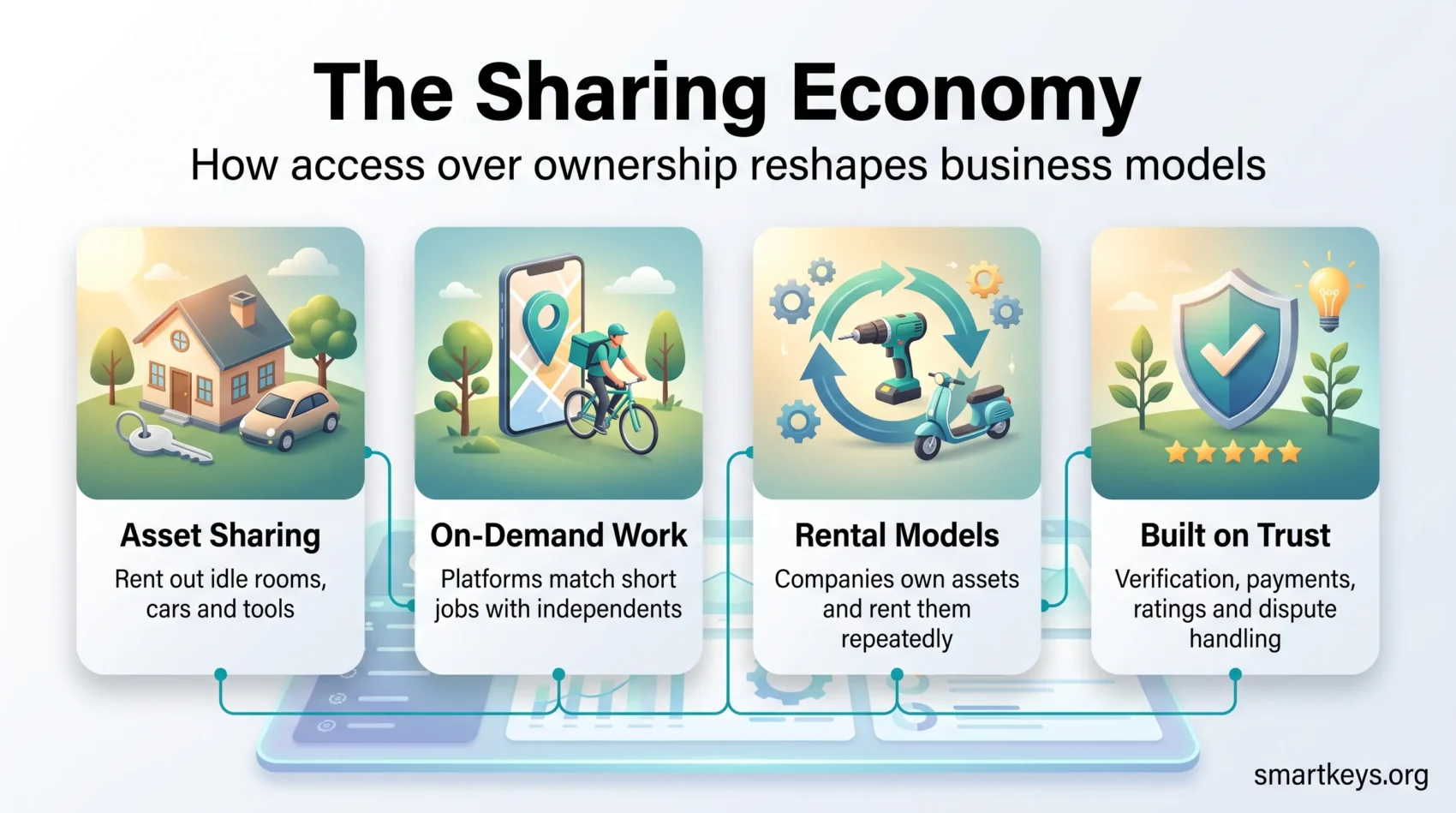
The first is peer-to-peer asset sharing: someone with an underused asset rents it out, as on Airbnb and Turo. The second is on-demand labour: a platform routes short jobs to independent workers, as Uber, Lyft and food delivery apps do. The third is access-based subscription, where a company owns the asset and rents it repeatedly. Car clubs and equipment rental fit here, and so, loosely, do streaming services.
Only the first is really “sharing” in the everyday sense. The other two are platform business models that use similar technology. Grouping them together is how a market ends up described as growing at an implausible rate: you are adding up three sectors with very different economics.
The common thread is the matching layer. Before smartphones, finding a stranger willing to rent you their spare room for two nights was harder than the room was worth. Payment processing, identity checks, ratings and GPS made the transaction cheap enough to bother with. That is the real innovation, and it explains why the model spread fastest where assets are expensive and sit idle: property and vehicles.
Understanding Access Over Ownership
For a customer, the appeal is straightforward. You get the use of something without the purchase price, the maintenance, the insurance or the storage. For the owner, an asset that was costing money starts earning some of it back.
That trade only works within limits. Renting is usually cheaper than owning when you need something rarely, and more expensive when you need it constantly. A drill used twice a year is a good candidate. A laptop used every day is not. Be honest about which side of that line your category sits on, because customers work it out quickly.

A second limit gets less attention: trust has a cost. Every platform spends real money on verification, insurance, dispute handling and fraud prevention, and those costs do not disappear at scale. Digital trust is an operating expense, not a one-off feature.
Sharing Economy Trends and Their Impact
The model has reshaped travel, transport and retail, and it is reshaping business models in adjacent categories. Three trends matter most for anyone planning around it.
Growth Has Concentrated, Not Spread
The 2010s produced a wave of forecasts predicting broad, rapid growth. The most quoted was PwC’s 2014 estimate that five sharing sectors would reach $335 billion in global revenue by 2025. It was a projection made more than a decade ago, and it is still copied into articles as though it were a measured result. It is not.
What happened is narrower and more interesting. A small group of platforms became very large while the long tail thinned out. Airbnb’s 2025 revenue of $12.2 billion, with $2.5 billion of net income, shows a business past the growth-at-any-cost stage. Below that tier, consolidation and closures have been the pattern.
Resale Has Become the Fastest-Moving Category
Buying used is the least glamorous form of access over ownership, and it has grown fastest. GlobalData, in research for ThredUp, put US secondhand apparel growth at 14 percent in 2024 and projected the global secondhand apparel market at $367 billion by 2029, a compound annual growth rate of around 10 percent.
For retailers this is a channel decision rather than a curiosity. Several brands run their own resale marketplaces instead of leaving the secondary market to third parties, which keeps the customer relationship and the margin in house. It also fits the circular economy commitments many companies have made.
Business-to-Business Sharing Is Growing Quietly
Shared warehousing, equipment pooling and freight capacity marketplaces get far less coverage than consumer apps, but solve the same problem. For a mid-sized manufacturer, renting capacity during a demand spike beats buying it and carrying it through quiet months.
The Rise of Peer-to-Peer Marketplaces
Peer-to-peer marketplaces let individuals earn from assets they already own. The technology is no longer the hard part. Building supply and demand in the same place at the same time is.
Why Some Marketplaces Work and Others Do Not
The successful ones share a pattern. The asset is worth enough that renting it out justifies the hassle, the transaction happens often enough for people to form a habit, and the platform can price and insure the risk. Accommodation and vehicles meet all three conditions, which is why they produced the biggest companies. Categories that fail usually fail on frequency: a tool-sharing app can be well built and still stall, because most people need a ladder twice a year and would rather ask a neighbour than open an app.
What the Car-Sharing Shakeout Showed
Car sharing is the clearest recent case study. Getaround shut down its US car-sharing operations on 12 February 2025, citing a lack of liquidity, while continuing in several European markets. Turo, its larger competitor, withdrew its planned US listing the same month.
Neither event means peer-to-peer car rental has no future. Both show that the model is capital hungry and insurance heavy, and that second or third place is a hard position to hold. If you are entering a sharing category, the strength of the incumbent matters more than the elegance of your product.
The Gig Economy: Flexibility and Its Costs
On-demand labour platforms touch the most people. MBO Partners put the US independent workforce at more than 72 million in its 2025 State of Independence study, with Generation Z making up 28 percent of it.
What Draws People In
The appeal is control over when and how much you work, plus a low barrier to starting. Someone with a car, a camera or a design skill can be earning within days. For businesses, the appeal is matching labour cost to demand instead of carrying fixed headcount, which is why freelance talent platforms are now part of normal workforce planning rather than an emergency measure.
What It Costs the Worker
The trade is real and worth stating plainly. Independent workers usually fund their own health cover, pensions, sick leave and equipment, and they carry the risk when demand drops. Income arrives unevenly and tax is their own problem to manage.
That gap is what regulators have spent recent years arguing about, and it is why many independents build a portfolio of clients rather than depend on one platform. If you manage this kind of workforce, our guide to working with freelancers covers the practical side, and our overviews of gig economy trends and gig economy 2.0 cover the wider picture.

The Rules Changed: Regulation in 2026
For most of its history the sharing economy grew faster than the law governing it. That gap is closing, and it is now the biggest planning variable for any platform that uses independent workers.
In the European Union, the Platform Work Directive was adopted by the Council in October 2024, and member states were given two years to write it into national law. It does two things. It creates a legal presumption of employment when the facts show a platform directing and controlling the work, putting the burden on the platform to prove otherwise. And it forces platforms to disclose how automated systems allocate work, set pay and restrict accounts, while banning the processing of data such as inferred emotional state or union activity. The Council has estimated that around 28 million people worked through digital labour platforms in the EU in 2022.
In the United States the picture is unsettled. The Department of Labor proposed a rule on 26 February 2026 that would rescind the 2024 independent contractor rule and apply a streamlined economic reality test, focusing on control over the work and the worker’s opportunity for profit or loss. The comment period closed on 28 April 2026 and the rule is not final. State law adds further variation.
The takeaway is not that one outcome is coming, but that classification is no longer a background detail. It affects pricing, unit economics and where you can operate. Our pieces on gig economy regulation and algorithmic management go deeper on both threads.
Rental and Subscription: Renting Instead of Owning
The rental economy is the commercial cousin of peer-to-peer sharing. A company owns the asset and rents it repeatedly, which removes the supply problem but adds a balance sheet.
Renting appeals to customers who want flexibility, who move often, or who cannot justify the capital cost. It appeals to businesses because a rented asset earns revenue over its whole life instead of once. The catch is utilisation: a rental business only works if the asset is out earning for a high share of the time, so demand forecasting and logistics matter more than marketing.
Subscription models sit close by and share the same maths, with one difference: revenue is predictable but cancellation is easy, so retention becomes the core metric. Our subscription business overview covers how those models are performing now.
Sustainable Consumption through Sharing
Sharing is often presented as automatically greener. It can be, but the effect depends on what it replaces.
Where the Environmental Case Holds
- Fewer items produced: when several households share one drill or car, fewer are manufactured. This is the least disputed benefit.
- Longer product lives: resale and rental keep goods in use for longer, the core of the sustainability case consumers actually reward.
- Better use of existing capacity: filling an empty seat or warehouse bay avoids building new capacity.
Where It Does Not
The rebound effect is real. If a cheap ride-hailing trip replaces a walk, a bus journey or a train, emissions go up rather than down. If cheap resale encourages people to buy more overall, the saving shrinks. Delivery platforms add vehicle miles that did not exist before.
Sharing reduces impact when it displaces ownership or a more polluting alternative, and increases it when it creates trips or purchases that would not otherwise have happened. Companies making green claims about shared models should be able to show which of the two is happening, especially as claims rules tighten. Tools for measuring it are covered in our look at carbon accounting software.
Digital Platforms as Business Models
The technology underneath a sharing platform is now well understood, which has lowered the barrier to launching one and raised the bar for competing.
What the Technology Layer Has to Do
A working platform needs five things: identity verification, a matching engine, payments with escrow or delayed release, a reputation system, and dispute resolution. Most of this can be assembled from existing services, so the differentiator is rarely the code. It is liquidity, meaning enough buyers and sellers that both sides get a fast match. Machine learning has changed pricing most of all, which is why pricing strategy is a core competence on these platforms rather than a finance task.
Where the Model Is Heading
Two directions look durable. Vertical marketplaces that serve one industry deeply, because trust and compliance are easier in a narrow category. And embedded models, where sharing is added to an existing business rather than launched as a standalone app, which is how many digital marketplaces now start.
The Platform Economy and Business Innovation
Platforms create value differently from traditional companies. A manufacturer builds a product and sells it. A platform builds a place where other people transact, then takes a share. That difference explains both the scale some platforms reach and the scrutiny they attract.
The economics are attractive because growth does not require proportional capital: adding a host costs a platform far less than adding a hotel room costs a hotel chain. They are fragile because participants can leave, and because a platform’s value to each user depends on how many others stay.
For established companies, the lesson is rarely “build a marketplace”. It is to ask which parts of the business could be opened to outside supply or demand. A logistics firm might sell spare capacity. A software vendor might let partners build on its data. That is the practical form business model innovation usually takes.

The counterweight is dependency. A business that gets most of its customers through one platform has handed over pricing power and the customer relationship. Many direct-to-consumer brands exist because their founders decided that trade was not worth making twice.
Implications for Small Businesses
Small firms can use the sharing economy without building a platform. The gains come from renting capability instead of buying it.
Adapting to Sharing Economy Dynamics
This economy lets you:
- Cut costs by sharing physical resources such as storage, workshop space or delivery capacity with other businesses
- Use marketplaces to reach customers you could not reach alone, while keeping a direct channel of your own
- Scale labour up and down with demand instead of carrying fixed headcount through quiet periods

Outsourcing and Efficiency Gains
Shared and on-demand resources turn fixed costs into variable ones, which matters most for assets you use rarely. Key advantages include:
- Avoiding large capital investments for infrequently used equipment
- Converting fixed costs into variable ones through cloud services and shared logistics
- Adding capabilities you cannot justify hiring for, which is the case for outsourcing selected tasks
The risk to watch is dependence. If one platform supplies most of your customers or most of your labour, a policy change on their side becomes a crisis on yours. Many micro-entrepreneurs manage this by running two or three channels in parallel from the start.
How to Build a Business in the Sharing Economy
If you are starting something here, the questions below separate ideas that can work from ideas that only sound good.
Test the Category Before the Product
- Is the asset expensive and idle? If it is cheap or in constant use, sharing adds friction without value.
- How often will a customer transact? Once or twice a year rarely builds a habit or recovers acquisition costs.
- Can the risk be insured at a sane price? This is where most niche ideas quietly die.
- Which side is harder to get? Almost always supply. Plan for that before you spend on demand.
Build Trust and Price It In
- Verification: identity and background checks proportionate to the risk in your category.
- Clear liability: both sides should know who pays for damage before anything is damaged.
- Visible dispute handling: fast, fair resolution drives repeat use more than any feature.
- Classification clarity: decide how workers are engaged, and check it in every market you enter.
Conclusion
The sharing economy did not replace ownership and did not fade away. It settled into the categories where its economics work: expensive assets that sit idle, and labour businesses want to buy by the hour rather than the year.
Three things are worth holding onto for 2026. The market is concentrated, so entering it means competing with well funded incumbents rather than filling an empty space. The environmental case is conditional and depends on what the sharing replaces. And regulation, particularly around who counts as an employee, is now the variable most likely to change the maths of a platform business.
The opportunity for most companies is not to build the next Airbnb. It is to find the assets, capacity or skills already sitting idle in their own operation, and work out whether someone else would pay for access to them.
Found this useful?
Make SmartKeys a preferred source on Google, and our articles will surface more often in your Top Stories, AI Overviews, and AI Mode.
Add as Preferred Source