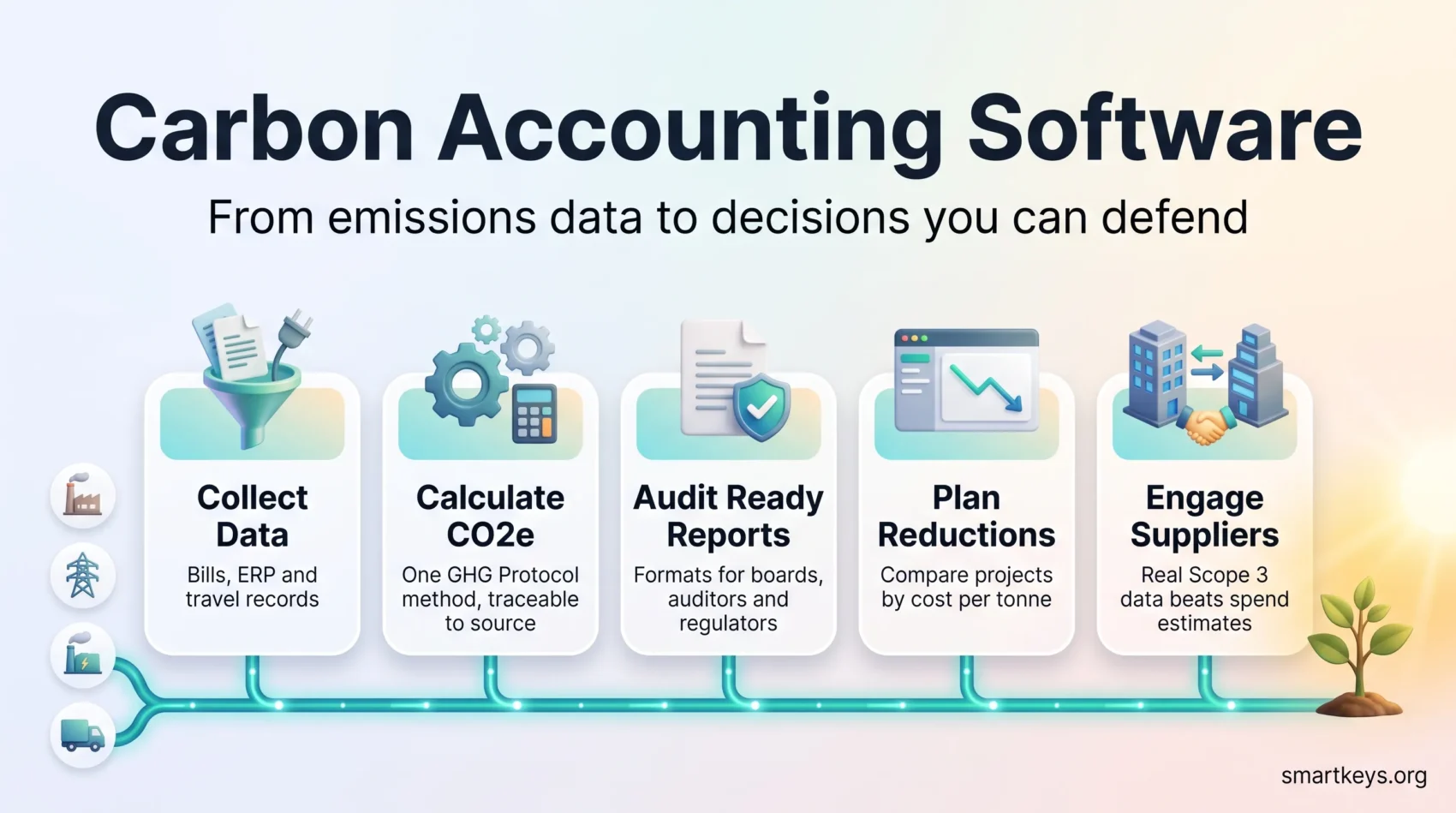
Carbon accounting software collects the data behind a company’s greenhouse gas emissions, calculates a footprint from it, and turns that into reports auditors and regulators will accept. Think of it as bookkeeping for emissions: instead of euros and invoices, you are tracking fuel, electricity, freight and purchased goods.
Most companies still cannot do this well. In the fifth annual carbon survey from Boston Consulting Group and CO2 AI, published in September 2025, only 7% of the 1,924 executives surveyed said their company measures emissions comprehensively across all three scopes. That number has fallen every year since 2023. At the same time, 82% said decarbonization had produced some economic benefit for the business.
That gap is the practical problem. Reduction targets, customer questionnaires and disclosure rules all assume you have a reliable number. This guide explains what these platforms do, how the market looks in 2026, what vendors actually publish about price, and which rules now shape your reporting.
Key Takeaways
- Only a small minority of companies measure all three emission scopes comprehensively, and the share is falling.
- The core job of the software is data collection, standardized calculation, and audit-ready reporting in one place.
- Scope 3, the emissions in your value chain, is usually the largest and hardest part.
- Most serious vendors do not publish prices, so budget for implementation and integration, not just the licence.
- The rules moved in 2026: CSRD scope narrowed, California pushed its first deadline to November, and the SEC proposed scrapping its climate rule.
Why emissions data is a bookkeeping problem first
Before a company can cut emissions, it has to know where they come from. That sounds obvious, and it is exactly where most programmes stall.
Most companies still cannot measure what they promise to cut
The BCG and CO2 AI survey covers 1,924 executives across 26 countries and 16 industries. Its headline finding for 2025 was that comprehensive measurement across Scopes 1, 2 and 3 sat at 7%, down from 9% the year before and 10% the year before that. Measurement is getting harder, not easier, mainly because Scope 3 keeps expanding as companies look further into their supply chains.
Meanwhile the data itself often lives in spreadsheets. A KPMG US survey of 550 board members, executives and managers, published in February 2024, found that 47% still used spreadsheets as their primary system for managing environmental, social and governance data.
What goes wrong when emissions live in spreadsheets
A spreadsheet works fine for one site and one year. It breaks in predictable ways once you scale:
- Version drift. Three regions send three files, each with a slightly different template, and nobody can say which is current.
- Invisible formulas. An emission factor hard-coded into a cell in 2023 quietly stays there in 2026.
- No audit trail. An assurance provider asks where a number came from, and the honest answer is that someone typed it.
- Manual rekeying. Time that could go into reduction projects goes into reconciling files instead.
The point of purpose-built software is not that it is smarter than your team. It is that it enforces one method, keeps a record of every input, and removes the copy-and-paste step. That is the same argument that drives a proper data governance strategy in any other part of the business.
The basics: CO2e and the three scopes
Two pieces of vocabulary carry most of the weight in this field. Both are simpler than they sound.
What CO2e means
CO2e stands for carbon dioxide equivalent. Greenhouse gases differ in how strongly they warm the planet, so methane, nitrous oxide and refrigerant gases are each converted into the amount of CO2 that would have the same effect. That gives you one number you can add up, compare between sites, and set a target against. It is also the unit behind any carbon neutrality claim, which is why the calculation method matters so much.
“Using CO2e lets you compare different sources on the same scale and set meaningful reduction goals.”
Scopes 1, 2 and 3 in plain English
The GHG Protocol, the accounting standard almost everyone uses, splits emissions into three buckets.
Scope 1 is what you burn directly: gas in your boilers, diesel in your own vans. Usually the easiest to measure because you have the fuel invoices.
Scope 2 is the energy you buy: electricity, heat, steam. Switching supply contracts or improving building efficiency shows up here quickly.
Scope 3 is everything else in your value chain: purchased goods and services, freight, business travel, and how customers use and dispose of your product. For most companies this is the biggest share by far, and it depends on data other organizations hold. That is why greener supply chains and emissions work end up being the same project. Employee commuting and home working sit here too, and the net effect of remote work on a company footprint is less obvious than it looks.
- Start with Scopes 1 and 2 for a fast, defensible baseline.
- Phase into Scope 3 category by category, beginning with your largest spend.
- Keep the method consistent so year-on-year comparisons mean something.
What carbon accounting software actually does
Strip away the marketing and these platforms do five things. Judge any vendor on how well it handles the ones that matter to you.
Data collection at scale
Good tools accept manual entry, bulk file uploads and API connections, so utility bills, ERP records, travel bookings and procurement data flow in without rekeying. The more of your digital procurement and finance data you can connect directly, the less time you spend chasing files.
Several vendors now use machine learning to map incoming line items to emission categories and to flag values that look wrong, such as a site reporting ten times its usual electricity use. That is genuinely useful, and it is also where vendor claims run ahead of reality most often, so ask for a demo on your own data.
Calculations you can defend in an audit
The calculation engine applies emission factors to your activity data. What matters is whether the method follows the GHG Protocol, whether the factor libraries are current and documented, and whether every figure can be traced back to its source and version. Some vendors have their methodology reviewed by an external body: Plan A, for example, states that its calculation methodology is certified by TÜV Rheinland. Treat certifications as one input, not proof on their own, and check what exactly was assessed.
Reporting for different audiences
Your board, your auditor, your biggest customer and a regulator all want different formats. Look for configurable report templates, PDF and CSV export, and an API so numbers can feed your existing business intelligence tools rather than living in a separate silo.
Target setting and decarbonization planning
An inventory on its own changes nothing. Scenario tools let you model what a fleet change or a supplier switch would do to the footprint, and compare projects by cost per tonne avoided. Dashboards should let you filter by site, supplier or category and drill into the underlying records, which is the difference between a chart and a decision.
Scope 3 and supplier engagement
Most Scope 3 estimates start with spend data multiplied by an industry average factor. That gets you a rough shape, not a plan. Improving it means asking suppliers for their own figures, which is what supplier portals and questionnaire modules are for. Structured, voluntarily shared supplier information has the same advantage as zero-party data in marketing: it beats inference.
“A capable platform becomes your single source of truth to operationalize sustainability goals and hit milestones.”
The carbon accounting software landscape in 2026
The market has consolidated noticeably. Analysts put it in the tens of billions of dollars: Fortune Business Insights estimated the carbon accounting software market at USD 27.5 billion for 2026, growing at about 22% a year to 2034, though estimates from different research firms vary widely depending on what they count. What is clearer is the shape of the field, and that software vendors are themselves under growing pressure to report, as our look at ESG reporting in SaaS covers.
Enterprise platforms
Persefoni, IBM Environmental Intelligence Suite and Sphera target large organizations that need governance, permissions and audit-grade output. Persefoni emphasises GHG Protocol and PCAF alignment and a traceable footprint ledger. IBM pairs emissions management with climate risk modelling. Sphera combines reporting with life cycle assessment, which suits manufacturers doing product-level work.
Ecosystem-native tools
If your company already runs on Microsoft or Salesforce, their own tools cut integration effort. Microsoft Sustainability Manager sells in Essentials and Premium editions and licenses at both tenant and user level; Salesforce offers Net Zero Cloud within its own platform. Neither publishes a full price list, and both route buyers through sales.
Decarbonization-first platforms
Plan A and SINAI put project selection and scenario modelling at the centre rather than reporting alone. If your goal is a ranked list of reduction projects with budgets attached, this is the right category to shortlist from. It also pairs naturally with wider climate tech investment decisions.
Supply chain and Scope 3 tools
This corner of the market changed hands in 2025. Emitwise, long a Scope 3 specialist, wound down its own product lines in June 2025, with Watershed taking on its customers under a strategic agreement; Green Project Technologies then acquired the Emitwise technology and part of its team in July 2025. If you read an older comparison that still lists Emitwise as a standalone option, that is why.
Watershed and Sweep remain the names to look at for supplier engagement and value-chain data, alongside Green Project. Check reference customers of a similar size, because supplier-facing tools scale very differently at 200 suppliers and at 20,000. This is the same due diligence you would apply to any supply chain resilience project.
Options for smaller companies
Greenly and Diligent ESG aim at teams without a dedicated sustainability function, trading depth for faster setup. Persefoni also offers a free tier, Persefoni Pro, which covers Scopes 1, 2 and 3 across all 15 Scope 3 categories and includes a report builder, limited to a single user. For a small company producing its first footprint, that is a realistic way to start without a procurement process.
How to choose: a practical checklist
Pick a system that turns data into decisions, not a repository that gathers dust. Work through the following before you shortlist.
Start from your biggest emissions source
If most of your footprint is purchased goods, a tool with beautiful Scope 1 dashboards will not help you. Run a rough estimate first, even a crude one, then buy for the category that dominates it.
Check standards alignment and what was certified
Confirm GHG Protocol alignment, ask which factor databases are used and how often they are updated, and ask what an external reviewer actually assessed. Then check the audit basics: data lineage, version history, role-based permissions, and an export your assurance provider can work from.
Test integrations and usability with real users
Verify connectors to your ERP, utility accounts, travel provider and finance system. Where native connectors are missing, an integration platform can bridge the gap, but that is extra cost and extra maintenance. Then put the interface in front of the people who will actually enter data, not the sustainability lead who already knows the vocabulary.
The rest of the checklist
- Scope 3 coverage: which of the 15 categories are supported, and is there a supplier portal?
- Target setting: does it support science-based targets and show progress against them?
- Security: SOC 2, ISO 27001, GDPR handling, and access controls your IT team will accept.
- Reporting frameworks: can it output the specific frameworks you are subject to without manual reshaping?
- Support: onboarding, sector experience, and named references in your industry and region.
- Exit: can you get your data out in a usable format if you switch vendors?
One practical test: run a short proof of value on a single high-impact category with your own messy data. It will tell you more than any demo.
What it costs and how to build the business case
Pricing in this market is unusually opaque, and any specific figure you read secondhand should be treated with caution.
What vendors actually publish
Very little. Salesforce lists Net Zero Cloud editions but shows “contact us” instead of a price. Microsoft documents the Sustainability Manager Essentials and Premium feature split and its two-part licensing on Microsoft Learn, but not the rate. Persefoni publishes that its Pro tier is free for one user, with Advanced priced on request. Third-party sites quote enterprise figures ranging from tens of thousands to several hundred thousand dollars a year, but those come from individual negotiated contracts and are not vendor-published list prices.
The honest planning assumption: a small company can start free or cheap, and an enterprise deployment is a significant annual commitment that you will only pin down by going to procurement.
Total cost of ownership beyond the licence
Budget for four things the licence does not cover: integration and data engineering work, internal time during onboarding, external assurance if you need audited figures, and modular add-ons such as supplier portals or extra regulatory modules. Companies that have run a finance automation project will recognise the pattern, because the software is rarely the expensive part.
Building the ROI case
Three arguments tend to convince a finance team:
- Time saved: hours no longer spent collecting and reconciling data, priced at loaded cost.
- Risk reduced: fewer restatements, cheaper assurance, less exposure if a disclosure rule applies to you.
- Decisions enabled: energy contracts, freight routing or supplier choices that cut cost and emissions at once.
If you are raising debt or capital with a sustainability component, credible numbers also matter to lenders, a trend covered in our piece on green finance. Model three years with conservative assumptions. An inflated business case is the fastest way to lose credibility in year two.
The rules that shape your reporting in 2026
Disclosure requirements moved substantially this year, mostly toward fewer companies reporting but with firm deadlines for those still in scope. This is the part of a sustainability strategy that changes fastest.
Europe: CSRD after the Omnibus
The EU’s Omnibus package cut the Corporate Sustainability Reporting Directive back sharply. Under the revised thresholds, large EU companies are in scope above roughly EUR 450 million in turnover and 1,000 employees, up from EUR 50 million and 250 employees. Listed small and mid-sized companies dropped out of scope entirely. Companies already reporting file their next reports in 2026 for financial year 2025; the next wave starts in 2028 for financial year 2027, and non-EU groups from 2029.
If you fell out of scope, the reporting obligation is gone but the customer questionnaires are not. Large clients still ask, which is a recurring theme in corporate responsibility reporting and in what consumers actually reward.
United States: California and the SEC
California’s SB 253 requires large companies doing business in the state to report emissions. The California Air Resources Board deferred the first reporting deadline on 24 June 2026, moving it from 10 August to 10 November 2026. That first report covers Scope 1 and Scope 2 only; CARB has said Scope 3 requirements will follow in later rulemaking. SB 261, the climate risk reporting law, remains on hold pending litigation after a Ninth Circuit injunction in November 2025.
At federal level the direction is the opposite. The SEC proposed rescinding its climate-related disclosure rules, with the proposal published in the Federal Register on 3 June 2026. Companies that built reporting processes for that rule have not wasted the work, since California and EU customers still ask for the same underlying data.
Standards on the move: GHG Protocol and SBTi
Two things worth watching if you are signing a multi-year contract. The GHG Protocol and ISO are consolidating their corporate standards into a single co-branded standard, with an integrated public consultation planned for the second quarter of 2027. And the Science Based Targets initiative published Version 2.0 of its Corporate Net-Zero Standard in June 2026: its validation portal opens in the first quarter of 2027, and V2.0 becomes mandatory for target submissions after 31 January 2028. Ask vendors how they plan to support both transitions.
From data to action: what results look like
The tooling is only worth the money if it changes decisions. EV charging software company AMPECO is a useful example because its published numbers are modest and specific rather than sweeping.
AMPECO and Plan A
AMPECO used Plan A to centralise its emissions data and says the platform saved it significant time on manual data entry, though it does not publish a percentage. The concrete outcomes it does publish are a 2023 corporate footprint of 471 tonnes CO2e, a target of halving Scope 1 and 2 emissions by 2025 against a 2022 baseline, net zero by 2030, B Corp certification in 2023, and a Silver rating in its first EcoVadis assessment.
Turning analytics into a plan
The pattern that works is unglamorous. Build a baseline you trust. Find the two or three categories that dominate it. Assign each a named owner, a budget and a date. Then re-measure with the same method so you can tell whether anything actually changed. Companies pursuing circular economy models follow the same sequence.
“When your platform unifies data, reporting, and planning, momentum follows.”
Conclusion
Carbon accounting software solves a data problem: it collects emissions inputs, applies one consistent method, and produces figures somebody else can check. That matters more in 2026 than it did a year ago, because fewer companies are legally required to report while the ones that are face firmer deadlines, and because customers keep asking regardless.
Choose based on where your emissions actually sit, not on vendor size. Expect to pay for integration work as much as for software. And plan for the standards to shift, since both the GHG Protocol and the SBTi are mid-revision. If your emissions data will be pulled from your accounting system, check that connection early; our QuickBooks Online review covers what a small-business finance stack can export.
Treat the decision like any other risk management exercise: write down the assumptions now, so the person who inherits the reporting in two years can follow them. If you want guidance on vendor strategy more broadly, read our take on ESG SaaS strategies to shape your final choice.
Found this useful?
Make SmartKeys a preferred source on Google, and our articles will surface more often in your Top Stories, AI Overviews, and AI Mode.
Add as Preferred Source