Every workday has a carbon footprint, and where you spend it changes the number. A day at the office adds a commute plus your share of a heated, lit and air-conditioned building. A day at home removes the commute but adds heating, lighting and equipment in your own house. Which one wins is not obvious, and the honest answer depends on details you control.
The question is no longer academic. Roughly a quarter of paid working days in the United States were worked from home in May 2026, according to Stanford’s Survey of Working Arrangements and Attitudes. Among employees whose jobs can be done remotely, Gallup found 52% working hybrid, 28% fully remote and 21% fully on site. Hybrid is the default now, so the emissions trade-off is a standing business question rather than a one-off calculation.
This article walks through what the research measures, where the emissions really sit, and which changes give you the biggest reduction for the least effort. It also shows why some hybrid schedules cut emissions sharply while others cut almost nothing. For the wider business context, see our guide to sustainable business innovation. If you want to see how the remote work carbon footprint fits into greener careers and workplace habits more broadly, our overview of sustainable work practices covers the bigger picture.
Key Takeaways
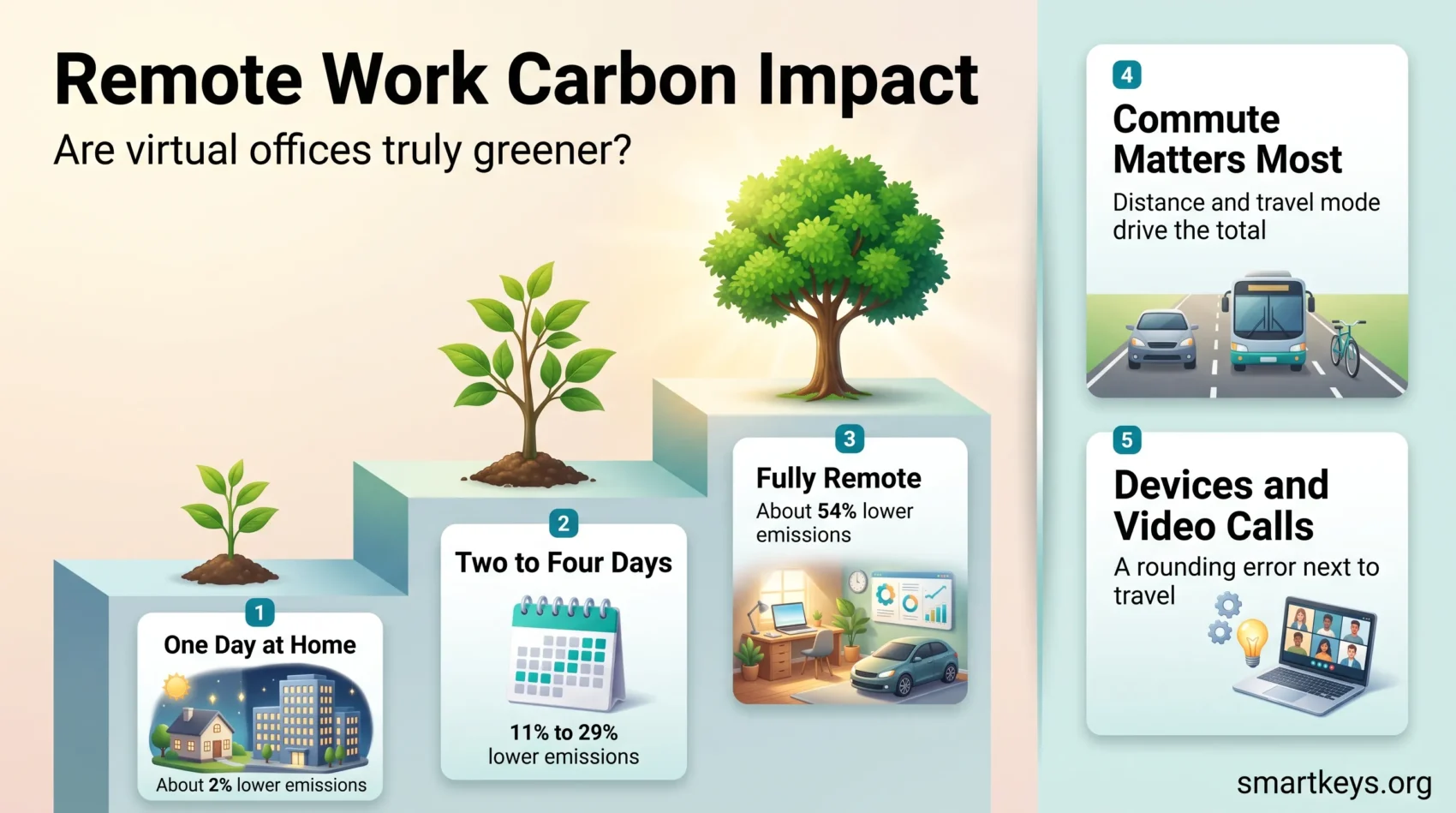
- Fully remote work cut individual emissions by about 54% in the largest study to date; hybrid schedules of two to four days at home cut 11% to 29%.
- One day a week at home changes almost nothing, because the office still runs at full capacity.
- Your commute is usually the single biggest item, so distance and travel mode matter more than anything else you do.
- Office buildings burn energy whether people show up or not, which is why sparsely occupied floors erase the savings.
- Laptops, video calls and internet use are a rounding error next to travel and heating.
Why the remote work carbon question is being asked now
Two things changed. Working from home stopped being a perk, and companies started reporting emissions in public filings rather than marketing brochures.
That second point is what turned this into a finance and compliance topic. Employee commuting sits in Scope 3, the category covering emissions a company causes but does not directly own, and it is now inside the reporting boundary for a growing number of firms. Our overview of carbon accounting software explains how those numbers get collected, and the corporate social responsibility trends guide covers the disclosure rules driving the demand.
“When a working pattern becomes ordinary, its environmental trade-offs become a routine business question.”
At the same time, office buildings are running at historically low occupancy. US office vacancy reached a record near 20% in early 2025, according to CommercialEdge. A half-empty building still needs heating, cooling and lighting, which changes the maths in ways that surprise most people.
What you actually want to know
Most readers want one of three answers. Does working from home reduce my emissions? How many days a week does it take to matter? Which practical change gives the biggest reduction? The sections below answer each in turn.
What the research actually shows
The most detailed study on this question was published in PNAS in 2023 by researchers at Cornell University working with Microsoft. It combined Microsoft employee survey data with the American Time Use Survey, the National Household Travel Survey and the Residential Energy Consumption Survey, so it captured commuting, home energy, office energy and device use in one model. Its findings are the closest thing to a settled answer we have.
Fully remote: roughly half the footprint
People working from home five days a week had a carbon footprint about 54% lower than comparable on-site colleagues. Almost all of that saving came from eliminated commuting and from no longer taking up space in a commercial building.
That number holds best for people who used to drive alone over a long distance. If you walked fifteen minutes to a well-run office, your saving will be far smaller.
Hybrid: two to four days is where the gain appears
Working from home two to four days a week reduced individual emissions by 11% to 29%. The range is wide because it depends on the commute you avoid and on how your employer runs the office on the days you are away.
Treat the top of that range as an aspiration, not a promise. You reach it when your commute is long and car-based and your employer actually consolidates its office footprint. You land near the bottom when the commute is short and the building runs exactly as before.
One day a week barely registers
The same study found that a single home day per week cut emissions by only about 2%. This is the finding most companies miss.
The reason is simple. Removing one person for one day does not turn off the heating, the ventilation or the lights. The building runs almost identically while your home energy use goes up. You have moved a little consumption from one place to another and saved one commute out of five.
Where the emissions actually sit
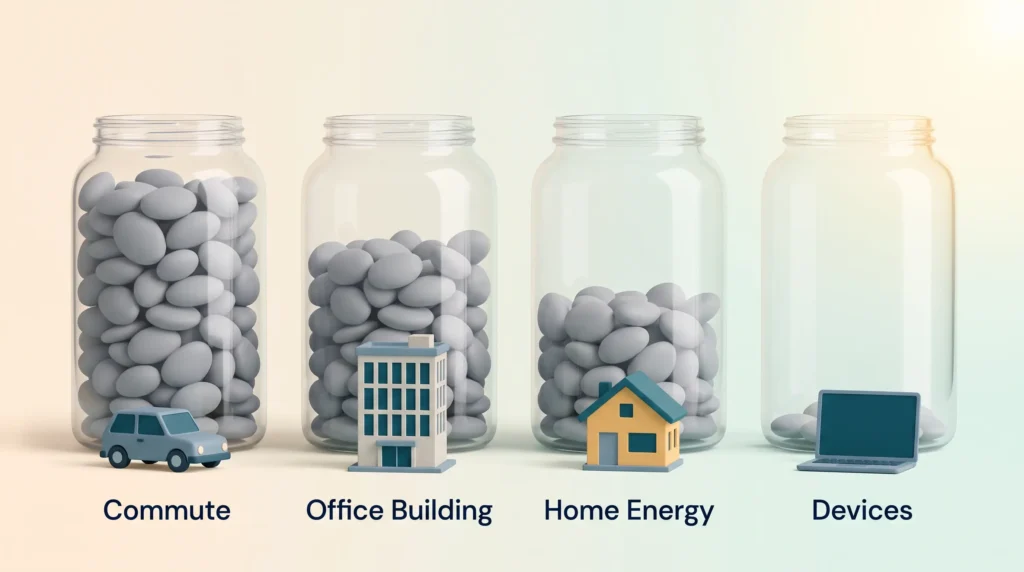
To act on any of this you need to know which part of your workday carries the weight. There are four buckets, and they are wildly unequal.
Commuting: the biggest single lever
Transportation accounts for about 28% of total US greenhouse gas emissions, the largest share of any sector, based on the Environmental Protection Agency’s national inventory. For most office workers, the daily drive is the largest climate cost of their job.
Distance and mode do most of the work. A solo driver on an average American round trip produces several kilograms of CO2 equivalent before switching on a computer. The same trip by train, bus or bicycle produces a fraction of that. Halving your driving distance, or switching one leg to transit, beats almost any change you make at your desk.
Office buildings: energy that ignores headcount
Commercial buildings, offices included, consume roughly 17% of total US energy according to the Energy Information Administration. Heating, ventilation and air conditioning, usually shortened to HVAC, plus lighting, are the main drivers.
Most of that consumption is fixed. A building conditioned for 500 people costs nearly the same to run when 100 show up, so energy per person rises steeply as occupancy falls. Hybrid working only cuts building emissions if someone adjusts the building: closing floors, changing HVAC schedules, or giving up leased space. Our piece on the evolution of office design covers how employers are handling that, and workspace lighting looks at one of the easiest fixes.
Home energy: the counterweight
Working at home shifts consumption onto your own meter. The UK government’s reporting factors put homeworking at 0.33378 kgCO2e per hour per person, a figure that covers a laptop, monitor, phone, printer and lighting plus typical domestic heating. Over an eight-hour day that is about 2.7 kgCO2e.
Compare that with the CIBSE benchmark used in a University of Exeter analysis, which puts a general office at roughly 3.5 kgCO2e per person per day for building energy alone, before any commuting is counted. Home energy is real, but in most cases it is smaller than your share of an office, and much smaller than a car commute.
Heating swings this most. A small, well-insulated room warmed for eight hours is cheap. Heating a whole house all day in a cold climate is not. Our guide to setting up a productive home office covers getting one room right.
Devices and video calls: a rounding error
Information and communications technology, meaning your laptop, network use and video conferencing, has a genuine energy cost. The Cornell study found it had a negligible effect on the total.
This matters because it is where people spend their guilt. Turning off your camera on a call is not a climate action. Not driving twenty miles is. The one caveat is at the infrastructure level, where AI workloads are pushing data centre demand up sharply; we cover that separately in AI and data centre energy use.
The rebound effect nobody plans for
The Cornell researchers found that non-commute travel grows as remote days increase. People run more local errands, make more short car trips at lunchtime and order more individual deliveries.
None of these is large alone. Together they can eat a meaningful share of the saving. Batching errands into one trip and consolidating deliveries protects gains you have already made.
A worked weekly comparison
Numbers help more than percentages. The University of Exeter analysis, using UK data and a 20 km round-trip commute, produced these weekly totals for one office worker:
- Five days in the office: about 33.4 kgCO2e per week, split roughly half commuting and half building energy.
- Five days at home: about 13.6 kgCO2e per week, all of it home energy.
- A hybrid split: lands between the two, in proportion to the commutes you avoid.
Treat these as a shape, not as your number. They assume UK electricity, UK housing and one commute distance. If you drive 60 km each way, the office column grows sharply. If you cycle two kilometres, little is left but the building energy.
What changes your own number
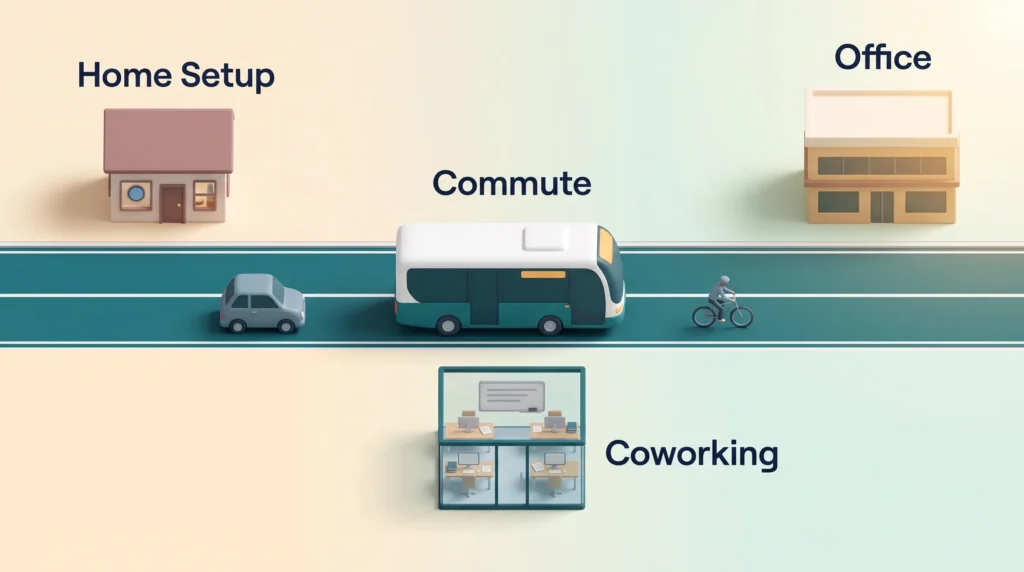
Four variables decide whether your working pattern helps or not.
Commute distance and mode
This is the dominant factor. A long solo drive can outweigh everything else combined. Public transport, carpooling, cycling or walking cut the same journey to a fraction. If you only change one thing, change this.
How your office is run
Ask facilities two questions: are heating and cooling schedules matched to actual occupancy, and can lightly used floors be closed rather than conditioned? If the answer to both is no, your hybrid schedule is saving less than you think. Consolidating everyone into fewer days and fewer floors is what turns attendance changes into energy changes.
Your home setup
Insulation, heating type and how much space you heat all matter. Zoning your heating to one room, using a smart thermostat and switching to LED lighting are the changes with the shortest payback. Choosing a renewable electricity tariff removes a large share of the remaining emissions without altering your habits at all.
Where you actually work
Home is not the only alternative to headquarters. A well-used coworking space packs people into efficiently occupied square metres, exactly the condition a half-empty corporate office fails to meet. Our guide to coworking spaces covers costs and availability, and virtual offices in a hybrid workforce looks at the fully distributed end of the spectrum.
What actually cuts emissions
Pick a small number of changes and make them permanent. These are ordered by size of effect.
- Cut or change the commute. More home days, or the same days travelled by transit, bike or shared car. This is the largest lever available to most people.
- Switch to renewable electricity. A green tariff at home, and pressure on your employer to buy renewable power for the office. It requires no behaviour change and works from day one.
- Match building operation to occupancy. Ask for HVAC setbacks, occupancy sensors and floor consolidation. This is where most of the theoretical hybrid saving is either captured or lost.
- Fix the obvious home items. LED lighting, a smart thermostat, heating one room rather than the house, and power strips that genuinely cut standby draw.
- Batch errands and deliveries. One planned trip beats four unplanned ones, and consolidated deliveries beat same-day single items.
- Measure quarterly. A simple estimate you actually repeat beats a precise one you do once. Our carbon neutrality roadmap shows how companies structure this.
“Small, consistent changes add up faster than rare grand gestures.”
For employers, the highest-value move is usually a stipend for efficient home equipment combined with a real reduction in leased space. Paying for insulation or a heat pump at fifty homes will often beat a solar array on a building nobody fills. Our overview of what consumers reward in sustainability covers how to prioritise between them.
What is changing in 2026
Three developments are worth tracking.

Buildings are getting instrumented. Occupancy sensors and building analytics let HVAC and lighting follow actual presence instead of a fixed timetable. That is the technical fix for the biggest weakness in hybrid working. The same sensor networks underpin much of what we describe in IoT and remote work.
Reporting is getting stricter. Commuting and homeworking emissions are moving from voluntary estimates into audited disclosures for larger companies, which is pushing employers to collect real travel data rather than assume an average. Our green finance and ESG in SaaS pieces cover how that filters through to budgets.
Space strategies are becoming flexible. Companies are moving to smaller cores plus flexible capacity, rather than leasing for a peak day that never arrives. That is the structural version of the same idea: stop conditioning space nobody uses. See the phygital workspace for where that is heading.
Conclusion
Working from home is greener than commuting to an office, but only by as much as your own circumstances allow.
The evidence supports a clear ranking. Fully remote work cuts individual emissions by roughly half. Two to four home days a week cut between a tenth and just under a third. One day a week does almost nothing. In every case the gain comes from travel avoided and building space no longer needed, not from anything happening on your screen.
So start with the commute, then push your employer to run the office in line with who is actually in it, then tidy up your home heating and electricity. Ignore the small stuff. If you want the broader picture of how work patterns are settling, our guides to remote work trends, the work-from-anywhere economy and future work trends pick up the thread, while green technology trends and green supply chains cover the wider sustainability agenda.
Found this useful?
Make SmartKeys a preferred source on Google, and our articles will surface more often in your Top Stories, AI Overviews, and AI Mode.
Add as Preferred Source