You can take back your time by planning a short, practical break from feeds and apps. A focused pause helps you stop reacting to every ping and start choosing where your attention goes.
The average internet user now spends about 2 hours 36 minutes a day on social and video feeds, according to DataReportal’s Digital 2026 Global Overview Report (October 2025 data). That is roughly 18 hours a week, so cutting it by a third gives you back a full working day every month.
The research is encouraging but modest. Pooled trials show small gains in wellbeing and a clearer drop in depression scores, while life satisfaction barely moves. A detox is a useful tool, not a cure.
This guide shows you how to run one: how to set a realistic goal, cut distractions at the times that matter, protect your sleep, and redirect the recovered hours. The aim is not to quit technology forever. It is to use it on purpose.
Key Takeaways
- Cutting daily feed time by a third frees up roughly six hours a week.
- Pooled trial evidence shows small but real gains in wellbeing and a clearer drop in depressive symptoms.
- Full abstinence is not automatically better than a sensible daily limit.
- Evening screen time has the strongest link to poor sleep.
- The point is deliberate use, not permanent quitting.
Why a Social Media Detox Matters Right Now
Each notification pulls you into a small decision, and each quick check often turns into a long detour away from work or rest. Half of American adults already act on this. In the American Psychiatric Association’s Healthy Minds Poll of 2,202 adults in June 2025, 50% said they had actively limited their social media use, and 62% said they feel anxious without access to their phone.
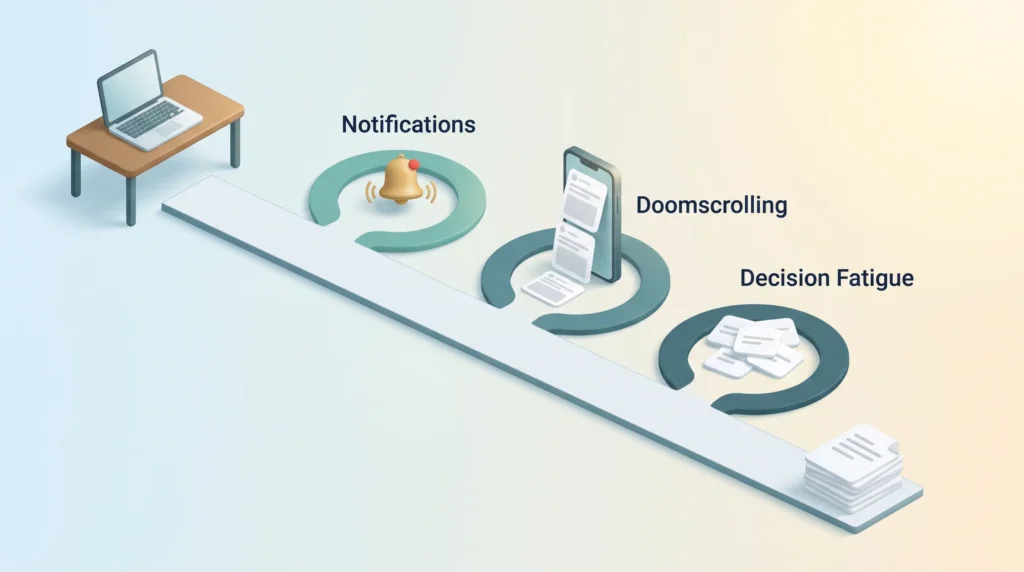
The attention drain: notifications, doomscrolling, and decision fatigue
Three habits do most of the damage, and each has a plain-English meaning.
Notifications fragment focus. Every alert creates a micro-task, and you carry that scattered attention into meetings and conversations. Silencing alerts during work blocks removes the interruption at its source. Our guide to managing work notifications covers the settings worth changing first.
Doomscrolling is the habit of scrolling through distressing news long after you have stopped learning anything new. It feels like staying informed, but it raises worry and burns the energy you needed for real tasks.
Decision fatigue is the drop in decision quality that follows a long run of small choices. Deciding whether to open an app, whether to reply, and whether to keep scrolling costs a little judgment each time. By the afternoon you have less left for the choices that matter.
How constant feeds shape your mood and your focus
The pattern feeds on itself: the more scattered you feel, the more appealing a quick scroll becomes. A break interrupts that loop and protects the long stretches of uninterrupted attention that serious work needs, which is why a detox pairs naturally with deep work.
What the Research Actually Shows in 2026
The effects are real, small, and narrower than most headlines suggest. Knowing that helps you set expectations you can meet.
Small but genuine gains in wellbeing
The largest pooled analysis to date, published in 2025, combined 32 randomized controlled trials with 5,544 participants. Restricting social media improved wellbeing with an effect size of g = 0.17. In plain terms that is small: noticeable across a group, but not life-changing for every individual. The authors described it as “weak support” for restriction as a general strategy.
The clearest signal is on depressive symptoms
A 2024 meta-analysis in Narra J pooled 10 studies published between 2013 and 2023. It found a statistically significant drop in depression scores after a digital detox (standardized mean difference -0.29; 95% confidence interval -0.51 to -0.07; p = 0.01). Stress, life satisfaction, and general wellbeing showed no significant change.
So if low mood is what you want to shift, a structured break is worth trying. If you expect it to make you broadly happier with your life, the evidence does not support that.
What a break does not fix
A 2025 meta-analysis in Scientific Reports looked specifically at full abstinence. Positive affect, negative affect, and life satisfaction all came out statistically unchanged, and longer abstinence periods did not help more than shorter ones.
That matters for how you plan. Going cold turkey for a month is not automatically better than a sensible daily limit, and it is much harder to sustain. The best-known limit study, run by Melissa Hunt at the University of Pennsylvania in 2018, capped 143 undergraduates at 10 minutes per platform per day for three weeks. Loneliness and depression both fell, most of all among the students who started out most depressed.
Signs You Need a Break from Social Media
A drop in energy, focus, or mood after scrolling is the clearest signal. These clues also tell you whether you need a full pause or just a firmer daily limit.
Sleep problems, anxiety spikes, and trouble concentrating
You take longer to fall asleep, or you wake up wired after a late scroll. Evening feed habits are usually the cause. Surges of stress after reading news or comments make it hard to settle back into work. If you notice a pattern of digital fatigue, your feeds are a likely contributor.
Compulsive checking, FOMO, and strained relationships
If you reach for your phone every few minutes, your brain is chasing quick rewards instead of steady attention. FOMO is short for fear of missing out: the worry that something important is happening without you. It is what turns a five-second check into a fifteen-minute scroll.
- You feel pressure to reply immediately and lose control of your own schedule.
- Comparing your ordinary day to other people’s highlight reels leaves you flat or restless.
- Conversations feel thin because part of your attention is elsewhere.
“Noticing these signs is not failure. It is data that helps you choose a break that fits your life.”
Set Your Goal: Choose the Type and Length of Your Detox
Decide between a full break and a daily time limit. Given the evidence above, a daily limit is the safer bet for most people.
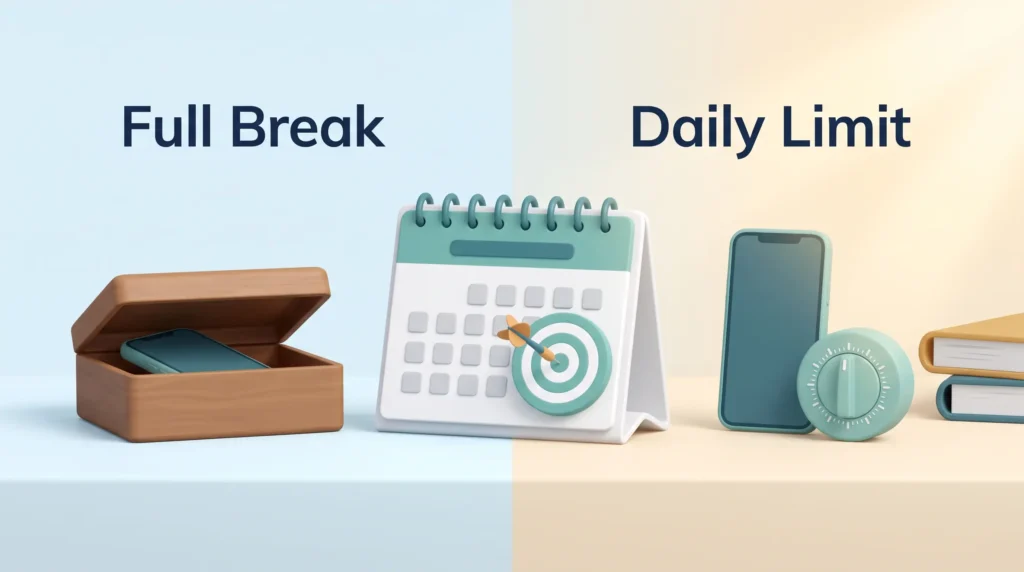
Choose your length. A weekend interrupts the habit, one week resets your routines, two weeks gives mood changes time to show up. A month builds a replacement habit, but only if the rules are gentle enough to keep.
Target the worst offender. You rarely need to pause everything. Pick the one platform that reliably costs you sleep, focus, or mood.
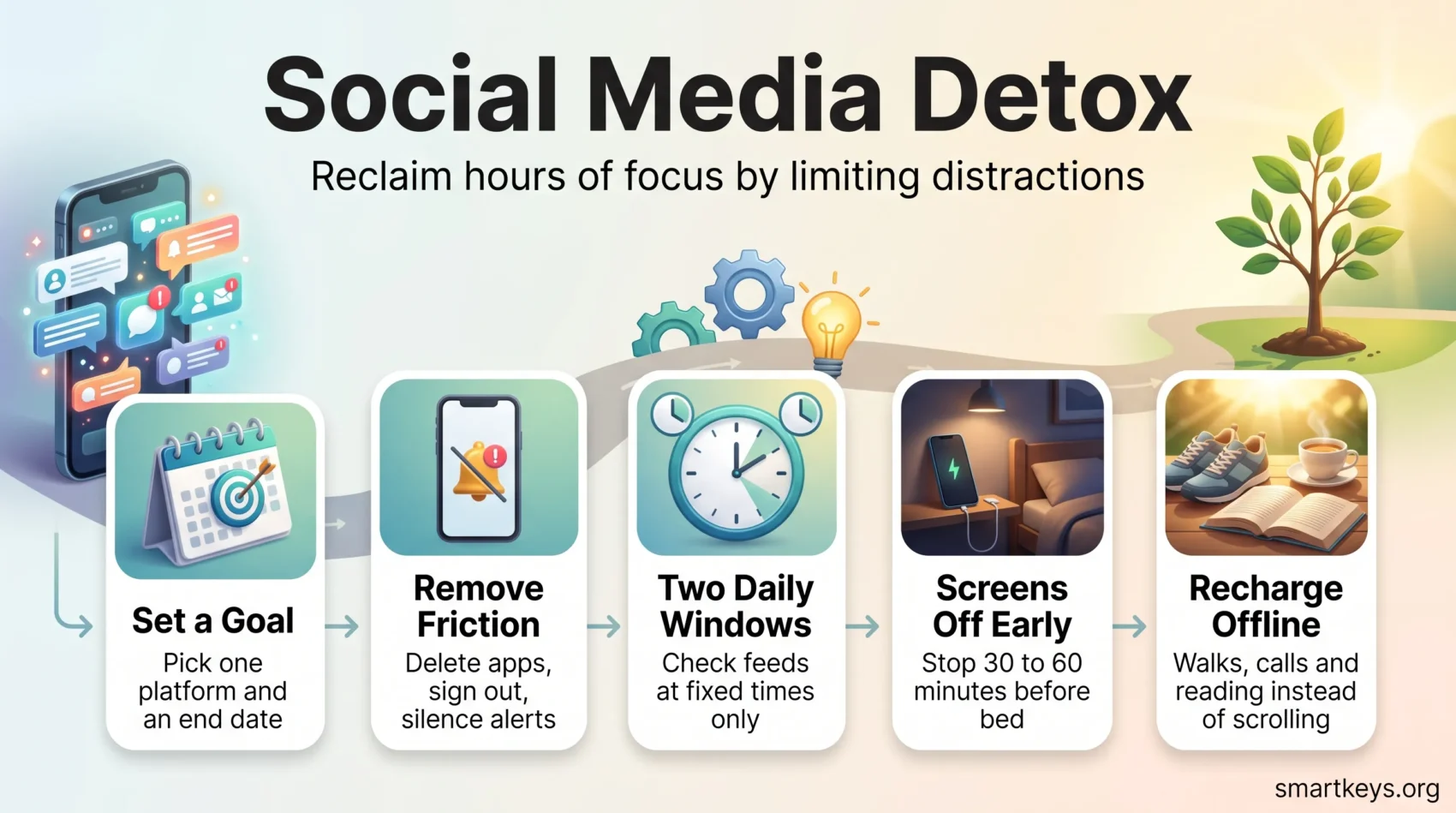
Keep the rules simple. No feeds after 9 p.m. Two checking windows a day. Fifteen minutes per session. A rule you can recite is a rule you will follow.
Account for your job. If a platform is part of your role, split personal and professional use into separate windows and, where possible, separate devices. A clear right to disconnect policy makes this far easier to hold.
- Write down a start date and an end date.
- Define success in advance: better sleep, steadier mood, fewer interruptions.
- Decide how you will handle direct messages so you do not feel pressured to check.
Treat it as an experiment: track your time and mood, review, adjust. Learning to set boundaries that survive a busy week matters more than any single rule you pick.
How to Do a Social Media Detox
A handful of disciplined moves will cut cue-driven checking. Start with the ones you can keep doing.
Remove friction: delete apps, sign out, turn off notifications
Delete the apps from your phone and sign out on your other devices. Opening a feed should take a deliberate step, not a thumb twitch.
Turn off push notifications. This is the highest-value change, because it removes the cue rather than fighting the response. If work chat is part of the problem, our guide to instant messaging boundaries covers how to stay reachable without being interrupted.
Schedule two checking windows and set time limits
Pick two short windows a day, for example 12:30 to 1 p.m. and 7 to 7:30 p.m. Enforce them with app timers rather than willpower. Two fixed windows beat “whenever I have a spare moment”, because they give the urge a scheduled home.
Tell people you are taking a break
Message the friends and colleagues who would notice, and say when you will respond. That removes most of the social pressure that pulls people back early.
Track screen time and mood
Note your daily minutes and a one-to-five mood rating. Two weeks is enough to see whether it is working, and a simple habit tracker is all the tooling you need.
- Keep your phone out of reach during work blocks, or switch on Do Not Disturb.
- Have replacements ready: a five-minute walk, a phone call, a page of journaling.
- Use an urge protocol: pause, name the urge, breathe, then redirect.
For a step-by-step plan, see our digital detox routine.
“Remove friction, set windows, tell people, track progress. Small rules create big gains.”
Tools and Settings That Help You Stick With It
Device controls can do the heavy lifting so your willpower does not have to.
Screen time dashboards and app limiters
Open iOS Screen Time or Android Digital Wellbeing and take a baseline of minutes per app. Most people are surprised by the number, which is why the baseline is worth taking before you set any caps. Then set limits that match your goal and let the app enforce them, so you are not renegotiating with yourself every time a platform tempts you.
Focus modes, Do Not Disturb, and notification batching
Switch on Focus or Do Not Disturb during work blocks and meals. Our walkthrough of Focus mode on iPhone covers the settings that make it stick.
Batch your notifications so alerts arrive at set times rather than continuously. That keeps you reachable without letting anyone interrupt you at will.
- Move tempting apps off your home screen so reaching them takes effort.
- Switch your screen to grayscale when feeds feel irresistible.
- Match your phone rules on desktop with website blockers.
Replace Scrolling with Activities That Actually Recharge You
Removing a habit leaves a gap. If you do not fill it deliberately, the old habit walks back in.
Movement and time outdoors
Schedule short walks, a hike, or a class. Movement breaks lift energy and improve sleep, and they beat scrolling on both counts. Even two minutes of stretching resets attention better than a feed, the same mechanism behind short breaks for focus.
Real connection
Call a friend, meet for coffee, volunteer. These give you the social contact the feed only imitates, and they are why people often report a break felt worthwhile even when their mood scores barely moved.
Calming habits
Read, journal, or run a short meditation session before bed. If restlessness is the problem, breathing techniques settle the nervous system in under two minutes.
Keep an “instead of scrolling” list where you will see it, and set low-friction cues: a book on the nightstand, shoes by the door.
Protect Your Sleep and Energy During the Detox
Evening screen time is where a detox pays off fastest. A 2025 study in Frontiers in Psychiatry followed 45,202 young adults in Norway. Each additional hour of screen use after bedtime was associated with a 59% higher risk of insomnia and 24 minutes less sleep. There was no meaningful difference between social media and other screen activities, so the problem is displaced time rather than content.
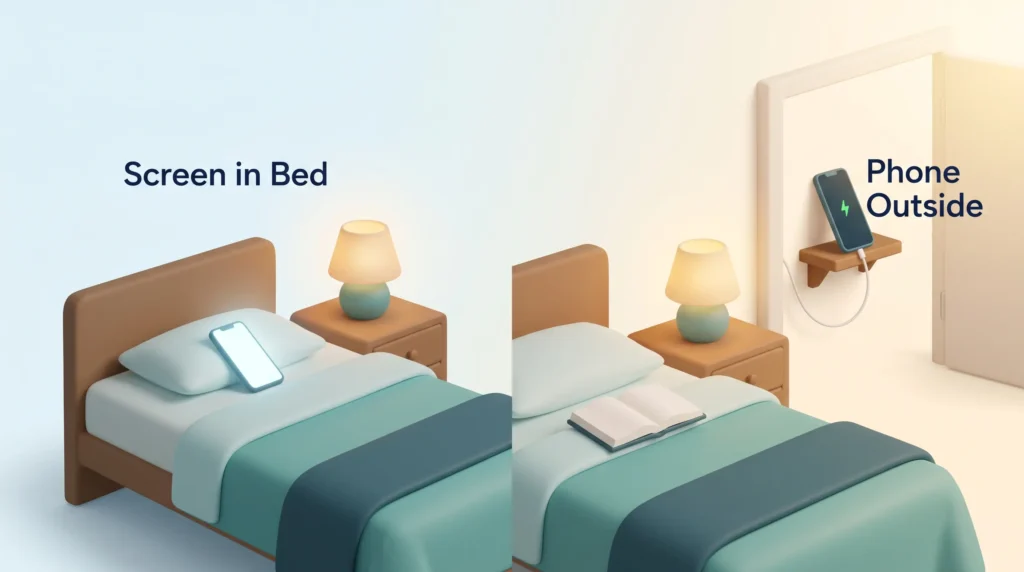
That is good news for your plan: you do not have to give up your phone, you have to stop taking it to bed.
Stop screens 30 to 60 minutes before bed
Set a nightly cut-off at least half an hour before you want to be asleep. If you need a device, use night mode and stick to low-stimulation apps such as an e-reader rather than a feed. Our guide to sleep and productivity covers the link between rest and output.
Create tech-free zones and a wind-down routine
Charge your phone outside the bedroom, or at least across the room. Reflex checks disappear when the phone is not within arm’s reach.
Build the cut-off into a repeatable evening routine: dim the lights, stretch, read, set out tomorrow’s first task. Protecting the other end of the day helps too, which is what a morning routine is for.
- Keep the same cut-off at weekends, or the habit resets every Monday.
- Do not check feeds in the first 30 minutes after waking.
- Log bedtime, wake time, and screen minutes so you can see the link yourself.
Manage Mood and Cravings While You Unplug
When you unplug, your reward system has to recalibrate. Expect a few days of restlessness. That passes, and it is not a sign the break is failing.
Name the feeling, then redirect the urge
Pause and label what you are feeling: anxious, bored, restless. Naming an emotion reduces its pull and gives you a moment to choose your response. Then urge-surf: breathe for 30 seconds, name the urge, and switch to a two-minute activity you decided on in advance. The urge peaks and fades on its own if you do not feed it.
Build offline rewards that compete with the feed
Create small, reliable rewards that reach the same nerve as a scroll: step into sunlight, make tea, do a brisk walk to shed stress.
Use friction at the times you know are hardest. Put the phone in another room, switch on Do Not Disturb, and hold your checking windows so your brain learns nothing important was missed. Working on one thing at a time makes the urge quieter in the first place.
- Note your triggers, whether a news app or a specific account, and remove them.
- Tell one person what you are doing, so you have someone to report back to.
Life After the Detox: Build Habits That Hold
A break only pays off if it changes what happens afterwards. Use the pause to decide which accounts earn their place.
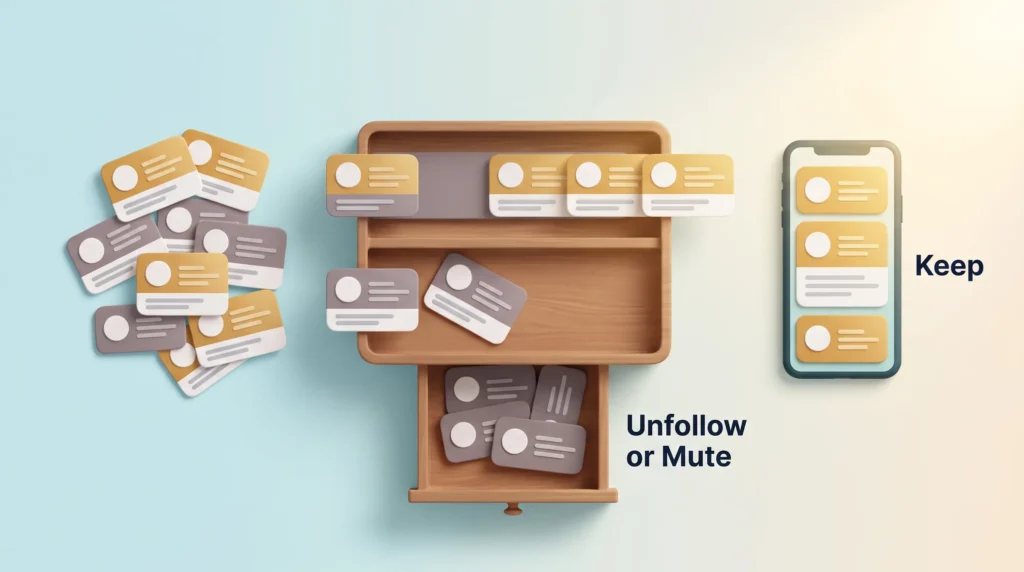
Curate your feeds and protect real connections
Unfollow or mute the accounts that trigger comparison or worry, and keep the ones that inform, teach, or genuinely lift your day. Then schedule in-person time: calls, coffee, walks. That rebuilds the relationships the feed was standing in for.
Keep limits, batch your use, reintroduce platforms one at a time
Hold your two daily windows. Hunt’s study capped total use at roughly 30 minutes a day and still saw loneliness and depression fall, so a limit in that range is a reasonable target rather than an arbitrary one.
- Separate work and personal use so notifications do not bleed into your job.
- Bring back one platform at a time and note what each does to your energy.
- Keep Focus, Do Not Disturb, and notification batching switched on as guardrails.
Review your rules monthly. If you need a longer reset than a detox can give, our piece on sabbatical policies covers what extended time away involves. For the day-to-day version, the techniques in focus management keep the gains in place.
“Treat the detox as the start of a durable habit, not a one-off challenge.”
Conclusion
Make the plan small enough to start this week. Pick a date, choose either a one-week pause or two short daily windows, and decide in advance what you will do instead when the urge hits.
Keep your expectations calibrated to the evidence. Pooled trials show small gains in wellbeing and a clearer improvement in depressive symptoms. They do not show that quitting social media makes people broadly more satisfied with their lives. The most reliable win is the one you can measure yourself: hours recovered, a bedtime you hold, and fewer interruptions in the middle of real work.
Track your minutes and mood for two weeks, tell one person what you are doing, and bring platforms back one at a time. Over a few months those changes add up to more attention, better sleep, and more time for the parts of your life that do not fit in a feed.
Found this useful?
Make SmartKeys a preferred source on Google, and our articles will surface more often in your Top Stories, AI Overviews, and AI Mode.
Add as Preferred Source