Stress at work is not a personal failing. It is a predictable response to workload, uncertainty and interruption, and it shows up in your output long before it shows up in your mood. Stress management is the set of habits and workplace changes that keep it from eating into your focus, judgement and health.
The scale is easy to underestimate. Gallup’s State of the Global Workplace 2026 report found that 40% of employees worldwide experienced a lot of stress on the previous day, still above pre-pandemic levels, and that engagement fell to 20% in 2025. This guide explains what stress does to your work, how to spot it early, and which techniques for stress relief hold up in a normal working week.
Key Takeaways
- Stress hits focus, memory and decision quality first, which is why output drops before anyone complains.
- Catching the early signs (fatigue, irritability, avoidance) is cheaper than treating burnout later.
- Short, repeatable habits beat occasional big gestures: breaks, movement, sleep and a realistic task list.
- Individual coping only goes so far. Workload, clarity and manager behaviour do most of the work.
- Organisations that offer real support, not just a wellness poster, see better retention and fewer absences.
Understanding the Link Between Stress and Productivity
Some pressure helps. A deadline sharpens attention and gets a stalled task moving. The problem is sustained pressure with no recovery, which is what most people mean when they say they are stressed at work.
Under that load, the brain prioritises the immediate threat over everything else. Working memory shrinks, so you lose the thread of complex tasks. Attention narrows, so you miss context. Decisions get faster and worse. None of it looks dramatic from outside. It looks like a report that takes three days instead of one, or an email thread that goes around twice because nobody read it properly.
What Stress Actually Costs at Work
The cost shows up in three places. Speed: work that used to take an hour takes two, because concentration keeps breaking. Quality: more errors, more rework, more decisions that have to be revisited. And time lost entirely, through sick days and people leaving.
The World Health Organization and the International Labour Organization estimate that depression and anxiety cost roughly 12 billion working days globally each year, worth close to one trillion US dollars in lost productivity. Work is not the only cause of either condition, but working conditions are one of the levers employers can actually pull.
Why Busy Days Feel Productive and Are Not
Stress pushes people toward reactive work. You answer the message that just arrived instead of finishing the analysis due Friday. That feels productive because things keep getting ticked off, but the important work slides. It also makes task switching more tempting and more costly, because every switch means reloading context and under stress that reload takes longer. If your day is a chain of half-finished things, the fix usually starts with the task list rather than with relaxation. Solid task management techniques remove a surprising share of the pressure.
Recognizing Signs of Stress in the Workplace
Stress rarely announces itself. It arrives as a run of small changes that are easy to explain away individually. Naming them early gives you options that you do not have once someone is fully burned out.
Common Symptoms and Their Effects
Watch for these in yourself and in the people you work with:
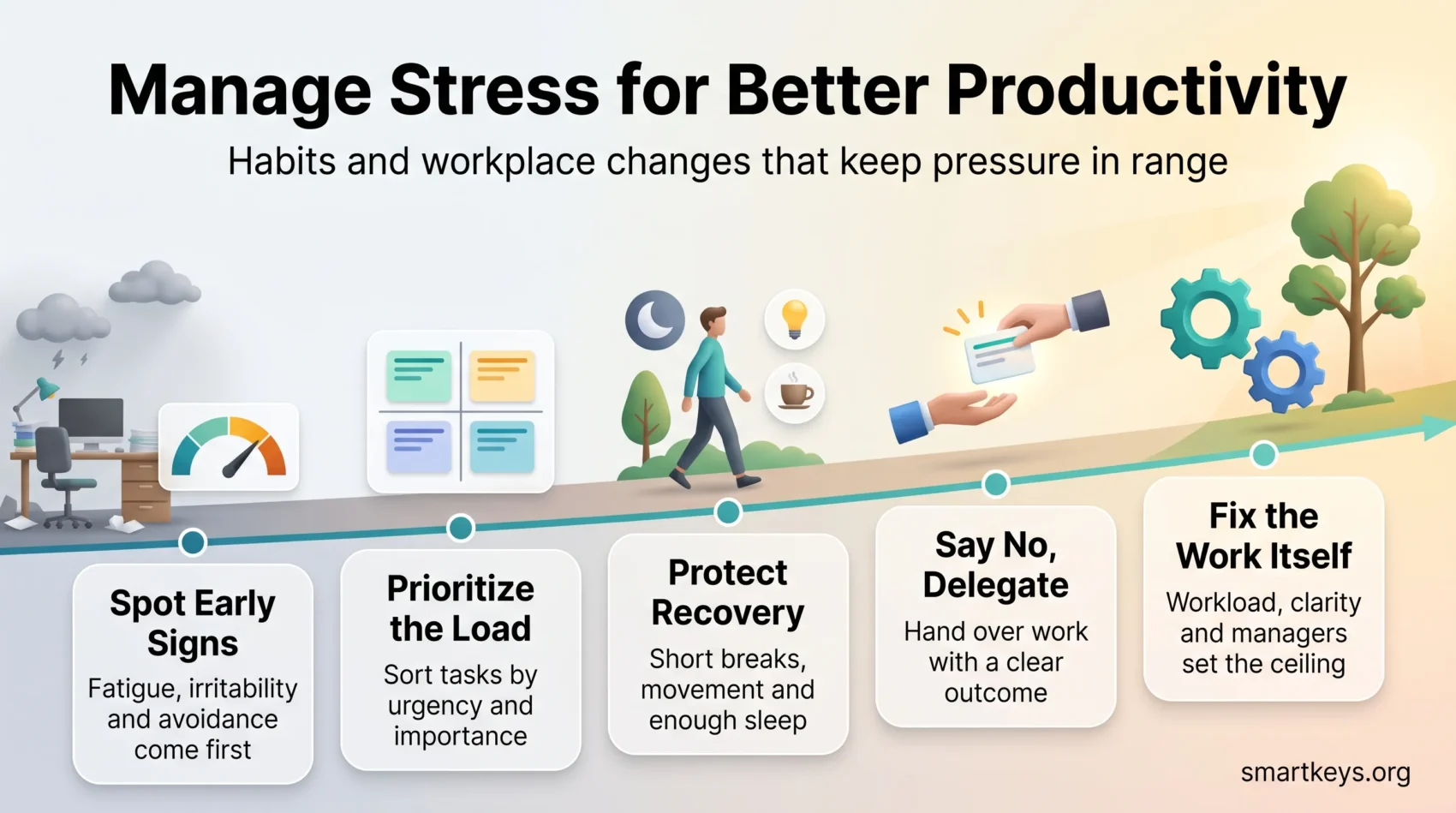
- Persistent fatigue that a normal night’s sleep does not fix
- Trouble concentrating, especially on tasks that need sustained thought
- Irritability and shorter fuses in meetings or on chat
- Decision avoidance, where straightforward choices keep getting postponed
- Physical complaints such as headaches, disturbed sleep or digestive problems
- Withdrawal: skipping optional meetings, going quiet in channels, declining social contact
One of these in a bad week means nothing. Several of them, for several weeks, is worth acting on. In distributed teams the withdrawal signal is the one most often missed, because there is no corridor in which to notice it. Managers of remote staff have to ask directly, and our guide to remote work and mental health covers that conversation.
When Stress Turns Into Burnout
Burnout is not just heavy stress. The World Health Organization classifies it in ICD-11 as an occupational phenomenon, defined by three features: exhaustion, mental distance or cynicism about the job, and reduced professional effectiveness. It is described as resulting from chronic workplace stress that has not been successfully managed.
That definition matters for a practical reason. If someone shows all three features, more resilience training will not help. The workload, the role or the way the work is organised has to change. Our guides to preventing burnout and managing employee burnout cover what those changes look like.
Stress Management Techniques That Fit a Working Day
The techniques that survive a real workweek are short, repeatable and need no equipment. The ones that fail require a free hour you do not have.
Practical Coping Strategies
Start with the load itself. Write down everything you are carrying, then decide what genuinely has to happen this week and what does not. Most overload is a prioritisation problem wearing a time management costume. The art of prioritisation does more for stress than any breathing exercise.
Then protect recovery inside the day. A short walk between two demanding meetings resets attention better than scrolling on your phone. Regular short breaks are the cheapest intervention available.
Two more habits are worth building. Learning to say no to work you cannot absorb prevents the overload in the first place. Delegating properly, with a clear outcome and a deadline rather than a vague handover, keeps that no from simply moving the problem sideways.
Mindfulness and Meditation
Mindfulness means paying deliberate attention to what is happening right now, without judging it. In practice that can be as small as two minutes spent noticing your breathing before a difficult call.
Research on workplace mindfulness programmes generally reports modest improvements in perceived stress and wellbeing, with weaker and less consistent effects on job performance. Treat it as one useful tool rather than a cure. Start with two to five minutes daily rather than a long weekly session, since consistency matters more than duration. Our guide to meditation at work covers the practical starting points.
Physical Health and Stress
Physical habits are not a side issue here. Sleep, movement and food all change how much pressure you can absorb before your work suffers.
How Exercise Reduces Stress
The US Department of Health and Human Services recommends that adults get at least 150 minutes of moderate aerobic activity, or 75 minutes of vigorous activity, each week, plus muscle-strengthening work on two days. The World Health Organization gives a similar range.
You do not have to hit that target to benefit. Shorter bouts are associated with lower reported stress and better sleep, and the mood effect shows up quickly rather than after months. If a gym habit is unrealistic, a twenty-minute walk at lunch is a reasonable start. There is more in our piece on exercise and productivity.
Sleep, Food and Steadier Energy
Sleep has the largest effect and is sacrificed first. Most adults need seven or more hours a night, and a short-sleep week reliably degrades attention and emotional control. Our guide to sleep and productivity explains what that costs during a workday.
Food matters mainly through energy stability rather than through any single ingredient. Meals built around protein, fibre and vegetables keep energy steadier than a run of quick sugar and caffeine. Caffeine late in the afternoon is worth watching, because it lingers long enough to shorten your sleep and start the cycle again. Our article on nutrition and productivity goes further.
What Organisations Can Actually Do
Individual habits have a ceiling. If the workload is impossible, no amount of deep breathing will fix it. The WHO’s 2022 guidelines on mental health at work make this point directly: they recommend organisational interventions, manager training and support for workers, not just resilience courses aimed at individuals.
Wellness Initiatives That Are Worth the Budget
The programmes that work share three features. They change something about the work itself, such as meeting load, deadlines or staffing. They train managers to notice and respond to strain rather than leaving it to HR. And they are easy to use without asking permission.
Clarity is an underrated one. Ambiguity about who owns what, or about what “done” means, is a steady low-level stressor that costs nothing to fix. Written procedures and a sensible policy on notifications and interruptions remove more friction than most wellness perks.
Support People Will Actually Use
Access matters more than range. An employee assistance programme nobody can find is worth less than one clearly signposted route to counselling. A mental health day that requires an explanation to two managers will not be taken.
Some rules help by design. A right to disconnect outside working hours removes the expectation of always-on availability, which is one of the more corrosive sources of low-grade stress.
Building a Supportive Team Environment
Most of what makes work stressful or bearable happens between people. Teams that raise problems early spend less time on crises.
Creating Psychological Safety
People raise problems when they expect a useful response rather than blame. Three practices build that expectation:
- Regular one-to-ones that cover workload explicitly, not just project status
- A visible response when someone flags overload, even if the answer is “not this week”
- Managers who describe their own constraints honestly instead of projecting effortless control
Communication That Lowers the Temperature
Unclear communication creates work and anxiety in equal measure. Write requests with the outcome, the deadline and the owner stated plainly. Keep decisions where people can find them later. Cut meetings that exist only to relay information that could be read instead. Our guide to running effective meetings covers the format changes that free up the most time.
Prioritization and Time Management
Feeling behind is one of the most reliable sources of workplace stress. Structure will not create hours, but it does replace a vague sense of being underwater with a specific, finite list.
How to Prioritize Your Tasks
The Eisenhower Matrix sorts work by urgency and importance into four groups:
- Urgent and important: do it now
- Important, not urgent: schedule it, because this is where the valuable work lives
- Urgent, not important: delegate it or handle it quickly
- Neither: drop it
The useful part is the fourth box. Most stressed schedules contain work that nobody would miss, and deleting it is faster than optimising it.
Techniques for Better Time Management
The Pomodoro Technique breaks work into focused intervals, traditionally 25 minutes, each followed by a short break. It suits tasks you have been avoiding, because starting a 25-minute block is easier than starting a project.
Time blocking works better for deeper work, since it reserves specific hours in your calendar for specific tasks. Whichever you use, plan slightly less than you think you can do. Persistent optimism about how long things take is one of the quiet engines of workplace stress. Our guide to deep work covers how to protect those blocks once you have them.
Handling Difficult Situations
Some stress comes from specific events rather than general load: a conflict, a project that has gone sideways, a workload that cannot be delivered.
Managing Conflict Without Escalating It
Unresolved conflict is more stressful than the conversation that resolves it. Avoiding it usually makes the situation worse, because the underlying issue keeps generating friction while the resentment grows.
Address the behaviour and its effect rather than the person’s character. “When the spec changes after we have started building, we lose two days” is a workable sentence. “You keep moving the goalposts” is not. Agree what happens next and write it down.
Dealing With an Impossible Workload
If the work genuinely will not fit, coping techniques are not the answer. Break the workload into its parts, estimate each honestly, and take the total to whoever sets the priorities. Ask them to choose what slips.
That conversation goes better with specifics. A list showing five deliverables and the hours each requires is a decision aid. “I’m overwhelmed” invites sympathy but changes nothing.
Daily Habits That Keep Stress Manageable
Small daily practices work because they need no decision. Building them into an existing routine makes them stick.
Relaxation Techniques Worth Trying
- Slow breathing: a few minutes of longer exhales than inhales, which reliably lowers physical arousal
- A walk outdoors: movement and a change of scene, without a screen
- Progressive muscle relaxation: tensing and releasing muscle groups in turn to release held tension
- Writing it down: five minutes of unstructured writing to get a looping worry out of your head
- A hobby with your hands: cooking, an instrument, drawing, anything that occupies attention without a deadline
Building a Routine You Will Keep
Anchor new habits to things you already do. Breathing exercises after your first coffee. A walk after lunch. A five-minute review before you close the laptop, so tomorrow starts with a plan rather than an inbox.
Set a real end to the working day and treat it as a boundary rather than a suggestion. Deliberate structured downtime is what makes the next day’s focus possible.
Conclusion
Stress is not something you eliminate. It is something you keep inside a range where you can still do good work.
The individual side is unglamorous and effective: sleep, movement, real breaks, a task list you can finish, and the willingness to say no. The organisational side matters more than most companies admit, because workload, role clarity and manager behaviour set the ceiling on what any personal habit can achieve.
Start with one change rather than ten. Pick the habit you are most likely to keep for a month, then add the next. Managing stress well is less about a dramatic reset than about removing a little friction, repeatedly, until the working week stops taking more than it gives.
Found this useful?
Make SmartKeys a preferred source on Google, and our articles will surface more often in your Top Stories, AI Overviews, and AI Mode.
Add as Preferred Source