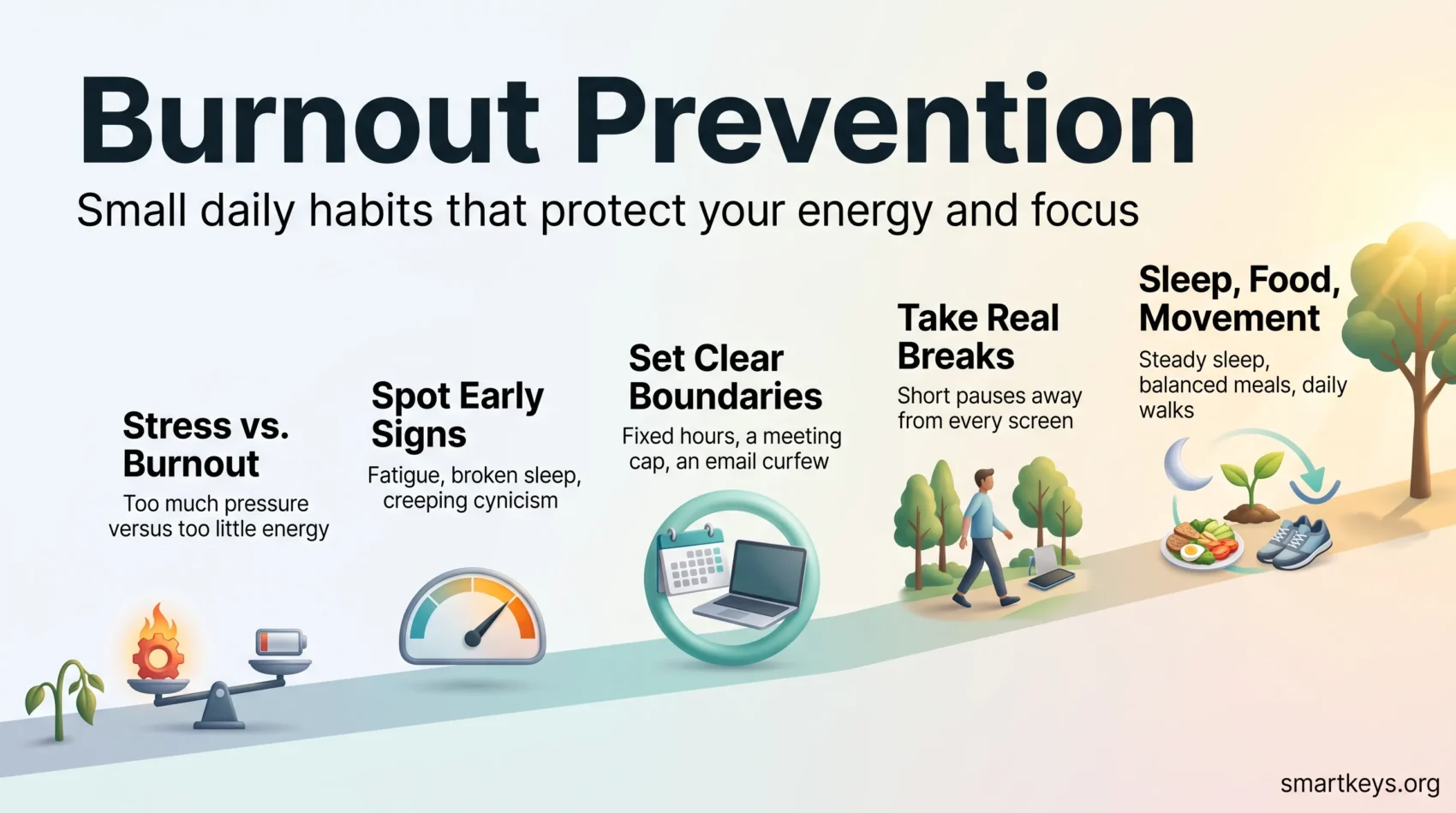
You don’t have to wait until exhaustion hits to act. Burnout rarely arrives overnight. It sends warnings for months. This guide shows you how to read those signals and what to change in your day, your workload, and your boundaries — so you protect your productivity without giving up your life outside work.
The pressure is not just in your head. Gallup’s State of the Global Workplace 2026 report found global employee engagement fell to 20% in 2025, the lowest level since 2020, at an estimated cost of $10 trillion in lost productivity. Manager engagement fell furthest — from 31% in 2022 to 22% in 2025. The people expected to shield their teams from overload are running out of fuel first.
Burnout is a chronic state of emotional, physical, and mental exhaustion that shows up as cynicism and a drop in effectiveness. The World Health Organization classifies it in ICD-11 as an occupational phenomenon: a syndrome resulting from chronic workplace stress that has not been successfully managed. That wording matters. It points at how work is designed, not at whether you are tough enough.
What follows is a practical roadmap — how to tell burnout from ordinary stress, which early signals deserve action, the five stages, the causes you can actually influence, and the daily habits that rebuild energy and a sense of control.
Key Takeaways
- Burnout is chronic, unmanaged workplace stress — not a personal weakness or one bad week.
- Stress means too much pressure. Burnout means not enough energy, motivation, or hope.
- Early signals — broken sleep, irritability, creeping cynicism — are your cheapest intervention point.
- Small daily shifts in breaks, sleep, food, and movement restore more energy than one long vacation.
- Clear boundaries and communication rules protect your schedule better than willpower ever will.
- Prevention is shared work: workload design belongs to your employer, recovery habits belong to you.
Why 2026 Feels Heavier: The Always-On Workday
Something structural changed in knowledge work, and it explains why so many people feel busy and depleted at the same time.
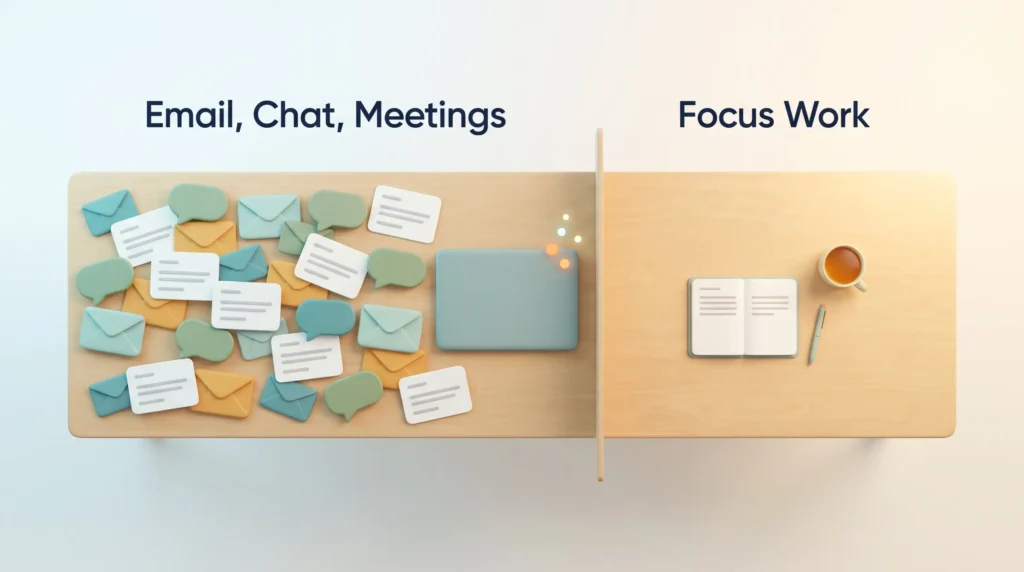
Microsoft’s Work Trend Index research describes an “infinite workday”: knowledge workers absorb roughly 275 interruptions per day — about one every two minutes during core hours — and spend around 60% of their time on email, chat, and meetings. That leaves roughly 40% for the thinking work they were actually hired to do.
AI tools were supposed to relieve that pressure. So far the effect is mixed. They remove some drudgery, but they also raise the expected output per person, and the pace ratchets up again. Fewer hours of grunt work does not automatically mean more recovery.
Regulators have noticed. By 2026, more than 15 countries have some form of right to disconnect legislation, and occupational safety frameworks such as ISO 45003 increasingly treat psychosocial risk as a workplace hazard. Practical takeaway: reasonable workload design is your employer’s duty, not a favor they grant you.
What this means for you: if your calendar is the problem, no amount of green smoothies will fix it. Work on both levels — the system and the habit.
What Burnout Is and Why It’s Different From Stress
Naming the pattern correctly helps you pick the right next step. Burnout is more than tiredness; it hits your mind and body in three distinct ways.
The three dimensions: exhaustion, cynicism, and ineffectiveness
Exhaustion is emotional and physical depletion. You feel drained even after a full night’s sleep or a weekend off.
Cynicism is detachment and a flattened outlook. Problems start to look permanent, pervasive, and personal — a thinking pattern that quietly locks you into passivity.
Ineffectiveness is a falling sense of accomplishment. Work takes longer, quality slips, and your self-worth at work takes the hit.
Stress vs. burnout at a glance
| Signal | Everyday stress | Burnout |
|---|---|---|
| Core problem | Too much pressure | Not enough energy or hope |
| Emotions | Over-reactive, urgent, wired | Blunted, detached, numb |
| Effect on drive | Hyperactive, busy | Helpless, disengaged |
| After a weekend off | You bounce back | You feel the same or worse |
| What helps | Prioritizing and recovery time | Reducing demands and rebuilding agency |
That last row is the practical difference. A weekend fixes stress. Burnout needs the demands themselves to change — which is why managing stress before it compounds is far cheaper than recovering from collapse.
When it overlaps with depression — and when to seek help
Burnout and depression share symptoms: disrupted sleep, irritability, withdrawal. But depression is a diagnosable disorder, and its low mood spreads across every area of life, not just work.
If low mood, loss of interest, or hopelessness are broad and long-lasting, talk to a healthcare professional. If the exhaustion is clearly tied to your role and you still feel like yourself elsewhere, start with workload changes and supportive conversations — and read our companion guide on managing employee burnout at the organizational level.
Early Warning Signs You Shouldn’t Ignore
Early signs arrive quietly. Watch for patterns over weeks rather than single bad days.
Physical signals
Persistent fatigue, frequent headaches, restless sleep, muscle tension, appetite shifts, and catching every cold going around. Your body tends to flag the problem before you admit it.
Emotional and behavioral signals
Irritability with people you normally like. Growing detachment from work you used to care about. Procrastination on routine tasks, skipped social plans, and a creeping sense that nothing you do matters much.
Doomscrolling instead of resting is a common one — it looks like a break and functions like more input.
The 60-second weekly self-check
Once a week, rate each statement from 1 (never) to 5 (almost always):
- I feel drained before the day even starts.
- I feel cynical or detached about work that used to matter.
- I get less done than I know I’m capable of.
- A weekend off no longer resets me.
A rising trend across two or three weeks is your cue to act — not to push harder. Match each signal to one same-day response: step outside, drink water, close the laptop at a fixed hour, or move one deadline.
The Five Stages of Burnout — and Where You Are on the Curve
Mapping your experience to a stage makes the response concrete and timely.
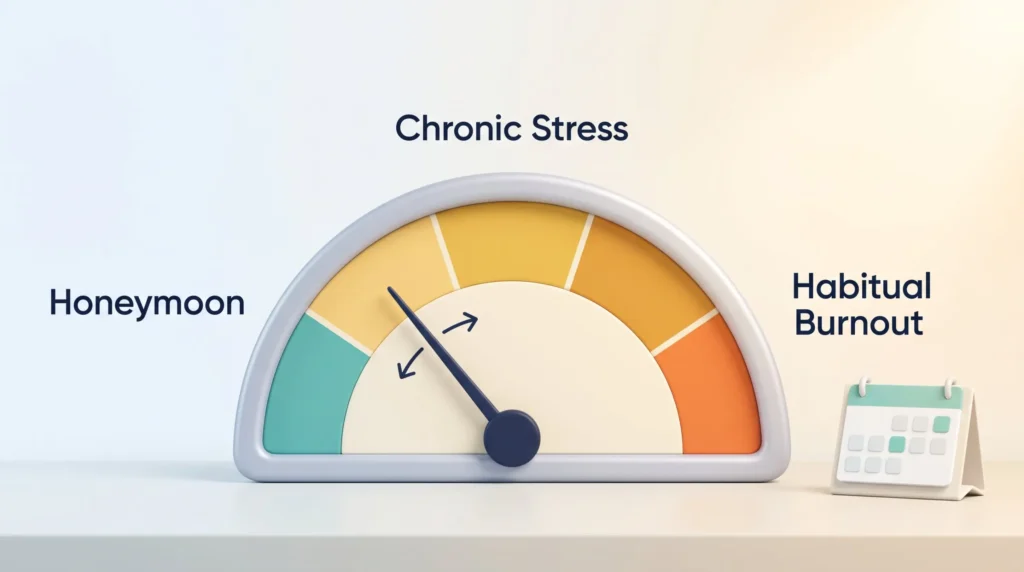
Stage 1 — Honeymoon
High commitment, creativity, and energy. Work feels exciting. This is the cheapest moment to build recovery habits, because you don’t need them yet.
Stage 2 — Stress onset
Sleep quality slips. Anxiety and irritability rise. Small tasks take noticeably more effort. Fix sleep and boundaries here and the curve usually flattens.
Stage 3 — Chronic stress
Fatigue becomes the baseline. Cynicism, social withdrawal, procrastination, or self-medicating show up. This stage needs a real workload conversation, not better time management.
Stage 4 — Full burnout
Pessimism dominates. Personal health slides, headaches or digestive issues appear, isolation deepens. Time away plus structural change is now the minimum.
Stage 5 — Habitual burnout
Low well-being becomes permanent and depression can develop. Daily functioning and life satisfaction drop. Professional support belongs here, not later.
Use it as a dial, not a diagnosis. Check in every two weeks and note which direction you’re moving.
Root Causes and Risk Factors You Can Address
List the concrete factors draining you, then target the ones inside your reach.
Workplace drivers
Heavy workload, unclear expectations, and limited control over how you work are the classic triggers. Add chaotic workflows, constant interruptions, bottlenecked approvals, and low recognition, and a tough job becomes an unsustainable one.
Gallup’s data on managers is the tell here: the layer with the most control over workload is also the most depleted. If your manager is underwater, your workload conversation needs to be specific and easy to say yes to.
Lifestyle contributors
Poor sleep, no real downtime, skipped meals, and screens filling every gap lower your resilience. So does working long hours with no social contact.
Some people cope with alcohol or stimulants. If that sounds familiar, talk with a healthcare professional about options.
Personal patterns
Perfectionism, pessimism, a high need for control, and difficulty saying no all make ordinary demands feel urgent. Two of these are unusually trainable: letting go of perfectionism and learning to decline work cleanly.
Pick your top three factors, rank them by how much you can change this week, and test one adjustment at a time — meeting-free mornings, a shared owner for a recurring task, or a checklist that removes a recurring decision.
Burnout Prevention: Daily Habits That Actually Work
Small, reliable habits beat dramatic overhauls. Change one thing at a time and keep it for two weeks before adding the next.

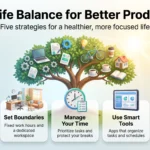
Set clear boundaries around hours, workload, and communication
Write a one-page boundary plan. It lists your working hours, your meeting ceiling per day, your response-time expectation for chat and email, and what counts as a genuine emergency.
Then share it. A boundary nobody knows about is just a private wish — this is where setting boundaries that people actually respect makes the difference.
Back it up structurally: block focus time on your calendar, turn off nonessential notifications after hours, and delegate one recurring task rather than absorbing it indefinitely.
Take real breaks, not screen breaks
Schedule three to five minute micro-pauses between blocks. Stand up, look at something more than 20 feet away, or run two minutes of slow breathing before a hard meeting.
Add one midday “oasis moment” away from all screens. A short walk outdoors resets attention in a way that scrolling never does.
A pause before a meeting is the difference between responding and reacting.
Sleep, nutrition, and movement: the core trio
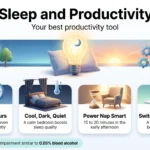
Aim for a consistent 7–9 hours of sleep with a fixed wake time. Regularity matters more than the occasional long night — a steady schedule beats a variable one, and sleep remains the highest-leverage productivity tool you have.
Build meals around protein, fat, and fiber so your energy doesn’t spike and crash. Our guide to nutrition and sustained focus covers the practical version for busy weeks.
Move in small doses. Around 20 minutes of activity measurably lowers stress hormones, and a 10-minute walk can lift mood for hours — which is why movement breaks outperform pushing through the afternoon slump.
Reclaim agency: track wins, find mentors, focus on controllables
Burnout thrives on the feeling that nothing you do changes anything. Counter it deliberately.
Each morning, pick one thing you fully control and finish it. Each evening, note one win, however small. Over a few weeks this rebuilds satisfaction faster than any motivational push.
Ask for a mentor introduction, or protect one block of deep-focus time per day and defend it. Managing your energy rather than just your hours is the mindset shift that makes the rest stick.
Build a Support System at Work and in Life
Social contact is a genuine buffer. Talking face to face with a good listener calms your nervous system in a way that a message thread cannot.
What you can do this week
Name two people to talk to — one inside work, one outside it. Swap a scroll break for a ten-minute walk with a colleague.
Ask for specific help. “Can you clarify which of these three is the real priority?” or “Can we move this deadline by two days?” is actionable. “I’m swamped” is not.
If you work remotely, be deliberate about it — isolation compounds quickly, as our guide to remote work and mental health explains.
What managers and organizations owe you
Individual habits cannot outrun a broken system. Well-run teams set meeting hygiene norms, define reasonable response times, and protect team-wide focus hours so deep work is possible at all.
They also train managers to spot early signs and respond with concrete adjustments — workload redistribution, a deadline reset, or a temporary scope cut — rather than a wellness webinar.
Small gestures count. Teams that recognize effort openly make it far easier for people to ask for help before they hit stage four.
Your First Four Weeks: A Simple Reset Plan
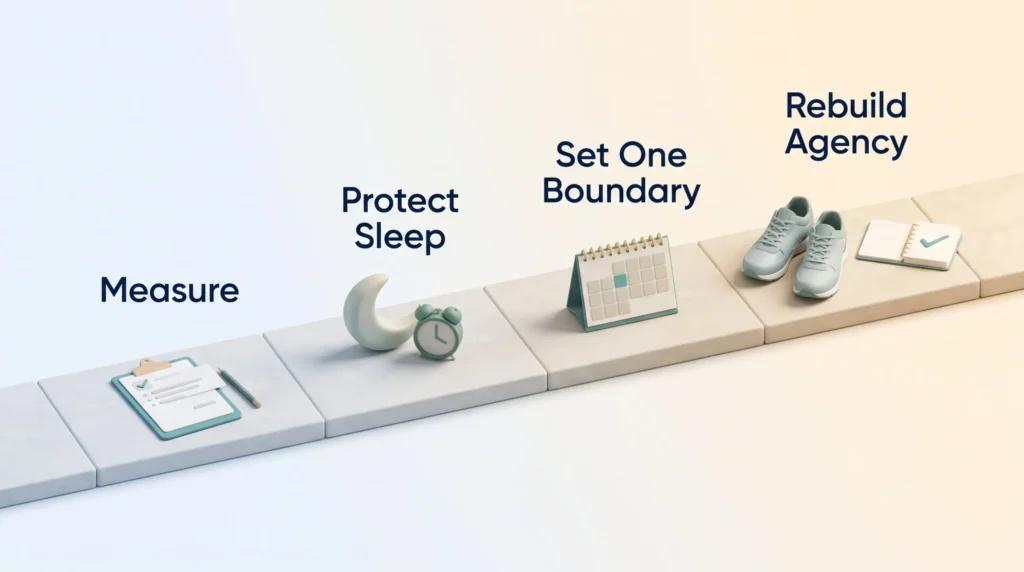
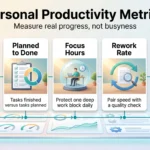
- Week 1 — Measure. Run the 60-second self-check. Note when your energy dips and what preceded it. Change nothing yet.
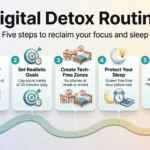
- Week 2 — Protect sleep. Fix your wake time, set a device curfew 60 minutes before bed. This one change makes every later change easier.
- Week 3 — Set one boundary. Pick the highest-cost one: an email curfew, a meeting cap, or a protected morning block. Tell your team.
- Week 4 — Rebuild agency. Add a daily movement break and a two-minute evening win log. Then review your self-check scores against week one.
If the scores haven’t moved, the problem is likely structural, not behavioral. That is your signal to escalate the workload conversation rather than optimize harder.
Conclusion
Choose small, repeatable steps. Pick one or two habits — a real break, a clearer boundary, a regular sleep window, a short walk — and hold them long enough to notice a difference.
Track simple signals: sleep quality, mood, recurring headaches. If those persist, or if signs of depression appear, contact a healthcare provider.
And keep the two levels separate in your mind. Your habits protect your recovery; your employer’s workload design decides how much recovery you need. Over weeks, the combination restores energy, focus, and a work-life balance you don’t have to defend every single day.
Found this useful?
Make SmartKeys a preferred source on Google, and our articles will surface more often in your Top Stories, AI Overviews, and AI Mode.
Add as Preferred Source