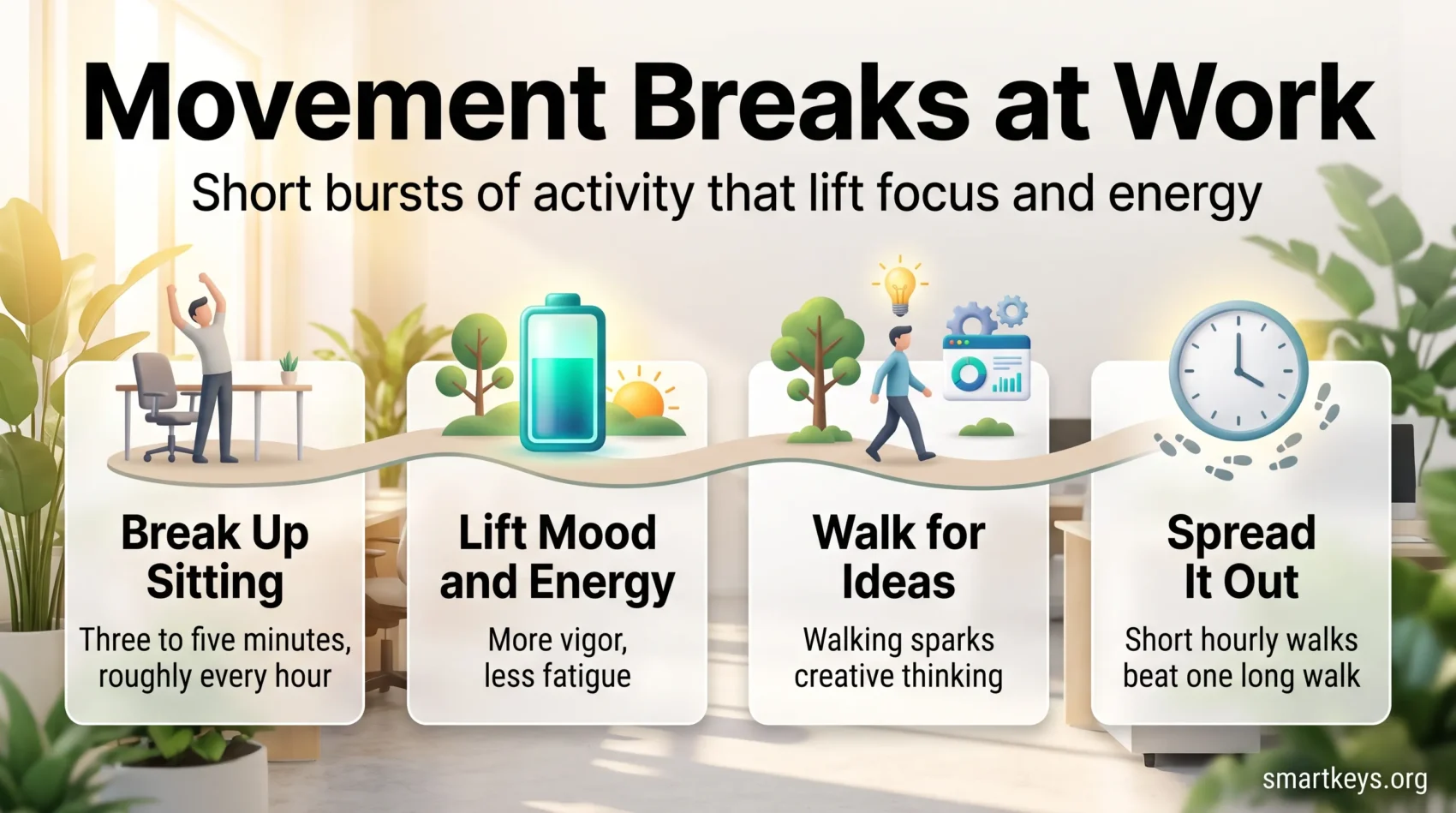
A movement break is a short, deliberate burst of physical activity in the middle of a working day: standing up and stretching, walking a lap of the office, climbing a flight of stairs. It usually lasts three to five minutes. The idea is not to squeeze in a workout. It is to interrupt a long stretch of sitting before your mood, energy and attention start to drain away.
That distinction matters. The evidence behind movement breaks is more specific than the usual advice suggests: they reliably lift how you feel, but their effect on how much work you get done is smaller and less certain.
Key Takeaways
- Movement breaks are short bursts of activity, typically three to five minutes, taken to interrupt prolonged sitting.
- The strongest evidence is for mood, vigor and fatigue. A 2022 meta-analysis found clear benefits for well-being.
- Effects on task performance are small and not statistically reliable in that same analysis. Longer breaks helped more.
- A trial of five-minute walks every hour beat one 30-minute morning walk for mood and fatigue across a sitting day.
- Frequency beats intensity. A cadence you actually keep is worth more than an ambitious plan you abandon.
What Counts as a Movement Break
Any break rests your attention, which is why planned downtime pays off for focus and productivity in the first place. A movement break adds a physical element: you leave your chair and use your body. Scrolling your phone at your desk is a break. Walking to the far end of the building and back is a movement break.
Researchers usually call these micro-breaks, meaning short pauses of ten minutes or less taken inside a work block rather than between tasks. The activity does not need to be strenuous. Standing, slow walking and brisk walking have all been tested, and all of them beat carrying on sitting.
The practical test is simple. Did you leave your chair, and did you move for a few minutes? If yes, it counts.
What the Research Actually Shows
Three lines of evidence are worth knowing, because they point in slightly different directions.
Mood and Energy: the Clearest Effect
The most comprehensive review to date is a 2022 meta-analysis in PLOS ONE, which pooled 22 study samples covering 2,335 participants. It found consistent benefits for well-being: vigor improved with an effect size of d = .36, and fatigue improved at d = .35. Both results were statistically significant.
An effect size around 0.35 is modest but real. In plain terms, it means most people feel noticeably fresher after a micro-break, not that anyone is transformed.
A 2024 study in npj Mental Health Research tested the same idea in ordinary working life rather than a lab. Researchers followed 211 university employees over 15 working days, prompting them at random to take a three-minute break after 30 minutes of sitting. Breaks improved mood and energy levels. Calmness did not change. Higher movement intensity produced larger gains, so a brisk walk beat standing still.
Task Performance: Smaller and Less Certain
The same 2022 meta-analysis found only a weak, non-significant effect on performance (d = .16, p = .116). That is an important caveat. Short movement breaks are not a proven way to raise your output on a given afternoon.
The analysis did find that break length mattered: the longer the break, the greater the boost to performance. The authors concluded that recovering from genuinely depleting work may need more than ten minutes. So if you have just finished something cognitively brutal, a three-minute walk may not be enough. Take a proper break instead.
Walking and Creative Thinking
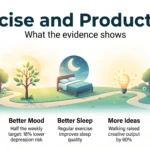
One well-known Stanford study by Oppezzo and Schwartz found that walking increased creative output by around 60% on average compared with sitting. The benefit applied to divergent thinking, meaning generating many possible ideas. It did not extend to focused problem solving with one correct answer, where walkers performed slightly worse.
That is a useful rule of thumb. Walk when you need options. Sit when you need to converge on an answer.
Why Prolonged Sitting Is the Underlying Problem
Movement breaks exist because of how desk work is structured. Hours of continuous sitting is the default, and the body responds poorly to it whatever you do in the evening.
The World Health Organization’s 2020 guidelines recommend 150 to 300 minutes of moderate aerobic activity a week for adults, and explicitly advise limiting sedentary time. Their headline message is that any physical activity is better than none, which is exactly the logic behind short breaks: the alternative is not a gym session, it is another hour in the chair.
This is also why a movement break is not a replacement for regular exercise. It addresses a different problem. Exercise builds fitness over months; movement breaks interrupt a single sedentary day. Both matter, and neither substitutes for the other.
When to Take One
Signals Worth Acting On
Rather than waiting for a timer, learn the signs that a break is overdue:
- You reread the same paragraph or email twice without absorbing it.
- You feel restless or irritable out of proportion to the task.
- You start reaching for your phone between every small action.
- Your shoulders, neck or lower back have started to ache.
These are the same early signals that, ignored over months, feed into burnout. A movement break will not prevent burnout on its own, but noticing the signals is a skill worth having.
A Cadence That Survives a Real Week
A short break roughly every hour, and a longer one every two to three hours, is a reasonable default. No study identifies one perfect interval, so treat it as a starting point.
If your calendar is dense with meetings, anchor breaks to transitions instead of the clock. Stand up when a call ends. Walk to fill your water bottle between two blocks of writing. Habits that attach to something already in your day survive better than free-floating ones, which is the core insight behind micro-habits.
What to Do in Three to Five Minutes
At Your Desk
Useful when you cannot leave the room, for example on a call with your camera off:
- Seated marches, lifting alternate knees for 30 seconds.
- Slow neck rolls and shoulder circles.
- Wrist and forearm stretches, which help if you type all day.
- A slow, deliberate breathing exercise while you sit tall.
These are the least effective of the three groups, because you stay seated. Use them when nothing better is available, not as your standard break.
On Your Feet
Better, because standing up is most of the benefit:
- Stand and reach overhead, then twist gently to each side.
- Ten to fifteen chair squats.
- Wall push-ups, which are easier than floor push-ups and possible in office clothes.
- Calf raises while you wait for a file to upload.
Out of the Room
The strongest option, and the one the research supports most directly:
- A brisk lap of the floor, the building or the block.
- One or two flights of stairs.
- Walking to a colleague’s desk instead of sending a message.
- Turning a one-to-one into a walking meeting.
If you work from home and the walk feels awkward, it usually means the space is working against you. Sorting out your home office layout so there is somewhere to walk to makes the habit far easier to keep.
How Long and How Often
Most studied micro-breaks fall between 30 seconds and ten minutes. Three to five minutes is a sensible default: long enough to change your posture, short enough that you will actually take it.
One randomized crossover trial is particularly instructive here. Researchers at the University of Colorado Anschutz Health and Wellness Center, with Johnson & Johnson Health and Wellness Solutions, had 30 sedentary adults complete six hours of sitting under three conditions: uninterrupted sitting, sitting plus a single 30-minute morning walk, and sitting interrupted by five minutes of moderate walking every hour. The hourly micro-bursts came out ahead of the single longer walk for mood, fatigue and food cravings. The findings appeared in the International Journal of Behavioral Nutrition and Physical Activity in November 2016.
The lesson is about distribution, not total minutes. Spreading the same movement across the day did more than saving it for one block.
For deeper recovery after demanding work, a short break is not the right tool. That is where a genuine pause belongs, whether that means structured downtime or, if your schedule allows it, a power nap.
Fitting Movement Into a Real Workday
The failure mode is not disagreeing with the idea. It is forgetting. Three things help.
First, put the breaks in your calendar rather than trusting yourself to remember. If you already use time blocking, add the break to the end of each block instead of treating it as spare time between blocks.
Second, use an external cue. A visual timer on the desk works better than a phone alarm, because it does not put you back on the device that pulls your attention. Timed work methods like the Pomodoro Technique already build in a break every 25 minutes, so movement fits naturally into the gap. If you prefer longer stretches of concentration, compare it with the alternative in Pomodoro versus focused sprints.
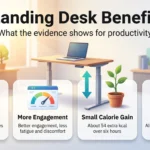
Third, remove the friction. A workspace that lets you stand and move without rearranging your setup makes breaks near-automatic. That is worth more than motivation. If you sit badly, fixing the basics of workplace ergonomics should come first, and a standing desk gives you a low-effort way to change posture without leaving your work.
Where Movement Breaks Will Not Help
Being clear about the limits keeps expectations honest.
They will not rescue a workload that is simply too large. If you are behind because there is more work than hours, the fix is prioritization, not a lap of the corridor.
They will not fix a fragmented day. If you are interrupted constantly, the problem is task switching, and adding more transitions can make it worse. Protect a block of uninterrupted time first, then break at the end of it.
They will not compensate for poor sleep or poor food. Movement masks tiredness briefly, but the cause needs addressing directly, whether that is your sleep or what you eat during the day.
And they will not turn a badly designed environment into a good one. Noise in an open-plan office or poor workspace lighting will keep draining your attention no matter how often you stand up.
Used for what they are good at, though, movement breaks are one of the cheapest changes available. They cost minutes, need no equipment, and the evidence that they make the working day feel better is solid.
Found this useful?
Make SmartKeys a preferred source on Google, and our articles will surface more often in your Top Stories, AI Overviews, and AI Mode.
Add as Preferred Source