Most workdays contain a stretch in the early afternoon where concentration stops cooperating. A power nap is one of the few fixes that works inside half an hour, and the evidence behind it is better than its reputation.
Almost everything depends on length and timing. The right size leaves you sharper; too long leaves you worse off than before. Here is what the research supports, how to fit a nap into a real workday, and where it stops working. For the nightly foundation no nap replaces, see our guide to sleep and productivity.
Key Takeaways
- A 20 to 30 minute nap is the length most sleep authorities recommend.
- NASA research on long-haul pilots recorded 34% better performance and 54% better alertness after a 26-minute nap.
- Early afternoon is the window. Napping after 3 p.m. tends to cost you sleep that night.
- Caffeine drunk just before a short nap peaks as you wake, which is why the coffee nap works.
- Naps beyond 30 minutes bring sleep inertia and, as a habit, track with worse metabolic health.
- A nap manages a sleep debt. It does not repay one.
Why Power Naps at Work Deserve a Second Look
In much of the English-speaking working world, sleeping during office hours still reads as a lack of discipline. In Spain, Japan and large parts of Asia, a short midday rest is unremarkable. The physiology is the same everywhere: alertness dips in the early afternoon whether or not anyone approves.
That dip is not caused by lunch. It belongs to the circadian rhythm, a scheduled low point roughly twelve hours after the deepest part of the night. Working against it means slower thinking and more small errors. Working with it means planning around the afternoon slump or sleeping through the worst of it.
Sleep debt makes that harder to ride out. According to the CDC’s National Center for Health Statistics, 30.5% of US adults slept less than seven hours a night in 2024, and only 54.8% woke feeling well rested most days.

Understanding the Concept of a Power Nap
A power nap is short daytime sleep, usually 20 to 30 minutes, taken to restore alertness rather than to make up for a bad night. The length is the point. Kept brief, sleep stays in its lighter stages and waking is clean. Past roughly half an hour it moves into slow-wave stages, and being pulled out of those produces the heavy feeling known as sleep inertia.
It belongs in the same family as a walk, a proper lunch break and other forms of deliberate downtime that protect your productivity. Like them, it is a way of managing energy across the day, not a substitute for nightly sleep. Williamson and Feyer, writing in Occupational and Environmental Medicine in 2000, found that 17 to 19 hours awake produced impairment comparable to a blood alcohol concentration around 0.05%. No 20-minute nap undoes that.
So treat naps as maintenance, not repair. If you need one daily just to function, the problem sits in your nights, and our guide to sleep and workplace performance covers that side.
How Power Naps at Work Affect Efficiency
The link between short naps and output is best documented where fatigue is measured because safety depends on it. Aviation and shift work produced the clearest evidence, and it transfers reasonably to desk jobs.
The Science Behind Naps and Productivity
The most cited result comes from NASA’s fatigue countermeasures research on long-haul flight crews. Pilots given a planned in-flight rest slept about 26 minutes on average and afterwards showed roughly 34% better performance and 54% better alertness than the control group: tired people doing demanding cognitive work, which is close to what knowledge workers face at 3 p.m.
Fatigue is widespread. The McKinsey Health Institute’s Employee Holistic Health Survey, run from April to June 2023 across more than 30,000 respondents, found that in 29 of 30 countries more than a third of employees reported experiencing fatigue. That is one reason burnout keeps climbing the workplace agenda.
Cognitive Benefits of Short Naps
Sleep supports memory consolidation, which is why a nap after a training session or a dense reading block beats one taken at random.
The more immediate effect is on attention. Concentration degrades over hours of continuous work, and a nap resets part of that decline in a way coffee alone does not. If your afternoons involve deep work, protecting the hour after a nap is worth more than the nap itself. It also fits methods such as the Pomodoro Technique, where the nap replaces a longer break.
Real-world Applications in the Workplace
Application is where most nap advice falls apart, because the average office has nowhere to do it. Remote and hybrid workers have the advantage: a bedroom is already there, and anyone building a productive home office can plan for it.
In shared offices the constraint is physical. Coworking spaces increasingly include quiet rooms, while most conventional offices leave people improvising. Where no space exists, the honest alternatives are movement breaks and daylight.
Benefits of Power Naps
Three effects are consistently supported: better alertness, better memory retention and less felt fatigue.
Improved Alertness and Focus
The alertness gain is the most reliable benefit and the fastest to appear, improving reaction time and reducing lapses of attention for several hours. It is largest in people already short on sleep. If your attention span collapses at the same time each afternoon, a nap addresses the cause, not the symptom.
Enhanced Memory Retention
Place a nap after input-heavy work rather than before it: after a course, a long document review or a client briefing. The benefit is real but modest, and it complements good learning habits rather than replacing them.
Stress Reduction and Mood Enhancement
Fatigue and irritability travel together, and reducing one usually reduces the other. A nap sits alongside the recovery practices that hold up: short breaks, stress management and real structured downtime.
How to Take Effective Power Naps
Three variables decide whether a nap helps or hurts: length, timing and setting.
Optimal Duration for Maximum Benefits
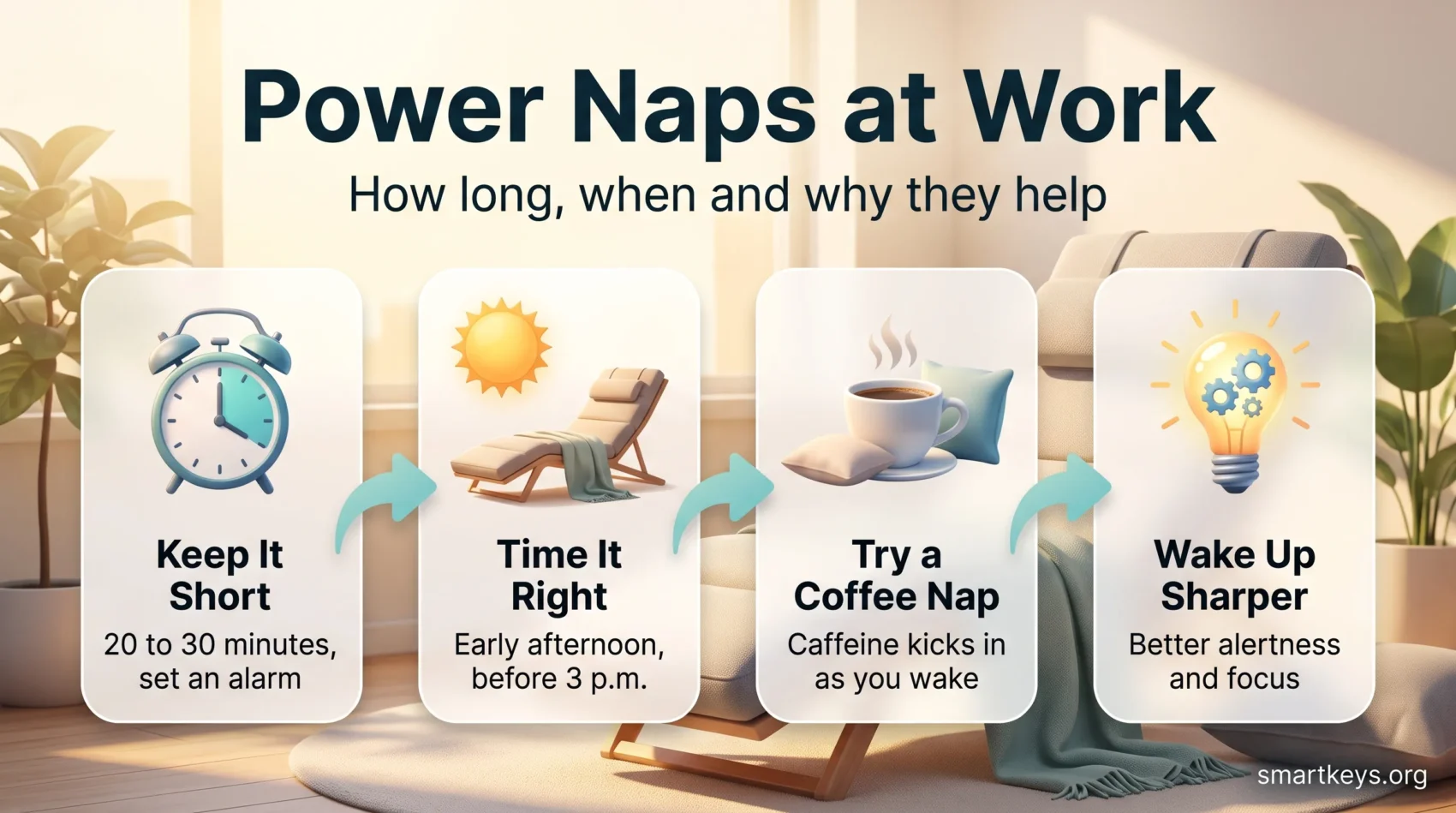
Mayo Clinic’s guidance is direct: 20 to 30 minutes is ideal, and regularly sleeping longer than that during the day is not advisable. Set an alarm, because the gap between a 25-minute nap and a 50-minute nap is the gap between waking sharp and waking impaired. Falling asleep is not strictly required; twenty quiet minutes with your eyes closed still lowers arousal.
Timing Your Nap: The Best Hours
Early afternoon is the window, broadly 1 p.m. to 3 p.m. on a conventional schedule. Sleep pressure is high enough to make falling asleep easy, but not so high that a short nap becomes a long one.
Mayo Clinic advises against napping after 3 p.m., because later naps eat the sleep pressure you need that evening. Shift workers should move the window to match their own rhythm. It is the principle behind working with your ultradian rhythms: schedule recovery where your energy actually falls.
Creating an Ideal Nap Environment
Quiet, dark and slightly cool is the standard recipe. Light suppresses sleep onset, so dimming the room matters more than the surface you lie on. The same logic runs in reverse for the rest of the day, which is why workspace lighting deserves attention. An eye mask and earplugs cover rooms you cannot control, and a reclined chair often beats a bed: oversleeping is less likely.

Strategies for Incorporating Naps into Your Workday
A nap survives a real schedule only if it is planned. Find the point where your output reliably drops, then block 30 minutes there: about 20 for sleep, the rest for settling and waking. If you already use time blocking, the nap is another block.
- Fix the slot: Keep it at the same time daily so your body learns to fall asleep quickly.
- Set two alarms: One to end the nap, one ten minutes later to mark the return to real work.
- Protect the recovery window: Schedule undemanding tasks for the first ten minutes after waking.
- Be open about it: Hidden naps create stress that cancels the benefit.
For remote workers this is calendar discipline, part of structuring a remote workday. In an office it usually needs a conversation with a manager first.
Power Naps for Energy Boost
The nap works better combined with the two other afternoon levers: caffeine and consistency.
Using Caffeine to Enhance Nap Effects
The coffee nap sounds contradictory and is not. Caffeine takes roughly 20 to 30 minutes to reach peak effect, so a cup drunk immediately before a 20-minute nap arrives just as you wake. The nap clears some of the adenosine that builds sleep pressure; the caffeine blocks what remains.
The Sleep Foundation’s review describes studies in night-shift workers and drowsy drivers where caffeine plus a short nap beat either alone on reaction time and sustained attention. Drink quickly and lie down at once, or the timing collapses. A heavy lunch deepens the dip, so our notes on nutrition and productivity help here too.
Setting a Routine for Daily Napping
Consistency turns a nap from a gamble into a tool, because sleeping at the same time each day trains sleep onset. Build the day around it: regular physical activity improves night sleep and daytime alertness, reducing how much work the nap has to do.

Potential Drawbacks of Power Naps
Napping is not universally beneficial. The honest version includes its costs.
Understanding Sleep Inertia
Sleep inertia is the grogginess and slowed thinking that follows waking, particularly from deeper sleep. Mayo Clinic notes it often clears within about 35 minutes, which is a long time to be impaired with a meeting waiting. Keeping the nap short is the main defence; the second is scheduling. Never place a nap directly before something demanding sharp judgement.
Long Naps and Their Impact on Nighttime Sleep
Long or late naps eat the sleep pressure that gets you to sleep at night, creating a loop where poor nights produce long naps that produce poorer nights.
There is also a health signal. A 2023 study in the journal Obesity, led by researchers at Brigham and Women’s Hospital and covering 3,275 adults in Murcia, Spain, found that people who habitually napped longer than 30 minutes had higher body mass index, higher blood pressure and more metabolic syndrome, while those napping 30 minutes or less had lower systolic blood pressure than non-nappers. The design was cross-sectional, so it cannot show cause. Mayo Clinic likewise flags naps beyond an hour a day as associated with higher risk of hypertension, diabetes and cardiovascular disease.
Successful Company Initiatives on Napping
A handful of employers have made rest an explicit part of the offer. That proves the idea is workable, not that it pays.
Case Studies of Companies Encouraging Naps
Google has installed MetroNaps EnergyPods in its offices for years, and Ben & Jerry’s and HuffPost have long maintained nap rooms. The clearest formal example is Wakefit, the Indian mattress company, which introduced a “Right to Nap” policy in May 2022 setting aside 2:00 to 2:30 p.m. for employees to sleep.
What is missing is public evidence on outcomes, since companies rarely publish measured effects. Treat nap rooms as a signal about culture and trust: the policy that permits rest without demanding justification does most of the work, and the furniture is secondary.
Conclusion
A power nap is a small, cheap intervention with an unusually good evidence base. Twenty to thirty minutes in the early afternoon restores alertness and makes the second half of the day usable. NASA’s flight-crew research remains the clearest demonstration.
The boundaries matter as much as the benefits. Keep it short, keep it before 3 p.m., and pair it with caffeine if you want the effect sooner. Daily dependence on napping means the nights need fixing, not the afternoons. If you have the autonomy, block 30 minutes, set an alarm, and judge it on how the next two hours go.
Found this useful?
Make SmartKeys a preferred source on Google, and our articles will surface more often in your Top Stories, AI Overviews, and AI Mode.
Add as Preferred Source