Your attention span is not a fixed trait. How long you stay on one thing shifts with your sleep, your interest in the task, the noise around you, and how often something pulls you away. Most of those factors are things you can change this week.
This guide is for people with work to finish: freelancers, team leads, and anyone producing something on a laptop next to a chat app that never stops. It covers what the research on workplace attention shows, the fixes that add focused minutes today, the habits that build a longer span over months, and which popular claims do not survive a check.
Key Takeaways
- Attention span is trainable. Sleep, interruptions and task design move it far more than willpower does.
- On-screen attention at work has shortened sharply since 2004, per long-running research by Gloria Mark at UC Irvine.
- The claim that humans focus for eight seconds and goldfish for nine has no verifiable source.
- Quick wins come from cutting the interruptions you control: notifications, open tabs and your phone.
- Lasting gains come from sleep, movement and repeated practice at holding a single task.
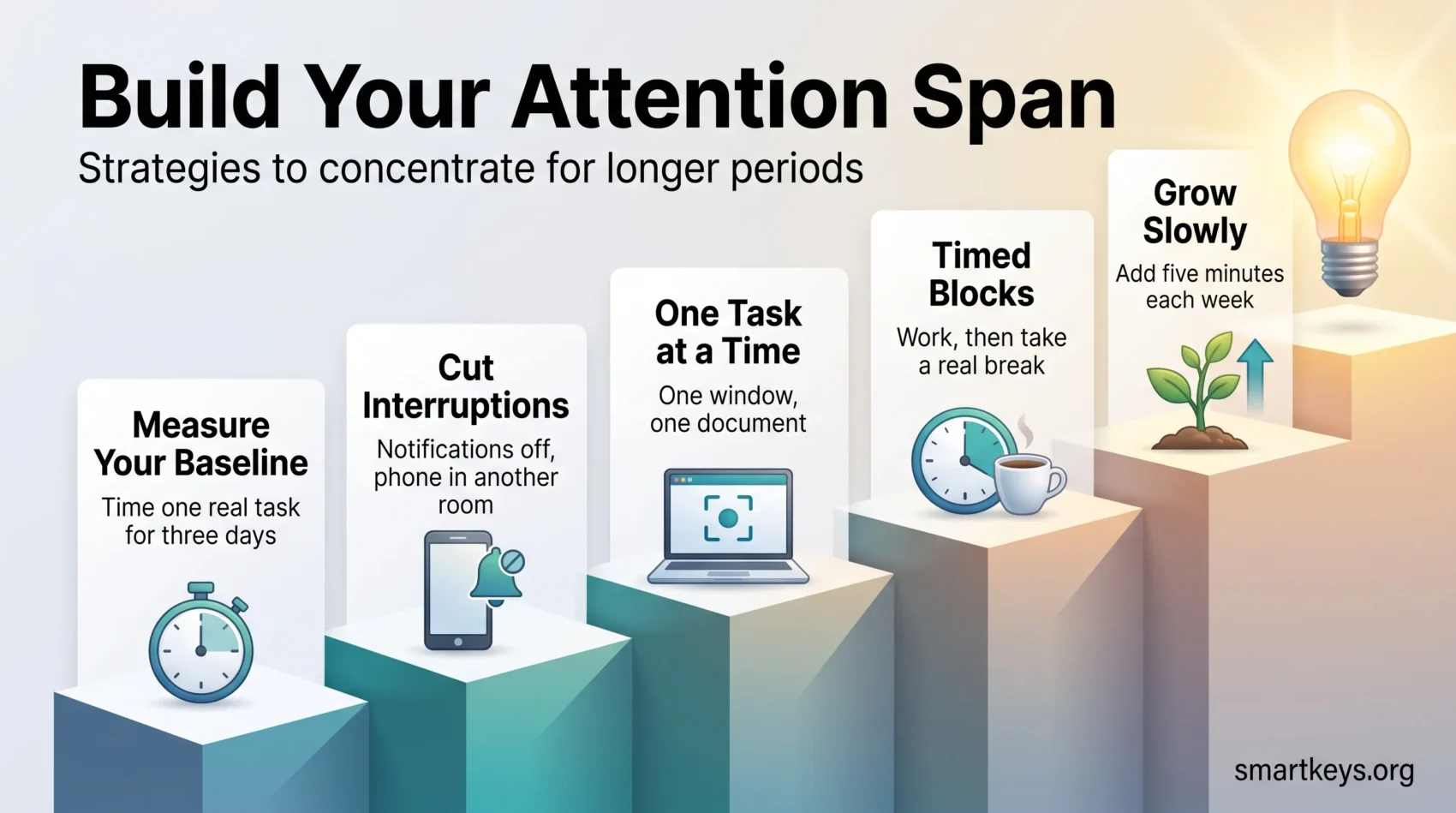
- Measure your baseline first, then extend your blocks in small steps.
What attention span actually means
Your attention span is the stretch of time you stay on one task before your mind moves to something else. That something else is rarely a decision you made on purpose. It is a message, a thought about another project, or a tab you opened an hour ago.
Two things break a work block, and each needs a different fix. External interruptions come from outside you: a colleague, a notification, a call. Self-interruptions come from you, with nobody prompting them. Studies of office work find self-interruption accounts for a large share of the total, so settings alone never solve the problem.
What the workplace data shows
Gloria Mark, professor of informatics at the University of California, Irvine, has measured how long office workers stay on a single screen since the early 2000s. In 2004 the average was about two and a half minutes. A later round put it near 75 seconds. Her most recent figure is roughly 47 seconds.
Read that as a description of a work environment, not a verdict on your brain. People still read long books and write long documents; what changed is how many things compete for the next second of their attention. So assume your default block will be short unless you design it to be longer. That is why time blocking and a closed door outperform a resolution to concentrate harder.
The goldfish claim is not real
You have probably seen the line that humans now focus for eight seconds while a goldfish manages nine. It spread from a 2015 Microsoft Canada consumer report, which credited a source nobody has since been able to verify. There is no study behind it.
Drop it. Attention is not one number you either have or lack. It varies with the task, your sleep and your surroundings, and those are the levers worth pulling.
Find your baseline before you change anything
Before you try to work for 90 minutes, find out what you can currently do. Skip this step and you set a target you cannot hit, miss it twice, and conclude you are bad at focusing.
Run a three-day test. Pick one real task, start a timer, and work until you genuinely break off. Write down the minutes. Do not force yourself to continue: you are measuring, not competing. Most desk workers land between 15 and 40 minutes.
That number is your starting block length. Set next week’s blocks slightly below it, then add five minutes a week. A block you finish builds confidence; a block you abandon teaches you nothing. For the pattern behind the number, run a time audit across a normal week.
One caution about a rule you may have read elsewhere. The guideline of “two to three minutes of focus per year of age” comes from classroom practice with children. It is a rule of thumb, not a research finding, and says nothing useful about an adult at work. For a smaller starting experiment, the 2-minute rule shows you that starting is the hard part.
Quick wins: add focused minutes this week
These changes take minutes to set up and pay off the same day.
Cut the interruptions you control
Start with notifications. Switch off every alert that is not a person waiting on you right now. On most days that leaves calls and direct messages from two or three people. Ten minutes spent on work notifications removes more interruptions than any amount of discipline.
Then deal with the phone. A drawer or another room beats face down on the desk, because the small effort of retrieving it is the point. If your pull runs toward particular sites, a website blocker enforces the rule while the habit forms.
Close the tabs. Every open tab is a small unanswered question your mind keeps returning to. Bookmark what you need later and close the rest. Then agree reply times with your team: clear instant messaging boundaries stop a chat message being treated as an emergency by default.
Work on one thing at a time
Switching between two pieces of work does not split your attention evenly. It costs you the time to reload the second task into working memory and raises your error rate. The research on multitasking is consistent here, which is why single-tasking is the more reliable default.
In practice: one task, one window, one document. When a second task pushes into your head, write it on a list and return to what you were doing. Writing it down is what quiets it. Those unfinished threads, sometimes called open loops, keep resurfacing until your brain trusts they are recorded.
Use timed blocks with real breaks
Pick a length you can finish. 25 minutes on and 5 off works for shallow admin. 45 on and 10 off suits writing, analysis or code. Set a timer so you stop checking the clock.
The break has to be a real break. Scrolling a feed is not rest, it is a different kind of input. Stand up, look out of a window, refill your water. Short breaks and brief movement breaks restore more than a change of screen does.
Protect the block on your shared calendar so colleagues can see it. A team-wide focus time policy holds up better than each person quietly defending their own morning, and it makes sustained deep work possible when your calendar is otherwise open to everyone.
Habits that build a longer span over months
Quick fixes stop interruptions. These habits raise the ceiling.
Practise holding one task
Attention improves the way most skills do: by doing the demanding version on purpose, repeatedly. Read one chapter without your phone in the room. Sit through a meeting without a second screen. Run one block a day that is slightly longer than comfortable.
Focused-attention practice, such as following your breath for five to ten minutes, is the deliberate version of the same drill. Claims that it transfers to general cognitive ability remain contested, but it trains the exact move a work block asks of you: notice you drifted, and come back.
Sleep, movement and food
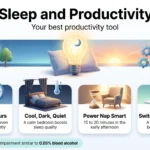
Short sleep degrades attention before you notice it. You feel roughly as capable as usual and perform measurably worse, which is why self-assessment fails here. Regular bed and wake times matter more than an occasional long night, and the link between sleep and productive work is among the better established findings in this field.
Regular aerobic exercise supports the brain systems involved in sustained attention, and a short walk changes how alert you feel over the following hour. Three brisk walks a week is a reasonable start. Eating is simpler than the supplement market suggests: keep water within reach, go lighter at lunch before an afternoon block, and expect some dip after midday regardless. Guidance on nutrition at work and on the afternoon slump covers what helps.
A focus plan you can run tomorrow
The night before, pick the one task that matters most and write down its first physical step. “Draft the pricing section” beats “work on the proposal”, because the first tells you what to type. A clear next action removes the pause where most mornings get lost.
In the morning, run the block before you open the inbox. Phone out of the room, one tab, timer set to your baseline length. Begin with a two-minute warm-up: reread the last paragraph you wrote, or restate the problem in a sentence. That carries you past the point where starting feels hard.
End the block by writing one line about where you stopped and what comes next. That is what lets you restart quickly tomorrow. Then take the break. Most people get two good blocks a day; three is a strong day, not a standard to fail against.
Where this usually goes wrong
Blocks set too long. You choose 90 minutes because it sounds serious, fall short twice, and quietly stop trying. Start below your measured baseline.
Optimising the system instead of doing the work. Rebuilding your task app is not focus practice. It is one of the most common productivity pitfalls, and it feels productive throughout.
Treating an unfixable environment as a personal failing. If you sit in an open office beside the coffee machine, or your role is to be interruptible, the answer is a conversation about when you are reachable. Moving routine updates to asynchronous work frees more attention than any personal habit can.
Conclusion
Attention span responds to conditions far more than to effort. Measure your real block length, cut the interruptions you control, and add five minutes a week instead of aiming for an hour tomorrow.
Pick one change today: notifications off, phone in another room, or one timed block before the inbox. Layer in the slower habits, sleep above all, over the next month. Change one thing at a time, so you can tell what worked.
Found this useful?
Make SmartKeys a preferred source on Google, and our articles will surface more often in your Top Stories, AI Overviews, and AI Mode.
Add as Preferred Source