Standing desks moved from novelty to standard office equipment in about a decade. The pitch was simple: sitting all day is bad for you, so stand instead. The research that has accumulated since tells a more useful story. Standing desks do change how people work, and some of the measured effects are real, but the benefits are narrower and more conditional than the marketing suggests.
A desk that moves is only one lever in optimizing your whole workspace, but it is the one with the most research behind it. This guide separates the standing desk benefits the evidence supports from the ones it does not, and shows how to set up and use a sit-stand workstation so it actually helps your workplace ergonomics instead of just changing which part of you aches.
Key Takeaways
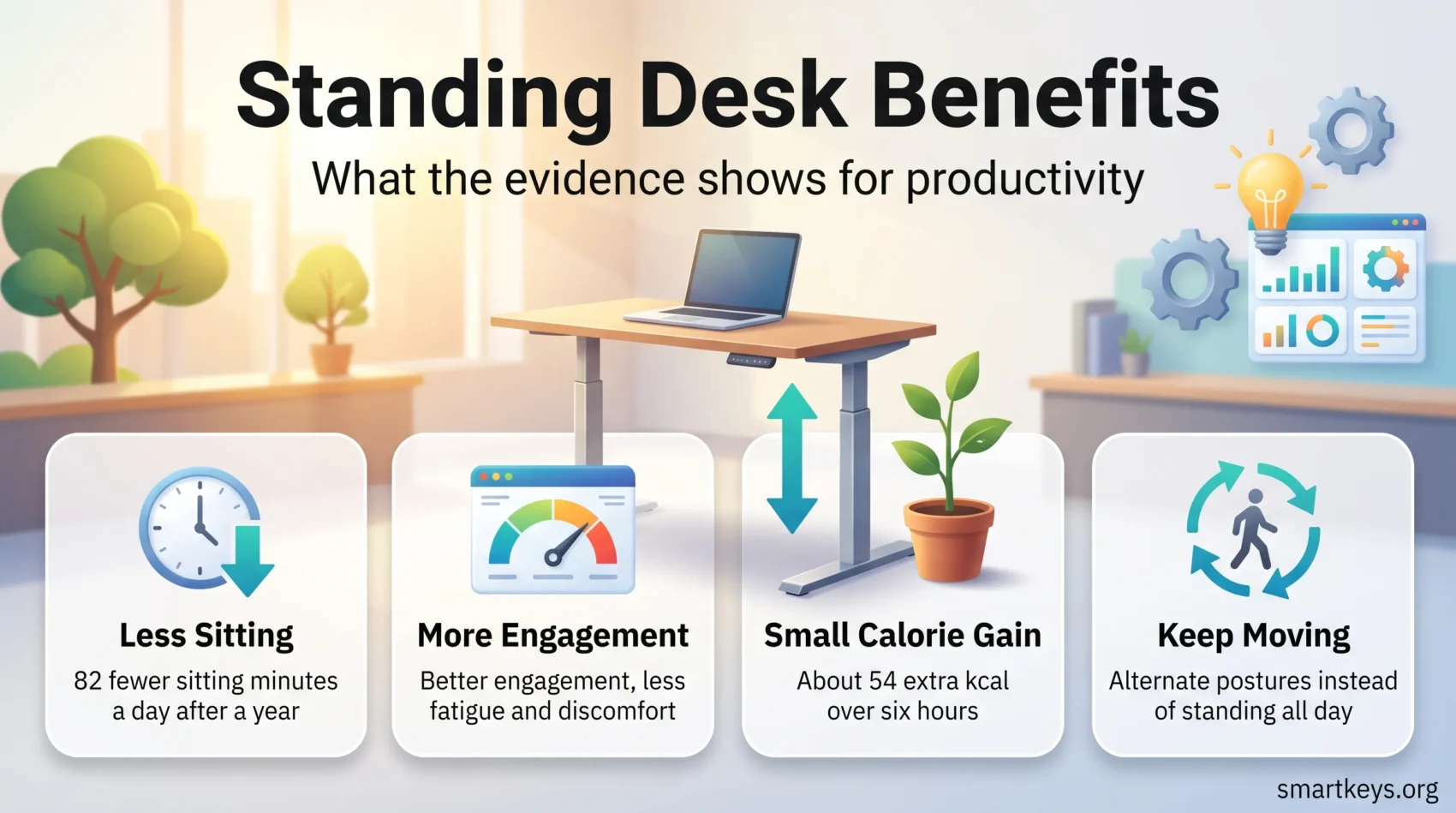
- The strongest workplace trial (SMArT Work, published in The BMJ) found sit-stand desks cut daily sitting by 82 minutes at 12 months and improved job performance, work engagement and occupational fatigue.
- A Texas A&M study of 167 call centre staff found stand-capable workers were about 46% more productive over six months than seated colleagues.
- The calorie story is small: standing burns roughly 0.15 kcal per minute more than sitting, about 54 extra kcal a day if you swap six hours.
- A 2024 study of 83,013 UK adults found more standing did not lower cardiovascular risk and was linked to higher risk of varicose veins and deep vein thrombosis.
- Cochrane rates the evidence for sit-stand desks as low quality, and effects shrink over time unless the habit is maintained.
What a Standing Desk Actually Changes
A sit-stand desk does one thing reliably: it removes the friction from changing posture. When standing costs you nothing more than pressing a button, you do it more often. That is the mechanism behind almost every benefit in the literature. It is not the standing itself so much as the interruption of long, unbroken sitting.
That distinction matters because it tells you how to use the desk. A workstation parked permanently at standing height is not the goal. A workstation you move several times a day is.
Height-adjustable desks come in three broad forms. Electric dual-motor desks adjust quickly and quietly and usually offer height presets, which makes switching almost automatic. Manual crank desks cost less and last well, but the effort involved means many people stop adjusting them. Desktop converters sit on an existing desk and raise the work surface, which is the cheapest route into sit-stand working.
Look for compliance with the ANSI/BIFMA standards for office furniture, which cover stability, structural strength and the height range needed to fit most users. That is a more useful buying signal than any manufacturer’s productivity claim.

The Productivity Evidence
Two studies carry most of the weight here, and both are worth understanding in detail rather than as a headline percentage.
The Call Centre Study
Researchers at the Texas A&M University Health Science Center tracked 167 call centre employees for six months. Seventy-four received stand-capable workstations; 93 kept conventional seated desks. Productivity was measured objectively as successful calls per hour, which is unusually clean for this kind of research.
The stand-capable group was about 46% more productive across the six months. The effect was small in month one and grew from the second month onward, as people got used to the desks. Nearly 75% of the stand-capable group also reported less body discomfort by the end. The study appeared in IIE Transactions on Occupational Ergonomics and Human Factors in 2016.
One caveat worth keeping in mind: call centre work is repetitive, measurable and phone-based, which is close to the ideal case for standing. Do not assume the same margin applies to deep analytical work or writing.
The SMArT Work Trial
The SMArT Work trial, published in The BMJ in 2018, randomised 146 NHS office workers to a sit-stand desk plus behavioural support or to usual practice. Sitting time fell by 51 minutes a day at three months, 64 minutes at six months and 82 minutes at twelve months, so the effect held up rather than fading.
Participants reported improvements in job performance, work engagement, occupational fatigue, presenteeism, daily anxiety and quality of life. Just as informative is what did not move: job satisfaction, cognitive function and sickness absence showed no notable change.
That is the honest shape of the evidence. Sit-stand desks appear to help with energy, engagement and discomfort. They are not a cognitive enhancer, and no credible study shows they make you think better.
Where the Evidence Is Weak
The Cochrane review of workplace interventions for reducing sitting pooled 10 short-term studies and found sit-stand desks reduced workplace sitting by roughly 100 minutes per workday, dropping to about 57 minutes in the three to twelve month range. Cochrane rated that evidence low quality and noted there is essentially nothing on what happens beyond a year.
Claims you will see repeated online but cannot trace to a published study include large percentage gains in focus, creativity or problem solving from standing. Treat those as marketing. If you want a reliable lever on concentration, the literature on attention span and on structured focus blocks is far better supported than furniture.
The Health Picture Changed in 2024
For years the standing desk case rested on cardiovascular health. That argument no longer holds in its original form.
Cardiovascular Health
A study published in the International Journal of Epidemiology in 2024 used wearable device data from 83,013 UK adults, followed for seven to eight years. Standing more did not reduce cardiovascular disease risk. Beyond about two hours of standing a day, the risk of orthostatic circulatory problems such as varicose veins and deep vein thrombosis rose.
The same study found that sitting for more than 10 hours a day raised both cardiovascular and orthostatic risk. The takeaway is not that standing is dangerous or that sitting is fine. It is that swapping one static posture for another static posture does not buy you heart health. Movement does. That is why a walk at lunch or a few movement breaks across the day matter more than desk height, and why regular exercise remains the intervention with the strongest evidence behind it.
Calories and Weight
A meta-analysis of 46 studies covering 1,184 participants put the difference in energy expenditure at 0.15 kcal per minute between standing and sitting. Replacing six hours of sitting with standing burns about 54 extra kcal a day for a 65 kg person, which the authors calculated as roughly 2.5 kg of fat over a year if nothing else changes.
That is a real effect and a modest one. A standing desk is not a weight loss device, and pairing it with better workday nutrition will do considerably more.
Back and Neck Pain
The CDC’s Take-a-Stand Project fitted 24 office workers with sit-stand devices and compared them with 10 controls. Sitting fell by 66 minutes a day, upper back and neck pain declined by 54%, and mood improved. The telling detail came at the end: when the devices were removed, the gains disappeared within two weeks and self-esteem scores dropped below baseline.
Low back pain is a different question. A 2020 systematic review and meta-analysis found that prolonged standing for desk work did not produce significantly less perceived low back pain than sitting, and concluded that both static postures are a problem. If your back hurts, the answer is variation and movement, not permanent standing.
Reducing Sedentary Time Is the Real Goal
The WHO 2020 guidelines on physical activity and sedentary behaviour recommend that adults limit sedentary time and replace it with physical activity of any intensity, including light activity. Notably, the WHO declined to set a specific hourly threshold, stating there was insufficient evidence for a quantified limit.
That framing is more useful than any sit-stand ratio you will find in a product brochure. The target is less continuous stillness, not a particular number of standing minutes. A standing desk is one tool for that. Walking to a colleague instead of messaging, taking calls on your feet, and building short breaks into the day all serve the same end.
Setting Up a Sit-Stand Workstation Properly
Most of the discomfort people blame on standing desks comes from bad setup rather than standing itself. The basics are quick to get right:
- Set the desk so your elbows sit at roughly 90 degrees with forearms parallel to the floor, in both the seated and standing positions.
- Position the top of the screen at or just below eye level and about an arm’s length away. If you run two monitors, keep the primary one directly in front of you.
- Use an anti-fatigue mat. Hard floors are the most common reason people give up on standing within the first month.
- Wear supportive shoes. Standing in the shoes you would wear to a meeting is not the same as standing in ones designed for it.
- Keep the desk surface clear enough that raising it does not become a chore. Basic desk organization makes the switch frictionless.
- Check your lighting. Screen glare changes when you raise the desk, so workspace lighting often needs adjusting too.
These principles apply whether you are outfitting a corporate floor or a spare room. For a full walkthrough of the room around the desk, see our guide to home office productivity and the broader piece on workspace optimization.
How to Transition Without Wrecking Your Legs
There is no evidence-based prescription for how many minutes to stand per hour. What the research does support is gradual adaptation and avoiding long static blocks in either posture.
Getting Started
- Begin with short standing periods rather than a full morning. Your feet, calves and lower back need time to adapt.
- Anchor standing to specific activities instead of the clock. Calls, email triage, reading and stand-up meetings work well standing. Detailed writing and analysis usually do not.
- Increase the total gradually over several weeks and stop when discomfort starts, not after it has set in.
- Use desk height presets or a recurring reminder, since the habit fails on friction more than on willpower.
- Sit down when you are tired. Standing through fatigue produces bad posture, which is worse than sitting well.
Building It Into the Day
Pairing posture changes with an existing structure makes them stick. If you already work in blocks, standing for the shallower blocks and sitting for the demanding ones fits naturally alongside time blocking. If your energy dips predictably after lunch, that is a good slot to be on your feet, and it works well with the other afternoon slump strategies.

The Take-a-Stand finding about the two-week rebound is the practical warning here. The benefits track continued use. A desk that spends six months at seated height is furniture, not an intervention.
Standing Desks in Organisations
For employers, the case for sit-stand desks is reasonable but should be made honestly. The measurable returns in the literature are lower reported discomfort, better work engagement and reduced occupational fatigue. Those are worth having. Promising a 46% productivity jump across every role is not supportable, and overselling it makes the next wellbeing initiative harder to fund.
A few things separate rollouts that work from ones that do not. Desks alone underperform: SMArT Work paired the equipment with brief coaching and prompts, and the Take-a-Stand rebound shows what happens when support stops. Choice matters as well, since not everyone wants a standing desk and forcing it produces resentment rather than movement. In open-plan offices, sightlines and acoustics shift when some people stand, which is worth thinking about at the layout stage.
Budget also deserves a realistic frame. Converters give most of the functional benefit at a fraction of the cost of full electric desks, which makes them a sensible way to test demand before committing. Where teams are distributed, sit-stand equipment is a common line item in wellbeing stipends, and it sits comfortably in wider employee wellness programmes. In hybrid setups, remember that someone with a good desk at the office may have a kitchen table at home, which is where most of the ergonomic risk actually sits.
Common Misconceptions
“Standing all day is the healthy option.” It is not. The 2024 cohort data links prolonged standing to orthostatic circulatory problems, and the low back pain research finds no advantage over sitting. Alternate.
“Standing desks burn a lot of calories.” They burn about 54 extra kcal over six hours for an average adult. Useful, but not a fitness plan.
“They make you sharper.” SMArT Work measured cognitive function and found no notable change. Standing may help you feel more alert; that is not the same as thinking better.
“You need an expensive electric desk.” A converter on an existing desk delivers the posture change, which is the part that matters. Spend the difference on a good chair and a decent mat.
“Sitting is the new smoking.” This comparison has no basis in the evidence and has been repeatedly criticised by researchers in the field. Prolonged sitting is a genuine risk factor. It is not comparable to tobacco.
The Bottom Line
A sit-stand desk is a reasonable purchase with a modest, real payoff. It reliably reduces sitting time, it reduces reported back and neck discomfort for many people, and in at least two decent trials it improved engagement, fatigue and measured output. Those are worthwhile gains for a one-off cost.
It is not a health intervention on its own. It will not fix a sedentary life, it will not make you smarter, and standing rigidly for eight hours will create problems of its own. Used as intended, as a way to keep changing posture through the day, it earns its place in a well-built workspace, particularly for anyone working long hours from a home setup.
Found this useful?
Make SmartKeys a preferred source on Google, and our articles will surface more often in your Top Stories, AI Overviews, and AI Mode.
Add as Preferred Source