Choosing a marketing automation platform is one of the more consequential software decisions a B2B team makes, because the system ends up owning your database, your campaign logic and your reporting. Adobe Marketo Engage is one of the oldest and most established options in that category, and it remains a genuinely enterprise-grade tool. It is also expensive, quote-only and demanding to run. This review looks at what Marketo Engage actually offers in 2026, what the packaging looks like today, what thousands of verified reviewers consistently say about it, and which teams are better served by something simpler.
Key Takeaways
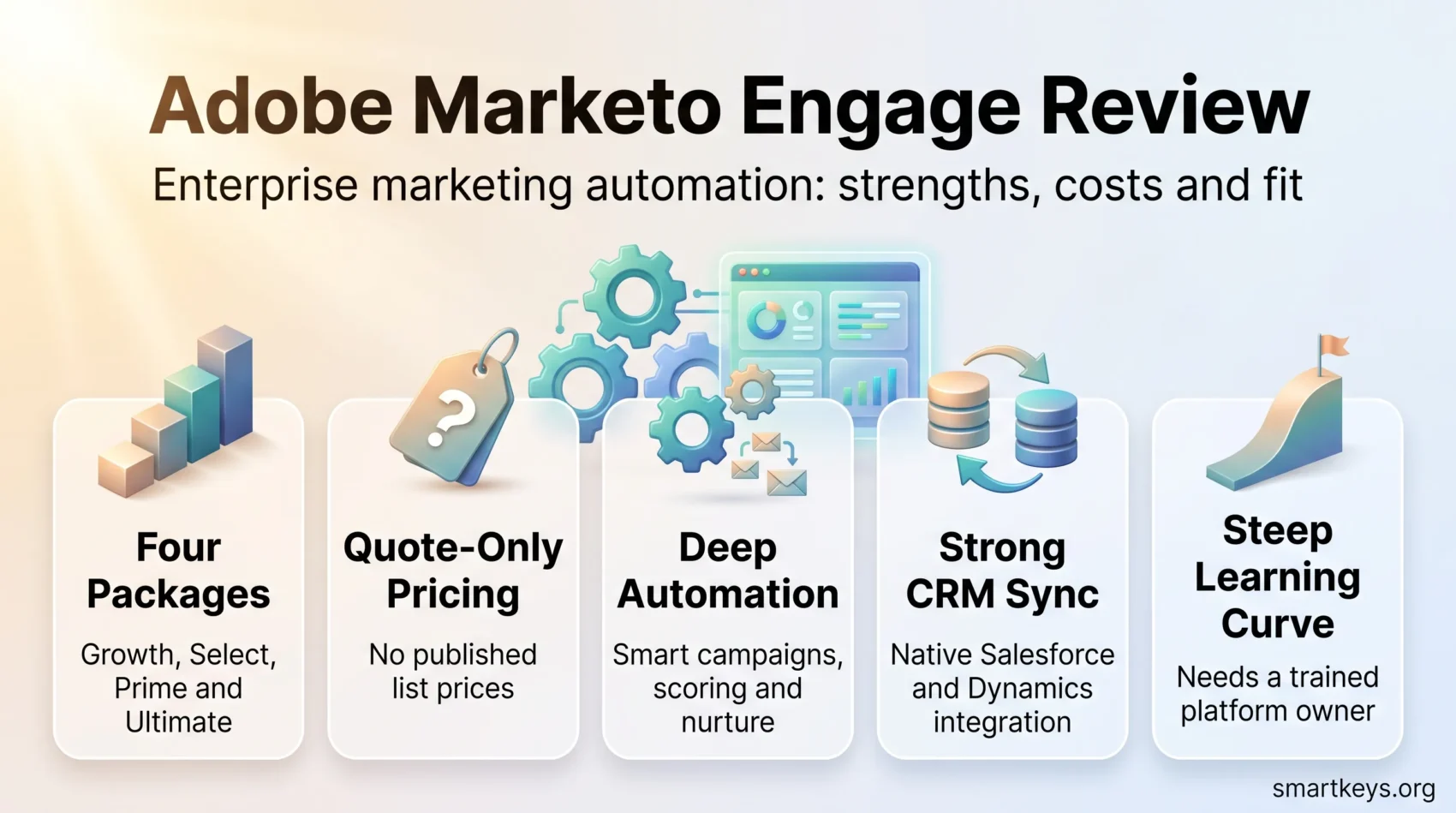
- Marketo Engage is sold in four packages — Growth, Select, Prime and Ultimate — and Adobe publishes no list prices for any of them.
- Growth includes 10 users and 20,000 API calls per day; Select, Prime and Ultimate each include 25 users and 50,000 API calls per day.
- Reviewers rate it 4.1 out of 5 on G2 (roughly 3,100 reviews) and 8.1 out of 10 on TrustRadius (roughly 2,800 reviews).
- The most consistent praise is for automation depth, lead management and CRM integration, especially with Salesforce.
- The most consistent criticism is the learning curve, the dated interface and the cost.
- In 2026 Adobe added agentic capabilities, including a Marketo Engage MCP Server and callable agents inside Smart Campaigns.
What Adobe Marketo Engage Is
Marketo launched in 2006 as a standalone marketing automation company and was acquired by Adobe in 2018. It now sits inside the Adobe Experience Cloud as Adobe Marketo Engage, which is why you will see both names used interchangeably in older documentation and community threads.
The platform is built around lead and account management rather than around content publishing. Its core job is to capture people, score them, move them through nurture programmes, and hand the qualified ones to sales with enough context to act on. Email, landing pages, forms, webinars and paid channels all feed that same database.
That focus explains who it fits. Marketo Engage is aimed at mid-market and enterprise B2B organisations with long sales cycles, multiple buying committees and a CRM that marketing has to stay in lockstep with. If your motion is closer to self-serve e-commerce or single-decision-maker SaaS, a lighter platform will usually get you further faster. Our comparison of ActiveCampaign and HubSpot for marketing automation covers that end of the market in more detail.
Marketo Engage as a Marketing Automation Tool
The thing Marketo Engage does better than most competitors is conditional logic at scale. Smart Lists and Smart Campaigns let you define audiences and triggers with a level of granularity that lighter tools simply do not expose, and tokens let you templatise that logic so it can be reused across dozens of programmes without rebuilding it each time.
Integration is the second structural strength. Native, bi-directional sync with Salesforce and Microsoft Dynamics is mature and well documented, and it is the main reason many enterprises stay on the platform even when they are frustrated with other parts of it. If your revenue reporting depends on marketing and sales records agreeing with each other, this matters more than any feature list. Teams evaluating the CRM side of that equation may also want to read our Salesforce CRM review.
The trade-off is operational weight. Complex campaigns with large audiences take time to process, and poorly built programmes compound that. Marketo Engage rewards disciplined naming conventions, a documented lead lifecycle and a named owner. Without that, it degrades into an expensive email sender.
Marketo Engage Features in 2026
The feature set is broad, and the higher packages unlock capabilities that materially change what the platform can do rather than just raising limits.
Cross-Channel Campaigns and Journeys
Marketo Engage coordinates email, landing pages, forms, webinars, ads and CRM tasks from a single set of campaign rules, so a prospect who converts on one channel is suppressed or re-targeted correctly on the others. Adobe has continued to invest here in 2026 with adaptive omni-channel journeys and reworked email design tooling. If you are thinking about channel orchestration more broadly, our guide to the evolution of digital marketing strategies is a useful companion piece.
Lead Management, Scoring and Automation
This is the platform’s centre of gravity. Behavioural and demographic scoring, lifecycle modelling, nurture streams and account-level views all sit in one place, and the scoring model can be as simple or as layered as your sales process needs. Reviewers on TrustRadius single out lead profiling, scoring and segmentation as among the strongest parts of the product. Teams sourcing the contact data that feeds those programmes often pair it with a data provider — our ZoomInfo review covers one common choice.
Analytics and Attribution
Standard reporting covers programme performance, email engagement and pipeline contribution. Multi-touch attribution through Marketo Measure is the genuinely differentiated piece, and it is reserved for the higher packages. This is also the most common source of complaints: reviewers on both G2 and TrustRadius describe reporting setup as complex and say deeper analysis often needs workarounds or an external BI layer. If unifying data across tools is the underlying problem, a customer data platform may be the better answer than more Marketo reports.
Agentic AI and the MCP Server
The most substantive 2026 change is Adobe’s shift toward agentic operations. Adobe has introduced a Marketo Engage MCP Server, which exposes Marketo data and processes to AI agents and external workflows through the Model Context Protocol, and callable agents that can be invoked from inside Smart Campaigns. Adobe’s Sales Qualifier and Brand Concierge agents are included in the Prime and Ultimate packages.
This is worth understanding before you buy, because it changes the evaluation. The question is no longer only “can it send the campaign” but “can our agents and our other systems read and act on this data safely”. For context on where that shift is heading across software generally, see our piece on AI in SaaS and our overview of artificial intelligence in marketing strategies.

Marketo Engage Pricing in 2026
Pricing is the part of Marketo Engage that generates the most confusion, largely because a lot of published figures online are guesses. Here is what Adobe actually states.
The Four Packages
Adobe sells Marketo Engage in four tiers, and its official pricing page lists no dollar amounts for any of them. Every tier is quote-only.
- Growth — core marketing email, segmentation, automation and measurement. Includes 10 users and 20,000 API calls per day.
- Select — essential marketing automation and measurement. Includes 25 users and 50,000 API calls per day.
- Prime — adds lead- and account-based marketing, journey analytics and AI personalisation. Includes 25 users and 50,000 API calls per day.
- Ultimate — the full platform, including premium attribution. Includes 25 users and 50,000 API calls per day.
Target Account Management and Marketo Measure appear only in the higher packages, so if account-based marketing or multi-touch attribution is the reason you are buying, Prime or Ultimate is effectively your starting point rather than Growth.
What Actually Drives the Bill
Because there is no rate card, your quote is negotiated. In practice the variables that move it are database size, which package you need, how many add-ons you attach and contract length. Reviewers consistently describe the platform as expensive relative to alternatives, and cost is one of the most cited drawbacks on G2.
A few things worth doing before you sign:
- Size your database honestly, including inactive records you plan to keep, since that number drives the quote.
- Ask which agents and add-ons are included in your package rather than assuming, as the AI features are split across tiers.
- Check whether an existing Adobe or Microsoft agreement gives you leverage on bundling.
- Get renewal terms in writing at the point of first signature, not at renewal.
If the quote comes back higher than your budget can defend, it is worth pricing the alternatives properly rather than downgrading within Marketo. Our HubSpot Marketing Hub review and our MailerLite and ActiveCampaign comparison cover two very different price points in the same broad category.
What Users Actually Say
Marketo Engage has one of the largest review bases in the category, which makes the aggregate signal unusually reliable. It holds 4.1 out of 5 on G2 across roughly 3,100 reviews, and 8.1 out of 10 on TrustRadius across roughly 2,800. Those are solid scores for an enterprise platform, and the themes behind them are consistent across both sites.
What Reviewers Consistently Praise
- Automation depth — the ability to build campaign logic that mirrors a real, messy sales process.
- Lead management — profiling, scoring and segmentation are repeatedly named as best-in-class.
- Integrations — Salesforce sync in particular is cited as a reason teams stay.
- Email and campaign execution at volume, including deliverability.
- An active community that answers questions quickly.
What Reviewers Consistently Criticise
- A steep learning curve. This is the single most cited drawback on G2, mentioned in well over a hundred reviews.
- A dated and unintuitive interface. Roughly a quarter of recent TrustRadius reviewers raise it, and G2 reviewers describe too many clicks for simple tasks.
- Reporting complexity, with workarounds needed for deeper analysis.
- Cost, described as high relative to the feature set.
- Organisational sprawl — campaign and asset management gets unwieldy without strict conventions.
The pattern is clear enough to plan around: the product is powerful and the friction is in operating it. Almost every serious complaint is about time, skill and clarity rather than about missing capability.
Marketo Engage Pros and Cons
On the positive side, Marketo Engage offers a mature and deep automation engine, strong lead and account management, well-tested CRM integrations with Salesforce, Microsoft Dynamics and SAP, premium attribution in the top tiers, and — new in 2026 — an agentic layer that lets external AI tools work with your marketing data through MCP. For large B2B organisations, that combination is difficult to replicate elsewhere.
On the negative side, pricing is opaque and negotiated, which makes budgeting harder and comparison slower. The interface is visibly older than newer competitors. Getting real value out of it requires trained ownership, and organisations that treat it as a tool anyone can pick up tend to underuse it badly. Support experiences vary widely between accounts.
The honest summary is that Marketo Engage is rarely the wrong tool technically and often the wrong tool organisationally. Ask whether you have the people to run it before asking whether it can do what you need. Teams that succeed with it usually already work in structured cycles — our guide to agile marketing describes the operating rhythm that tends to fit.
How Marketo Engage Compares
Against HubSpot, Salesforce and the Rest
Against HubSpot, the split is familiar: HubSpot is easier to adopt, ships with its own CRM and is friendlier to smaller teams, while Marketo Engage offers deeper conditional logic and stronger account-based capability once you have the resources to use them. Against Oracle Eloqua, the two are closer peers, and the decision usually comes down to which CRM and which agency ecosystem you are already committed to.
For smaller sales teams the comparison set looks different entirely. Tools like Pipedrive, Bitrix24 or the options in our Freshworks CRM versus Pipedrive comparison solve a different problem at a fraction of the cost. And if your actual need is high-volume email rather than lead lifecycle management, our Mailchimp review, the Mailchimp versus Klaviyo comparison and our Sendinblue and ConvertKit comparison are far more relevant starting points.
Who Marketo Engage Actually Fits
Marketo Engage makes sense when you are running long, multi-touch nurture programmes across a large database, when marketing and sales share a lifecycle definition that has to be enforced in software, when you need attribution that survives finance’s scrutiny, and when you have at least one person whose job includes owning the platform. If two or more of those are missing, the platform will cost more than it returns.
Getting Started with Marketo Engage
Implementation is where most Marketo projects are won or lost. Before you build a single campaign, define your lead lifecycle stages and your scoring model on paper and get sales to agree to them. Retrofitting that agreement later is painful.
Set up naming conventions and folder structures early, and use tokens at both the asset and the programme folder level so that personalisation and campaign settings are defined once rather than copied. Build one nurture stream end to end, measure it, and only then scale the pattern.
Budget for training. Adobe provides documentation, guided learning and a large community forum, and regional user groups are useful for seeing how other teams solved the same problems. The community is one of the platform’s real assets.
Demos, Training and Community Resources
Adobe does not offer a self-serve free trial for Marketo Engage. Access starts with a demo and a sales conversation, so treat the demo as your evaluation rather than as a sales pitch: bring your own use cases, your own data volumes and your own integration requirements, and ask to see them built rather than described.
The material worth working through before and during onboarding includes:
- Adobe’s product documentation and guided learning paths
- Recorded feature walkthroughs and webinars
- The Marketo Engage community forums for implementation questions
- Regional user groups for peer benchmarking

Who Should Choose Marketo Engage
If you are a B2B organisation with a complex funnel, a Salesforce or Dynamics backbone, a marketing operations function and a budget that can absorb an enterprise quote, Marketo Engage is a defensible choice and one you are unlikely to outgrow. The 2026 agentic additions strengthen that case, because they make the platform easier to connect to the AI tooling teams are already adopting.
If you are a smaller team, if nobody owns marketing operations, or if your buying cycle is short and simple, the platform’s strengths will mostly show up as overhead. That is not a flaw in the product. It is a mismatch, and it is an expensive one. Narrative and positioning work — the kind covered in our guide to brand storytelling — will move the needle more than a heavier automation stack will.

Verdict
Adobe Marketo Engage remains one of the strongest enterprise marketing automation platforms available, and the review data backs that up: 4.1 on G2, 8.1 on TrustRadius, and thousands of reviewers who agree on both what works and what does not. The automation depth and lead management are genuinely excellent. The interface is dated, the reporting is fiddly and the cost is high.
Because there is no published price and no self-serve trial, your evaluation has to happen in the sales process. Go in with your database size, your integration requirements and your team’s actual capacity written down, and insist on seeing your own scenarios demonstrated. Do that and you will get a realistic read on whether Marketo Engage is worth the investment for your organisation — and if it is not, the alternatives in the same space are well documented and considerably cheaper. Teams building reach rather than automation might find more leverage in B2B influencer marketing or in the visibility work covered in our Semrush review.
Found this useful?
Make SmartKeys a preferred source on Google, and our articles will surface more often in your Top Stories, AI Overviews, and AI Mode.
Add as Preferred Source