Social media has stopped being a promotional add-on and become a core distribution, service and hiring channel. The scale is no longer in doubt: DataReportal’s Digital 2026 Mid-Year Global Update counted 5.79 billion social media user identities at the start of April 2026 — more than two thirds of the world’s population, and 294 million more than a year earlier. What has changed is the difficulty. Organic reach is scarce, discovery increasingly happens inside the apps themselves, and finance teams want to see what the channel returns. This guide covers what social media realistically does for business growth in 2026, and how to measure it.
Key Takeaways
- 5.79 billion social media user identities were active in April 2026, growing 5.4% year on year (DataReportal).
- Reach is abundant; attention is not. Assume paid distribution is part of the plan, not a rescue.
- Discovery has moved inside the platforms — social search and short-form video now sit ahead of the website in many buying journeys.
- Influencer partnerships need clear, conspicuous disclosure, and the brand carries the legal responsibility.
- Measurement only earns budget when metrics connect to revenue, pipeline or cost saved.
Understanding the Role of Social Media in Business Growth
Social media reaches more people than any other owned channel a business can build. DataReportal puts monthly social media use at 94.7% of the world’s internet users, and the average user spends roughly 18 hours and 36 minutes a week across platforms. That is an enormous amount of attention — but it is attention distributed across dozens of apps and thousands of creators, which is exactly why an undifferentiated presence rarely pays back.

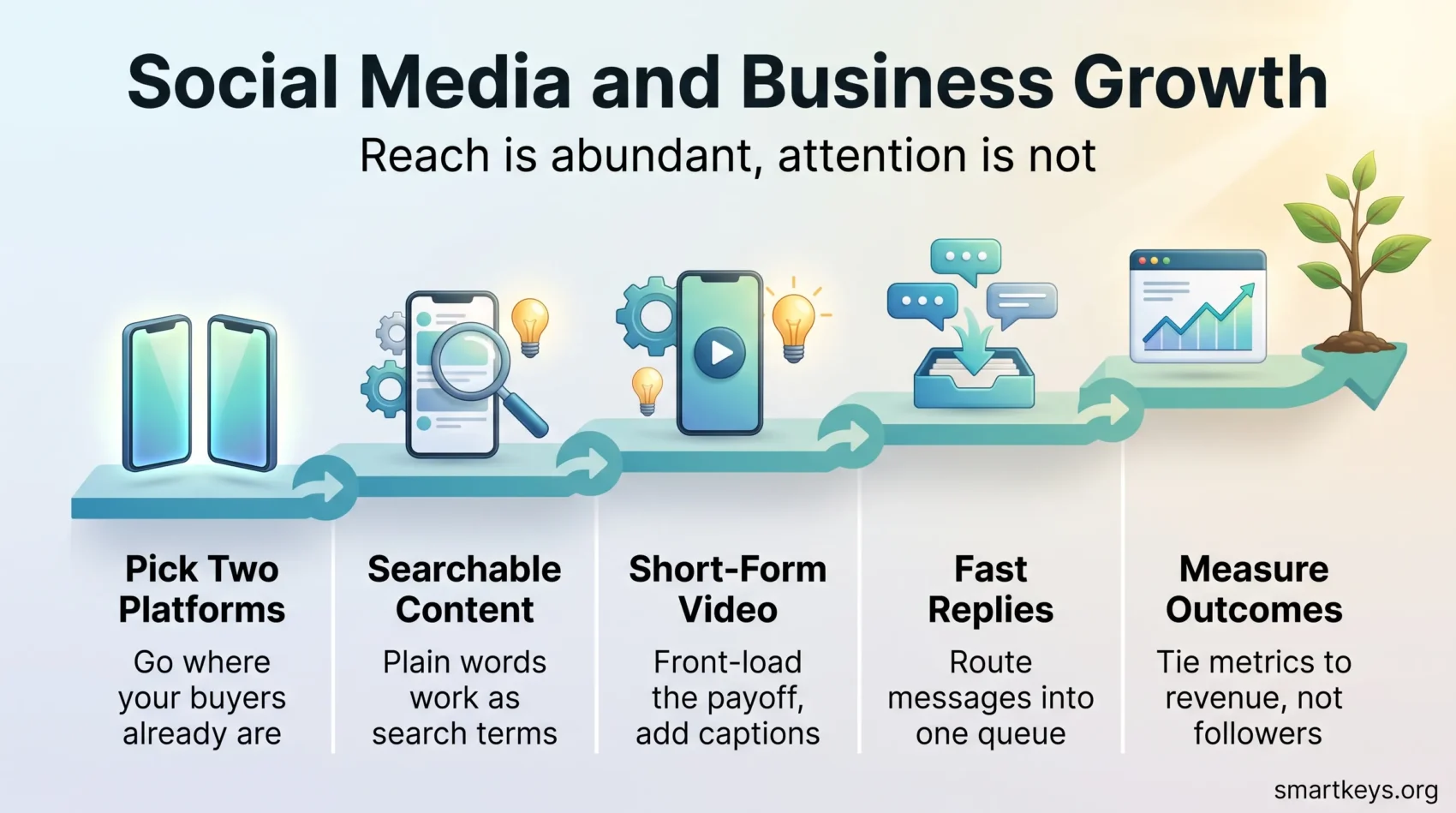
Facebook, Instagram, LinkedIn, TikTok, YouTube and X each serve a different job. Treating them as one channel with one content calendar is the most common and most expensive mistake. A tighter approach is to pick the two platforms where your buyers already are, and let a clear go-to-market strategy decide what you publish there.
Used well, social media does five concrete things for a business:
- Adds a human element: people connect with people, and social is where a company’s voice becomes recognisable.
- Drives qualified traffic: posts and profiles route interested people to your site, product or booking page.
- Generates demand: consistent presence creates the recognition that makes later outreach land.
- Builds brand awareness: repeated, relevant exposure is still how brands get remembered.
- Creates relationships: replies, DMs and comments are a low-cost research channel most companies underuse.
Tooling matters less than discipline, but it does matter. Scheduling and analytics platforms — compared in our Buffer vs Hootsuite breakdown — remove the manual work so your team can spend its time on the content itself. Feeding social interactions back into your CRM system and, at larger scale, into a customer data platform is what turns scattered engagement into something you can actually act on.
Enhanced Brand Visibility Through Social Media
Visibility on social media is earned twice: once by the algorithm, and once by the person deciding whether to stop scrolling. Both reward specificity. Generic corporate updates lose to content with a clear point of view, a recognisable format and a reason to exist.
Adapting the format to the platform is the baseline. A LinkedIn post that opens with a concrete result reads very differently from the same idea cut into a fifteen-second vertical video. Distributed teams in particular benefit from a documented content brief, because the person writing and the person filming are rarely in the same room.
Brand storytelling is what makes any of this repeatable. A narrative that connects your product to a problem people recognise gives your team a template instead of a blank page every Monday. If you want to understand why some creative sticks and other creative slides past, the research behind neuromarketing is a useful lens — it deals directly with attention, memory and decision-making.
Paid distribution is now part of the job rather than an admission of failure. Organic reach on the major platforms is too limited to carry a launch on its own. Testing several creative variants against a narrow audience usually beats spending the same budget on one polished asset.
Whatever mix you land on, watch engagement per impression rather than raw follower counts. Followers are a stock number that flatters you; engagement rate tells you whether what you published this week actually worked.
Improving Customer Engagement via Social Media
Engagement is the part of social media that most directly touches revenue, because it is where a prospect becomes a conversation. Clicks on a call to action, profile visits, saves, comments, shares and direct messages all count — and each says something different about intent. A save signals future purchase interest far more strongly than a like.
Response speed is the operational half of this. People who ask a question on a public profile expect an answer in hours, not days, and an unanswered complaint is visible to everyone else considering you. Assigning ownership for social replies — and routing them to the same queue as email and chat — is usually a bigger win than any content change.

Authenticity has become a practical requirement rather than a slogan. Sprout Social’s 2025 Index, based on a survey of more than 4,000 consumers and 1,200 marketers, found that about a third of consumers consider it embarrassing when brands chase viral trends, and it identified a persistent trust gap between social teams and executives over the channel’s business impact. The lesson is not to avoid culture, but to enter it only where you have something credible to say.
Consistency across platforms strengthens recognition, and direct engagement builds the habit of interaction. A structured engagement workflow helps teams track conversations, respond faster and spot recurring issues before they reach support. Feeding those patterns back to product and sales closes the loop between what customers say publicly and what your company does about it.
Social Media Trends Shaping Business Strategies
Trends are worth tracking only when they change what you should do on Monday. Three currently qualify.
Search, Commerce and AI Inside the Apps
The first is social search. A meaningful share of product research now starts inside TikTok, Instagram, YouTube or Reddit rather than a search engine, which means the words in your captions, on-screen text and video titles function as search terms. Treating social content as searchable — with plain, descriptive language instead of clever wordplay — is now a discoverability decision, not a stylistic one. The same discipline that governs SEO platforms such as Semrush applies here.
The second is commerce moving into the feed. EMARKETER forecasts that US social commerce sales will surpass $100 billion in 2026. For consumer brands that shortens the path from discovery to checkout dramatically; for B2B it mostly matters as a signal that people are now comfortable transacting where they browse.
The third is AI in the production process. Generative tools now sit inside most content workflows, from drafting captions to cutting video. This is the useful version of AI augmentation: it removes production bottlenecks, not judgement. Our overview of AI in marketing covers where the gains are real and where they are oversold.
The Rise of Short-Form Video Content
Short-form vertical video remains the dominant format across TikTok, Instagram Reels and YouTube Shorts, and it is where platforms still push the most organic reach. For most companies the constraint is not ideas but production capacity, which is why repurposing beats originating: one customer interview can become a long-form post, four short clips and a dozen quote graphics.
Two rules make short-form work harder. First, front-load the payoff — the first two seconds decide whether the rest is seen at all. Second, design for sound-off viewing with captions and on-screen text, since a large share of feed video is watched muted.

Leveraging Influencer Marketing for Growth
Creator partnerships work because they borrow trust that a brand account cannot manufacture. The mechanics have professionalised considerably: briefs, usage rights, exclusivity windows and performance clauses are now standard rather than exceptional.
When selecting partners, engagement rate and audience fit beat follower count almost every time. Creators with smaller, tightly defined audiences typically deliver better engagement per dollar and are easier to work with repeatedly — and repetition is what builds association. In B2B the same logic applies to practitioners and analysts, as covered in our guide to B2B influencer marketing.
Disclosure is not optional. The FTC’s Endorsement Guides require material connections — payment, free product, an ongoing relationship — to be disclosed clearly and conspicuously, in a place viewers will not miss. The FTC is explicit that a hyperlink is insufficient, that relying on a platform’s built-in disclosure tool alone is not enough, and that the advertiser remains responsible for what endorsers do on its behalf. Handing the programme to an agency does not transfer that responsibility.
Practical guardrails that keep programmes out of trouble:
- Write disclosure requirements into the contract and check the live post, not just the draft.
- Give creators claims they are allowed to make — and an explicit list of ones they are not.
- Track results per creator and per piece, so renewals are a decision rather than a habit.
An internal alternative is often overlooked: your own employees. A structured employee advocacy programme reaches audiences that brand accounts cannot, at a fraction of paid cost, provided people are given something worth sharing.
Social Media Analytics: Measuring Success
Measuring the impact of social media on your business is where most programmes either earn their budget or quietly lose it. The failure mode is familiar: reporting activity — posts published, followers gained — instead of outcomes.
Key Metrics to Track on Social Platforms
- Engagement rate: interactions divided by reach or impressions, which stays comparable as your audience grows.
- Reach and impressions: split organic from paid, or you will misread what your content is doing on its own.
- Audience composition: whether the people following you resemble the people who buy from you.
- Saves, shares and DMs: the highest-intent signals available on most platforms.
- Referral traffic and assisted conversions: the bridge between social activity and revenue.
- Benchmarks: your own trend over time first, competitors second.
Using Data to Inform Business Decisions
Analytics earn their keep when they change decisions. Regular review lets you:
- Identify which content formats actually perform, and stop producing the ones that do not.
- Set specific, measurable, time-bound goals tied to business objectives rather than platform vanity metrics.
- Run controlled tests on hooks, formats and posting times instead of arguing from taste.
- Spot shifts in audience behaviour early, while there is still time to adjust.
Presenting the results well is its own skill. A short narrative that connects the numbers to a business question — the approach described in our guide to data storytelling — gets more traction with executives than a dashboard screenshot.
Building and Fostering Brand Communities
A brand community is different from an audience. An audience consumes what you publish; a community talks to each other, and that changes the economics — members answer each other’s questions, produce content you did not commission and stay longer than campaign-acquired followers.
Communities also produce unusually honest research. Direct interaction surfaces the language customers actually use, the objections they raise and the workarounds they have invented, all of which improve product and messaging faster than a survey would.
Start with a defined purpose and a small number of metrics: active members, question response rate, and how much of your content originates from members. Platform choice follows purpose — a forum, a LinkedIn or Facebook group, a Discord server and a rewards programme all suit different behaviours. The community-led growth model treats this as an acquisition channel with its own funnel rather than a marketing side project.
What kills communities is inconsistency. A visible moderator, a predictable rhythm of prompts and discussions, and genuine responses to questions matter far more than the software you choose. The payoff is real: an active community lowers support costs, shortens sales cycles through peer validation, and produces a steady supply of user-generated content.
Recruitment Potential Through Social Media
Social media has changed hiring as much as it changed marketing. Candidates research employers the same way consumers research products — and they look at your team’s posts, not just your careers page.
Employer branding is therefore continuous rather than campaign-based. What your employees say about working with you, visible over months, carries more weight than any recruitment ad. That makes advocacy and recruiting the same programme viewed from two directions.
LinkedIn remains the default for professional hiring, but it is not the only option. Technical communities, industry-specific groups and even short-form video reach candidates who are not actively looking. Targeted content also widens the top of the funnel — pairing it with skills-first hiring practices tends to surface candidates that a degree-first filter would have missed.
Measure it like any other channel. Applications per source, quality of hire, time to fill and cost per hire tell you which platforms deserve continued effort, and which are absorbing recruiter hours for nothing.
Conclusion
Social media’s influence on business growth is not in question — with 5.79 billion user identities and monthly use by almost 95% of internet users, the audience is effectively everyone. The advantage now comes from focus: choosing fewer platforms, publishing content people would miss if it stopped, answering quickly, and disclosing partnerships honestly.
The companies that get value from social media in 2026 tend to do three unglamorous things well. They connect social data to the rest of their stack, from email marketing tools through to marketing automation platforms, so a social interaction is not a dead end. They measure against business outcomes rather than follower counts. And they treat the channel as a long-term asset — as our broader look at how digital marketing has evolved and at AI in business operations both suggest, compounding beats intensity.
Reach is no longer the differentiator. Relevance, speed and honesty are.
Found this useful?
Make SmartKeys a preferred source on Google, and our articles will surface more often in your Top Stories, AI Overviews, and AI Mode.
Add as Preferred Source