A distribution strategy is simply your plan for how a product reaches the person who buys it: which channels you sell through, who handles delivery, and who owns the customer relationship at the end. Get it right and you grow without losing control of price or brand. Get it wrong and you end up on shelves that undercut you, or invisible in the places your buyers actually shop.
The stakes keep rising because buying keeps moving online. In the second quarter of 2026, US retail e-commerce sales reached $340.2 billion, or 17.1 percent of all retail sales, and grew 12.2 percent year over year while total retail grew 6.7 percent (US Census Bureau, Quarterly Retail E-Commerce Sales, Q2 2026). Online is still the smaller share of spending, but it is the part that is expanding fastest.
This guide walks through the choices in order: what the model covers, which channel types exist, how price and placement pull on each other, and how to launch in a market you do not know yet. If you want the wider view on selling across several channels at once, start with your omnichannel playbook.
Key Takeaways
- Your channel mix decides how much control you keep over price, data, and brand.
- Direct routes protect margin. Partner routes buy reach and local knowledge.
- Price architecture and placement have to be designed together, not in sequence.
- Pilot a new market with one or two channels before you layer more on top.
- Channel conflict is prevented by written rules, not by goodwill.
What a distribution strategy actually covers
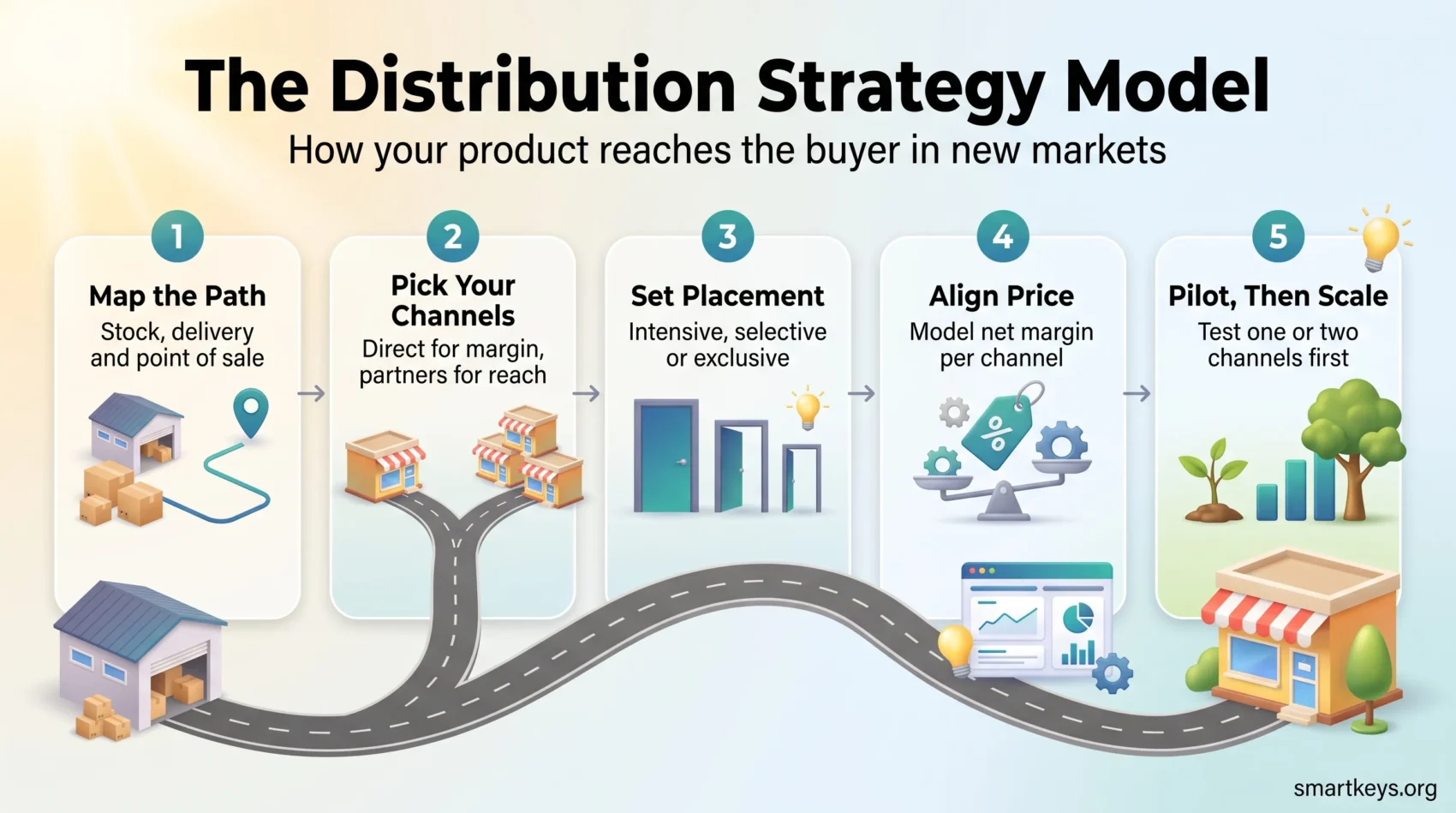
Start by mapping the full path your product takes, because every step on it costs money and creates a chance to disappoint someone. That path covers inventory, storage, order processing, transport, tracking, and the final point of sale.
Physical shelves and online listings need different things. A shelf needs packaging that reads well from a metre away and an assortment that fits the retailer’s shopper. A listing needs photography, specifications, and reviews. The same product often needs both versions of itself.
It also helps to think in primary and secondary channels. Primary channels carry your volume and do most of your brand-building. Secondary channels reach a niche, cover a region you cannot serve directly, or protect margin on higher-priced items. Naming which is which stops you from spreading budget evenly across routes that do very different jobs. For the individual routes, see our guide to the types of distribution channels and channel levels 0 to 3, which explains what wholesalers, resellers and other intermediaries add at each step.
- Check what is normal in your category before you place. A premium product in a discount aisle rarely recovers.
- Test your own readiness first: can you see stock in real time, process orders reliably, and keep product data in sync?
- Write down the rules. Partners and internal teams should not have to guess your standards.
Why the plan pays off: cost, speed, and customer experience
Tightening the network shortens lead times and frees budget, which is why distribution is a competitive lever and not just an operations chore. Shared fulfilment centres and accurate stock counts let you move faster with fewer mistakes.
Cutting cost and time to market
Better routing, shared warehouse space, and live stock data speed up launches and lower the cost of each unit shipped. They also remove the hidden costs that never appear in a plan: double handling, emergency freight when a shipment is late, and picking the wrong item.
- Pool routes and warehouse space to cut transit days.
- Agree service level agreements (SLAs) with partners, which are written promises about delivery times and handling quality, with consequences attached.
- Track fill rate (the share of orders you can ship complete and on time) alongside speed and accuracy, so operations connect to revenue.
Designing for a consistent customer experience
Selling across several channels only works when they feel like one company. A customer who buys online and collects in store should see the same price, the same product name, and the same return policy in both places. Buy-online-pickup-in-store, transparent tracking, and a return process that does not require a phone call all raise the chance of a second purchase. This is where blending online and in-store experience stops being a slogan and becomes a set of concrete system decisions.
What is changing in the US market right now
Buying habits and delivery expectations have moved faster than most distribution plans. The Census figures above show where the growth sits, and that growth changes what your channels have to do.
Online and in-store are converging
Retailers now ship from store shelves, offer curbside pickup, and run B2B marketplaces that behave like consumer sites. The practical effect is that “online” and “retail” are no longer separate plans with separate stock. Our guide to current e-commerce trends covers where the buying journey is heading, and much of that journey now starts on a phone.
Delivery windows keep shrinking
Micro-fulfilment centres, which are small automated warehouses placed inside or near a city rather than out by the motorway, make same-day delivery possible without a national network. Local carriers and urban sorting hubs do the rest. The trade-off is real: faster promises mean more stock held in more places, which ties up cash.
Sustainability has moved from marketing to procurement
Packaging rules, emissions reporting, and supplier standards now show up in contracts rather than in brochures. Retailers increasingly ask suppliers for data they used to keep to themselves. Two practical entry points are greener supply chains and planning for resale, covered in our piece on recommerce.
The technology layer underneath
Four tools do most of the work. AI improves demand forecasting, so you order closer to what will actually sell. IoT sensors, meaning connected devices that report their own location and condition, give you visibility while goods are in transit. Warehouse robotics speed up picking. Blockchain, a shared ledger no single party can quietly edit, is used mainly for traceability where several companies need to trust the same record; our piece on blockchain in logistics covers where that holds up and where it does not. For the broader picture of what these tools deliver, see AI in business operations and the wider supply chain trends.
“Fast delivery, clear traceability, and greener choices are no longer optional. They decide who gets shelf space and who does not.”
The core approaches you can combine
Your channel mix decides how customers find you, what they pay, and who owns the relationship afterwards. Most companies end up combining several of the following rather than picking one.
Direct versus indirect
Selling direct means you handle pricing, packaging, service, and fulfilment yourself. You keep the margin and the customer data, but you also carry the cost of a storefront and a warehouse. Selling indirect means going through wholesalers, retailers, or value-added resellers (VARs), which are partners who bundle your product with their own services before selling it on. You gain reach and local expertise quickly, and you give up some control over how the product is presented. The direct-to-consumer route is worth reading before you commit to either extreme.
Selective, intensive, and exclusive placement
These three terms describe how widely you place a product. Intensive means everywhere you can get in, which suits low-price, high-volume goods where availability is the whole game. Selective means a chosen set of retailers, which protects positioning for mid-market and premium products. Exclusive means one partner per market, which creates scarcity and gives that partner a strong reason to push your product hard. Exclusive deals also mean that if the partner underperforms, you have no fallback.
Dual and hybrid setups
Running your own store alongside a wholesale network balances margin against coverage. The risk is cannibalisation: your own site undercuts the retailer who just gave you shelf space, and the retailer stops ordering. The fix is written rules on pricing and assortment, agreed before launch rather than after the first complaint.
Omnichannel orchestration
Keep inventory, pricing, and service aligned so the experience matches wherever someone buys. Shared product codes (SKUs) and synchronised product content are the unglamorous foundation. Without them, the same item appears under two names at two prices and your support team spends its week explaining why. Our omnichannel playbook covers how to align pricing, promotional calendars, and partner enablement across channels.
Reverse routes: returns, repair, and recycling
Reverse logistics is the path a product takes back to you, whether for a refund, a repair, or recycling. Planning it properly recovers value that would otherwise be written off and gives customers a reason to trust a higher price. Patagonia’s Worn Wear repair and resale programme is the best-known example of treating that return path as part of the product rather than as a cost centre.
- Brief retailers and intermediaries on presentation and service standards in writing.
- Phase your channels as you scale. Start focused, then layer partners on.
- Set governance early, while you still have the leverage to set terms.
How price architecture and placement shape each other
Price design often decides which retailers will take your product at all, and placement then feeds back into what customers think it is worth. Treat the two as one decision.
Matching the price signal to the shelf
Premium cues belong in selective outlets. Value pricing belongs in mass e-commerce and big-box retail. A recommended retail price (MSRP) plus controlled placement protects a premium position. For value offers, pack sizes and promotional mechanics matter more than the headline figure. Our pricing strategy framework and the case for value-based pricing both go deeper on setting the number itself.
Costs, margins, and what retailers expect
Marketplace fees, retailer commissions, and shipping all sit between your list price and what you actually keep. Model the net margin per channel before launch, not after the first quarter’s numbers arrive. Minimum advertised price (MAP) rules, which set the lowest price a partner may advertise publicly, are the standard tool for stopping a race to the bottom between your own resellers.
Tiered, volume, and dynamic approaches
Use tiered discounts, volume ladders, and time-bound promotions to help partners sell through stock without starting a price war. Pair automated price signals with hard floors so a demand algorithm cannot quietly erode your positioning overnight.
- Set price floors and fixed promotional windows before partners ask for exceptions.
- Model net margin after channel fees and logistics, per channel.
- Measure sales impact by channel and adjust in short cycles.
Choosing channels for a market you do not know yet
The best channel is the one your target buyer already uses, not the one that is cheapest to sign. Everything below is a way of finding that out before you commit budget.
Map the buying journey by segment and geography
Sketch the short path each target group takes: where they first hear about a product like yours, where they compare, and where they buy. A small business owner researching on a laptop and a shopper browsing on a phone during a commute need different entry points. Our guide to global expansion covers the market selection step that comes before this one.
Audit capability, cost, and the control you need
Score each option on three things: can the partner actually fulfil, what does it cost to serve a customer through them, and how much control over price and presentation do you keep. If control matters more than speed, weight the direct route higher even when it looks more expensive on paper.
Prevent channel conflict with rules, not conversations
Assign segments, territories, and assortments per channel, then publish the rules. Differentiated product lines per channel are a common approach: the retailer gets a variant your own site does not sell, so the two are not competing on an identical item. Selling across borders adds another layer, covered in cross-border e-commerce.
Pilot, measure, then scale
Run a small pilot to test price acceptance, service quality, and real demand. Pick partners on coverage and competence rather than enthusiasm, build an onboarding playbook, and set the numbers that would justify expansion before you start. A launch checklist sits in our go-to-market strategy guide.
The technology and data underneath
The single most valuable link is between your storefront and your warehouse, because it decides whether customers see stock that actually exists. Getting that right cuts out-of-stocks, speeds delivery, and prevents the refund conversations that damage trust.
One source of truth for stock, orders, and content
Inventory, orders, and product content should each have one authoritative system, with everything else reading from it. Consistent specifications and images raise conversion and cut returns, because customers get what they expected. Item-level tracking with RFID tags and connected sensors adds real-time location and stock counts on top.
Forecasting and routing with AI
Demand forecasting models flag likely spikes early enough to adjust production and capacity. The same class of model optimises delivery routes and arrival estimates. Set alerts on a few metrics that matter: fill rate, variance between promised and actual delivery times, and forecast error. The point is that your team notices a problem before the customer does.
Enabling partners
Partner portals and shared dashboards shorten onboarding and raise execution quality. Offer connections between systems, ready-made product content, and a playbook so partners sell the product the way you intended. How far to formalise this is the subject of our piece on building a partner ecosystem.
- Decide who owns product data and how corrections flow back.
- Decide build versus buy for each tool, weighted by whether it scales without new headcount.
- Hold joint reviews with partners so targets stay aligned.
“Unified systems turn good intentions into reliable customer experiences.”
Building sustainability in without adding friction
Emissions and cost usually move in the same direction, which makes distribution one of the easier places to act. Fewer, fuller shipments cost less and emit less. Right-sized packaging cuts material spend and handling time at the same time.
Shifting to lower-emission transport where lead times allow, consolidating shipments, and designing packaging around the product rather than the pallet are the three changes with the clearest payback. Planning for returns and in-market repair extends product life and recovers value that would otherwise be scrapped.
- Set targets that cut emissions without breaking service commitments.
- Upgrade facilities where energy costs are high enough to justify the payback period.
- Train vendors on packaging and handling standards, and check compliance.
- Report honestly. Credible numbers across the chain beat impressive ones you cannot defend.
Prioritise by impact and feasibility. Sustainability that adds a step to the customer experience tends not to survive its first busy quarter.
Adapting the model for experiences rather than products
When you sell a stay, a seat, or a session, the same logic applies with different names. Online travel agencies (OTAs) and global distribution systems (GDSs) such as Sabre, Amadeus, and Travelport bring broad demand, and they take a commission that comes straight out of your margin.
The goal is not to leave those channels. It is to use them for discovery and then move repeat customers to direct booking, where you keep the full price and the customer data. Loyalty benefits, add-ons available nowhere else, and a booking flow that takes under a minute do more of that work than discounting does. Retail loyalty programmes are worth borrowing from here, and our guide to customer retention covers the mechanics.
Local partnerships extend the same idea. Rideshare, tour operators, and EV charging providers add value your competitors do not offer and give you something to talk about besides price. Hold them to a scorecard on quality and access, the same way you would a distributor.
Execution: activate, govern, and improve
Turn the plan into contracts, system connections, and shared visibility so partners can sell confidently from day one.
Activation means finalising terms, connecting systems to marketplaces, and proving that inventory is unified before anyone can oversell. Run test orders before go-live. It is a cheap way to find the problems that would otherwise surface in front of a customer.
Contracting and onboarding partners
Onboard with a ready pack: product content, pricing rules, and communication templates. Train the people who will actually sell, share the playbook, and set clear service levels for lead time, returns, and support.
Operational readiness
Define the assortment per channel and lock pricing bands to prevent conflict. Sync stock to a single source of truth and publish the service targets your operations team is committing to.
Performance management
Track sales velocity, product mix, margin, and customer satisfaction per channel rather than in aggregate. An average hides the channel that is quietly losing money. Partner scorecards work best with both incentives and a clear remediation path. Keeping the commercial teams aligned around those numbers is the subject of our guide to sales and marketing alignment.
- Set a governance rhythm: weekly operational reviews, quarterly commercial ones.
- Run pilots and controlled tests so you learn without risking core sales.
- Map escalation paths, so an operational problem reaches the right person quickly.
Conclusion
Distribution rewards deliberate sequencing over ambition. Assess where your product genuinely fits, pilot the two channels most likely to work, and track a small number of honest metrics for reach, margin, and sell-through.
Keep what works and stop what does not, quickly. Align price and placement so the product reads the same way wherever someone finds it, and put governance in place while you still have the leverage to set the terms.
The context will keep moving. Online buying keeps taking share, delivery expectations keep tightening, and sustainability requirements keep arriving through procurement rather than marketing. Treat this model as a living document: assess, instrument, iterate, and measure again.
Found this useful?
Make SmartKeys a preferred source on Google, and our articles will surface more often in your Top Stories, AI Overviews, and AI Mode.
Add as Preferred Source