Cross-border e-commerce is no longer the frontier of online retail. It is a mature, roughly $1.31 trillion channel in 2026, growing faster than domestic online sales and forecast to reach about $1.84 trillion by 2030 at an annual rate near 8.7% (Statista). Against a global e-commerce market of roughly $6.88 trillion this year (eMarketer), that puts international sales at close to a fifth of everything bought online.
What changed is not demand. It is the cost of crossing the border. Between August 2025 and July 2026, the United States, the European Union and the United Kingdom all ended or scheduled the end of the duty-free thresholds that made cheap international parcels viable. Any cross-border e-commerce strategy written before that shift is out of date. This guide covers what the new shipping and customs rules mean in practice, and how to price, ship and handle returns under them.
Key Takeaways
- Cross-border e-commerce is worth about $1.31 trillion in 2026 and roughly a fifth of global online sales.
- The US $800 de minimis exemption ended for all countries on 29 August 2025.
- The EU applies a flat 3 euro duty on items in parcels under 150 euros from 1 July 2026, ahead of full duty collection later.
- The UK ends its 135 pound relief on 1 October 2028, with no interim levy.
- Landed cost transparency, local payment methods and a workable returns route now decide conversion.
What Cross-Border E-Commerce Means Today
Cross-border e-commerce is any online transaction where the seller and the buyer sit in different countries: a marketplace listing shipped from a warehouse abroad, a direct-to-consumer brand selling into Europe from the US, a B2B supplier invoicing across a border. The mechanics differ, but the same four questions decide whether the sale works: who pays the duty, which currency the buyer sees, how long the parcel takes, and what happens if it comes back.
The channel has consolidated around a few very large players. Amazon recorded roughly $398.5 billion in cross-border revenue in 2024 and Alibaba about $131.8 billion, according to ECDB, while the United States led exports at around $684.5 billion ahead of China at about $180.7 billion. Marketplaces remain the fastest route into a new country because they absorb what is hardest to build alone: local payment rails, translated listings and a returns address in the buyer’s own country.
Demand is genuinely global. IPC’s shopper research puts the share of consumers who have bought from a retailer outside their home country at around 59%, and roughly three quarters say they want to buy in their own language. That is a reminder that personalization in e-commerce starts with language and currency, not with recommendation algorithms. It also explains why broader e-commerce trends increasingly read as local questions.
The Market in 2026: Size and Growth
Where the Money Is
Cross-border volumes are growing faster than domestic online retail in most markets, which is why the channel keeps gaining share even as overall e-commerce growth cools in North America under tariff pressure. Latin America has been the fastest-growing region in percentage terms, while Asia-Pacific remains the largest by absolute value.
Growth is also shifting from unit volume to average order value. When duty-free thresholds disappear, shipping a $12 item across an ocean stops working. What survives is the higher-value order, the consolidated shipment and the product genuinely unavailable locally. Sellers built on low-price, high-frequency parcels are repricing hardest in 2026.
Regional Patterns and Emerging Markets
Regional dynamics matter more than global averages. China dominates parcel volume: the European Commission reported 4.6 billion small parcels entering the EU in 2024, about 91% of them from China. Payment behaviour splits just as sharply. Worldpay’s Global Payments Report 2026 put digital wallets at 56% of global e-commerce value in 2025, but that hides a wide spread: roughly 89% in China, 68% in India, 52% in Germany and only 39% in the United States.
Emerging markets in Southeast Asia, Latin America and Africa keep adding online buyers faster than mature markets, largely through mobile. If your checkout does not work on a mid-range phone over a patchy connection, you are not really selling there. In mobile commerce generally, the constraint is rarely the product page and usually the payment step.
The Customs Reset in the US, EU and UK
This is the change that reshaped the channel, and it happened in three separate moves.
The United States
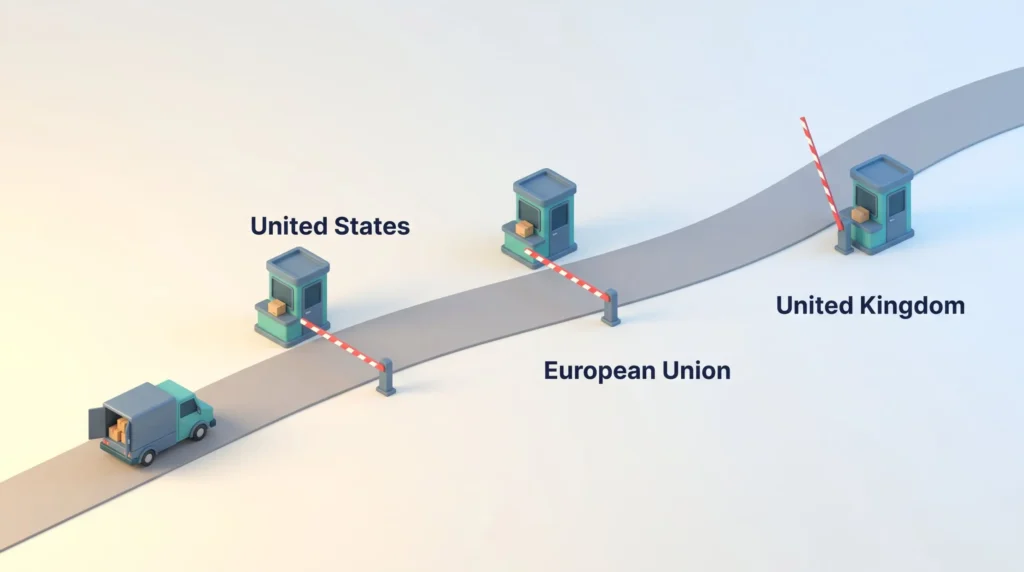
The US had one of the world’s most generous low-value import allowances: $800 per shipment, duty free, set at that level in 2016. It ended in stages. Shipments from China and Hong Kong lost the exemption on 2 May 2025, and it went for all remaining countries on 29 August 2025. Every low-value shipment entering the US now needs a formal customs entry, with duties and taxes applied where relevant.
For sellers, duty is no longer an edge case handled at the border. It is a line item to calculate before checkout, or the buyer meets it as a surprise invoice from the carrier.
The European Union
The EU is retiring its 150 euro customs duty exemption in two steps. The Council gave the final green light on 11 February 2026. From 1 July 2026 a transitional flat duty of 3 euros applies to items in parcels valued under 150 euros, charged per tariff sub-heading rather than per parcel. Full duty collection follows once the EU customs data hub is operational, which is currently expected around 2028.
Note that VAT was already due on these consignments under the 2021 import rules. What is new is the customs duty, and the flat 3 euro interim charge is deliberately blunt: it is meant to be collectable at scale before the data infrastructure exists to do it properly.
The United Kingdom
The UK took a slower path. Its 135 pound customs duty relief is being withdrawn, and on 23 June 2026 the Treasury moved the end date forward to 1 October 2028 from the previously announced 1 March 2029, citing import volumes that had trebled in two years. The measure is expected to raise around 600 million pounds a year. The UK chose not to copy the EU’s interim flat levy, so there is no bridging charge before the cutoff.
If you sell into all three markets, the sequencing matters: the US is already live, the EU starts charging in July 2026, and the UK gives you until late 2028. Treat that as a schedule, not a reprieve.
What Businesses Gain from Selling Across Borders
The upside has not gone away. Selling internationally spreads demand across seasons and economies, so a slow quarter at home can be offset by a strong one elsewhere. It also lets a niche product find enough buyers to be viable, which is the most defensible reason to sell abroad: if a customer can get the same item locally, duty and shipping will usually beat you.
International presence also builds reach that domestic advertising cannot buy. Many companies find their first foreign customers arrived through a marketplace listing they barely promoted, which is a signal worth following up with a proper global expansion strategy rather than an accident to leave alone.
Finally, cross-border demand is a cheap research channel. Where orders cluster tells you which markets deserve a localized site or local stock, and which are better served through a marketplace. That evidence beats a market-sizing spreadsheet.
What Shoppers Gain
Access to Products That Are Not Sold Locally
The most durable reason consumers buy abroad is availability. Specialist components, regional food and drink, small-label fashion and out-of-market editions are often not distributed locally. Cross-border retail turns that gap into a purchase, and it is the part of the channel least affected by duty changes, because there is no domestic alternative to compare against.
Price and Choice
Price still drives a large share of cross-border purchases, with IPC research putting it at roughly six in ten shoppers. But the calculation has changed. Once duty and handling fees are added at the border, a headline price advantage can vanish. Shoppers now compare landed cost rather than list price, which rewards retailers who show the full figure up front.
Better logistics have made the trade-off easier to accept. Tracked international delivery is now standard rather than premium, and conversational commerce channels have made order updates easier to get without contacting support.
Where Cross-Border Sales Break Down
Duties, Taxes and Landed Cost
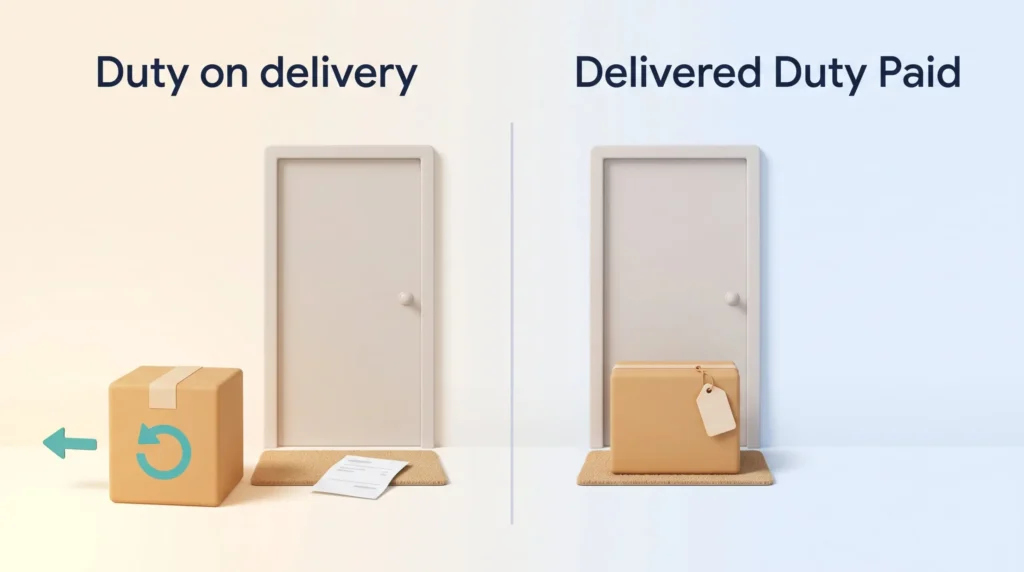
The most common failure is a checkout that quotes product price and shipping, then leaves duty to the carrier. The buyer receives an unexpected bill, refuses the parcel, and the seller pays for the return leg as well as the outbound. Delivered Duty Paid pricing avoids this by calculating transport, customs and import charges at checkout and presenting one figure.
DDP is more work, since it requires correct tariff classification, country-of-origin data and a broker relationship. It is also the only approach that survives the 2026 rules cleanly. Classification errors are not rounding errors: the code sets the rate, and under the EU interim system it also sets how many 3 euro charges land on one parcel.
Data rules add a second compliance layer. Customer records crossing borders fall under GDPR and an expanding set of national regimes. If you store customer data outside the country of sale, check the position first: data localization requirements have tightened in several jurisdictions.
Logistics and Returns
Returns are where cross-border margins die. US returns alone were forecast at around $849.9 billion in 2025, roughly 15.8% of online sales, and an international return costs far more than a domestic one. Shipping an item back across a border can exceed its value, and reimporting it may trigger duty again.
The workable answers are unglamorous. Use a local returns address in the destination market, even a third-party depot. Write a policy that is honest about who pays. For low-value items, refund without requiring the return. And invest in what prevents returns: accurate sizing, honest photography and clear delivery timelines. Lessons from building supply chain resilience apply here, since one carrier or customs bottleneck can strand a whole market.
Cross-Border E-Commerce Strategies That Work
Localization Beyond Translation
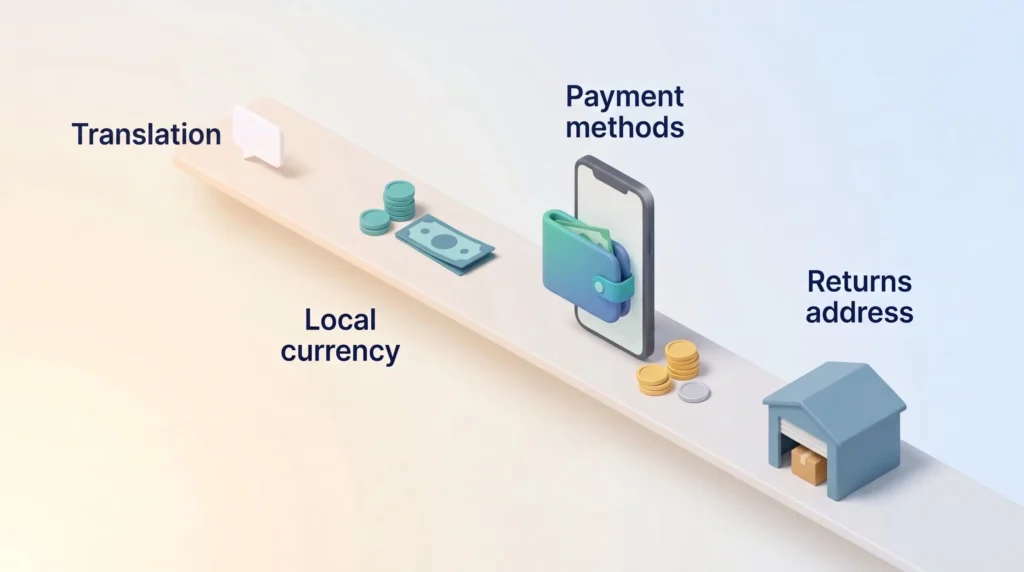
Localization is often reduced to running the site through a translation tool. That is the smallest part of it. What moves conversion is the set of details telling a buyer this store was built for them:
- Language and currency: Prices in local currency, with duty included, and product copy written rather than machine-translated for your top markets.
- Payment methods: The dominant local method, not just cards. In several Asian markets a wallet is the default; in parts of Europe, bank transfer and buy-now-pay-later carry more volume than credit cards.
- Delivery expectations: A realistic date, not a range of two to six weeks. Certainty beats speed for most international buyers.
- Trust signals: A local returns address, local contact details and reviews from buyers in that market.
- Mobile experience: Fast pages and a checkout that works on a mid-range device over mobile data.
Localization pays off unevenly, so sequence it. Localize the two or three markets already producing orders, and leave the rest on a marketplace listing until volume justifies the work. Broader globalization trends point the same way: expansion in 2026 is narrower and more deliberate than it was five years ago.
Pricing and Payments
Price your international catalogue separately from your domestic one. Duty, shipping, payment fees and currency spread add a large share to landed cost, and a flat markup across all markets either prices you out of some or loses money in others. Look at each corridor on its own numbers.
On payments, follow the local data rather than your home habits. Wallets carry the majority of global e-commerce value, but the specific wallet varies by country, and offering the wrong one is the same as offering none. The same shift is visible in digital wallets for work payments and in biometric payment methods: authentication and settlement are local questions with global consequences.
Technology in Cross-Border E-Commerce
Three technology layers do most of the useful work here, and none are new or exotic.
Landed cost engines classify products, apply the right tariff and tax treatment per destination, and return a single price to the checkout. Since August 2025 in the US and July 2026 in the EU, this has gone from a nice-to-have to the component that decides whether an international order completes at all.
Multi-carrier shipping platforms compare routes, generate customs documentation and consolidate parcels. Consolidation matters more under the EU’s per-item interim duty, because how you bundle a shipment now changes what it costs. Tracking visibility is an underrated conversion factor too: buyers tolerate longer delivery when they can see where the parcel is.
Marketplace and channel management tools keep listings, stock and pricing consistent across storefronts and countries. This is where most sellers start, and staying there for smaller markets is a reasonable choice. Digital marketplace trends continue to favour sellers who treat marketplaces as a distribution layer rather than a competitor.
AI plays a real but narrower role than the marketing suggests. It is useful for adapting product copy at scale, classifying products against tariff codes and forecasting demand by market. It is not a substitute for a customs broker. The same pattern shows up in AI in marketing and AI chatbots for customer service: strong on volume tasks, weak on those carrying legal or financial consequence.
What to Expect Next
The direction of travel is clear enough to plan around. Duty-free low-value imports are ending across major markets, and nothing suggests a reversal. That favours higher average order values, consolidated shipments and products with a genuine reason to travel, and works against arbitrage models built on cheap parcels and thin margins.
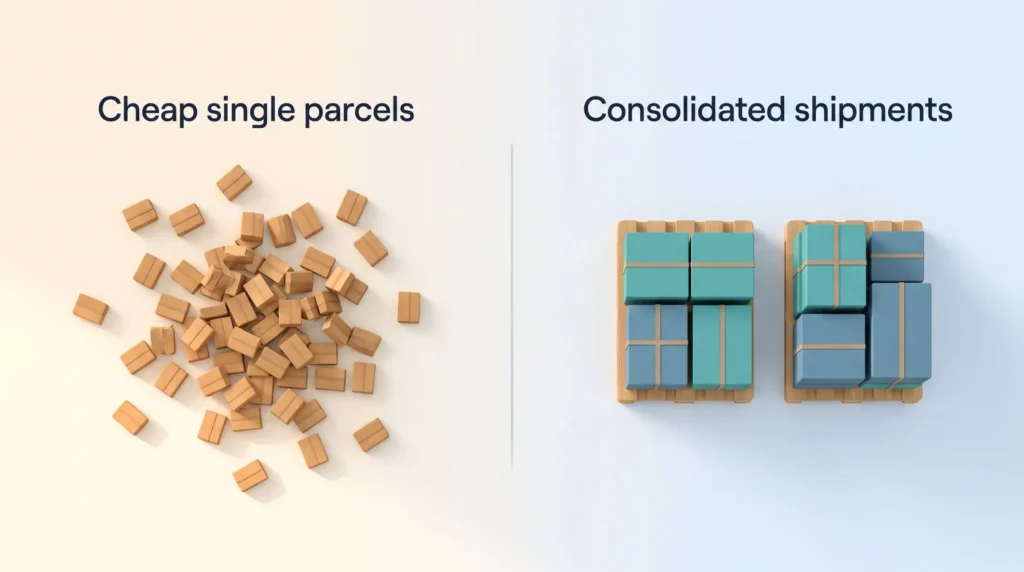
Expect compliance to keep tightening rather than settling. The EU’s flat interim duty is a placeholder for a full system arriving around 2028, and the UK cutoff lands in the same window. Anyone planning past 2027 should assume duty is collected on everything, everywhere, and design the checkout accordingly.
Expect the marketplace share of cross-border volume to hold or grow. Every new compliance requirement raises the fixed cost of selling directly into a country, and marketplaces spread that cost across many sellers. International direct sales will not disappear, but they will concentrate where a brand has real volume. Weigh that against the case for a direct-to-consumer strategy and what D2C brands have learned about owning the customer relationship.
Expect sustainability rules to arrive in the same conversation as customs. Packaging and product compliance requirements increasingly attach to imports, and enforcement is moving toward the seller rather than the shipper. Companies already tracking business sustainability requirements or working on greener supply chains will find that transition easier.
Conclusion
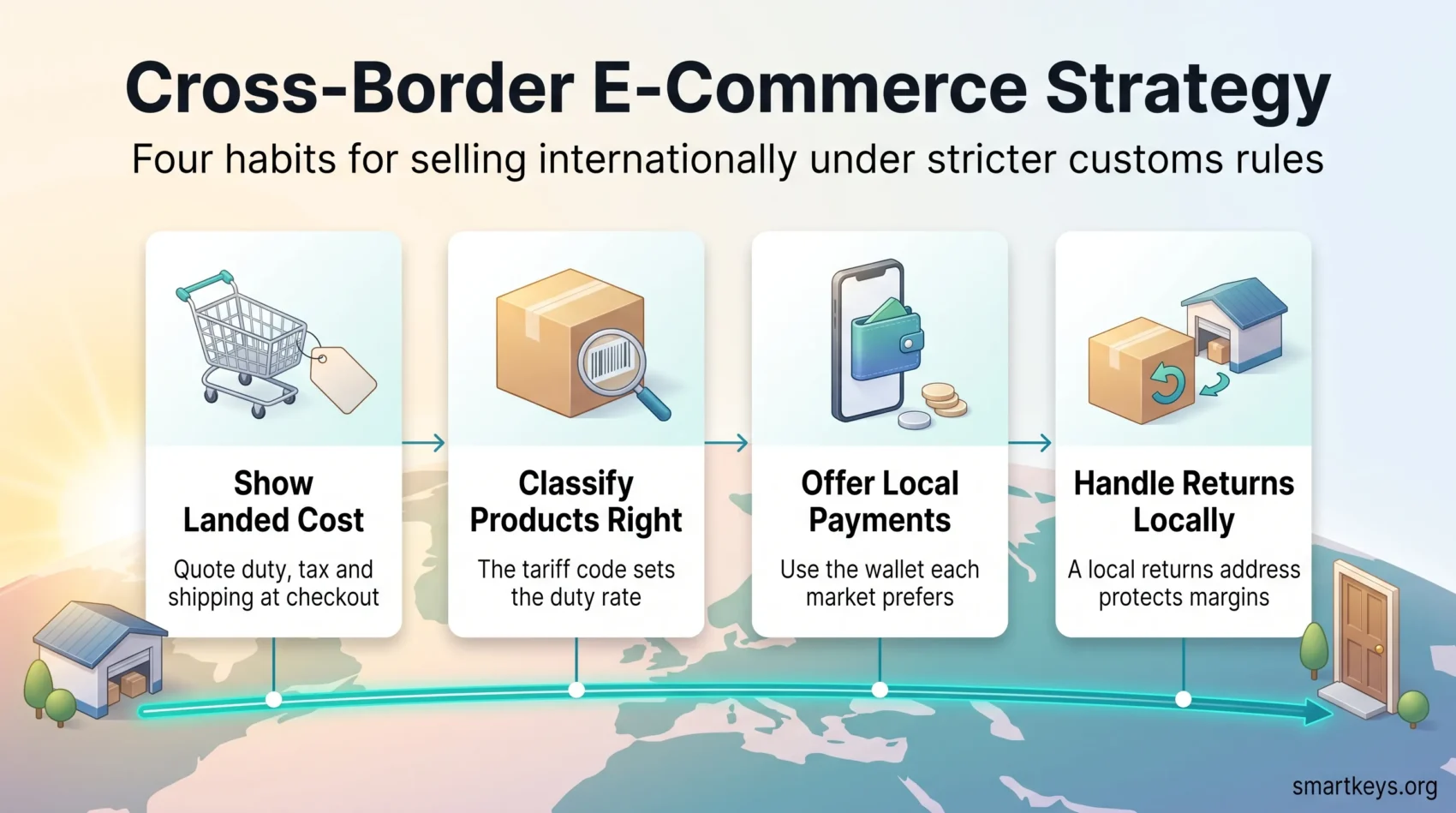
Cross-border e-commerce in 2026 is a bigger opportunity under stricter rules. Demand is intact: consumers buy internationally for products they cannot get at home, and close to a fifth of global online spending crosses a border. The supply side is harder, because the duty-free thresholds that subsidised cheap international shipping are gone or going.
The businesses that do well from here share a few habits. They quote landed cost at checkout. They classify products correctly. They offer the payment method that market actually uses. They have a returns answer that does not involve shipping a jacket back across an ocean. None of that is glamorous, and all of it matters more than any forecast about market size. Pick two markets, get the fundamentals right there, and expand from evidence rather than ambition.
Found this useful?
Make SmartKeys a preferred source on Google, and our articles will surface more often in your Top Stories, AI Overviews, and AI Mode.
Add as Preferred Source