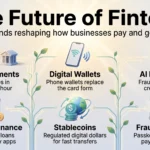
The emergence of digital wallets is no longer a forecast — it is the default way the world pays. In 2025 digital wallets carried 56% of global e-commerce value and 33% of in-person spend, more than cards, bank transfers or cash, according to Worldpay’s Global Payments Report 2026. For anyone running a business, paying contractors or simply buying lunch, that shift changes how money moves, how quickly it settles and how it is protected. This guide sets out where digital wallet work payments stand in 2026 and what to do about them.
Key Takeaways
- Digital wallets handled 56% of global online spend and 33% of in-store spend in 2025 — over $13.8 trillion combined (Worldpay, Global Payments Report 2026).
- Payment apps are on track to power 46% of global point-of-sale value by 2030.
- Adoption is regional, not uniform: wallets take 89% of Chinese e-commerce value but 39% in the United States.
- Tokenisation, encryption and biometric checks make wallet payments harder to compromise than a plastic card.
- Instant-payment rails such as FedNow and SEPA Instant now sit behind a growing share of wallet transfers.
- Integration effort, not consumer demand, is the real barrier for most businesses.
The Rise of Digital Wallets in Financial Transactions
Digital wallets have moved from convenience feature to primary rail. The shift towards cashless payments is reshaping how businesses collect money and how workers receive it — and it brings both speed and stronger protection to secure online transactions.
The Shift to Cashless Payments
Worldpay’s Global Payments Report 2026 puts digital wallets at 56% of global e-commerce value and 33% of point-of-sale value in 2025, representing more than $13.8 trillion in combined spending across the 42 markets it tracks. Payment apps are forecast to reach 46% of global POS value by 2030.
Those averages hide sharp regional differences. In China, Alipay and WeChat Pay account for 89% of e-commerce and 87% of POS value. India’s UPI-driven wallets take 68% of online and 61% of in-store value, and Brazil’s Pix reaches 42% and 34% respectively. The United States lags at 39% of e-commerce and just 17% of POS value, while Germany passed 52% of online value in 2025. If you sell across borders, the wallet mix is a market-by-market question, not a single integration decision.

Age is the other divide. In the UK, 66% of 18–24-year-olds use a digital wallet, against 29% of 55–64-year-olds and 23% of those over 65. A workforce or customer base skewed young is already wallet-first; one skewed older still needs a card and bank-transfer fallback.
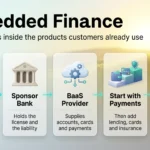
Industries well beyond retail now build on this rail. Insurers, healthcare providers and media platforms use wallet-based payment processing solutions to cut settlement times, and the same infrastructure underpins embedded finance offers from non-financial brands and the growth of mobile commerce.
The Advantages of Digital Wallet Work Payments
Adopting digital wallet work payments brings benefits that line up with how people actually work in 2026. Platforms such as Apple Pay, Google Wallet and PayPal consolidate cards, bank accounts and stored balances into one authenticated space, removing the need to carry cash or plastic and cutting the number of times payment details are re-entered.
Convenience and Security
The convenience is obvious; the security case is stronger and less well understood. Wallets use encryption in transit and tokenisation at rest, so a merchant never receives the underlying card number. Device-level biometrics add a second factor that a stolen card cannot replicate. Wallets also widen access to open banking services for people with limited banking history, which matters for distributed and freelance workforces.
Some concrete advantages:
- Limits how much financial and personal information any single merchant holds.
- Bundles rewards, receipts and loyalty in the same flow as the payment.
- Removes manual card entry, which is where most checkout abandonment happens.
- Supports flexible payment options such as buy now, pay later without a separate integration.
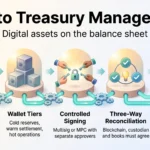
Taken together, these features make wallets a credible core of modern corporate treasury and financial management, not just a checkout button.
How Digital Wallets Revolutionize Payment Processing Solutions
Digital wallets are pulling payments onto faster rails. Where a card payment authorises in seconds but settles in days, wallet transactions increasingly ride instant-payment infrastructure that settles in real time — and that changes what a business can do with its cash.
Improving Transaction Speed and Efficiency
The rails have matured quickly. The Federal Reserve’s FedNow Service counted roughly 1,600 participating financial institutions by January 2026, having added about 500 during 2025. Value moved over the service reached $853.4 billion in 2025, up from $38.2 billion the year before.
Europe went further and made it mandatory. Under the EU Instant Payments Regulation, euro-area providers have had to receive instant euro transfers since January 2025 and to send them since 9 October 2025, at no extra charge, with funds available in under ten seconds. The same deadline introduced Verification of Payee, a free name-matching check before the payer confirms. Instant transfers made up 30.7% of euro credit transfers in the third quarter of 2025, up from 19.7% a year earlier. Non-euro EU states follow in 2027.
For a business, faster settlement means:
- Cash arrives the same day rather than several days after the sale.
- Reconciliation is simpler, because the payment and the data arrive together.
- Cash-handling and chargeback costs fall.
- Payout timing becomes a product feature — useful for gig and shift workers.
Pairing wallets with finance automation is where the real saving sits: the payment, the ledger entry and the reconciliation stop being three separate jobs.
Mobile Payment Apps: Transforming Everyday Transactions
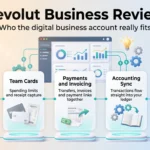
Mobile payment apps are where most people meet this technology. Apple Pay, Google Pay, PayPal, Cash App and, in Europe, bank-run schemes and challengers such as Revolut Business have made digital money transfers a routine part of the day rather than a deliberate financial task.
User-Friendly Interfaces and Features
Ease of use decides which app wins. One-tap authorisation, biometric confirmation and account setup that takes minutes rather than days do more for adoption than any feature list. Layered on top, loyalty schemes, cashback and instant receipts give people a reason to open the same app twice.
Acceptance has followed. Most retailers now take contactless wallet payments as a matter of course, and many wallets let users switch between cards, bank accounts, stored balances and crypto holdings at the point of payment. In several markets these apps are consolidating into super apps that combine payment, messaging and commerce in one place.

Digital Wallet Work Payments: A Game Changer for Businesses
For businesses, wallets change more than the checkout screen. They change when cash lands, how much payment data you have to store, and how quickly you can pay people who are not on a traditional payroll.
What Changes Inside the Business
The practical effects are consistent across sectors:
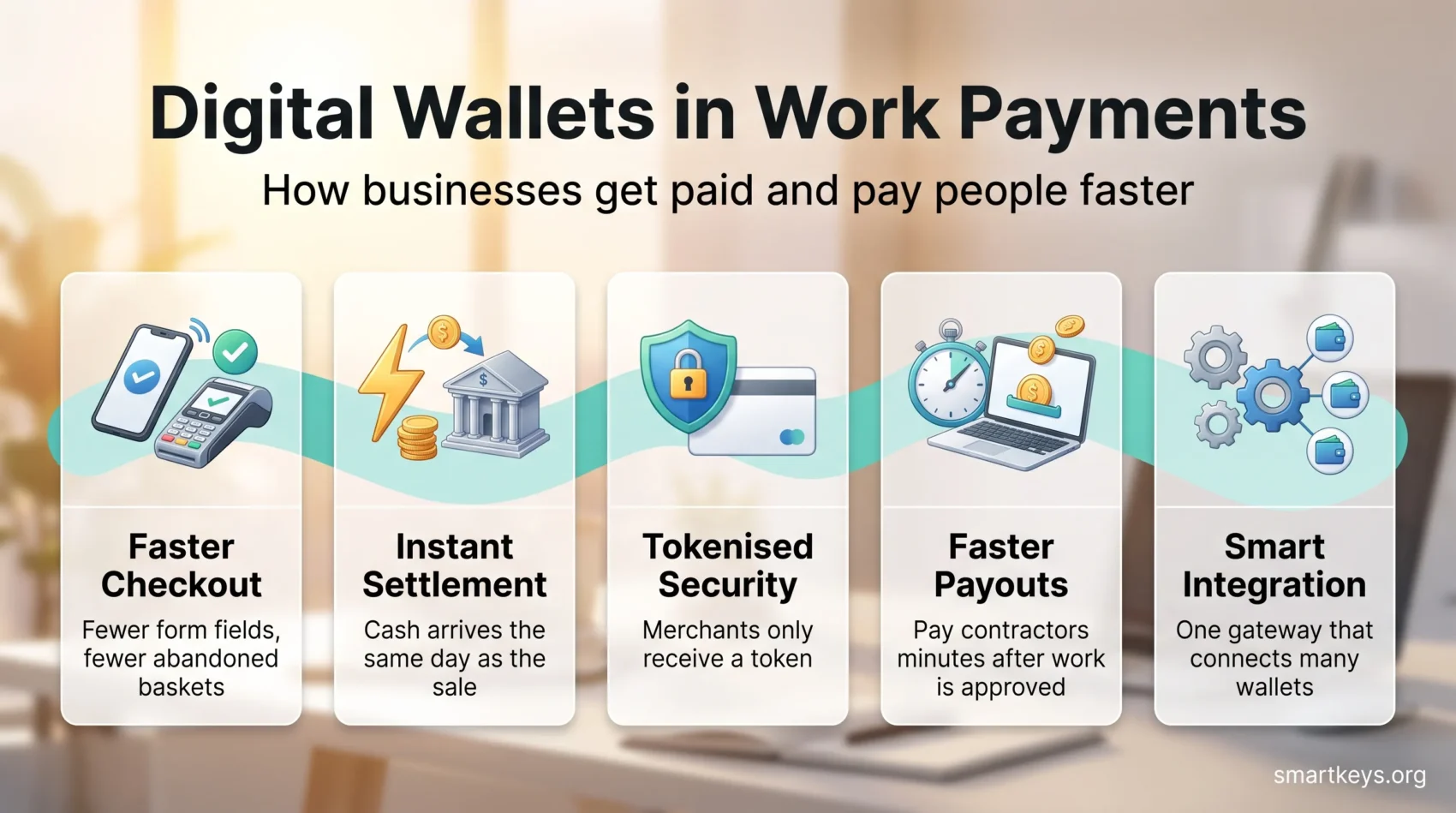
- Faster checkout: Fewer form fields means fewer abandoned baskets, online and at the till.
- Better cash flow: Real-time settlement shortens the gap between sale and usable cash.
- Lower fraud exposure: Tokenisation means a breach of your systems does not expose card numbers.
- Faster payouts: Contractors, freelancers and shift workers can be paid within minutes of work being approved.
- Richer data: Payment metadata feeds directly into forecasting and reporting.
That last point comes with an obligation. Payment data is regulated data, and wallet adoption pulls businesses into scope for rules on storage, consent and reporting. Handling it with RegTech tooling rather than spreadsheets is the difference between an advantage and a liability. For finance teams already running cloud accounting platforms, most of the plumbing already exists.
Security Features of Digital Wallets in Online Transactions
Security is the reason wallets scaled, not a caveat to them. The protections are layered, and each layer removes a different attack.
Ensuring Safe Transactions
- Encryption: Payment data is unreadable in transit, so intercepting it yields nothing usable.
- Tokenisation: The merchant receives a single-use or merchant-specific token instead of your card number, so a merchant breach cannot be replayed elsewhere.
- Biometric authentication: A fingerprint or face check ties the payment to the device holder, not just to a device.
- Device binding: Credentials are provisioned to one device and can be revoked remotely if it is lost.
These controls only work if the surrounding environment is sound. Wallets sit inside a wider security posture, and the same principles that shape current business cybersecurity practice apply here: least privilege, continuous verification and rapid revocation. Approaches such as decentralized identity and cybersecurity mesh architecture are extending the same logic to identity and distributed systems, and biometric payment systems push authentication closer to the person.

Integrating Digital Wallet Technology with Existing Payment Systems
Adding wallet support to an existing stack is a project, not a switch. The friction is rarely consumer demand — it is legacy terminals, accounting systems and processes that assume card rails.
Challenges and Solutions
The recurring obstacles:
- Compatibility: Older point-of-sale hardware and ERP systems may not speak the required protocols.
- Cost of upgrades: Terminal replacement and gateway changes carry real capital cost.
- Fragmentation: Each market has its own dominant wallet, so one integration rarely covers all of them.
- User education: Both staff and customers need to know what changed at the till.
Ways to reduce the pain:
- Pick a gateway that aggregates wallets: One integration that fronts many wallets beats a dozen direct connections.
- Train staff before launch: Most failed rollouts fail at the counter, not in the code.
- Start with your largest market: Prove the flow where volume justifies the work, then expand.
- Use specialist partners: Integration expertise is cheaper to rent than to build once.

Treated as part of a wider digital transformation programme rather than an isolated payments project, wallet integration tends to land faster, because the data and identity work is shared with everything else.
Consumer Expectations and the Role of Fintech Payment Platforms
Expectations have moved faster than most payment stacks. People who can pay a friend in ten seconds do not accept three days for a refund, and workers paid instantly on one platform notice when another takes a fortnight.
What to Watch Next
Three developments are worth tracking through 2026 and beyond.
First, account-to-account payments. Where instant rails exist, wallets increasingly bypass card networks entirely and pull directly from a bank account — the model already dominant in India and Brazil, and enabled in Europe by open banking rules.
Second, regulated stablecoins. The US GENIUS Act, signed in July 2025, created a federal framework for payment stablecoins, and bank regulators have since issued supervisory guidance. That gives businesses a clearer basis for testing digital-asset settlement in cross-border scenarios, alongside broader questions about cryptocurrencies in global business transactions and blockchain adoption.
Third, competition on service, not price. Wallet economics are converging, so fintech payment platforms increasingly differentiate on speed, dispute handling and developer experience. The same pattern shows up across the wider fintech market, in P2P lending and in insurance.
Conclusion
Digital wallets have already won the argument. With 56% of global online spend and a third of in-store spend running through them in 2025, the question for a business is no longer whether to accept them but how well the integration is done, how fast the money settles and how carefully the resulting data is handled.
The advantages are real: faster settlement, lower fraud exposure, better checkout completion and the ability to pay people quickly regardless of where they are. The costs are equally real, and they are mostly integration and process costs rather than transaction fees. Businesses that treat wallet support as infrastructure — connected to accounting, identity and reporting — get the benefit. Those that bolt on a payment button get a slightly nicer checkout and little else.
Found this useful?
Make SmartKeys a preferred source on Google, and our articles will surface more often in your Top Stories, AI Overviews, and AI Mode.
Add as Preferred Source