Peer-to-peer (P2P) lending was supposed to cut banks out of the loan business entirely. Two decades on, the reality is more interesting: the model survived, but it changed hands. Retail lenders have been pushed to the margins in the United States, Europe has built a formal licensing regime around the sector, and China wound its market down to nothing. This guide covers where P2P lending trends actually stand in 2026 — market size, which platforms still accept everyday investors, what returns look like after losses, and what the rules now require.
Key Takeaways
- The global P2P lending market was worth about USD 176.5 billion in 2025 and is projected at USD 222.9 billion for 2026, according to Precedence Research.
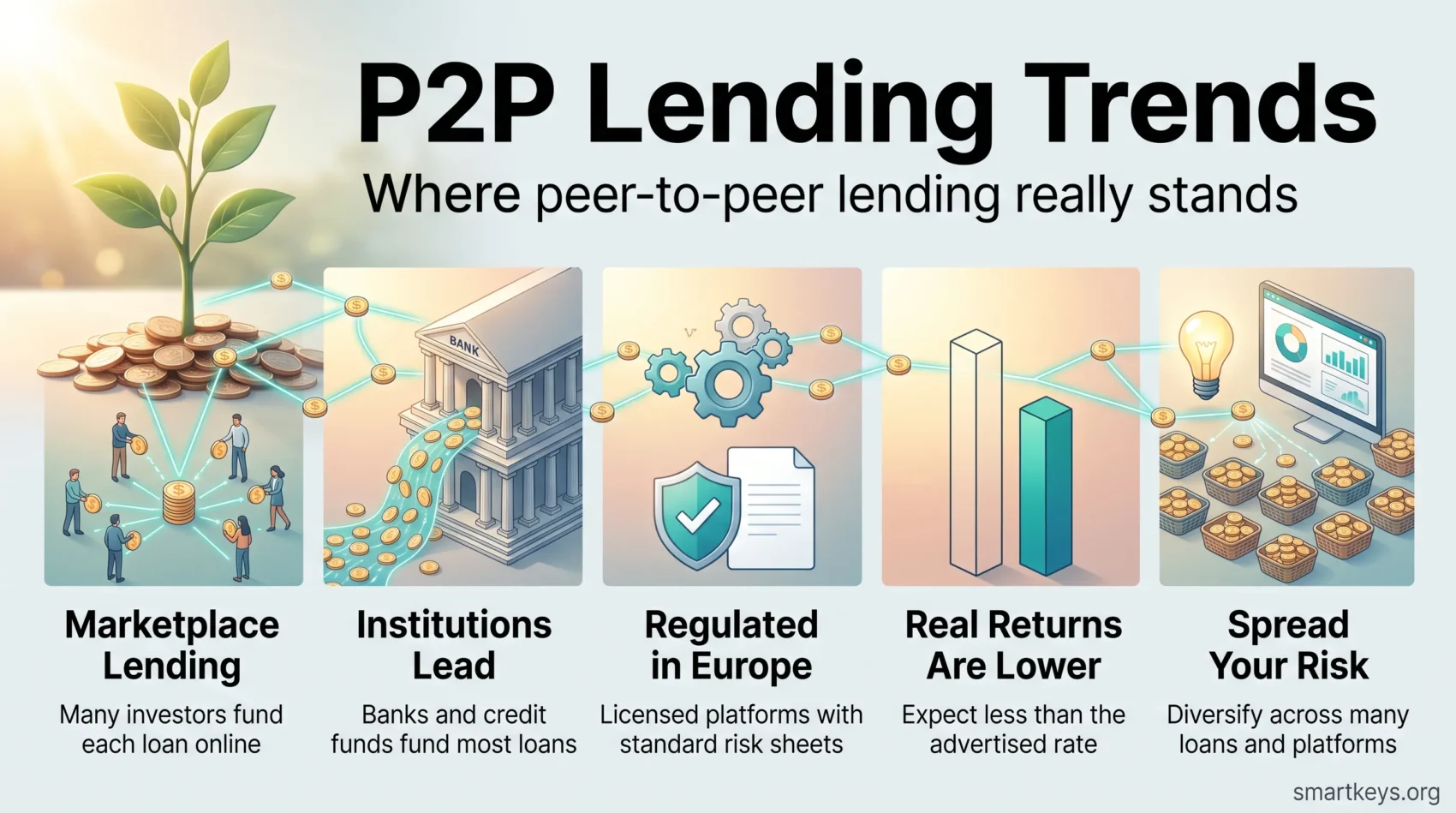
- In the US, institutions now fund the overwhelming majority of marketplace loans; LendingClub closed its retail Notes platform at the end of 2020 and Prosper is the main survivor for small investors.
- In the UK, both Zopa and Funding Circle exited retail P2P in 2022, leaving a much smaller field.
- Europe runs the most structured market: 237 firms held an ECSPR licence as of June 2026, with standardised risk disclosures and a EUR 5 million cap per project.
- Advertised European returns cluster between 10% and 15%, but realised returns typically land one to three percentage points lower on well-run platforms.
Introduction to Peer-to-Peer Lending
Peer-to-peer lending connects borrowers with investors through an online marketplace instead of a bank balance sheet. You apply, the platform scores you, and the loan is funded by many small contributions rather than one institution. Approval is usually faster than a bank’s, and pricing can be sharper because the platform carries far less overhead.
For investors, the appeal is yield. P2P notes pay more than deposits because you are taking credit risk directly, without a bank absorbing losses in between. That trade-off is the whole product: the extra return exists precisely because defaults come out of your pocket.
The sector is growing again after a difficult stretch. Precedence Research puts the global market at roughly USD 176.5 billion in 2025 and USD 222.9 billion in 2026, forecasting USD 1,602.5 billion by 2035 on a 24.68% compound annual growth rate. North America held the largest share in 2025 at 37.4%, while Asia Pacific is expected to grow fastest.
Those headline numbers hide a structural shift. Most of that volume is funded by institutions — pension funds, credit funds, banks — using platforms as origination engines. That distinction matters more than any growth forecast, because it determines whether a given platform is open to you at all.

The Genesis of Peer-to-Peer Lending
P2P lending began in 2005, when Zopa launched in the UK and Prosper followed in the US. Both promised the same thing: a marketplace where savers could lend directly to borrowers and both sides would beat bank rates.
Early Platforms: Zopa and Prosper
The first platforms ran something close to an auction. Borrowers listed what they needed, lenders bid, and the platform handled servicing and collections. It was a genuinely new distribution model, and it arrived just before the 2008 financial crisis pushed both borrowers and savers to look past the banks.
Neither pioneer still runs that model. Zopa wound down its P2P business and officially exited in January 2022 to concentrate on its banking licence. Prosper is the outlier: it continues to offer Notes to retail investors, with a minimum of $25 per Note for a standard individual account.
Disrupting Traditional Banking Models
The disruption was real, but it did not play out as predicted. Instead of replacing banks, the strongest platforms became them or partnered with them. LendingClub bought Radius Bank in February 2020 and shut its retail Notes platform on 31 December 2020, telling investors that under a banking framework it was “not economically practical” to keep offering Notes. Funding Circle permanently closed its retail P2P business in March 2022.
What survived is the underwriting technology and the origination model, now often embedded inside other products — the same pattern driving embedded finance across consumer brands.

P2P Lending Trends in Today’s Market
The 2026 market is bigger in volume and far smaller in retail participation than the one early platforms imagined.
Current Market Size and Growth Projections
Precedence Research values the global market at USD 176.5 billion in 2025, rising to USD 222.9 billion in 2026 and a projected USD 1,602.5 billion by 2035. Asia Pacific is the fastest-growing region in that forecast, at a 25.52% CAGR.
Set that against the retail picture in the US and the gap is stark. Retail’s share of platform funding fell below 10% as early as 2017, and by 2026 more than 90% of US marketplace loans are institutionally funded, with retail-funded originations in the low single-digit billions a year. The industry grew; the crowd left.
Europe tells a different story because regulation kept retail in the frame. The European Commission reported EUR 4.25 billion raised by 181 licensed crowdfunding service providers in 2024, and CrowdIndex counted 237 authorised ECSP firms as of June 2026.
Key Players in the P2P Lending Space
The names to know now split into three groups:
- US retail access: Prosper remains the main route for ordinary investors to buy consumer loan notes.
- Institutional originators: LendingClub, Upstart and Funding Circle still originate at scale, but fund through banks and credit funds rather than the crowd.
- European ECSPR platforms: a licensed field of roughly 237 firms, mostly serving real-estate and SME loans to retail investors under harmonised EU rules.
Competition also comes from outside the category. Card issuers, buy-now-pay-later providers and business banking apps all chase the same borrower, and the broader fintech landscape keeps compressing the margin any single lending model can hold. For small businesses in particular, a P2P loan is now one option among many for managing cash flow gaps.

The Role of Technology in P2P Lending
Technology is what let platforms price loans without branches. It is also where most of the remaining competitive advantage sits.
Data-Driven Underwriting Processes
Platforms score applicants using far more than a credit bureau file: repayment history, bank transaction data, employment signals and behavioural patterns all feed the model. Open banking rules made much of this possible by giving lenders permissioned access to account data, and the shift toward open banking infrastructure continues to widen what an underwriter can legitimately see.
The output is a risk grade and an interest rate. Better models mean tighter pricing and lower losses, which is why predictive analytics in finance has become the core discipline rather than a support function. Identity checks have moved the same way, with biometric verification increasingly standard at onboarding.
Blockchain and Smart Contracts
Blockchain has had a smaller practical impact on mainstream P2P lending than early forecasts suggested. Where it does appear, it is usually for automating repayment logic through smart contracts or for tokenised loan books, rather than replacing platform infrastructure. Our overview of blockchain adoption in business and of decentralised business models covers where the technology has and has not stuck.
A parallel market of crypto-collateralised lending has grown alongside P2P, but it is a different risk product with its own volatility — our guide to cryptocurrency in business explains why the two rarely belong in the same allocation.

Investor Interest and Opportunities
P2P notes are an alternative credit allocation, not a savings account substitute. Sizing them correctly is the difference between a useful diversifier and an expensive lesson.
Evaluating Risk and Return in P2P Lending
Advertised yields on European platforms run roughly 9% to 18% a year, with most offers clustering between 10% and 15%, according to CrowdIndex data. Realised returns are lower. On well-run platforms the gap between advertised and realised is typically one to three percentage points; on troubled platforms it has exceeded eight.
That gap is the number to underwrite. It comes from defaults, recovery delays, currency effects and cash drag while your money waits to be deployed. A platform quoting 13% and delivering 10% is behaving normally; one quoting 13% and delivering 4% is telling you something about its loan book. Applying a structured risk management framework to platform selection is more useful than comparing headline rates.
Portfolio Diversification through P2P Investments
Fractional investing is the mechanic that makes this workable. With a $25 minimum per Note on Prosper, a modest account can spread across hundreds of loans, so no single default is material. Concentration is the main avoidable risk in P2P, and it is entirely within your control.
Diversify across platforms too, not just loans. Platform failure and loan default are separate risks, and the first is what wiped out investors in the market’s worst episodes.

Reinvesting repayments keeps capital working, but it also compounds exposure to a platform you may not want more of. Review the allocation on a schedule instead of letting auto-invest run indefinitely, and treat P2P as one sleeve of an alternatives bucket that might also hold green finance instruments.
P2P Lending Trends Shaping the Future
Two forces are doing most of the work: better credit models and geographic expansion into markets banks underserve.
Impact of AI on Credit Analysis
Machine learning models now handle the bulk of scoring at scale platforms. The measurable benefits are faster decisions, more accurate default prediction and the ability to price thin-file borrowers that traditional scorecards reject outright.
The constraint is explainability. Lenders in most jurisdictions must be able to justify a credit decision, which rules out models nobody can interrogate — our guide to explainable AI covers the techniques that make automated decisions auditable. Expect regulators to keep tightening here rather than loosening.
Market Expansion in Emerging Economies
Emerging markets are where the growth forecasts come from. Rising smartphone penetration, large populations with limited credit history and banks unwilling to underwrite small tickets create genuine room for marketplace lending. Asia Pacific leads that expansion in most forecasts.
The caveat is that growth and investor safety are not the same variable. China’s experience is the cautionary case: the market grew explosively, then regulators shut it down entirely, with the number of operating platforms falling to zero by November 2020 and losses widely estimated at over $100 billion. Fast-growing markets without mature supervision carry that tail risk.
The Evolution of Regulatory Frameworks
Regulation is the single biggest change to this sector since 2020, and it is what separates today’s European market from the free-for-all of the 2010s.
Europe’s ECSPR Regime
The European Crowdfunding Service Providers Regulation has applied fully since 10 November 2021, with the transitional period closing on 10 November 2023. Licensed platforms must hold minimum regulatory capital of EUR 25,000 or a quarter of the previous year’s operating expenses, whichever is higher, and observe a EUR 5 million cap per project.
For investors, the practical benefits are concrete. Every offer comes with a standardised Key Investment Information Sheet, so risk disclosure follows a common format rather than each platform’s house style. ESMA maintains a public register, which means you can verify a licence rather than trust a claim. Meeting these obligations is pushing platforms toward automated compliance tooling, part of the broader move to regtech solutions across financial services.
Ensuring Investor Protection
Beyond licensing, platforms compete on protection features: buyback obligations from originators, provision funds, appropriateness tests and clearer default reporting. None of these eliminate credit risk, and a buyback guarantee is only as strong as the originator behind it.
Operational security counts too. A platform holds your identity documents and payment details, so its controls belong in your due diligence alongside its loan book — the fundamentals in our cybersecurity overview apply directly.
Challenges Facing the P2P Lending Industry
The sector’s problems are well documented, which is itself a sign of maturity.
Mitigating High Default Rates
P2P borrowers skew toward those banks decline, so defaults run higher than on comparable bank portfolios. Platforms respond with better scoring, tighter grade limits and stricter originator vetting. As an investor, check whether a platform publishes cohort-level performance data — those that do not are asking for trust they have not evidenced.
Building Consumer Trust
Trust remains the sector’s scarce resource, and the reasons are historical rather than hypothetical: China’s collapse, the retreat of the UK pioneers and a series of smaller platform failures in Europe. Recovery depends on transparency about fees, recovery rates and who actually bears losses. Platforms that publish uncomfortable numbers tend to be the ones worth using.

Global Perspectives on P2P Lending
There is no single global P2P market. There are three regional ones with very different rules and very different retail access.
Comparative Analysis: U.S. vs. European Markets
The US market is large, institutionally funded and largely closed to small investors outside Prosper. Growth there is a story about origination technology and bank partnerships, not about crowds.
Europe is the opposite: smaller in absolute volume but built around retail participation, with ECSPR providing a single passportable licence across member states. If you are an individual investor looking for genuine P2P exposure in 2026, Europe is where the accessible supply is. The UK sits outside that regime with its own FCA rules and a much-reduced platform count after the Zopa and Funding Circle exits.
Asia Pacific’s Rapid Growth Potential
Asia Pacific carries the strongest growth forecasts, driven by underbanked populations and high mobile adoption. It also carries the widest regulatory dispersion, from strict licensing regimes to markets with little supervision at all. India, Indonesia and parts of Southeast Asia are cited most often for expansion, but investor protections vary enormously between them, and China remains closed to the model.

What to Expect Next
Three developments are worth watching over the next couple of years.
First, the EUR 5 million per-project cap under ECSPR is widely expected to be reviewed, which would change what European platforms can list. Second, consolidation continues: compliance costs favour larger platforms, and smaller ones are being acquired or pursuing banking licences. Third, AI underwriting keeps improving while explainability requirements tighten around it — two trends pulling in opposite directions.
What is unlikely to happen is a return to the 2015 vision of individuals replacing banks wholesale. The realistic outcome is a smaller, better-regulated retail market alongside a much larger institutional one — a less exciting story than the original pitch, and a more durable one. The same maturation shows up across other digital models, from subscription business models to startup funding trends.
Conclusion
P2P lending in 2026 is a real asset class with real yield and real losses, operating under rules that did not exist when the first platforms launched. For borrowers, it is a legitimate alternative when a bank says no. For investors, it pays above deposits in exchange for credit risk you hold directly.
The practical advice is unglamorous. Verify the licence, read the disclosure sheet, assume realised returns below the advertised rate, spread across many loans and more than one platform, and size the allocation so a platform failure would be annoying rather than damaging. Adjacent categories such as insurtech are making the same transition from disruption narrative to regulated industry.
Found this useful?
Make SmartKeys a preferred source on Google, and our articles will surface more often in your Top Stories, AI Overviews, and AI Mode.
Add as Preferred Source