Web3 is the idea that the people who use an online service can own a piece of it, rather than only rent access.
That ownership is recorded on a blockchain, a shared database that many independent computers keep copies of, so no single company controls the record. A customer can hold a membership token, a share of a network, or a digital item in their own wallet, and take it with them.
The useful question is narrower than the hype suggests: which parts of this actually make money in 2026, and which are still experiments. This guide separates the two, with current figures and the rules you have to work inside.
Key Takeaways
- Web3 adds three things to a normal business model: verifiable ownership, automated payouts, and a community that has a financial reason to care.
- Stablecoins are the one category operating at real scale. Around $305 billion sits in them (DefiLlama, September 2026).
- Tokenized real assets such as Treasury funds and credit have grown fast from a small base, reaching roughly $38.8 billion (RWA.xyz, September 2026).
- Perpetual NFT royalties are not automatic. OpenSea made creator fees optional in 2023, and marketplaces decide whether to honour them.
- Compliance is now the gate. The EU’s MiCA transition ended on 1 July 2026, and US stablecoin rules are still being written.
- Start with one narrow pilot: a clear metric, a fixed budget, and a legal review before launch.
What a Web3 business model actually means
Every Web3 model rearranges the same three things.
Ownership: the customer holds the asset, not your database
In a normal service, loyalty points live in your database. You can change the rules, expire the points, or close the programme.
With a token, the record sits on a public blockchain and the customer holds it in a wallet, an app that stores the keys proving the item is theirs. They can keep it, sell it, or use it elsewhere. That shift cuts both ways. You gain credibility because you cannot quietly change the terms. You lose the ability to fix mistakes by editing a row.
Incentives: paying people for contribution, not clicks
The second idea is rewarding actions that create value for the network. A mapping company pays drivers for street imagery. A software project pays developers who fix bugs. The reward is a token, which can be sold or used for access.
This works when the rewarded action is useful and hard to fake. It fails when the reward is easy to farm, because people optimise for the reward rather than the outcome. Before designing any incentive, ask what someone would do to game it. If that is cheap and easy, redesign it. The same discipline applies to any community-led growth programme, token or not.
Community: customers with a financial stake
The third idea is giving customers a say. Token holders vote on a roadmap, a treasury spend, or a fee change, which creates a group that promotes the product because it benefits from success.
The tradeoff is speed. A decision that took one meeting now takes a proposal, a discussion period and a vote. Keep governance narrow at the start: a small budget or a feature shortlist, not the whole business.
What a smart contract does and does not guarantee
A smart contract is a small program stored on the blockchain that runs automatically when its conditions are met. If a digital item sells for $100 and the contract says the creator gets 10%, the payout happens without an invoice or a middleman. That is a genuine improvement on manual reconciliation, and it is the same logic behind smart contracts in ordinary business agreements.
Two limits matter. A contract only enforces what happens on the blockchain, so it cannot make a marketplace route a sale through it. That is exactly why NFT royalties broke, as the next section explains. And a bug in the code is a bug in the money, so contracts need an independent security audit before they hold anything valuable.
Where the money actually is in 2026
Most Web3 categories are still small. Two are not, and being honest about which is which saves wasted budget.
Stablecoins and payments: the one category at real scale
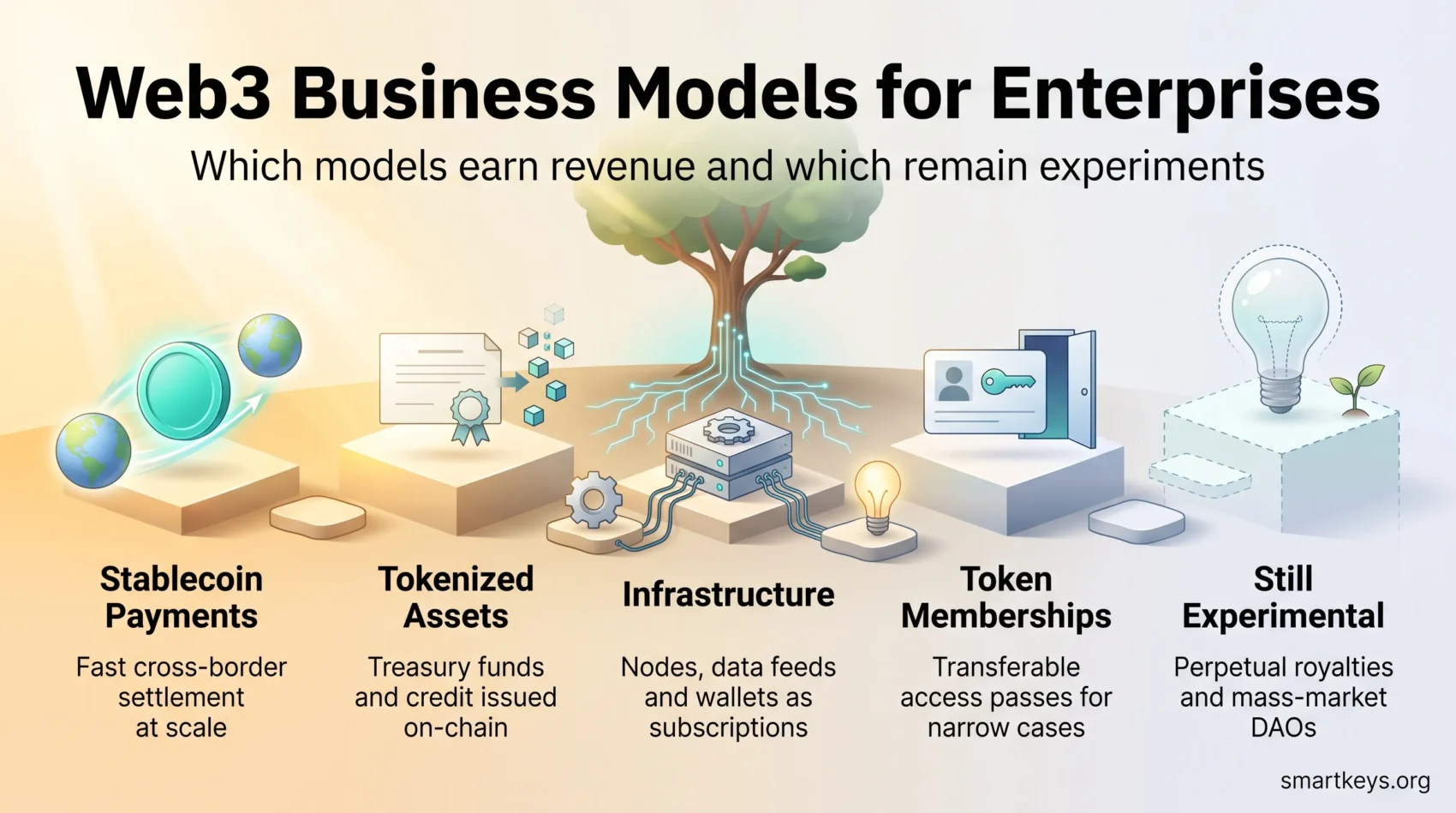
A stablecoin is a token designed to hold a fixed value, usually one US dollar, backed by reserves the issuer holds. It settles in minutes, at any hour, across borders, and it is the biggest working use case in the space. Roughly $305 billion was held in stablecoins in September 2026, according to DefiLlama. The appeal is practical: a supplier abroad can be paid on a Sunday without waiting for correspondent banks, and treasury teams can move funds between entities without a multi-day settlement gap.
The honest comparison is with what you already have. Domestic instant payment systems have closed much of the speed gap, so the case is strongest for cross-border flows and weakest inside one country. Our guides to digital wallets for work payments and open banking cover the non-crypto options that often solve the same problem with less compliance work. For distributed teams, paying remote staff in crypto covers the payroll version of this question and crypto treasury management the holding of assets afterwards.
Tokenized real-world assets: fast growth from a small base
Tokenization means issuing a blockchain record that represents ownership of something conventional: a money market fund, a bond, a slice of private credit, or gold in a vault.
The growth is real. RWA.xyz put tokenized asset value at about $38.8 billion in September 2026, excluding stablecoins, against $26.4 billion in March and roughly $6.6 billion a year before that. Most of it sits in government securities, private credit and commodities rather than the tokenized property and art that get the headlines.
One caveat matters. Much of this reflects assets being issued on-chain rather than traded there, so the figure measures issuer adoption more than liquidity for buyers. For most businesses the practical use is narrow: holding tokenized Treasury funds as short-term cash, or using tokenized collateral to settle faster. A fuller picture of the sector sits in our fintech trends overview and the blockchain in business guide, while decentralized finance for business transactions covers the lending and settlement side in more detail.
Infrastructure: selling shovels to everyone else
The least glamorous category is the steadiest. Infrastructure companies sell the plumbing: node hosting, data feeds, wallet software, indexing and storage.
Two terms help here. An oracle feeds outside information, such as a currency rate, into a smart contract, because a blockchain cannot see the internet on its own. An RPC provider runs the servers applications use to read from and write to a blockchain.
These businesses look like normal software companies. They charge subscriptions, report monthly recurring revenue, and compete on uptime and support. This is usually the layer you buy rather than build, on the same build-versus-buy logic covered in the API economy.
NFTs, memberships and loyalty: what survived the crash
An NFT, or non-fungible token, is a blockchain record that points to one specific item and proves who holds it. The speculative market for profile pictures collapsed years ago. What remained is duller and more useful: the same technology as a membership card.
A token can gate access to a product tier, an event, a private community, or an early release. Because the customer holds it, they can prove membership without logging into your system, and they can sell it if they lose interest. That resale is an argument for the model, not against it: it puts a market price on your membership.
The royalty promise that did not hold
The most repeated claim about NFTs was perpetual royalties: the creator earns a cut of every future resale, forever, enforced by code.
It did not work that way. Royalty payments depend on the marketplace choosing to route the sale through the contract that pays them. In August 2023 OpenSea, then the largest marketplace, switched off its royalty enforcement tool and made creator fees optional, following competitors that had already stopped enforcing them. Some marketplaces still honour royalties voluntarily, but there is no automatic guarantee.
So design for the first sale and treat resale income as a bonus. If your business case only works with guaranteed royalties, it does not work.
Where token-based loyalty earns its cost
Ordinary points programmes are cheaper to run, easier to change and invisible to regulators. A token programme earns the extra effort in three cases: customers genuinely want to transfer or resell their status, partners want to honour the same membership across companies, or you want proof that you cannot dilute the benefit later.
If none of those apply, use a database. Our guide to customer loyalty in the digital age covers the conventional options, and subscription business models the recurring revenue models that usually beat tokens on simplicity.
DAOs: turning customers into part-owners
A DAO, or decentralized autonomous organization, is a group that makes decisions by member vote, with the rules and the treasury held in smart contracts. Think of it as a co-operative whose bylaws are software.
The realistic version is not replacing your board. It is running one shared budget or one product area with community input: a vendor letting holders vote on which integrations get built next, or a brand letting a community allocate a marketing fund.
Getting the legal shape right first
For years the open question was what a DAO is in law. An unincorporated group can leave members personally exposed to liability, which is serious once real money moves.
Several US states have addressed this. Wyoming’s Decentralized Unincorporated Nonprofit Association Act, adopted in 2024, gives a DAO a recognised legal form that can hold assets, sign contracts and limit member liability. Other jurisdictions offer foundation structures with a similar effect. The choice is a question for your lawyers; the sequence is not negotiable. Settle the legal wrapper before the treasury holds anything.
Practical governance design
A few rules keep these groups functional. Set a quorum, the minimum participation for a vote to count, low enough to reach but high enough to mean something. Allow delegation, so members who do not follow every proposal can hand their vote to someone who does. Publish treasury spending. Use off-chain polling for early signals and on-chain votes only for binding decisions, because each on-chain vote costs transaction fees.
Watch two numbers: turnout per proposal, and the share of voting power held by the largest few holders. If turnout falls while concentration rises, you have a company with extra paperwork, not a community. The principles overlap with open innovation models and data governance strategy.
DePIN: paying people for hardware they already own
DePIN stands for decentralized physical infrastructure network. The idea is straightforward: instead of a company building the network itself, it pays thousands of individuals to contribute equipment and pays them in tokens or fees when customers use the capacity.
In practice: a wireless network pays people to host small radio hotspots in their windows, a mapping network pays drivers for dashcam footage, and a compute network rents out spare graphics cards for AI workloads.
Why the model can work, and when it fails
The advantage is capital. Building coverage normally means buying hardware before anyone pays for it. This model shifts that cost to contributors, in exchange for a share of future revenue.
The failure mode is common. Token rewards attract hardware faster than sales teams find buyers, so supply arrives with no demand behind it. Contributors then earn less than the equipment cost them and leave. Before treating a DePIN network as a supplier, ask the question that decides it: how much revenue comes from paying customers rather than token issuance. If the network cannot answer clearly, it is subsidising itself.
For a buyer, the rest is ordinary procurement. Compare price, reliability, coverage and contractual recourse against a conventional vendor. Decentralization is only a benefit if the service ends up cheaper or better. Related reading: blockchain in logistics on tracking physical goods and supply chain trends on the wider operational picture.
The rules you now have to work inside
Regulation used to be the reason to wait. In 2026 the rules exist, so the risk is launching without reading them.
Europe: the MiCA transition has ended
MiCA, the EU’s Markets in Crypto-Assets Regulation, licenses firms that provide crypto services to customers in the EU. Those firms are called crypto-asset service providers.
The grace period is over. ESMA, the EU securities regulator, confirmed that transitional arrangements expired on 1 July 2026, and stated that any entity providing crypto-asset services to EU clients without a MiCA licence is in breach of EU law and must stop.
For most companies this does not mean applying for a licence. It means checking that your vendor holds one, because using an unlicensed provider for EU customers is a compliance problem you inherit. Ask for the licence, the issuing regulator and the date.
United States: stablecoin rules are still being written
The GENIUS Act, enacted in July 2025, created the federal framework for payment stablecoins, and implementation is still under way. The Treasury Department published a proposed rule on 18 August 2026 covering the issuance, offer and sale of payment stablecoins, with comments due by 19 October 2026.
The Act’s prohibition on digital asset service providers offering non-compliant payment stablecoins takes effect on 18 July 2028. That gives real lead time, but it also means the requirements your vendor must satisfy are not final yet. Build that uncertainty into any contract you sign now.
Data protection applies as normal
One point gets missed often enough to state plainly. A public blockchain is permanent and visible to everyone, so personal data written to it cannot be deleted. That sits badly with data protection rights.
The standard fix is to keep personal data in ordinary encrypted storage and put only a hash, a short fingerprint of the data, on the blockchain. The hash proves a record has not been altered without revealing what it says. Our privacy compliance framework guide covers the wider obligations, and decentralized identity explains how credential systems avoid publishing personal data.
How to judge whether a project is real
Web3 projects publish an unusual amount of data, which makes it easy to confuse activity with health.
Start with revenue from customers: what the project earns in fees paid by users, separately from tokens it issues to attract them. A network paying out more in incentives than it collects in fees is buying its own growth numbers.
Then check concentration. What share of tokens do the team and early investors hold, and when do they unlock? The schedule is normally public, and large unlocks are the most predictable source of price pressure.
Next, security: independent audit reports, when they were done, and whether findings were fixed. Then retention rather than totals: how many users came back this month compared with last.
Finally, judge enterprise claims by contracts. Paid pilots count; announced partnerships do not. Apply the scepticism you would to any vendor, as in business model innovation.
A practical way to run your first pilot
If you decide to test something, keep it small and finite.
Pick one problem where ownership or automated payment genuinely helps, not one where a token is decoration. Cross-border supplier payments, a transferable membership tier, or provenance records for goods needing an audit trail are the honest candidates.
Set a fixed budget and one success metric before you start.
Run the legal review before launch, involving finance, tax and data protection. Token accounting and tax treatment are complicated, and discovering that at the end is expensive.
Buy rather than build, at least at first: wallet infrastructure, custody, compliance screening and payment rails are all available as services.
Give the pilot a fixed end date and write down what you learned. Most pilots should end, which is the point of running them cheaply. Teams that treat a low-code prototype the same way, as in low-code business process automation, reach a decision faster.
Conclusion
Strip away the vocabulary and Web3 offers three things a normal business model does not: ownership your customer controls, payouts that execute without an invoice, and a community with a financial reason to help.
In 2026 the evidence is much clearer than it was. Stablecoin settlement works at scale. Tokenized funds and credit are growing quickly from a small base. Memberships and provenance records are useful in narrow cases. Perpetual royalties, mass-market DAOs and most consumer token economies remain unproven.
The sensible position is neither dismissal nor enthusiasm. Pick the one use case where the technology solves a problem you actually have, check the compliance position before committing, run it on a fixed budget, and measure it against what you do today. If it wins, expand it. If not, you will have spent a quarter finding out instead of a year.
Found this useful?
Make SmartKeys a preferred source on Google, and our articles will surface more often in your Top Stories, AI Overviews, and AI Mode.
Add as Preferred Source