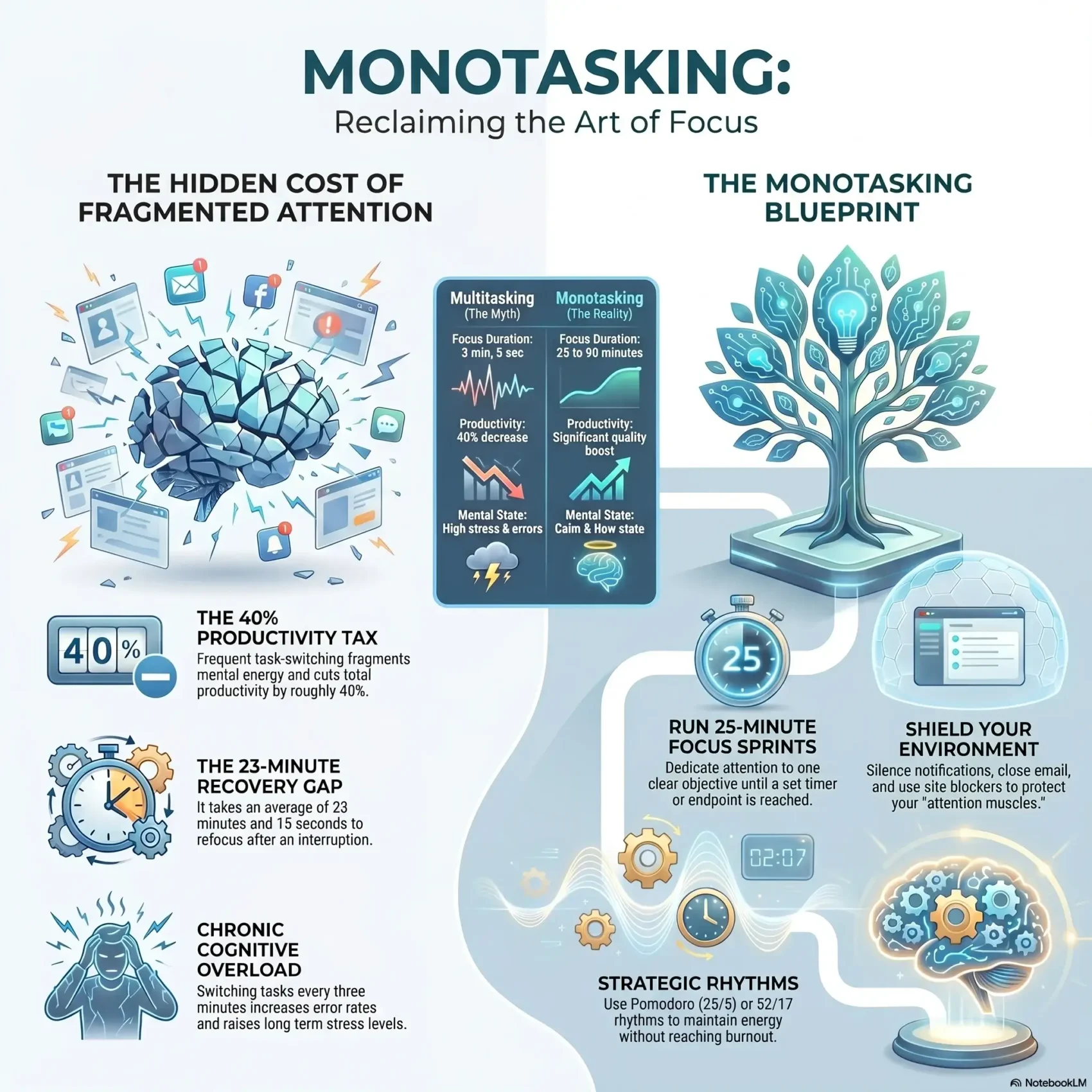
You can reclaim hours and calm by learning to do one thing at a time. Recent research shows the cost of interruptions is steep: it can take about 23 minutes and 15 seconds to return to a task after an interruption, and people switch tasks every three minutes and five seconds on average.
When your attention is split, your brain wastes time and makes more errors. MIT studies and the American Psychological Association both show frequent switching cuts productivity by roughly 40%. Author Thatcher Wine argues in his book that steady single-task practice rebuilds attention control and improves mental fitness.
This short guide explains what monotasking is, how it differs from multitasking, and why tiny distractions and media pings derail deep work. You’ll get simple steps to protect your focus, reduce stress, and turn one thing time into a habit you enjoy.
Want practical tips and a quick starter list? Check this piece on mindful productivity for related techniques: mindful productivity.
Key Takeaways
- One clear objective boosts focus and cuts wasted time.
- Interruptions cost minutes to recover and reduce accuracy.
- Switching tasks often lowers productivity and raises stress.
- Practical habits—timers, app limits, and a short list—help protect attention.
- Reading or listening with full presence strengthens your brain’s control.
What monotasking is and why your brain thrives on one thing at a time
Giving one task your full attention changes how your brain uses time. Monotasking means you focus deliberately on a single task or project until a clear end point. This approach boosts work quality and lowers stress because your mental energy isn’t split.
Monotasking defined: single-task attention for better focus, quality, and less stress
Monotasking is a practical approach: pick one project, reduce interruptions, and finish or pause at a set endpoint. Practical moves—like putting your phone away and turning off email notifications—help protect your attention. Thatcher Wine’s book encourages steady practice, like focused reading, to rebuild attention control.
The myth of multitasking: research on time loss, performance drops, and errors
Multiple studies show rapid switching reduces productivity. MIT research and the American Psychological Association find multitasking cuts output and raises errors. Field work by Gloria Mark shows people need about 23 minutes and 15 minutes to refocus after an interruption. Even a quick glance at a notification costs far more time than it seems.
- Benefit: Better quality when you limit tasks.
- Cost: Switching harms performance and creativity.
- Simple fix: Notice a distraction, acknowledge it, and gently return to one thing.
Monotasking
Start by choosing one clear task and protecting the minutes you give it. This approach—also called single-tasking—means you dedicate attention to a defined thing until a set end point.
That practice trains your brain to resist context switches and reduces errors. As Thatcher Wine suggests, focused activities like reading or listening work as exercise for attention muscles. MIT research backs this: our capacity for simultaneous thought is limited, so switching often hurts progress and raises stress.
Think of this as learnable skills, not a perfection test. With simple strategies you can shield time, enter flow more often, and protect your health by avoiding chronic overload.
“Practice focused blocks to rebuild attention control and make steady progress.”
- Pick one task: clarify the goal and next step.
- Limit interruptions: silence notifications and batch checks.
- Use short focus sprints: protect time to boost quality work.
How to monotask today: a step-by-step guide to deep focus and real progress
Decide what matters most for the next 25 minutes, then protect that time from interruptions. Write one clear sentence that says the exact task and why it moves your project forward.
Plan your work block
Note the purpose, likely obstacles, and one quick counter-move for each obstacle. Keep this short so your task time starts with clarity and momentum.
Remove distractions in your environment
Close email, silence your phone, and disable notifications. Add a site blocker like Freedom, StayFocusd, or LeechBlock, and use separate desktops to hide unrelated apps.
Set time limits with a timer
Run a 25-minute “focus one” sprint, then take a 5-minute break. Repeat 2–4 rounds to stack meaningful progress without burnout.
Clear your brain with a quick list
Keep a short brain-dump list for tasks, ideas, and media pulls using Evernote, Trello, or Asana. Capture distractions there, then return to your one task so you don’t lose flow.
- Start: one-sentence goal and obstacles.
- Protect: close email, silence phone, add blockers.
- Run: 25 minutes with a timer, then log progress.
“Pause when urges to switch arise, note the distraction, and gently steer back to the plan.”
End each sprint by noting what you finished, new issues, and the next step. This small habit turns thing time into steady progress and lowers stress as you build your focus practice.
Build a focus-friendly day: structure, breaks, and energy management
Designing your day around peak focus windows turns scattered hours into reliable progress. Reserve your deepest work for moments when your energy is highest and protect those blocks with calendar holds and a clean environment.
Schedule deep work when your attention and energy peak
Map the day to your natural rhythms. Block 60–90 minute sessions for demanding tasks and mark them “Do Not Disturb.”
Control notifications and email: batch check-ins and do-not-disturb windows
Batch email and notifications into 2–3 check-ins so you avoid the 20+ minutes lost after interruptions. Keep your phone out of sight during focus blocks to lower stress.
Use smart breaks: Pomodoro resets and the 52/17 rhythm
Mix short sprints with longer resets. Try a few 25-minute Pomodoro rounds, or test a 52/17 rhythm for steady productivity. Add a short walk before a deep session and a 3-minute review after to cue your brain.
“Protecting task time and shaping your day around energy beats constant multitasking.”
- Schedule deep work at peak energy.
- Batch messages and silence pop-ups.
- Use smart breaks and simple rituals to reset.
Make monotasking a team sport: norms, tools, and goals at work
Teams that agree on focus rules get more work done with less friction. Set clear expectations so people know when to reply and when to protect deep time. Many organizations expect constant availability, which encourages multitasking and raises errors and stress.
Reset expectations: meeting norms, response times, and HR-led support
Create simple rules: define acceptable response windows, block meeting-free periods, and protect a shared day for deep work. Ask HR to lead training that explains the research: it can take ~23 minutes to refocus after an interruption and multitasking can cut productivity about 40%.
Practical moves: silence notifications, turn the phone to DND during focus sprints, and batch email checks.
Tie tasks to goals: meaningful projects, KPIs, and fewer errors under pressure
Have managers link each project and task to clear KPIs so people see the why. When your team knows the impact, motivation and performance improve and stress falls.
- Align norms that reduce distractions and protect blocks of time.
- Build skills with short one task time sprints so practice becomes a habit.
- Provide shared tools: blockers, templates for focus blocks, and weekly planning rituals.
“Model healthy breaks and policies; leadership support makes focus cultural, not optional.”
Conclusion
Pick one concrete task now, set a short timer, and watch your momentum grow. You have a simple plan to protect your attention and use your time well. Monotasking reduces errors, lowers stress, and boosts productivity compared with frequent switching or multitasking.
Use short focus blocks, scheduled breaks, and quick brain dumps to handle any distraction. Over a few days you’ll see better quality work, steady progress, and higher energy across the day. Share these habits with other people at work so teams can protect blocks of time and improve health. Choose one thing, start one task, and build the momentum of consistent thing time.