Most advice about focus assumes the problem is your calendar. Often it is your attention. You sit down to write a report, and within a minute you are checking a message or replaying a conversation from the morning meeting. Mindfulness is one of the few responses to that problem with a serious research record behind it. It is also one of the most oversold.
This guide separates the two: what mindfulness actually is, what the trial evidence supports, which practices are worth your time, and where the claims run ahead of the findings.
Key Takeaways
- Mindfulness means paying deliberate attention to the present moment without judging it. Meditation is one way to train it, not the thing itself.
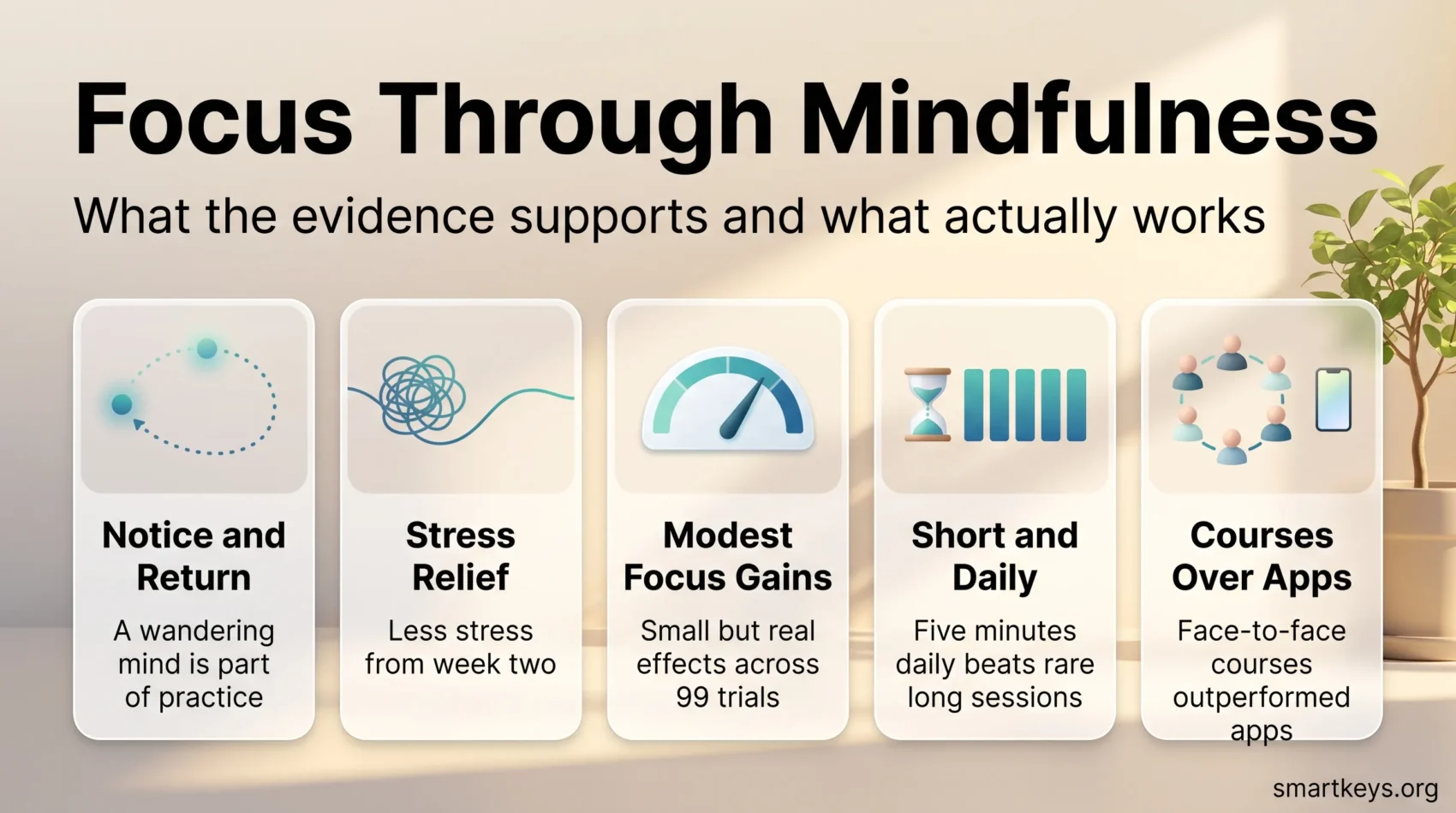
- Across 99 randomised trials, mindfulness programmes produced a small improvement in work performance against people who did nothing, and no clear advantage over other training.
- The measured gains for attention and executive control are real but modest. Working memory shows no reliable effect.
- Face-to-face courses have outperformed app-only programmes in the pooled data.
- Short practices of five minutes or less, done consistently, beat long sessions done rarely.
- A wandering mind is part of the practice, not evidence that you are bad at it.
What Mindfulness Actually Means
Mindfulness is the practice of noticing what is happening right now, on purpose, without immediately labelling it good or bad. That is the whole definition. You notice you are tense. You notice your attention has drifted to tomorrow’s deadline. You bring it back, it drifts again, and you bring it back again.
The repetition is the training. Nothing mystical is required, and you do not need to empty your mind. That is neither the goal nor possible.
Mindfulness and Meditation Are Not the Same Thing
People use the two words interchangeably, which causes confusion. Meditation is a formal exercise: you set aside time, sit down, and practise. Mindfulness is the quality of attention that exercise builds, and you can apply it while washing up, walking to a meeting, or listening to a colleague.
Many people who dislike sitting still get value from a short daily meditation practice, and others only from informal moments during the day. If sitting feels impossible, start with the informal version.
Where the Practice Came From
The workplace version traces back to one programme. In 1979, Jon Kabat-Zinn founded the Stress Reduction Clinic at the University of Massachusetts Medical Center and developed Mindfulness-Based Stress Reduction, usually shortened to MBSR. It is an eight-week course with weekly group sessions, a full-day retreat, and daily home practice.
That structure matters when reading the research. Most of the strongest studies test a programme of that intensity. A five-minute app session is far lighter, and the results reflect that.
What the Evidence Supports, and What It Does Not
This is where most articles overreach, so it is worth being precise.
Effects on Work Performance
The largest recent review pooled 99 randomised controlled trials covering 16,054 participants. Compared with people who received no programme at all, mindfulness training produced a small improvement in task performance, with an effect size of 0.25. In this context an effect size of about 0.2 is conventionally called small, and 0.5 moderate.
Two findings from the same review deserve more attention than they get. Compared with people given an active alternative, such as another training course, mindfulness showed no statistically significant advantage. And face-to-face delivery clearly beat app-based delivery in the pooled results.
The clearest gain was not in task output at all. It was in what researchers call contextual performance: helping colleagues and working beyond the strict job description. That effect was larger, at 0.40. The authors rated the overall certainty of the evidence as very low, citing high dropout rates and few preregistered analysis plans.
Effects on Attention and Thinking
A separate meta-analysis of 27 randomised trials with 1,632 healthy adults looked specifically at cognition. It found small but real improvements in attention and in executive control, which is the mental ability to hold a goal in mind and resist competing pulls. Both effects came in around 0.18.
Working memory, meaning how much information you can actively juggle, showed no reliable improvement. More in-class sessions produced stronger effects, which again points towards structured courses rather than occasional app use.
What Happens in the Brain
You may have read that mindfulness physically reshapes the brain, for example by thickening the prefrontal cortex, the area behind the forehead involved in planning and focus, or by shrinking the amygdala, which reacts to threats. Those claims mostly come from small studies or from comparing experienced meditators with people who never meditate. Comparisons like that cannot show what caused the difference.
Researchers at the University of Wisconsin-Madison tested the idea directly. They randomly assigned more than 200 adults with no meditation experience to an eight-week MBSR course, a comparable health programme without mindfulness, or no training, and scanned their brains before and after. The results, published in Science Advances in 2022, showed no structural brain changes from MBSR compared with either control group.
That does not mean nothing happens. People can feel less stressed and pay attention differently without a visible change in brain structure after eight weeks. It does mean the brain-rewiring headlines run well ahead of the evidence.
Effects on Stress
Stress is where the case is strongest. A 2025 trial randomised 138 people new to meditation to a guided app or a waiting list, with ten minutes of daily practice for eight weeks. The app group reported less stress and less rumination, meaning repetitive worried thinking, from week two, and the gain held to week eight.
One result is worth holding onto. Their appraisal of the stressful events themselves did not change. Mindfulness did not make their problems smaller. It changed how much those problems occupied them afterwards. That is a realistic description of what to expect, and it places mindfulness closer to stress management than to raw output.

Practices You Can Start This Week
Given the evidence, the sensible approach is short, frequent and specific. Pick one or two of the following and attach each to something you already do, so it does not depend on remembering.
Breathing Exercises Under Five Minutes
Breath practices are the easiest entry point: always available, no equipment. They work as a reset between tasks rather than as a cure for anything.
- Box breathing: inhale for four counts, hold for four, exhale for four, hold for four. Repeat four to six times. Good before a difficult call.
- Extended exhale: breathe in for four counts and out for six. A longer out-breath tends to feel calming for most people.
- Counting breaths: count each breath up to ten, then start again at one. Noticing you have lost count is the exercise working.
If you want to go further with the mechanics, our guide to breathing techniques covers the patterns in more detail.
The Body Scan
A body scan means moving your attention slowly through your body and noticing what you find, without trying to fix it. It takes five to fifteen minutes and suits the end of a workday.
Sit or lie down comfortably and take a few slow breaths. Start at your feet and move upward, spending two or three breaths on each region: feet, legs, hips, back, shoulders, arms, neck, jaw, face. You are not aiming to relax those areas, only to notice them. Relaxation often follows anyway, particularly at the jaw and shoulders, where desk work quietly accumulates tension.
Mindful Observation, Walking and Writing
These informal versions fit into gaps you already have.
- Mindful observation: pick one object and study it for sixty seconds. Colour, texture, edges, how the light falls on it. The task is deliberately small, which is what makes it work as a reset.
- Mindful walking: walk for five minutes with your attention on your feet meeting the ground. This pairs naturally with the movement breaks you should be taking anyway.
- Reflective writing: spend five minutes writing what is actually on your mind, unedited. Our guide to journaling for productivity covers formats worth trying.
Two habits pair especially well with this: single-tasking, meaning working on one thing until you deliberately stop, and taking real short breaks instead of swapping work for a phone screen.
Apps and Tools: What They Do and What They Do Not
Guided apps such as Headspace and Calm are the usual starting point, and they solve a real problem. A recorded voice tells you what to do, which removes the awkwardness of sitting in silence wondering whether you are doing it right. The stress trial described earlier used exactly this kind of app and found real benefit.
Set your expectations from the pooled data, though. In the 99-trial review, app-based programmes did not match face-to-face courses. If the practice turns out to suit you, a structured course with a teacher is a better next step than a longer app streak.
Pricing changes often and varies by country, so check current terms before subscribing rather than trusting a figure in any article, including this one.
Choosing Something That Fits
The best tool is the one you will open on a bad day. A few things to weigh:
- Session length: if the shortest option is twenty minutes, you will skip it. Look for three and five-minute sessions.
- Guidance style: voices are personal. Try a few before paying.
- Free options: many recordings cost nothing, and a plain timer with no voice works for some people.
Be wary of streak counters. Turning a calming practice into a metric you can fail at defeats the point.

Common Problems and How to Get Past Them
Almost everyone hits the same two obstacles. Both are predictable, which makes them easier to handle.
A Wandering Mind Is Not Failure
People quit because they conclude they are bad at it: their mind wandered, so the session must have gone wrong. In fact the wandering is the raw material. Noticing that your attention has left, and returning it, is one complete repetition of the exercise.
A session in which your mind wandered thirty times and you brought it back thirty times is a successful one. Judging yourself for drifting adds a second layer of stress on top of the first, which is exactly the pattern the practice is meant to interrupt.
Staying Consistent
Consistency beats duration. Five minutes daily does more than forty minutes on an occasional Sunday, and the research on in-class sessions agrees: repetition matters more than length.
Attach the practice to an existing anchor. After you sit down at your desk. Before the first meeting. When you close your laptop. Building it into a morning routine works well, because early slots are less likely to be eaten by other people’s priorities. Treat it as a small piece of steady, incremental improvement rather than a project with a finish line.
Fitting Mindfulness Into a Busy Workday
You do not need extra hours, only the transitions you already have.
During Work Tasks
- Set an intention before you start: name in one sentence what this block of work is for. It makes drifting easier to notice.
- Work on one thing at a time: the switching between tasks is where attention leaks away, as the research on multitasking consistently shows.
- Take three breaths before responding: useful for a message that irritates you. It converts a reaction into a decision.
- Listen without rehearsing: in a conversation, keep your attention on what the other person is saying instead of drafting your reply. It is the same skill as returning to the breath, applied to a colleague.
- Notice the handover: spend ten seconds between two tasks acknowledging that one has ended. Attention lingers on unfinished work otherwise.
This sits naturally alongside deep work and other focus management techniques, which handle the scheduling side of the same problem.
Scheduling Breaks That Actually Restore You
- One minute of breathing between meetings: the smallest useful intervention, and the easiest to keep.
- A short walk without your phone: five minutes of walking attention costs almost nothing and reliably clears mental clutter.
- One meal away from the screen: eat lunch without a laptop or a feed and pay attention to the food. It turns a break you already take into a real pause.
- An end-of-day body scan: a clear boundary between work and the rest of the evening, which matters most if you work from home.
Breaks only restore you if they are genuinely different from work. Scrolling a feed is another screen demanding attention, which is why reducing digital overload pairs so well with mindfulness.

None of this replaces a workable workload. If your calendar has no gaps at all, the honest first step is prioritisation, not breathing.
Shaping a Space That Supports Attention
Your environment does part of the work for you. A room that constantly pulls at your attention makes every practice harder.
Your Own Desk
Start by clearing the surface. Visible clutter is a queue of small unfinished decisions, and each one takes a fraction of your attention. Our guide to desk organisation covers the practical side.
Light matters more than most people expect, and getting workspace lighting right is one of the cheapest improvements available. Sound is the other lever: steady background noise is usually easier to work with than intermittent noise. If you work from home, our guide to setting up a home office covers the rest.
A note on standing desks: they reliably reduce sitting time, but the evidence on productivity and wellbeing is more mixed than the marketing suggests. Treat one as a way to vary your posture, not as a focus tool.
Shared and Open Offices
Open-plan noise is the most common complaint people have about their workplace, and it is the hardest environment for attention. You cannot redesign the floor alone, but a few things help. Agree on quiet hours with the people around you. Use a visible signal, such as headphones, that the team reads as a request not to interrupt. Take your breathing practice elsewhere: a stairwell, a corridor, or outside. Our guide to managing distractions in an open office covers the acoustic and behavioural fixes in depth.
If you manage a team, the most useful thing you can offer is not a meditation subscription. It is protected time without meetings. The same applies to distributed teams, where the pressures on remote work and mental health are well documented.

The Honest Summary
Mindfulness is a useful skill with a modest evidence base. The measured effects on attention and task performance are small. The effects on stress and rumination are more convincing, and they show up quickly, often within two weeks of short daily practice.
What it will not do is compensate for structural problems. A calendar with no gaps, unclear priorities, or a manager who messages at eleven at night are not attention problems. They are workload and management problems, and no breathing exercise fixes them.
Within those limits, it is worth the time. Five minutes of breathing before a hard task. A body scan at the end of a difficult day. Noticing, once an hour, where your attention has actually gone. These cost almost nothing to test on yourself for a fortnight.
Found this useful?
Make SmartKeys a preferred source on Google, and our articles will surface more often in your Top Stories, AI Overviews, and AI Mode.
Add as Preferred Source