Emotion recognition AI promised managers a shortcut: point a camera or a microphone at your workforce, and learn how people really feel. In 2026 that shortcut is largely closed. The European Union banned the practice in workplaces outright, the underlying science has not held up, and the two most visible vendors withdrew their emotion features years before regulators forced the issue.
That does not make the topic irrelevant. Emotion detection tools are still sold, still deployed in customer-facing settings, and still bundled quietly into meeting software and contact centre platforms. If you run a team, buy software, or write policy, you need to know exactly where the line sits.
This guide covers what the technology actually does, what the research says about its accuracy, what the EU AI Act prohibits and permits, what US employers must now disclose, and which alternatives give you real insight into employee sentiment without stepping over a legal line.
Key Takeaways
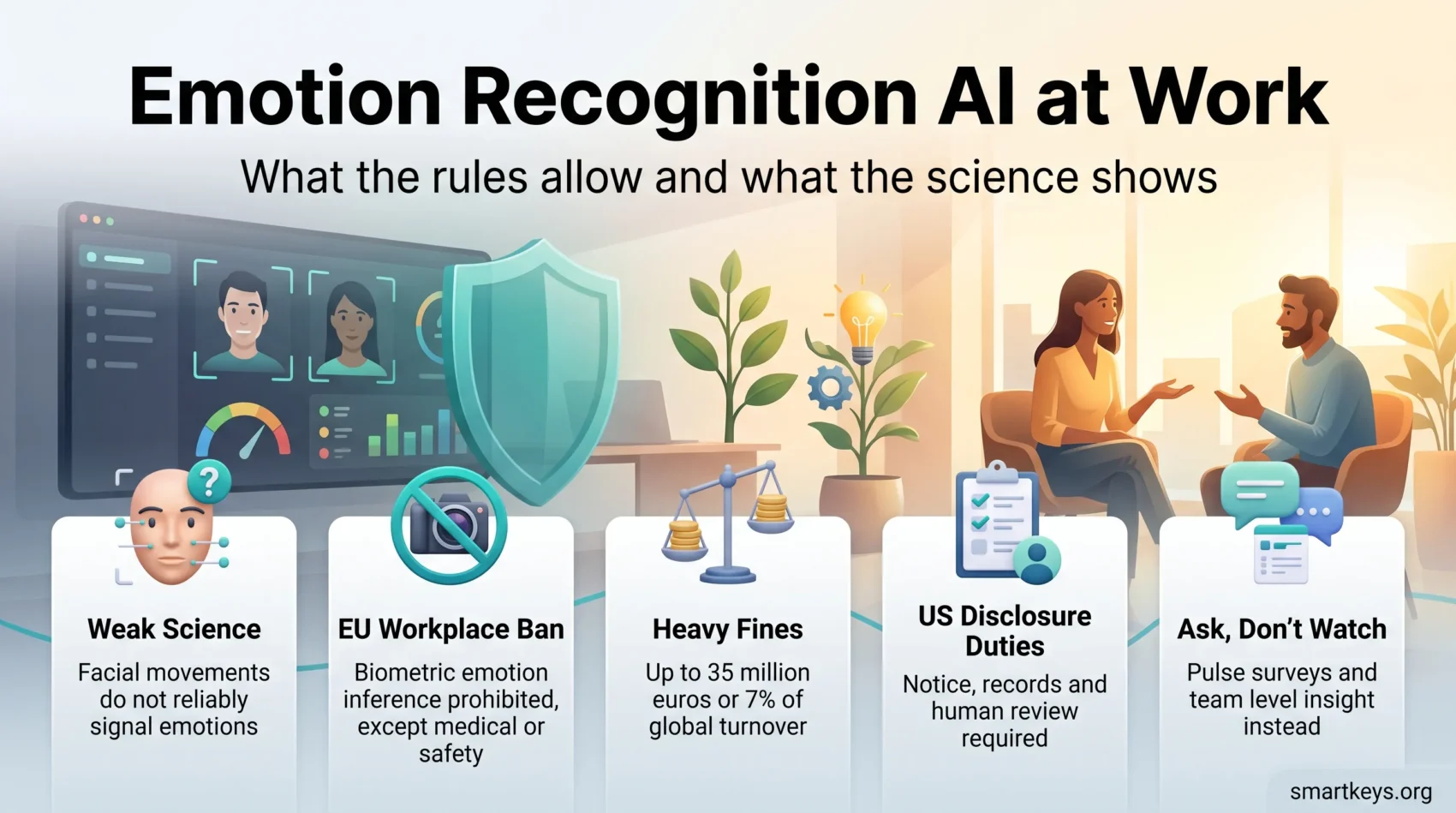
- Article 5(1)(f) of the EU AI Act has prohibited AI systems that infer emotions from biometric data in workplaces and education since 2 February 2025.
- Breaching that prohibition carries fines of up to 35 million euros or 7% of worldwide annual turnover, whichever is higher.
- A landmark 2019 review concluded that facial movements do not reliably signal specific emotional states across people and contexts.
- Microsoft retired emotion inference from its Azure Face API in 2022, and HireVue dropped facial expression scoring in 2021.
- US employers face disclosure duties rather than a ban, with new rules in Illinois, California and Colorado.
What Emotion Recognition AI Actually Does
Emotion recognition AI, also called affective computing or emotion AI, is software that assigns emotional labels to people based on signals it can measure. Most systems work from one or more of four inputs: facial images or video, voice recordings analysed for pitch and pace, physiological data from wearables such as heart rate or skin conductance, and written text.
The first three are biometric inputs, and that distinction matters enormously for what is legal. Text based sentiment analysis, which scores the tone of an email or a survey comment, sits in a different regulatory category from a camera that scores a face.
Typical outputs are coarse. A system might return a confidence score across a handful of categories such as happy, sad, angry, surprised, fearful and neutral, or a position on a two-axis map of valence and arousal. Vendors then wrap that output in a business narrative: engagement dashboards, agent coaching, candidate scoring, or wellbeing alerts.
The gap between “this face shows a raised brow and a tightened mouth” and “this employee is disengaged” is where almost every problem in this field lives.
The Science Problem: Faces Are Not Emotion Readouts
The commercial case for emotion AI rested on an assumption that a specific facial configuration maps to a specific internal feeling in a consistent, universal way. That assumption did not survive scrutiny.
In 2019 a team led by Lisa Feldman Barrett published Emotional Expressions Reconsidered in Psychological Science in the Public Interest, reviewing more than a thousand studies. The conclusion was blunt: how people communicate emotion varies substantially across cultures, situations and even within the same person from one moment to the next. A scowl is sometimes anger and often something else entirely. The paper explicitly warned against technology that infers emotional state from facial movements alone.
That finding is why so much of the marketing language around this category should be read carefully. High accuracy scores quoted by vendors are usually measured against posed datasets, where actors were instructed to produce a canonical expression. Performance on posed faces tells you very little about performance on a real employee sitting in a real meeting.
The same caution applies to voice analysis. Accent, language, background noise, a head cold and simple personal style all move the signal. If you are evaluating any system whose output drives a decision about a person, ask for validation data gathered in your own operating conditions, and ask whether the model is an explainable AI system or a black box.
There is a human cost on top of the accuracy problem. Once staff know a system scores their expressions, many start managing their faces for the machine. Sociologists call this emotional labour: the effort of showing the feelings a job expects rather than the ones you actually have. A tool meant to measure how people feel ends up teaching them to hide it, which makes its readings even less useful.
What the EU AI Act Prohibits at Work
The EU AI Act draws the sharpest line in the world on this technology. Article 5(1)(f) prohibits “the placing on the market, the putting into service for this specific purpose, or the use of AI systems to infer emotions of a natural person in the areas of workplace and education institutions, except where the use of the AI system is intended to be put in place or into the market for medical or safety reasons.”
Those prohibitions have applied since 2 February 2025. Under Article 99(3), non-compliance is subject to administrative fines of up to 35 million euros or, for an undertaking, up to 7% of total worldwide annual turnover for the preceding financial year, whichever is higher. This is the heaviest penalty tier in the Act, above the tiers for high-risk system failures.
The ban is not limited to EU-headquartered companies. It reaches any organisation putting such a system into service in the EU, which in practice means most multinational employers with European staff. Anyone building an EU AI Act compliance programme should treat workplace emotion inference as a hard stop rather than a risk to be managed.
The Two Narrow Exceptions
Medical and safety uses survive the ban, but the Commission’s guidance on prohibited practices instructs that both be read narrowly and limited to what is strictly necessary and proportionate.
Medical means genuine therapeutic use, typically involving a CE-marked device, not a wellbeing dashboard with a clinical-sounding name. A mental health app that an employer offers to staff does not become a medical use just because it talks about stress or mood. Safety means protecting life and health, such as a drowsiness detection system in a vehicle, not protecting property, revenue or brand reputation. Fraud prevention does not qualify.
What Falls Outside the Ban
Several things sit outside Article 5(1)(f), and vendors will point at every one of them:
- Systems that infer intentions rather than emotions, which the prohibition does not cover.
- Text based sentiment analysis, because it does not rely on biometric data.
- Detection of physical states such as fatigue or pain.
- Recognition of readily apparent expressions and gestures, as opposed to inference of an underlying emotional state.
These carve-outs are narrower than they look, and the boundary between “detecting a frown” and “inferring frustration” is exactly where enforcement disputes will happen. Data protection law applies regardless: biometric processing still needs a lawful basis under the GDPR, and consent from an employee to their employer is rarely considered freely given.
Transparency Duties Where the Ban Does Not Reach
Outside the workplace and education contexts, emotion recognition is permitted but conditional. Article 50(3) of the AI Act requires deployers of emotion recognition and biometric categorisation systems to inform the people exposed to the system about its operation, and to comply with data protection law. Those transparency obligations have applied since 2 August 2026.
Two details matter in practice. The notice has to be given before or at the time of exposure, not on request afterwards. And the trigger is being “exposed to” the system, a lower threshold than interacting with it, which captures people whose recordings are analysed later.
For a contact centre analysing caller voice, that means the disclosure has to be built into the call flow. If you are reviewing customer service technology or deploying conversational AI, this is now a procurement question rather than a nice-to-have.
Where US Employers Stand in 2026
The United States has no federal equivalent of the EU prohibition. Instead there is a growing patchwork of state disclosure and record-keeping duties that catch emotion analysis alongside other automated tools.
- Illinois: HB 3773 took effect on 1 January 2026 and requires employers to notify applicants and employees when AI is used for employment decisions, covering recruitment, hiring and promotion. Illinois also has the Biometric Information Privacy Act and the Artificial Intelligence Video Interview Act, both of which bite on facial analysis in hiring.
- California: FEHA regulations effective 1 October 2025 confirm that existing discrimination law applies to automated decision systems, extend record retention for automated decision system data to four years, and make evidence of anti-bias testing relevant to discrimination claims.
- Colorado: the original Colorado AI Act was repealed and replaced by the Automated Decision-Making Technology Act, signed on 14 May 2026 and effective 1 January 2027. It requires advance notice to candidates and employees, a plain language explanation within 30 days of an adverse decision, three years of records, and a right to human review by someone empowered to override the system.
The pattern is consistent even where the rules differ: tell people, document what you did, and keep a human in the loop. Building that into your AI governance model now is cheaper than retrofitting it later. The same logic underpins broader employee data privacy obligations.
What the Vendors Did Before the Regulators
Two decisions tell you more than any market forecast.
In January 2021 HireVue announced it would stop using facial expression analysis to score job candidates, following an algorithmic audit and a 2019 complaint to the Federal Trade Commission. The company retained voice and language analysis but removed the visual component from its assessments. That change mattered well beyond one vendor, because large employers had relied on such video assessments for high-volume graduate hiring. Unilever was among the best-known users.
In June 2022 Microsoft retired the emotion inference and attribute prediction capabilities of the Azure Face API under its Responsible AI Standard. New customers lost access from 21 June 2022 and existing customers had until 30 June 2023 to stop using the features. Microsoft cited the absence of consensus on a definition of emotion, the difficulty of connecting facial expressions to internal states across populations, and the risk of stereotyping and discrimination.
Meeting software faced the same test. In May 2022 more than 25 human rights organisations publicly urged Zoom to drop plans to analyse the emotions of people on video calls. They argued the method lacked scientific support, would disadvantage people with disabilities and some ethnic groups, and could let employers discipline staff for showing the “wrong” emotion. For remote teams, where the video call is the workplace, that last point is the one to remember.
The HireVue and Microsoft decisions both predate the EU prohibition by years. When two of the largest players in a category withdraw a feature voluntarily, that is a signal about the underlying evidence, not just about compliance risk. It sits alongside the broader questions raised by bias in AI hiring and by AI hiring tools generally.
The Market That Remains
The category has not disappeared. Fortune Business Insights valued the global emotion AI market at 3.4 billion US dollars in 2025 and projects 4.15 billion in 2026, growing at roughly 22% a year to 2034. As with all vendor-commissioned market sizing, treat the number as an order of magnitude rather than a precise measure, and note how widely estimates vary between research firms.
Growth is concentrated where the workplace ban does not apply: automotive driver monitoring, market research with informed participants, healthcare and therapeutic applications, and consumer product testing. Enterprise HR is the segment under the most pressure.

What to Use Instead
The underlying management question is legitimate. Leaders do need to know whether a team is under strain, whether a change landed badly, and whether people are quietly disengaging. There are defensible ways to find out.
- Ask people directly. Short, frequent, anonymised pulse surveys with a published response plan outperform inferred signals, because self-report captures the thing you actually care about. AI-assisted engagement surveys can help with analysis and follow-up question design.
- Aggregate, do not individualise. Reporting sentiment at team level with a minimum group size protects individuals and still surfaces the trend. Individual scoring is where both the legal and the trust problems begin.
- Use behavioural and outcome data. Attrition, absence, internal mobility and participation rates are observable facts. Workforce analytics tools work with these without touching biometrics.
- Train managers to have the conversation. A capable manager in a regular one-to-one detects strain more reliably than any camera, and can act on it.
- Be explicit about what you measure. A published measurement policy is the practical expression of a transparency culture, and it is what stops suspicion from spreading in both directions.
This matters most for distributed teams, where visibility is thin and the temptation to instrument everything is strongest. The evidence on remote employee engagement and on remote work and mental health points to the same conclusion: asking works better than watching.
A Checklist Before You Buy Anything
If a vendor offers emotion, sentiment or wellbeing detection, work through these questions before a pilot:
- Does the system use biometric data, and will it be used in a workplace or education setting in the EU? If both, stop.
- What exactly does the model output, and what decision will that output influence?
- What validation data exists from conditions like yours, rather than from posed datasets?
- How does accuracy vary across age, gender, ethnicity, disability and neurodivergence?
- Who is told, when, and in what words?
- Can an employee contest an outcome, and who has authority to override it?
- How long is the data retained, and who else can access it?
The same discipline belongs in any review of AI employee monitoring, algorithmic management and biometric authentication at work, and it applies equally to sensors embedded in wearable technology in workplaces and to robotics on the shop floor.
Conclusion
Emotion recognition AI is the clearest example so far of a workplace technology that regulators stopped before it scaled. The reason is not squeamishness about surveillance alone. It is that the product claimed a level of insight the science does not support, and the consequences of acting on a wrong inference fall on the individual employee.
For employers the practical position in 2026 is simple. In the EU, inferring emotions from biometric data at work is prohibited, with narrow medical and safety exceptions and fines at the top penalty tier. Elsewhere it is permitted but increasingly conditioned on notice, documentation and human review. Everywhere, it is a weak substitute for asking your people how they are and being willing to act on the answer.
Where emotion AI does have a future, it is in consented, individual-facing contexts rather than in management dashboards. Companies that want a healthier culture will get further by investing in manager capability and honest feedback loops than in sensors. That balance between technological capability, ethical considerations and responsible business practice is what will decide which uses of affective computing survive the decade. It is the same question running through every serious discussion of AI in the workplace.
Found this useful?
Make SmartKeys a preferred source on Google, and our articles will surface more often in your Top Stories, AI Overviews, and AI Mode.
Add as Preferred SourceFAQ
Is emotion recognition AI legal in the workplace?
In the European Union it is prohibited. Article 5(1)(f) of the EU AI Act bans AI systems that infer emotions of a person in workplaces and education institutions from biometric data, and that prohibition has applied since 2 February 2025. The only exceptions are genuine medical uses and safety reasons protecting life and health, and regulators have said both must be read narrowly. Breaching the ban can cost up to 35 million euros or 7% of worldwide annual turnover, whichever is higher. In the United States there is no federal ban, but Illinois, California and Colorado all impose notice, record-keeping or review duties on employers using automated tools in employment decisions.
What is emotion recognition AI?
Emotion recognition AI, also called emotion AI or affective computing, is software that assigns emotional labels to people based on measurable signals. Most systems analyse facial images, voice characteristics such as pitch and pace, physiological data from wearables, or written text. The output is usually a confidence score across a small set of categories such as happy, angry or neutral. The first three input types count as biometric data, which is what triggers the EU workplace prohibition. Text based sentiment analysis is treated differently because it does not rely on biometrics, though it still falls under general data protection rules.
Is emotion AI the same as emotional intelligence?
No, they are different things that are often confused. Emotional intelligence is a human skill: noticing and managing your own emotions and responding well to how others feel. Emotion AI is software that tries to attach emotional labels to people from their face, voice, body signals or text. Some vendors blur the two and market emotion AI as a way to build a more emotionally intelligent workplace. The evidence points the other way. Training managers to listen, ask and respond is lawful everywhere and works, while inferring emotions from biometric data at work is banned in the EU and unreliable elsewhere.
Do the claimed workplace benefits of emotion recognition hold up?
The claims are mostly unproven. Vendors have promised better communication, earlier detection of burnout, higher engagement and stronger customer satisfaction, but the published evidence for these outcomes in real workplaces is thin. The bigger problem sits upstream: a 2019 review in Psychological Science in the Public Interest found that facial movements do not map reliably to specific emotional states across people, cultures and situations. If the input signal is unreliable, the downstream benefit cannot be trusted either. Self-reported measures such as pulse surveys give a more direct reading of how people actually feel.
What are the main risks of emotion recognition technology?
Four risks stand out. First, legal exposure, since workplace use in the EU sits in the highest penalty tier of the AI Act. Second, accuracy failures that vary systematically by age, ethnicity, disability and neurodivergence, which turns an error into a discrimination problem. Third, behavioural distortion, where employees learn to perform the expressions the system rewards rather than doing the work. Fourth, erosion of trust, which is hard to reverse once staff believe they are being read rather than heard. Microsoft cited stereotyping and discrimination risk directly when it retired its own emotion features in 2022.
How can sentiment analysis support employee wellbeing without breaking the rules?
Keep it text based, consented and aggregated. Analysing free-text survey responses does not use biometric data, so it sits outside the EU workplace prohibition, though it still requires a lawful basis and clear notice under data protection law. Report results at team level with a minimum group size so no individual can be identified, publish what you measure and why, and commit to a visible response plan. The useful output is a trend that prompts a conversation, not a score attached to a person. Pair it with observable data such as attrition and participation rates rather than inferred emotional states.
Which industries still use emotion recognition AI?
Use has shifted away from employment towards contexts where the EU ban does not apply and participants can consent. Automotive driver monitoring is the largest growth area, since drowsiness and distraction detection falls under the safety exception. Market research and consumer product testing use it with informed participants. Healthcare and therapeutic applications continue under medical device rules. Contact centres still deploy voice analysis on customer calls, but Article 50(3) of the AI Act has required deployers to inform exposed people about the system since 2 August 2026. Enterprise HR is the segment under the heaviest pressure.
How can organizations ensure ethical use of emotion recognition technology?
Start by confirming whether the use case is lawful at all, because in an EU workplace the answer is usually no. Where a system is permitted, apply the same discipline you would to any high-impact tool: document the purpose, name the decision it influences, demand validation data gathered in conditions like yours, and test accuracy across demographic groups. Tell people before or at the time of exposure, in plain language. Give employees a route to contest an outcome and give a named person the authority to override the system. Set a retention limit and review the deployment on a fixed schedule.