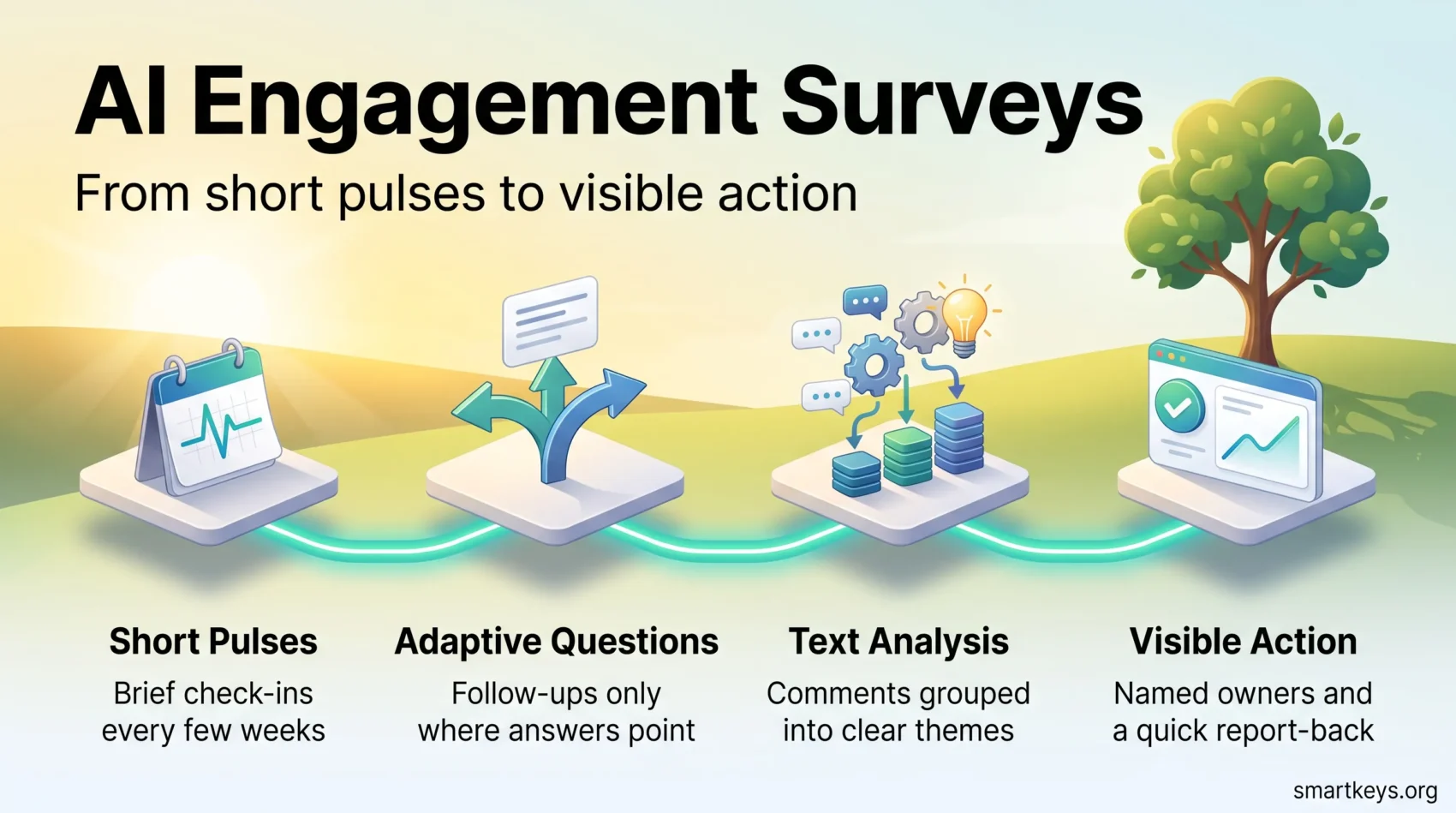
An AI engagement survey is a short, frequent check-in whose questions adapt to each answer, and whose written comments are read by software instead of by hand. The goal is simple: find out how people actually feel while there is still time to do something about it.
Most companies still run one long survey a year. The results arrive weeks later, the mood has moved on, and managers get a report rather than a next step. Continuous listening replaces that with short, regular pulses and automatic analysis of what employees write.
The stakes are not small. Gallup’s State of the Global Workplace 2026 put global employee engagement at 20% in 2025, the lowest level since 2020. For the broader picture of what drives employee engagement and why it keeps slipping, see our overview.
This guide stays with the survey tools themselves: what AI sentiment analysis does with open-text answers, where it falls short, the European rules that now apply, and how to run a program your workforce trusts.
Key Takeaways
- Short, frequent pulses beat one annual snapshot, because you can still act on what they tell you.
- Natural language processing reads open-text comments at scale and groups them into themes.
- Since February 2025, the EU AI Act bans reading emotions from faces or voices at work. Analysing written answers is still allowed.
- Question design, cadence and follow-up decide data quality more than the software does.
- Visible action after a survey is what keeps participation rates from collapsing.
Why continuous listening matters in 2026
An annual survey answers “how did the year feel?” A pulse answers “how is this week going?” Only the second lets you fix something before a good person resigns.
Gallup’s 2026 figures show why the topic keeps rising up the agenda. Manager engagement dropped to 22% from 31% in 2022, and employee thriving sat at 34%. Managers carry most of the responsibility for team morale, and they are struggling themselves.
Connect feedback to numbers leadership already tracks
Engagement data becomes persuasive when you tie it to metrics leadership reviews anyway: voluntary turnover, absence, time to fill a vacancy, output per team. A survey score rarely changes a budget decision. A score that predicts which team will lose two people next quarter does.
An example: a support team’s participation drops from 80% to 45% over two pulses, and the few comments that arrive mention shift changes. That is worth a manager conversation this month, not a line in next year’s report. Pairing it with predictive analytics in employee management helps you spot the dip early rather than explain it afterwards.
How these surveys differ from a traditional questionnaire
Two things separate an AI-supported survey from a standard form: the questions change as you answer, and the comments are read automatically.
Adaptive question flows
A traditional form asks everyone the same twelve questions. An adaptive flow asks a shorter core set, then follows up only where the answer suggests it is worth it. Rate workload as poor and you get a follow-up about workload. Rate it well and you skip that branch entirely.
The payoff is length. People finish a survey that feels relevant, and response rates matter: a 40% return tells you mostly about the people who still bother to answer.
What NLP actually does with written answers
Natural language processing, or NLP, is the branch of AI that turns written language into structured data. In an engagement survey it does three jobs: it groups comments into themes such as workload, recognition or tooling; it scores tone as positive, negative or neutral; and it counts how often each theme appears so you can see which issue is largest rather than which comment is loudest.
This is genuinely useful at scale. Reading 4,000 free-text comments by hand takes a small team a week, and different readers categorise them differently. Automated tagging is faster and, more importantly, consistent from quarter to quarter. The same approach underpins most workforce analytics tools now sold to HR teams.
It is also imperfect. Sentiment models still misread sarcasm, industry jargon and mixed messages (“the new system is great, when it works”). Treat the tags as a first sort of the pile, not a verdict.
Keep the data clean or the analysis is worthless
Deduplicate responses, remove test entries, and keep question wording stable if you want to compare quarters. Changing a question and then reporting the score shift as progress is an easy way to mislead yourself. Spot-check automated tags against human reading each cycle, and set clear rules for who may see raw comments.
What the EU AI Act allows, and what it forbids
If you employ people in the EU, this section decides which products you can buy.
Since 2 February 2025, Article 5 of the EU AI Act prohibits AI systems that infer emotions from biometric data in the workplace. In plain terms: software that reads faces on video calls, analyses voice tone, or interprets physiological signals to judge how an employee feels is banned, with narrow exceptions for medical and safety purposes. Fines reach 35 million euros or 7% of global turnover.
Analysing written survey answers is a different matter. The European Commission’s guidance states that inferring emotions from written text does not fall under the prohibition, because the ban is tied to biometric data. Text-based sentiment analysis in an engagement survey therefore remains lawful, though the GDPR still governs how you collect and store the responses.
Two further dates matter. From 2 August 2026, the Act’s transparency duties apply: employees must be told when they are interacting with an AI chatbot, and anyone exposed to an emotion recognition system must be informed. Separately, the Digital Omnibus agreed in 2026 pushed the high-risk obligations for employment-related AI from August 2026 to 2 December 2027. That is a delay, not a cancellation, and it is the deadline to plan against if survey data feeds into promotion or performance decisions. Our guide to EU AI Act compliance covers the wider picture, and AI in employee monitoring covers the adjacent question of what you may observe day to day.
Planning the program before you buy anything
Most failed listening programs fail for organisational reasons, not technical ones. Nobody owned the follow-up.
Set objectives, owners and success metrics
Name the two or three outcomes you want to move, put a person’s name against each, and agree how you will know whether it worked. “Reduce first-year turnover in customer support from 28% to 20% by Q4” is a goal. “Improve engagement” is a slogan. The same discipline that makes continuous performance management work applies here.
Tell employees exactly what you collect and how you will act
Write down, in plain language, what is collected, whether it is anonymous, how long it is kept, who can see it, and what happens next. Publish it before the first survey goes out. State the minimum group size needed before a manager sees a breakdown, because employees on a team of four will otherwise assume they are identifiable. The rules in data privacy at work set the baseline here.
Choose a platform that fits the HR stack you already run
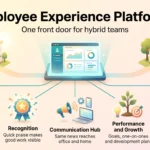
Prioritise integration with your HRIS, the system that holds employee records, so team, role and tenure fields stay accurate without manual uploads. Check access controls, data residency, retention settings and whether the vendor lets you audit their models. Many employee experience platforms now bundle surveys, which can be simpler than running a separate tool.
Designing surveys people will actually finish
Target questions by role and team
A warehouse team and a remote engineering team do not share the same friction. Tailor a portion of each pulse to the group, and keep a small core set identical across the company so you can still compare.
Mix formats, but keep open text short
Rating scales give you numbers you can trend. Open text gives you the reason behind the number. Two or three rating questions plus one well-framed open question (“what is the single thing that slowed you down most this month?”) usually produces better comments than a blank box labelled “any other feedback”.
Right-size the frequency
Pulse every four to six weeks, run a deeper survey once or twice a year, and add event-triggered checks after major changes. Surveying more often than you can act teaches people that answering is pointless.
Include an employee NPS question if you want one headline number
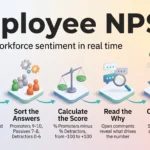
Employee Net Promoter Score, or eNPS, asks how likely someone is to recommend the company as a place to work, then subtracts detractors from promoters. It explains nothing on its own, but it travels well in a board pack. See employee NPS for how to read it without over-interpreting it.
From dashboard to action
Live dashboards and alerts
Dashboards should refresh as responses arrive and sit where managers already work, not behind a login they visit quarterly. Alert on the two signals that matter: a sharp drop in participation, and a sudden sentiment swing in one team. Route each alert to a named person with a response time.
Segmentation and benchmarking
Break results down by team, tenure and location to find where a problem sits. Compare each team against the company average and its own history; external benchmarks rarely match your context. Below a minimum group size, show no breakdown at all.
Predictive signals, used carefully
Some platforms flag teams at elevated turnover risk by combining sentiment shifts, participation drops and tenure patterns. Used well, that prompts a conversation. Used badly, it becomes a score attached to individuals, exactly the territory the EU AI Act will regulate as high risk from December 2027. Keep predictions at team level. The trade-offs are covered in AI decision making and augmented analytics.
“Prioritised actions with assigned owners make insights operational, not just observational.”
Ethics, privacy and bias
Privacy by design means consent where it is required, anonymisation by default, role-based access, and storage that satisfies the GDPR in Europe and the CCPA in California.
Check the model for skew
Sentiment models are trained mostly on formal English. Comments from non-native speakers, or in shift-work shorthand, can be scored more negatively than they deserve. Audit results across language groups and locations annually, and document what you checked. The same failure mode is well documented in AI hiring bias.
Keep a human in the loop
Automation should shorten the analysis, not make the decision. Any output that touches an individual’s standing at work needs a manager who adds context before acting. Train managers to read a dashboard properly, including what a small sample does and does not support, which is part of building broader data literacy across the organisation.
Turning results into visible change
Pick two themes per cycle, not ten. Give each an owner, a deadline and a one-line description of what will be different. Then publish what you heard and what you did, in the channel where you asked.
That loop protects your response rate. Employees answer the next survey based on what happened after the last one, not on how good the questions are. Teams that report back within two weeks and name their changes tend to hold participation; teams that go quiet see it fall away. Manager capability is the other half, which is why remote leadership skills and follow-up discipline matter more than platform features.
Where feedback points at workload rather than process, read it as a signal about capacity and check it against what is known about employee burnout and wellbeing support before adding another initiative. For distributed teams, the findings often overlap with remote employee engagement patterns.
“When feedback becomes a visible chain of actions and outcomes, trust and participation follow.”
For methods that translate sentiment into practical steps, see emotion analysis and action, plus employee engagement trends and talent retention strategies.
Conclusion
AI engagement surveys are worth running when three things are true: you ask often enough to catch problems early, you read the answers honestly, and you change something visible afterwards. The technology handles the middle part well. It cannot supply the first or the third.
Start smaller than feels impressive: one pulse, three questions, one open box, two owners, a published summary within two weeks. Add segmentation, prediction and integrations once the loop closes reliably. And keep the rule in view: read the words people write, not the expressions on their faces. For the wider shift, see AI and machine learning in HR management and AI and employee retention.
Found this useful?
Make SmartKeys a preferred source on Google, and our articles will surface more often in your Top Stories, AI Overviews, and AI Mode.
Add as Preferred Source