US employee engagement has been stuck at 31% for two years running, and the global figure just fell to its lowest level since 2020.
Engagement here means something specific. It is Gallup’s measure of how involved and enthusiastic people are about their work, built from questions like whether someone knows what is expected of them, has the materials to do the job, and has recently discussed their progress. It is not a happiness score, and not the same as satisfaction with pay.
The gap costs real money. Gallup estimates that employees who are not engaged or actively disengaged cost the US economy roughly $2 trillion a year in lost productivity, and puts the global figure at about $10 trillion, equal to 9% of global GDP.
This guide covers what the 2026 data actually shows, which drivers still move the number, and which changes produce visible results inside a quarter rather than a reorganization that takes a year.
Key Takeaways
- US engagement sits at 31%, unchanged from 2025. Global engagement fell to 20% in 2025.
- Managers and workers under 35 have slipped fastest since 2020.
- Clear expectations and confidence in leadership move the number more than perks do.
- Recognition is cheap and badly underused: fewer than one in three US workers can strongly agree they got any praise in the past week.
- Hybrid work has settled at roughly half of remote-capable US staff, at about 2.3 office days a week.
- Pick two or three changes, measure them, and report back. Broad programs rarely survive contact with a busy quarter.
Why engagement is worth your attention in 2026
Engagement is one of the few workforce measures that connects directly to output. Gallup’s long-running research links higher engagement to lower absenteeism and turnover, fewer safety incidents, and better customer scores. That is why a flat national number matters to you as a manager, not just to an HR dashboard.
The elements that dropped hardest since 2020 are also not expensive ones. Gallup identified declines in clarity of expectations, having the right materials and equipment, the chance to do what you do best each day, and connection to the organization’s mission. Those are management problems, not budget problems.
What you can realistically change
Most of what shapes engagement sits with the direct manager and the team’s working agreements: how goals are written, how often people hear where they stand, how quickly blockers get cleared. You cannot change the labor market this quarter.
That narrows the job usefully. Instead of a company-wide culture program, pick the two or three habits your team is missing. Tracking the result is easier too, since employee Net Promoter Score (eNPS) and short pulse surveys give a signal within weeks.
The state of engagement: the numbers that matter
Start with the hard figures rather than the commentary around them.
In the first half of 2026, Gallup found 31% of US employees engaged at work, unchanged from 2025, with 18% actively disengaged. Actively disengaged means more than indifferent: these are people whose dissatisfaction shows up in their behavior toward colleagues and customers.
Globally the picture is worse. Gallup’s State of the Global Workplace 2026 put global engagement at 20% for 2025, down from a 23% peak in 2022 and the lowest reading since 2020. Employee thriving, a separate wellbeing measure, rose one point to 34% after three years of decline.
Managers and under-35s are slipping fastest
Gallup reports that younger workers, hybrid workers and managers have declined most sharply since 2020. Manager engagement globally dropped nine points from 2022 and sat at 22% in 2025.
That is awkward, because managers are the mechanism through which most engagement work reaches people. If your team leads are running on empty, a new recognition platform will not land. Look at manager workload and span of control before you buy anything.
For younger staff the complaints are concrete: unclear expectations, feedback twice a year, and no visible path to the next role. Our guide to how Gen Z is shaping the future of work covers what this group asks for, and much of it costs nothing.
How to read a national number
A national average tells you the weather, not your own climate. Use it as a benchmark, then measure your own teams. A department at 45% engagement inside a country at 31% still has a third of its people uninvolved.
The drivers that actually move the number
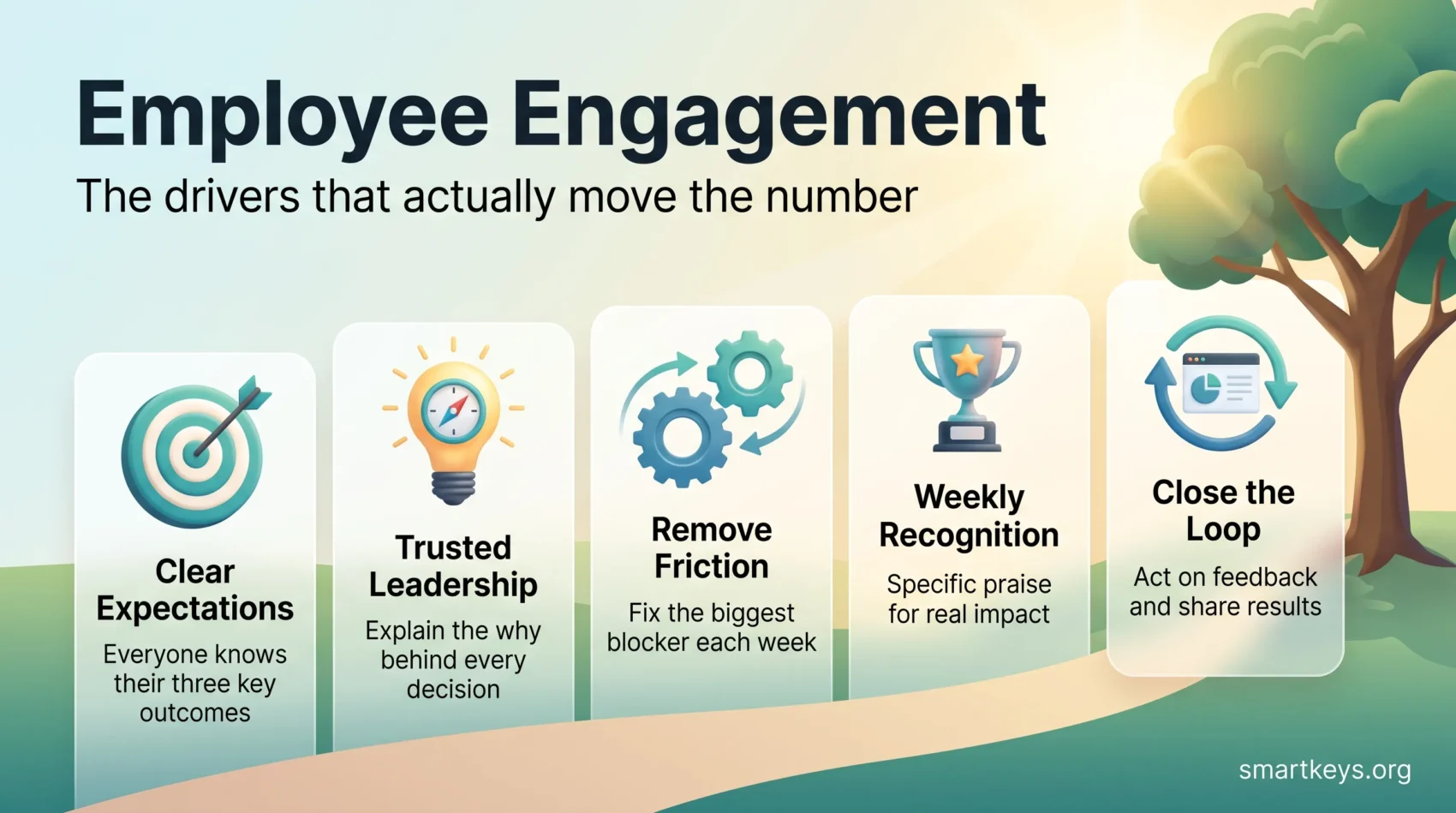
Three things do most of the work: clear expectations, confidence in leadership, and removing the friction that stops good work.
Clarity of expectations comes first
“I know what is expected of me at work” is the foundation of Gallup’s engagement model, and it is one of the elements that fell most since 2020. Hybrid schedules, faster reorganizations and AI-driven changes to job scope have all blurred role boundaries.
The fix is unglamorous. For each person, write down the three outcomes their role is judged on this quarter and what good looks like for each. Then check that the person can repeat it back without reading the document. If they cannot, it is not clear yet.
Confidence in leadership
People give discretionary effort to organizations they believe are being steered competently. Trust in leadership is built by boring consistency: regular updates, plain explanations of why decisions were made, and visible follow-through when something was promised.
Where trust is thin, silence is read as bad news. A short biweekly update saying “here is what changed and what is still undecided” outperforms a polished quarterly presentation. Leadership trends in 2026 looks at how that expectation has shifted.
Remove the friction, then measure outcomes
“I have the materials and equipment I need” is a low bar that a surprising number of workplaces fail. Broken tooling, approval queues and duplicated reporting quietly convert motivated people into resigned ones.
Ask each team member one question in your next one-on-one: what slowed you down most last week? Fix the top answer within ten working days. Then shift your review rhythm from tracking activity to tracking results, the core idea behind continuous performance management.
Internal communication as a strategic lever
When communication is deliberate, people understand priorities and act without waiting for permission. When it is not, they fill the gaps with rumor, and rumor is almost always worse than the truth.
The practical test: can someone on your team name the company’s top three priorities and say who owns them? If not, the problem is distribution, not content.
Explain the why, not just the what
Decisions land better when people can see the reasoning. You do not need to justify every call, but you do need to say what the decision was for and what would make you change course. That is the difference between transparency as a value statement and transparency as a habit, and our piece on building a transparency culture covers where the sensible limits sit.
A cadence people can rely on
Use a rhythm rather than a campaign: a short leadership note, a regular open forum for questions, and a manager cascade that translates the message into what it means for each team. Centralize policies and FAQs in one place so nobody has to hunt.
For distributed teams the same principles apply with more written follow-up, which is the heart of building a remote company culture that survives without hallway conversations.
“A short pulse survey after a major announcement tells you within days whether the message actually landed.”
Recognition that moves the needle
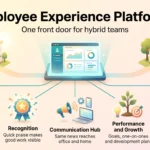
Recognition is the cheapest engagement lever available and the most consistently wasted.
Gallup finds fewer than one in three American workers can strongly agree they received any praise from a supervisor in the last seven days. Employees who say they are not adequately recognized are three times more likely to say they will leave within the year.
Frequent, specific and from more than one direction
Three qualities make recognition work.
Frequent matters because the effect fades quickly. Gallup’s Jim Harter describes recognition as a short-term need to be met weekly, sometimes daily.
Specific matters because vague praise reads as filler. “Thanks for the extra effort” says nothing. “The way you rewrote the onboarding checklist cut our setup calls in half” tells the person exactly what to repeat.
Multi-source matters because people differ. Some want a public mention in the team meeting; others find it excruciating and would rather have a private note or a stretch assignment.
- Recognize the impact, not the activity.
- Mix formats: public callouts, private notes, growth opportunities, small rewards.
- Close the week with a short ritual such as “wins of the week”.
- Track recognition frequency by team, so you can see which groups are being missed.
Recognition also feeds directly into retention, which is where the cost of getting it wrong shows up first. Our guide to talent retention strategies sets out what else keeps strong performers in place.
AI in engagement: personalization without losing the human
AI now sits inside most engagement tooling, usually in three roles: summarizing open-text survey comments, routing questions about policy and benefits, and tailoring internal messages so people get what applies to them.
Used carefully, that saves real time. Reading 4,000 free-text survey responses by hand takes a week; a summary with the raw comments still available takes an afternoon. How that text analysis works, and what to check before you buy, is explained in the guide to AI survey tools and real-time sentiment analysis.
Where the line sits
The risk is not that AI gives bad answers. It is that employees experience the tooling as surveillance, at which point survey honesty collapses and you lose the signal you were trying to improve.
Keep humans on performance decisions, promotions, pay and recognition. Publish what data the tools use and who can see it. Before deploying anything that watches how people work, check the rules: AI in employee monitoring covers what EU and US state law now requires.
There is a workload angle too. PwC’s 2025 Global Workforce Hopes and Fears Survey of nearly 50,000 workers found 35% feel overwhelmed by change at least once a week, rising to 42% among Gen Z. Adding tools without removing work makes that worse.
Hybrid work and return to office: where the balance sits
The hybrid argument has largely settled in practice, whatever the headlines suggest.
Gallup’s mid-2025 data put 51% of remote-capable US employees in a hybrid arrangement, 28% exclusively remote and 21% fully on site. Hybrid workers spend about 46% of the week in the office, the equivalent of 2.3 days, a figure that has barely moved since 2023.
Hybrid workers are also one of the groups whose engagement fell most since 2020. Two office days a week does not fix engagement by itself, and neither does three days at home.
Make office days worth the commute
The complaint that sinks most return-to-office policies is not the commute. It is arriving at the office to sit on video calls with people who are somewhere else.
Anchor shared days around work that benefits from being in the same room: planning, onboarding, retrospectives, difficult conversations, anything that needs a whiteboard. Protect the remaining days for concentrated work. Detail on the meeting side is in hybrid meeting etiquette, and the wider picture in hybrid work productivity.
Announce the reasoning before the rule
If in-office requirements change, say what the change is for and how you will judge whether it worked. A policy presented as a measurement of trust invites people to test it.
Track engagement, performance and attrition by work arrangement rather than assuming. The evidence on wellbeing across arrangements is collected in hybrid workspaces and employee wellbeing, and the engagement side specifically in remote employee engagement.
Wellbeing, inclusion and belonging
Wellbeing is not a perk budget. It is mostly workload design.
Gallup’s 2026 global report found 34% of employees thriving, and daily stress reported by around 40% worldwide. PwC’s figure of 35% feeling overwhelmed at least weekly points at the same thing from a different angle. Most of that traces back to how much work is in the system and how clearly it is prioritized, not to whether there is a meditation app.
The practical moves are unglamorous: rebalance workloads before people burn out, make it normal to flag overload, and give managers permission to cut scope. Managing employee burnout goes through the warning signs worth watching for.
Inclusion as a working practice
McKinsey’s 2023 analysis found companies in the top quartile for executive team gender diversity were 39% more likely to financially outperform bottom-quartile peers, with the same 39% figure for ethnic diversity. That is a correlation across a large sample rather than proof that diversity causes returns, and it is worth stating it that way.
What is more actionable is the mechanism: inclusion works when different perspectives actually reach decisions. Structured feedback channels, diverse interview panels and sponsorship rather than informal mentoring all push in that direction. See diversity and inclusion in business for what holds up in 2026 and diversity and inclusion work for the underlying frameworks.
Skills, voice and the manager in the middle
Growth is one of the strongest reasons people stay, and one of the easiest things to quietly stop funding.
Learning that people can actually reach
PwC’s 2025 survey found only 51% of non-managers felt they had the learning resources they needed, against 66% of managers and 72% of senior executives. The people furthest from the budget get the least development, which is exactly backwards if retention is the goal.
The World Economic Forum’s Future of Jobs Report 2025 estimates that 39% of workers’ key skills will change by 2030. That is a five-year horizon, not a crisis, but it does mean training tied to real projects beats a course catalog. Short formats help, which is the argument for microlearning, and the broader case is in upskilling and reskilling.
Voice only counts if the loop closes
Surveys create expectations. Running one and publishing nothing is worse than not asking, because it teaches people that feedback disappears.
Ask fewer questions more often. Pick the top two themes, name an owner and a date for each, and publish what you changed and what you decided not to change. The second half matters as much as the first. Workforce analytics tools can handle the plumbing, but they cannot decide what you act on.
Managers carry the whole thing
Every practice above is delivered by team leads. With manager engagement itself at 22% globally, treat that as the first constraint rather than the last.
Give managers fewer priorities, clear talking points when messages cascade, and time in the week that is actually protected for coaching. If their calendar has no room for a real one-on-one, nothing else on this list will happen.
Where to start this quarter
Do not run all of this at once. Pick three pilots, run them for ninety days, and measure them.
A defensible starting set: rewrite role expectations for one team so every person can state their three outcomes; introduce a weekly recognition ritual and track how often each person is named; run a short pulse survey after your next big announcement to check whether the message landed.
Then report the results, including the parts that did not work. That single habit does more for trust than most engagement programs, and it is how the next three pilots get approved. Tooling can support the effort, as AI and employee retention shows, and the wider context is in HR trends in 2026.
Found this useful?
Make SmartKeys a preferred source on Google, and our articles will surface more often in your Top Stories, AI Overviews, and AI Mode.
Add as Preferred Source