Leadership in 2026 is being measured against a harder set of numbers than at any point in the past decade. Global employee engagement has slipped to 20%, manager engagement has fallen to 22%, and trust in immediate managers sits at 29%. Those three figures explain most of what is actually changing in leadership trends right now.
The shift is less about a new management philosophy and more about capacity. Leaders are being asked to run wider teams, absorb AI into everyday decisions, and hold distributed groups together with fewer layers of support beneath them. Knowing which practices hold up under that pressure matters more than another list of buzzwords.
This guide covers what the 2026 research shows, where leaders are struggling most, and which approaches are backed by evidence rather than sentiment.
Key Takeaways
- Global employee engagement fell to 20% in 2025, its lowest level since 2020, according to Gallup.
- Manager engagement dropped to 22% – a nine-point slide since 2022, making managers the weakest link in most organizations.
- Trust in immediate managers stands at 29%, and 71% of leaders report increased stress, per DDI’s Global Leadership Forecast 2025.
- Only 26% of AI users say their leadership is clearly and consistently aligned on AI.
- Empathetic leadership and psychological safety are no longer soft extras; they are how organizations retain the managers they still have.
- Speed and agility, not headcount, are how most business leaders now define competitive advantage.
The Forces Reshaping Leadership in 2026
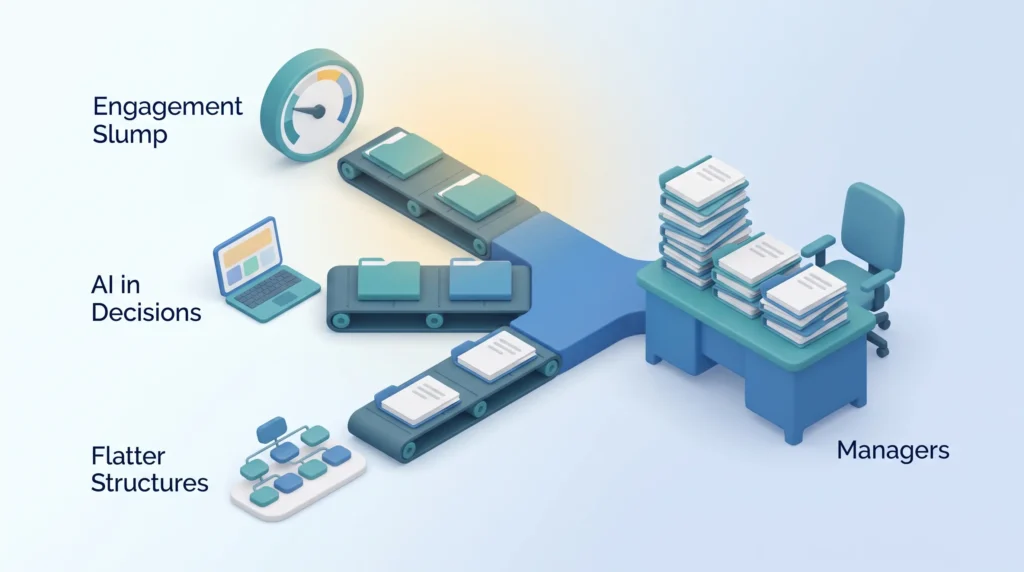
Three forces dominate the current leadership agenda: an engagement slump that has not reversed, the arrival of AI in day-to-day decision-making, and organizational structures that keep getting flatter. Each one shifts work onto the people managing teams, and each one rewards different skills than the command-and-control model most leaders were trained in.
How Work Culture Has Changed
Flexible arrangements are now a permanent feature rather than an experiment. Most knowledge organizations run some mix of office and remote days, which means leaders coordinate across schedules and time zones as a matter of routine. That has pushed written communication, clear decision rights and outcome-based expectations to the centre of the job. Deciding when to use email, chat or a meeting is now a leadership skill in itself, not an administrative detail.
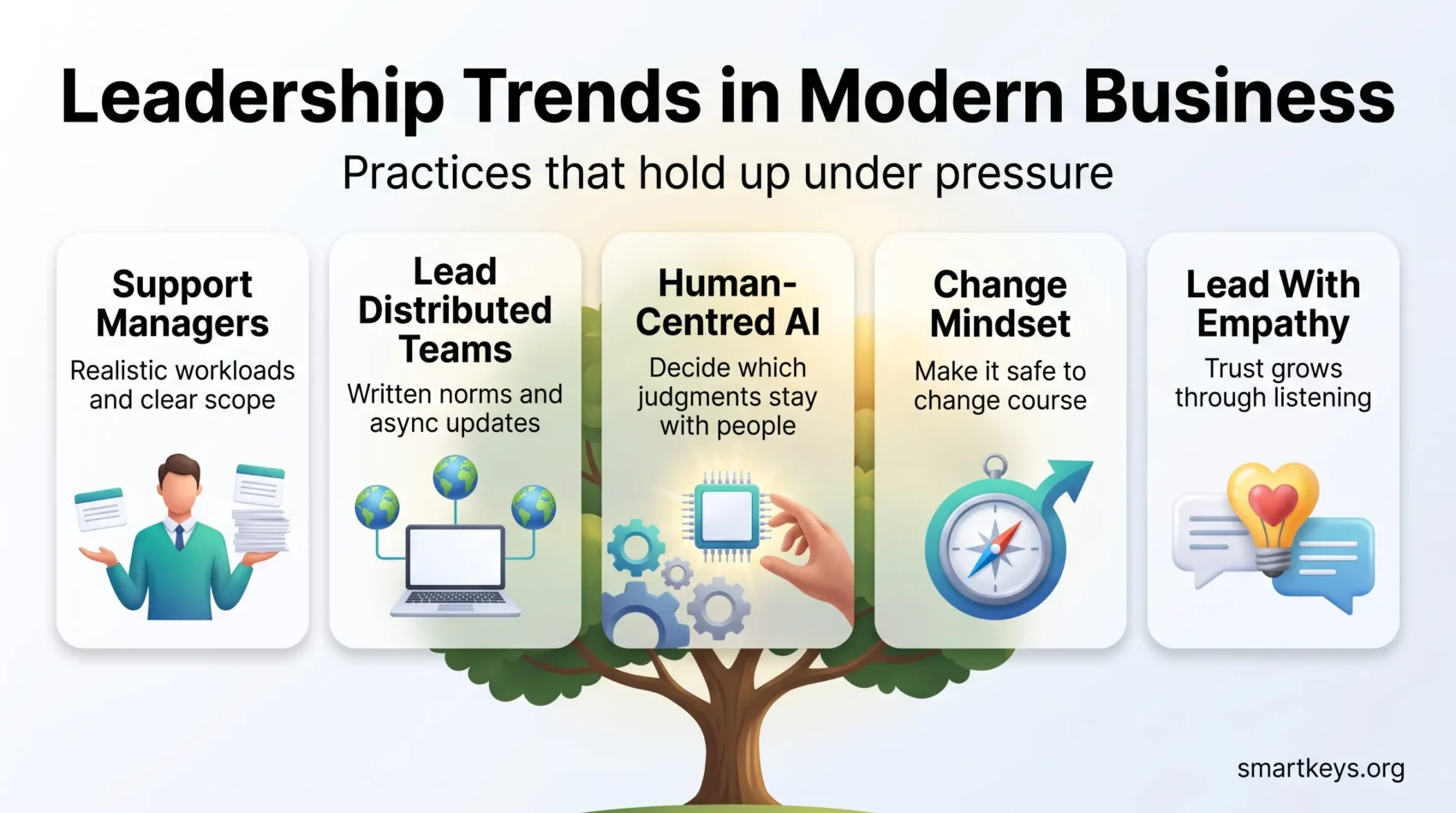
At the same time, cost discipline has flattened many org charts. Fewer management layers mean wider spans of control, and managers who once led six people now often lead twelve. The practices that scale in that setting – documented decisions, asynchronous updates, structured check-ins – are the ones worth investing in.
What the Engagement Data Shows
Gallup’s State of the Global Workplace 2026 report puts global employee engagement at 20% for 2025, down from 21% in 2024 and 23% in 2022. Employee wellbeing moved in the other direction, with 34% of workers thriving, the first improvement in three years. Gallup estimates the productivity cost of low engagement at roughly $10 trillion, or about 9% of global GDP.
The more useful signal for leaders is where the decline is concentrated. Manager engagement fell to 22% in 2025, a nine-point drop since 2022 and the steepest slide of any group. In organizations Gallup classifies as world-class workplaces, 79% of managers were engaged. The gap is not a mystery of the market; it is a difference in how those organizations support the people in the middle.
Leading Distributed and Hybrid Teams
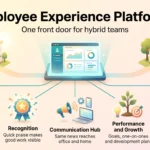
Distributed work has reshaped leadership by removing line of sight. Leaders can no longer read the room, so they have to build the signals deliberately: clear communication norms, visible priorities, and regular contact that is not just status reporting. The fundamentals of remote leadership skills now apply to almost every manager, not only to those running fully remote teams.
Building a Distributed Work Culture
A workable distributed culture rests on a few repeatable habits rather than on morale events:
- Written norms for response times, meeting-free blocks and escalation paths
- Transparent decision records so people outside the room understand the reasoning
- Open feedback channels that do not depend on being physically present
These habits do more for belonging than virtual social hours, and they reduce proximity bias – the main way hybrid setups quietly disadvantage people who are not in the building.
Key Strategies for Effective Distributed Leadership
For leaders running spread-out teams, four practices carry most of the weight:
- Use collaboration tools for shared visibility of work, not for surveillance of activity.
- Run consistent one-on-one check-ins focused on obstacles, growth and feedback rather than status.
- Default to asynchronous communication so people in different time zones are not permanently disadvantaged.
- Build a coaching habit: DDI found that only 19% of managers are strong at delegation, which is where most development conversations start.
Policy matters too: clear flexible work schedules give managers something concrete to lead within, instead of leaving every team to invent its own rules.
Leadership Trends in 2026: What to Expect
The leadership agenda for 2026 is shaped by AI adoption, tighter budgets and a shortage of ready successors. This reflects the evolving work culture and the pressure to turn technology investment into measurable results. Expect a focus on agility, judgment and emotional intelligence rather than on new frameworks.
Adapting to an AI-Heavy Business Landscape
Deloitte’s 2026 Global Human Capital Trends, based on responses from more than 9,000 business and HR leaders across 89 countries, found that 70% name speed and agility as their primary competitive strategy for the next three years. It also found that organizations taking a purely technology-focused approach to AI are 1.6 times more likely to miss their expected return than those taking a human-centred approach.
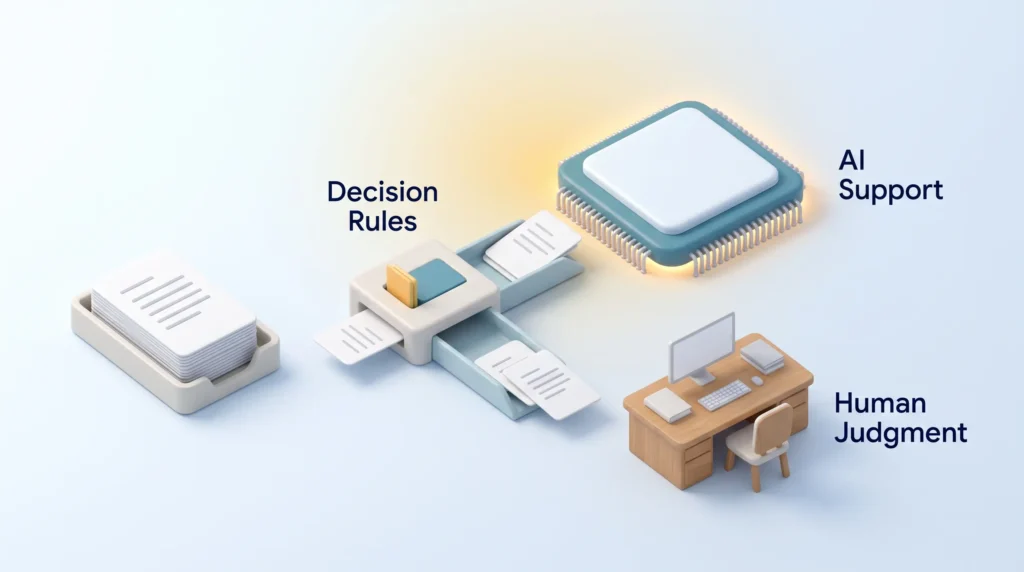
That is the practical test for leaders this year. Rolling out tools is straightforward; redesigning how decisions get made around them is not. Teams experimenting with AI agent workflows or broader AI augmentation tend to get further when a leader has defined which judgments stay with people.
Emerging Leadership Challenges Ahead
Succession is the quiet crisis. DDI reports that 77% of CHROs lack confidence in their bench strength for critical roles, and that intent to leave among high-potential individual contributors has been rising. High-potential employees are far more likely to leave within a year when managers do not provide growth opportunities.
Regulation adds another layer. Leaders now need at least a working grasp of future-of-work legislation covering algorithmic management, monitoring and AI use, because those rules increasingly shape what managers are allowed to do. Planning for disruption through workforce contingency planning has moved from a nice-to-have to a standing expectation.
Building the Right Culture for Distributed Teams
Culture in a distributed organization is whatever gets repeated. Leaders shape it through the meetings they keep, the decisions they document and the behaviour they reward – not through values statements.
Key Elements of a Strong Distributed Culture
Trust, clarity and shared standards do most of the work. Trust grows when people can see how decisions are made; clarity comes from written expectations; shared standards keep quality consistent when nobody is watching over anyone’s shoulder.
- Autonomy over how work gets done, paired with clear agreement on what “done” means
- Regular check-ins that surface obstacles early rather than reviewing completed work
- Visible recognition of contributions, especially for people outside the head office
Overcoming Challenges in Distributed Team Dynamics
Miscommunication and isolation remain the two failure modes. Both respond to structure. Replacing the open-door policy with an open-calendar approach gives people a predictable way in. Keeping a few overlap hours protects real-time collaboration without forcing everyone onto one time zone. And deliberately making room for unstructured thinking matters too, since creativity in remote teams rarely survives a calendar packed wall to wall.
Developing a Change Mindset
A change mindset is the ability to adjust direction without treating every adjustment as a failure. With technology cycles shortening and budgets under review, agile leadership is less a methodology than a habit of revisiting assumptions on a schedule.
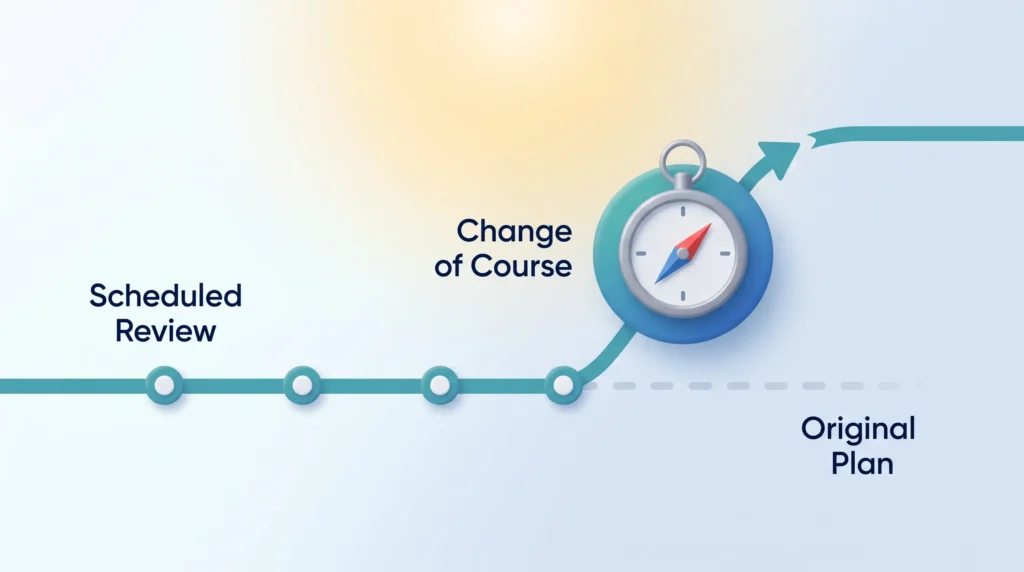
Importance of Agility in Leadership
Agility depends on psychological safety. If people expect to be blamed for a change of course, they hide problems until the problems are expensive. Leaders who make it safe to report bad news early get better information, and better information is the whole point. Team resilience training is one structured way to build that capacity rather than hoping for it.
Strategies to Foster a Change Mindset
- Build continuous learning into the working week rather than into an annual training budget.
- Reward well-reasoned experiments that fail, not only the ones that succeed.
- Use scenario planning to pressure-test assumptions before circumstances force the question.
- Name the decision rights explicitly, so people know what they can change without asking.
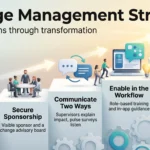
- Communicate reasoning, not just conclusions – people adapt faster when they understand why.
These practices matter most during large programmes. Most digital transformation efforts stall on adoption rather than on technology, and adoption is a leadership variable.
Investing in Employee Well-being
Wellbeing has moved from perk to operating requirement. Gallup’s 2026 data shows 34% of employees thriving overall, which means roughly two-thirds are not. For leaders, the relevant question is no longer whether to invest but which investments change anything.
Company Responsibilities Towards Workforce Well-being
The measures with the clearest link to outcomes are structural rather than symbolic:
- Realistic workloads and staffing levels, which is where most burnout actually originates
- Genuine access to mental health support, not just a listed benefit
- Predictable boundaries around after-hours contact
- Fairness in pay and progression, since perceived inequity is itself a stressor
Pay transparency belongs in that list. Ambiguity about how compensation is set does quiet, ongoing damage to trust.
Practices for Supporting Employee Mental Health
- Train managers to spot early warning signs and to have the conversation, rather than routing everything to HR.
- Audit meeting load and notification expectations before adding another wellbeing programme.
- Keep communication channels open so problems surface before they become resignations.
- Watch leader wellbeing specifically: DDI found 71% of leaders under increased stress, and 40% of those have considered stepping away from leadership roles.
Empathetic Leadership: Leading with Heart
Empathetic leadership gets dismissed as soft until you look at the retention numbers. Leaders who understand what their people are dealing with make better decisions about workload, sequencing and support – and those decisions are what keep teams intact.
Building Trust Through Empathy
Trust is the scarce resource. DDI’s Global Leadership Forecast 2025, which surveyed 10,796 leaders and 2,185 HR professionals across more than 50 countries, found trust in immediate managers at 29%, a sharp fall since 2022. Empathy alone will not fix that, but the behaviours behind it will: listening without immediately problem-solving, following through on commitments, and being straight about constraints instead of managing perceptions.
Creating a Supportive Work Environment
A supportive environment is one where people can raise a problem without calculating the political cost. That is built through consistency more than warmth. Leaders who apply the same standards to everyone, explain their reasoning and admit mistakes create the conditions where feedback flows upward – which is the only way leaders find out what is really happening in a distributed organization.
Shifting Leadership Styles in Modern Organizations
Organizational structures have been flattening for several years, and leadership styles have followed. Fewer layers mean less room for approval-based management and more need for leaders who set direction and then get out of the way.
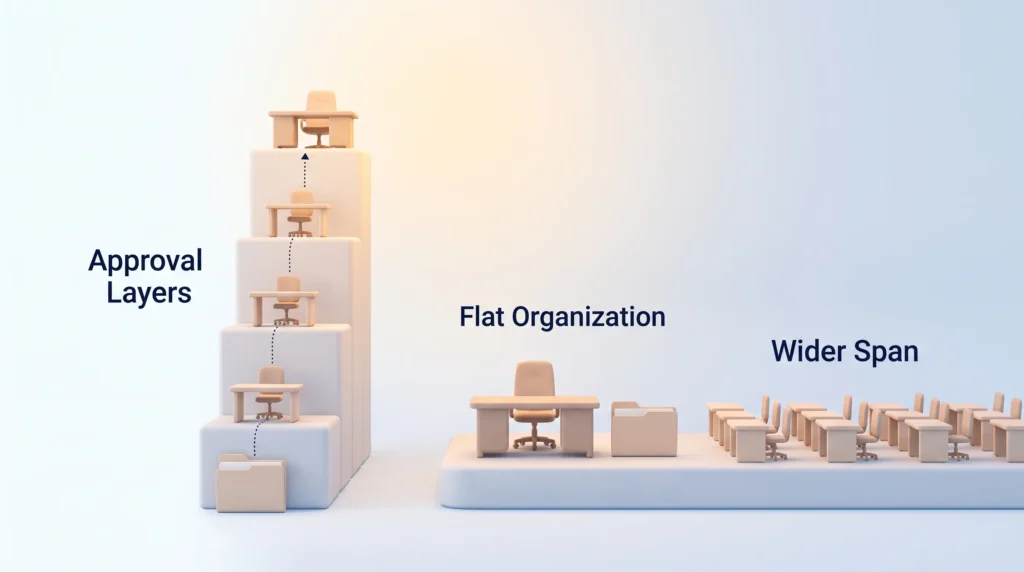
Flat Organizational Structures
Flat organizations speed up decisions by shortening the distance between the problem and the person who can act on it. The trade-off is coordination: with wider spans of control, managers have less time per person, so clarity of scope becomes essential. Approaches to AI-driven organizational design are one response, and the rise of fractional executives is another, giving smaller companies senior expertise without a full-time hire.
Democratic Leadership Practices
Democratic leadership works when the boundaries are explicit. Involving a team in a decision that has already been made erodes trust faster than not asking at all. Done properly – with clear scope for input and a stated decision-maker – participatory management improves both the quality of decisions and the willingness to carry them out.
Emotional Intelligence in Leadership
Emotional intelligence is the practical skill of reading a situation accurately and responding usefully. In flatter organizations with wider spans of control, it is often the difference between a manager who scales and one who becomes a bottleneck.
Understanding and Managing Emotions
Self-awareness is where it starts. Leaders who can name their own reaction before acting on it make fewer decisions they have to walk back. That matters more under pressure, and pressure is the default condition for most managers right now.
Building Strong Interpersonal Relationships
Strong working relationships come from repeated small interactions, not occasional big ones. Where they are strained, the cause is usually predictable: unclear expectations, unacknowledged workload, or feedback that only arrives at review time.
Inclusivity and Diversity in Leadership
Inclusivity in leadership is measured by who gets heard and who gets promoted, not by policy documents. Inclusive leaders raise psychological safety, and psychological safety is what makes diverse teams outperform homogeneous ones instead of simply disagreeing more.
Creating Diverse Teams for Innovation
Three practices carry most of the effect:
- Define what you are actually trying to change, and measure it, rather than tracking representation alone.
- Fix the process points where bias enters – job descriptions, shortlisting, promotion criteria.
- Run meetings so that quieter contributors are heard by design, not by chance.
Strategies to Enhance Inclusive Leadership
- Give underrepresented employees access to sponsors, not only mentors – sponsors advocate in rooms they are not in.
- Accommodate different working styles as a default, which also benefits distributed and neurodivergent staff.
- Review progression data regularly and act on what it shows, including when the answer is uncomfortable.
Inclusion holds up when it is built into ordinary management practice. Treated as a separate programme, it tends to survive exactly as long as its budget line.
Leadership Trends Shaping the Future
The clearest near-term shift is that AI is moving from a tool leaders authorize to a factor in how leaders decide. That changes the skill set more than the org chart.
Technological Advancements and Leadership
Microsoft’s 2026 Work Trend Index, based on a survey of 20,000 knowledge workers across ten markets, found that just 26% say their leadership is clearly and consistently aligned on AI, while 65% worry about falling behind if they do not adapt. That gap between anxiety and direction is a leadership problem, not a technology one.
The Role of AI in Modern Leadership
Harvard Business Impact’s 2026 Global Leadership Study found that 53% of respondents expect leaders to make greater use of AI in strategic decision-making this year, and 50% of organizations are prioritizing AI-based talent management and internal mobility. Both point the same way: leaders will spend less time gathering information and more time deciding what to do with it.
The uncomfortable finding sits underneath. DDI reports that frontline leaders are three times more likely than executives to voice concerns about AI – the people closest to the work are the least reassured. Leaders who address that directly, by naming what will change and what will not, get adoption. Leaders who announce a strategy and move on get quiet resistance.
Conclusion
The through-line in the 2026 research is that leadership capacity, not leadership philosophy, is the constraint. Engagement is at a six-year low, manager engagement is falling faster than anyone else’s, and trust in immediate managers sits at 29%. None of that is solved by a new framework.
What the evidence supports is unglamorous: realistic workloads, consistent one-on-ones, explicit decision rights, and honest communication about what AI will and will not change. Organizations that support their managers well already show engagement several times the global average, so the gap is a matter of practice rather than circumstance.
If you take one thing into the rest of the year, make it this: look after the people in the middle. They are carrying the widest spans, the most change and the least support – and the numbers say they are the group most at risk of checking out.
Found this useful?
Make SmartKeys a preferred source on Google, and our articles will surface more often in your Top Stories, AI Overviews, and AI Mode.
Add as Preferred Source