Flexible work schedules have stopped being a perk and settled into the plumbing of how organisations run. The argument in 2026 is no longer whether people can work outside a fixed nine-to-five, but which specific arrangements hold up under scrutiny — and how to run them without letting coordination quietly fall apart.
This guide covers what flexible work actually looks like today, how widespread it is according to official statistics, what the strongest research says about performance and retention, and how to implement a policy that survives contact with a real business.
Key Insights
- 22.6% of US workers teleworked or worked at home for pay in March 2026, a share that has barely moved for a year (US Bureau of Labor Statistics).
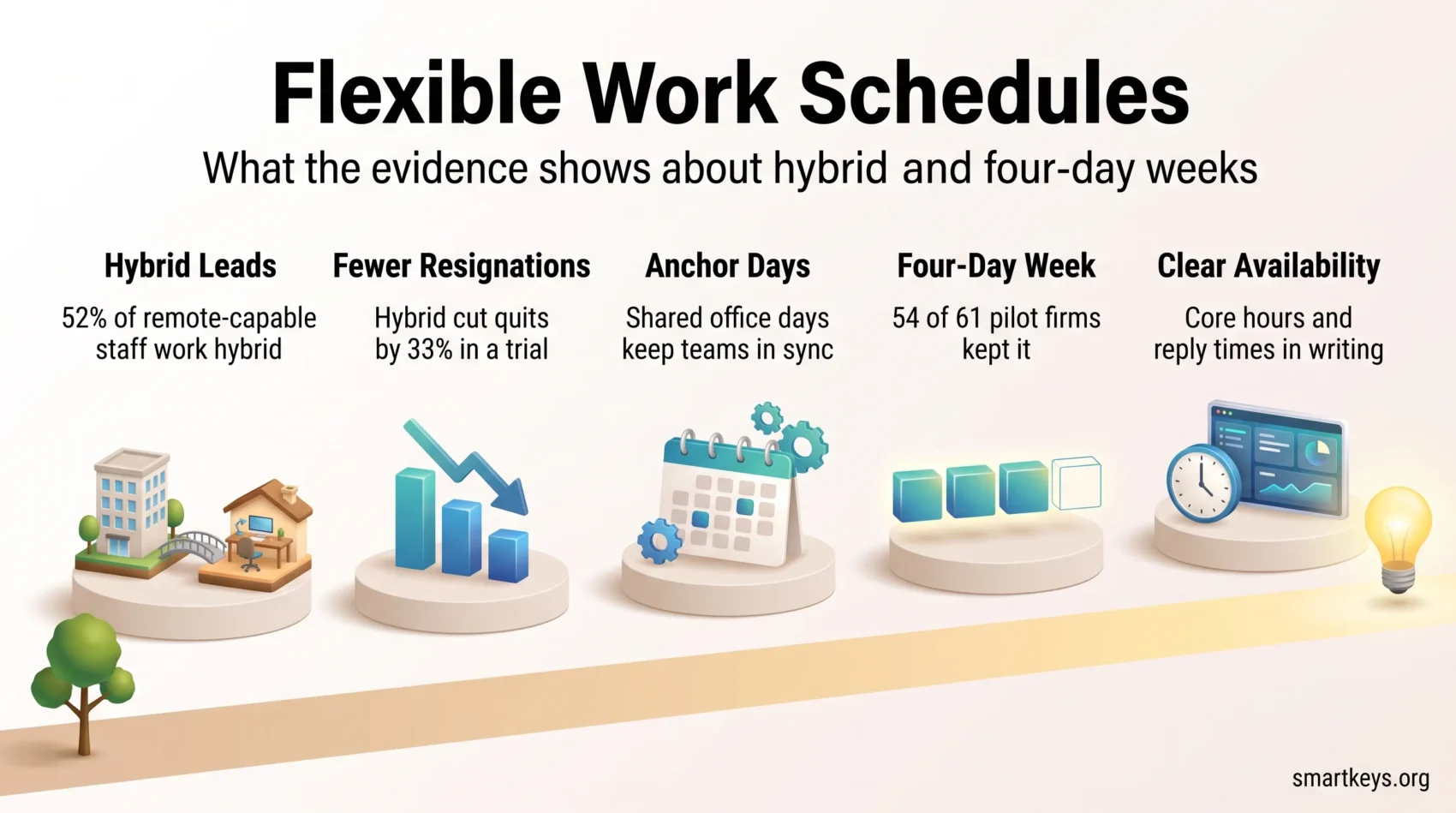
- Among remote-capable US employees, hybrid is the dominant model: 52% hybrid, 28% fully remote, 21% fully on-site (Gallup, Q2 2025).
- A randomised trial published in Nature found hybrid working cut resignations by 33% among non-managers with no measurable hit to performance or promotions.
- Americans value the option to work from home two or three days a week at roughly 8% of pay (Barrero, Bloom & Davis, Journal of Economic Perspectives, 2023).
- In Randstad’s Workmonitor 2026, work-life balance outranked pay when workers evaluate job offers for the first time in the survey’s history.
- Schedule control is shifting back to employers: the share of hybrid workers who say their schedule is “entirely up to me” fell from 37% to 34% in a year (Gallup).
What Counts as a Flexible Work Schedule
A flexible work schedule is any arrangement that loosens the fixed relationship between work and a set time or place. In practice, most policies combine a handful of recognisable building blocks.
Flexitime keeps the total hours but lets people choose start and finish times, usually around a band of core hours when everyone must be reachable. Compressed schedules pack the same hours into fewer days — the “4-10” week being the common version. Hybrid work splits the week between office and home. Job sharing divides one full-time role between two part-timers. Part-time and reduced-hours arrangements cut the total workload. Asynchronous work removes the expectation of an immediate reply, which matters most for teams spread across time zones.
These are not interchangeable. Flexitime solves a scheduling problem; hybrid solves a location problem; a compressed week solves a fatigue-and-commuting problem. Picking the wrong one for your constraint is the most common way flexible work policies disappoint everyone involved.
How Common Flexible Work Actually Is
Official data is a useful antidote to the noise. The US Bureau of Labor Statistics reports that 22.6% of employed people teleworked or worked at home for pay in March 2026, within a band of 21.5% to 23.0% over the preceding year. That is a plateau, not a collapse and not a boom. Women teleworked more than men (24.9% versus 20.5%), and take-up is concentrated among workers aged 25 and over.
The picture changes when you narrow to jobs that can be done remotely. Gallup’s tracking of remote-capable US employees puts hybrid at 52%, fully remote at 28% and fully on-site at 21% — figures that have shifted only marginally since 2022. The headline-grabbing return-to-office mandates have made far less difference in aggregate than the coverage suggests.
What has changed is who decides. Gallup found the share of hybrid employees saying their schedule is entirely their own choice slipped from 37% to 34% in a year, with managers and company leadership picking up the difference. Flexibility is persisting; autonomy within it is being trimmed. If you are trying to stay visible and advance while working remotely, that distinction is worth watching closely.
What the Evidence Says About Performance
Most claims about flexible work being good or bad for productivity rest on surveys of opinion. There is better evidence available.
The strongest single study is a randomised controlled trial run at Trip.com and published in Nature in 2024. More than 1,600 graduate employees were assigned by birthday to either five days in the office or a hybrid schedule with two days at home. After six months, resignations among non-managers had fallen by 33%, with the largest effects for women and employees with long commutes. Performance reviews, promotion rates and — for engineers — code output showed no meaningful difference between the groups.
The practical reading is narrow but valuable: a moderate hybrid arrangement bought a substantial retention gain at no measurable performance cost. It does not prove that fully remote work performs identically, and it does not transfer automatically to every role or culture. It does mean the burden of proof now sits with anyone claiming that two days at home damages output.
Randstad’s Workmonitor 2026, which surveyed 27,062 workers across 35 markets, adds the demand side. Work-life balance ranked above pay when workers assess job offers for the first time in the survey’s history, and 46% named work-life balance as the main reason they stay with an employer, against 23% who named pay. Pay still dominates as an initial attractor at 81% — flexibility wins people over once they are in the door rather than pulling them through it.
The Rise of Hybrid Work Models
Hybrid has won by default, so the interesting question is how it is structured rather than whether to adopt it.
Freeform and Anchor Models
Two patterns dominate. The freeform model leaves in-office days entirely to the individual, maximising personal flexibility at the cost of predictable overlap. The anchor model fixes one or more shared days for collaboration and leaves the rest open. Anchor days are more common in practice because they solve the coordination problem that freeform creates: if everyone chooses independently, the office fills and empties at random and the collaboration benefit evaporates.
Gallup’s fairness data points the same way. Employees rated schedules set by their team as far fairer than schedules imposed by leadership alone, which suggests the workable middle ground is team-level anchor days rather than either extreme.
Where Hybrid Struggles
Hybrid creates real problems that flexitime does not. Meetings become half-remote by default, which is worse than fully remote unless the room is set up for it. Information stops being ambient and has to be written down. Proximity bias creeps into who gets stretch work. Teams that handle this well tend to invest in a digital headquarters where decisions and context live, and they train managers explicitly — the skills that make someone effective leading a distributed team are not the ones that made them effective in a room.
Some organisations have gone further and created dedicated ownership for this, which is why the chief remote officer role exists at all. Others lean on employee experience platforms to read engagement signals they can no longer pick up from the room.

Compressed Work Weeks and the Four-Day Week
A compressed week condenses the same workload into fewer days. The four-day week goes further by cutting total hours, usually with no reduction in pay. The two get conflated constantly, and they carry different risks: compression concentrates fatigue into longer days, while a genuine four-day week forces a real conversation about what work gets dropped.
What the UK Pilot Showed
The most substantial evidence comes from the UK four-day week pilot coordinated by Autonomy with researchers from Cambridge, Salford and Boston College. Sixty-one organisations took part. A year after the trial ended, 54 were still operating a four-day week and 31 had made it permanent.
Among the organisations that responded to the follow-up, 82% reported improvements in staff wellbeing, 50% saw reduced staff turnover and 32% reported easier recruitment. Every manager and chief executive surveyed described the impact on their organisation as positive or very positive. A parallel survey of employees found the gains in physical and mental health, work-life balance and burnout held up rather than fading once the novelty passed.
The caveats matter. Participants were self-selected organisations that wanted the model to work, skewed towards professional services and small employers. That is a reason to treat the results as a strong signal for similar organisations rather than a universal finding.
Who It Suits
Compressed schedules work best where output is measurable and handover is straightforward. They fit poorly where coverage is the whole point — support desks, clinical rotas, anything with a service-level agreement — unless you stagger the days off across the team. AI-assisted shift scheduling has made that staggering considerably easier to manage in shift-based settings.
Flexible Hours and Schedule Control
Flexitime is the least glamorous form of flexibility and often the most useful. It costs nothing in real estate, it does not require a hybrid policy, and it addresses the mismatch between fixed office hours and the rest of an adult life — school runs, medical appointments, caring responsibilities, or simply doing focused work at the hour your brain actually cooperates.
The mechanics are what make or break it. Define core hours when everyone is reachable and leave the rest open. Publish working patterns so colleagues can see them rather than guess. Agree response-time expectations explicitly, because the implicit expectation is always “immediately” and that quietly cancels the flexibility you just granted.
Individual habits carry weight here too. People who thrive on flexible hours generally have deliberate structure underneath — boundaries and routines that separate work from everything else, plus disciplined calendar management. Without that, autonomy turns into availability at all hours. For working parents balancing work and family duties, this structure is usually the difference between flexibility helping and flexibility becoming a second shift.
One more advantage worth naming: for people who struggle with the distractions of an open office, control over hours often matters more than control over location.
Job Sharing, Part-Time and Fractional Roles
Job sharing splits one full-time role between two part-time employees. Done properly it delivers coverage that neither person could provide alone, brings two skill sets to one job, and keeps experienced people in roles they would otherwise leave. Done badly it creates a handover tax that consumes the hours it was meant to save.
The requirements are specific: a written split of responsibilities rather than a vague division of hours, a shared record of decisions, and one clear point of accountability for anything that crosses the boundary. Our guide to the job sharing model covers the operational detail.
The same logic has moved up the org chart. Fractional executives give smaller companies senior expertise without a full-time salary, extending the principle from schedules to employment structures. Flexible scheduling and flexible contracting are increasingly the same conversation.
Technology That Makes Flexibility Work
Tooling is necessary and not sufficient. The basics — chat, video, shared documents, a project tracker — are commodity purchases at this point. What separates functioning flexible teams from struggling ones is the discipline around the tools rather than the tools themselves.
Three things reliably pay off. First, writing decisions down where anyone can find them later, so being offline for four hours costs nothing. Second, removing meeting scheduling friction; automated scheduling tools eliminate a surprising amount of the coordination overhead that flexible hours create. Third, treating security as part of the policy rather than an afterthought — cybersecurity for distributed work gets materially harder when devices and networks are outside your control.
What tooling cannot replace is the spontaneous conversation distributed teams lose. Creative and exploratory work has to be scheduled deliberately rather than left to chance encounters that no longer happen.
The Legal Picture
Flexible work is moving from policy into legislation, which changes the planning horizon for employers.
In the UK, the Employment Rights Act 2025 tightens the existing right to request flexible working. From 2027, employers refusing a request must follow a specified consultation process and explain why the refusal is reasonable by reference to one of the eight statutory business reasons. The framework remains request-based — it creates no entitlement to flexible work — but the burden shifts noticeably towards employers having to justify a no.
Rules differ substantially by jurisdiction, and multinational employers face a patchwork rather than a standard. If your workforce spans borders, this intersects with how you set pay across locations. Our overview of future of work legislation tracks how governments are approaching this more broadly.
How to Implement Flexible Schedules
The organisations that make flexible work stick treat it as an operating change rather than a benefit announcement.
Start from the constraint. Identify the actual problem — attrition, commuting cost, coverage gaps, recruitment reach — and choose the arrangement that addresses it. A four-day week will not fix a coordination problem.
Get leadership behind it visibly. Policies that senior staff quietly ignore die within two quarters.
Train managers before launch. Managing by output rather than presence is a learned skill, and the people asked to do it usually were not hired for it.
Define availability, not just flexibility. Core hours, response-time norms and escalation paths need to be written down. Ambiguity here is what turns flexibility into always-on work.
Measure something real. Agree what good performance looks like before the change so you are not arguing about it afterwards.
Pilot, then review. Run it with one team for a fixed period, gather structured feedback, adjust, then expand. Set a review date at the outset so revisiting the policy is normal rather than a sign of failure.
Keep records. Written agreements about individual arrangements prevent the drift and resentment that informal deals reliably produce.
It is also worth connecting schedule flexibility to adjacent policies rather than treating it in isolation — flexible time-off policies and sabbatical programmes address the same underlying need for control over time, and a coherent set of policies lands better than a single isolated concession.
Conclusion
Flexible work schedules have reached a stable, unglamorous maturity. The share of people working outside the traditional model has plateaued rather than continuing to climb, hybrid has emerged as the default for work that can be done anywhere, and the best available research says a moderate arrangement retains people without costing output.
The open question is no longer adoption but design. Who sets the schedule, how availability is defined, whether managers are equipped to manage by results, and whether the policy fits the actual constraint the business faces — these determine whether flexibility delivers or simply relocates the problem. Organisations that treat it as an operational discipline get the retention and wellbeing benefits. Those that announce a policy and hope tend to end up with the coordination costs and none of the gains.
For a broader view of where working practices are heading, see our roundup of productivity trends for 2026 and our guide to boosting remote work productivity.
Found this useful?
Make SmartKeys a preferred source on Google, and our articles will surface more often in your Top Stories, AI Overviews, and AI Mode.
Add as Preferred Source