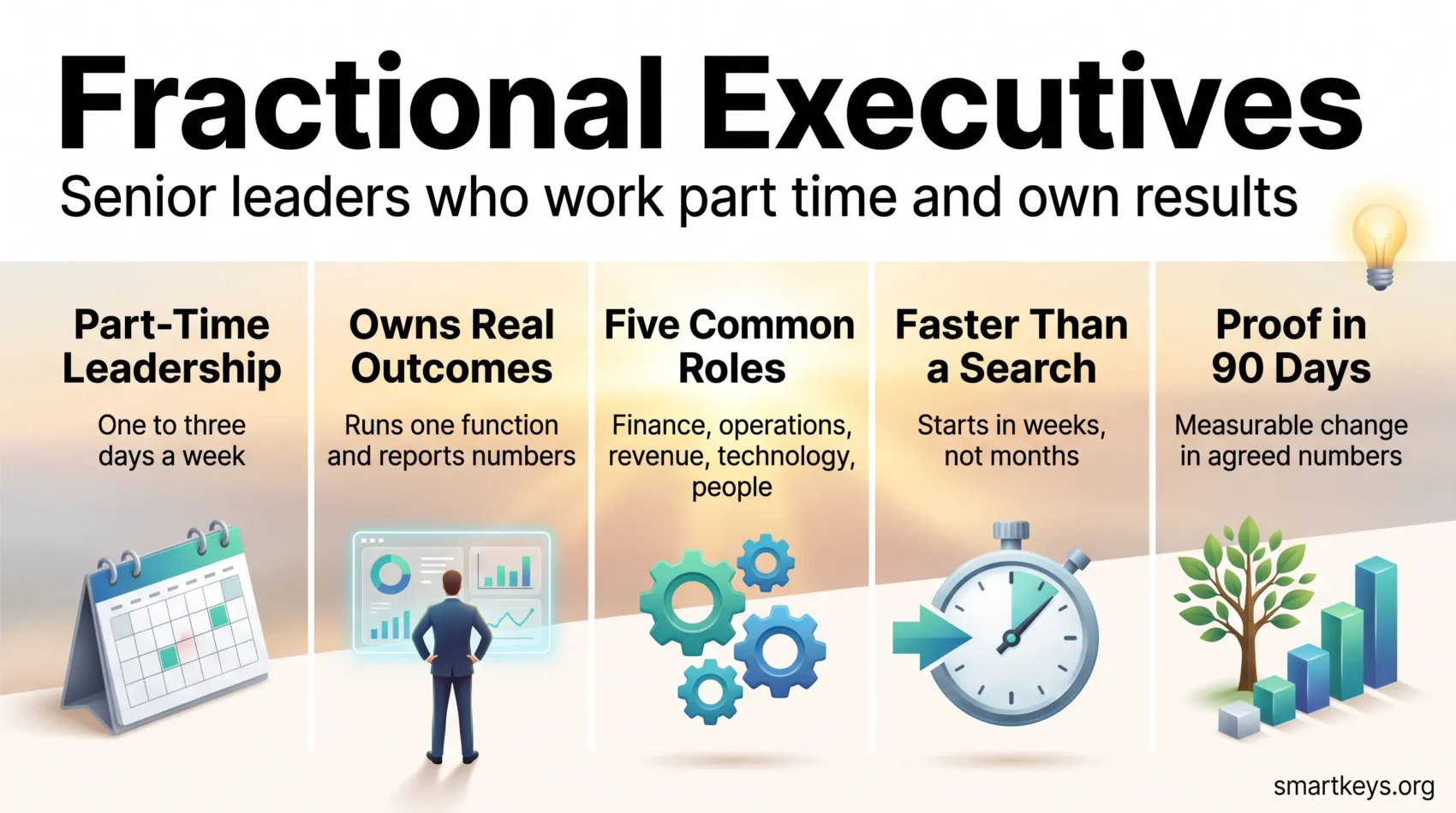
A fractional executive is a senior leader you hire part time, usually for one or two days a week, to run a specific part of your business. Not to advise from the sidelines. To own the work, report on numbers, and hand it back once the job is done.
The model has grown alongside independent work generally. MBO Partners counted 72 million Americans working independently in 2025, including 5.6 million earning more than $100,000 a year. That high earning group grew 19% in a year and 86% since 2020, and it is the pool most fractional executives come from.
This guide is for founders, owners, and boards deciding whether to hire one. It covers what the role really is, what it costs against a full-time salary, how to structure the contract, what the first 90 days should produce, and where these engagements fail.
Key Takeaways
- A fractional executive owns outcomes, not slides. They sit in your meetings, run a function, and report against agreed numbers.
- The cost case is a comparison, not a discount. Benchmark any quote against the full-time salary for the same role plus benefits.
- Speed is the real advantage. You can start in weeks instead of running a search that takes months.
- Five functions dominate: finance, operations, marketing and revenue, technology, and people.
- Contractor status is a legal question. Federal and state tests differ, and getting it wrong is expensive.
- Judge the first 90 days on evidence: a working forecast, a clear pipeline, or a documented process, not a strategy deck.
- Related reading: see how companies structure hours and availability in our guide to flexible work schedules.
What a Fractional Executive Actually Is
“Fractional” simply means you buy a fraction of a person’s week. A fractional chief financial officer might work Tuesdays and Thursdays for you and spend the rest of the week with two other clients.
What separates the model from other outside help is ownership. A fractional leader holds a real title, joins the leadership meeting, makes decisions in their area, and is measured on results.
A concrete picture. A software company with 40 staff has no finance leader. Invoices go out late, nobody knows the cash position beyond the bank balance, and an investor wants a three year model. A fractional CFO joins two days a week. Month one: a rolling 13 week cash forecast and a fixed invoicing process. Month three: the investor model and a monthly reporting pack. Month nine: the company hires a full-time finance manager, and the fractional CFO drops to half a day a week to coach them.
How It Differs From Nearby Arrangements
- Consultant: delivers analysis on a project. Usually holds no title and makes no decisions inside your company.
- Advisor or board member: gives periodic input, often a few hours a month, without operational responsibility.
- Interim executive: works full time for a fixed period, usually covering a sudden departure or a crisis. Deeper immersion, higher cost, shorter horizon.
- Fractional executive: part-time hours, ongoing relationship, real operational ownership of one function.
The boundary is not always clean, which is why your contract needs to say which one you are buying.
Why Companies Hire Part-Time Leaders
Three reasons come up again and again. Cost is only one of them, and often not the most important.
The Cost Comparison, Done Honestly
Judge a fractional quote against what the same seniority costs full time. US Bureau of Labor Statistics data for May 2025 puts median pay for financial managers at $166,570 a year and for chief executives at $213,990. Those are medians across all employers, so a finance leader in a major metro or a high growth sector costs more. On top of salary you carry payroll taxes, benefits, equity, and recruiting fees.
Against that baseline, one or two days a week usually lands well below a full-time package. But the saving is only real if the part-time hours genuinely cover the work. If you need a finance leader in the building every day, buying two days is not a saving. It is a shortfall you pay for later. Our guide to building an on-demand workforce strategy covers how to decide what stays on payroll.
Speed
Executive searches take months: write a spec, run the search, interview, negotiate, wait out a notice period. A fractional leader can often start within weeks, because they are already set up to take on a new client.
That matters most when the clock is external. A funding round, a launch, an audit, or a sale process does not wait for your hiring timeline. Companies preparing to raise usually want finance leadership in place before diligence starts, which is why this sits close to our coverage of startup funding trends.
Access To Expertise You Cannot Justify Full Time
A 30 person company may need someone who has taken a product from $2 million to $20 million in revenue. It cannot fund that salary, and that person probably does not want the job full time anyway. Part time makes the match work for both sides, which is also the logic behind several emerging C-suite roles.
Six Signs You Are Ready To Hire One
- Decisions are queuing behind you. If your calendar is the bottleneck for pricing, hiring, and spending, the company has outgrown founder-led management.
- Nobody owns a function that matters. Marketing is run by three people part time and none of them sets the strategy.
- You cannot answer basic questions with numbers, such as how much cash you have in 90 days or what a customer costs to acquire.
- A senior hire just failed or left. Part-time cover stabilizes the function while you work out what the role should be.
- A one-off event is coming. A raise, an acquisition, a new market, or a systems migration creates work that does not continue at that level afterwards.
- Two functions keep blaming each other. Sales says the leads are bad, marketing says they are not worked. Our guide to aligning sales and marketing covers the agreements that settle this.
If none of these apply, you probably do not need one yet. A strong manager with clearer goals may fix it for less.
Fractional, Interim, or Full Time: Picking the Model
Two questions settle this in most cases.
How long will the work last? If the need continues indefinitely and grows, hire full time. If it peaks and then drops, a part-time or fixed-term arrangement fits better.
How much of the job is presence? Decisions and systems compress well into two days. Being available whenever people need you does not compress at all. A chief people officer rebuilding your review process can work part time. A leader expected to coach 15 managers daily cannot.
A common sequence: interim leadership stops the bleeding, a fractional leader builds the system and hires their own replacement, and the full-time hire inherits something that works. Some companies formalize the middle step as a contract-to-hire arrangement.
The Five Roles Companies Hire Most
Fractional CFO
The chief financial officer owns the money: a rolling cash forecast, a budget the team actually uses, clean monthly reporting, and a financial model when you raise or sell. The first deliverable is almost always visibility, meaning you know what the next 13 weeks of cash look like. Our guide to cash flow management explains how that forecast is built, and finance automation covers the tooling that keeps it current.
Fractional COO
The chief operating officer owns how work gets done. Expect them to map your main processes, find where things stall, set a weekly operating rhythm, and make clear who decides what. In a services business that often means fixing delivery handoffs. In a product business it often means getting planning and shipping onto one calendar.
Fractional CMO or CRO
A chief marketing officer owns demand. A chief revenue officer owns the whole path from first touch to closed deal. They usually start by defining the target customer properly, cutting channels that do not work, and building one reliable reporting view. Our go-to-market strategy guide is a useful companion, and RevOps automation tools covers the systems layer underneath.
Fractional CTO or CIO
A chief technology officer owns what you build. A chief information officer owns the systems you run on. Part-time work here focuses on architecture decisions you cannot easily reverse, vendor selection, security basics, and giving a self-taught engineering team a structure to grow into.
Fractional CHRO Or Head Of People
This role covers hiring, performance, pay structure, and the policies that keep you out of trouble. Typical work includes a levelling framework, a review cycle people take seriously, and written rules for how the company works. See continuous performance management for the review side, our hybrid work policy template for the written rules, and our overview of HR trends for context.
Costs, Hours, and How Engagements Are Structured
The Three Pricing Models
- Hourly. You pay for time used. Good for small or unpredictable scopes. Bad when you want someone thinking about your business between sessions, because every conversation has a meter running.
- Monthly retainer. A fixed fee for an agreed number of days per month. The most common arrangement and the easiest to budget. Make sure the contract says what happens when a month runs long.
- Project or milestone based. A fixed price for a defined outcome, such as a completed financial model. Works when the deliverable is genuinely definable. Breaks down when the scope is really “make finance work”.
Some engagements add a success fee tied to a funding close or a revenue target. Be careful: an incentive tied to closing a round can push a leader toward the deal rather than the right deal.
How To Sanity Check A Quote
Published rate benchmarks for this market come almost entirely from firms selling the service, so treat them with caution. Working backwards from full-time pay is more reliable.
Take the median salary for the role from official data. For finance leadership that is the $166,570 figure above. Add employer taxes and benefits, checked against what your own senior hires cost, then divide by the working year to get a day rate. A fractional leader should cost more per day, because they carry their own overheads, absorb gaps between clients, and bring experience you could not otherwise hire. If a quote is several times that figure, ask what justifies it. If it is far below, ask what seniority you are getting.
Hours
Most arrangements land between one and three days a week. Below one day there is rarely enough time to run anything, so you are buying advice rather than leadership. Above three days the cost approaches a full-time package, which is a signal to reconsider.
Write into the contract how hours flex. Agree the ceiling and the notice period before you start, not in the middle of a busy quarter.
The Legal Side: Contractor Status in 2026
Most fractional executives work as independent contractors, often through their own company. That is normal but not automatic. Whether someone counts as a contractor or an employee is decided by law, not by the label on the invoice.
In the United States the federal test sits under the Fair Labor Standards Act. The Department of Labor published a proposed rule on 27 February 2026 that would restore its earlier 2021 framework. That framework weights two factors most heavily: how much control the worker has over their own schedule and assignments, and whether they can make a profit or a loss through their own initiative and investment. The comment period closed on 28 April 2026, and the rule was still a proposal at the time of writing, so check its current status before relying on it.
State law is separate and often stricter. California and several other states apply an ABC test, which treats a worker as an employee unless the hiring company can show all three of its conditions are met. A federal change does not override that.
Three practical steps reduce your risk:
- Write a scope, not a job description. Define outcomes and deliverables rather than fixed hours at your desk.
- Let them work like a business. They should use their own equipment where practical, serve other clients, and invoice on their own terms.
- Take advice before you sign, especially across borders. A leader based abroad raises tax and employment questions a standard contractor agreement does not answer. Our guide to global expansion strategy covers the employer of record route many companies use instead.
None of this is legal advice, and rules change. Have an employment lawyer review the arrangement, particularly if it runs long or the hours creep upward.
How To Choose: A Due Diligence Checklist
Interviewing a fractional leader is not like interviewing an employee. You are buying a track record and a way of working, and you have weeks rather than quarters to find out whether it fits.
Ask For Specifics, Not Stories
Good candidates can tell you what they inherited, what they changed, and what moved. Push for numbers and dates. “We improved conversion” is a story. “Trial to paid conversion went from 4% to 7% over five months after we rewrote the onboarding emails and the pricing page” is a track record a reference can confirm.
Check Capacity And Stage Fit
Ask how many clients they serve and what each one takes. Someone running five engagements at two days each is overcommitted. Ask what happens when one client hits a crisis.
Then test stage fit. A leader who spent 20 years at large corporations may struggle where they have to build the spreadsheet themselves. Ask what they did personally last time, not what their team did.
Call References Yourself
Ask former clients three questions: what did they deliver, what did they get wrong, and would you hire them again elsewhere. The second is the useful one, because every real engagement has something in that column.
Run A Paid Trial
A four to six week paid diagnostic is the cheapest insurance available. Give them a real problem, access to the data, a deadline, and an agreed output. You learn more from watching someone work for a month than from any number of interviews.
Where To Find Candidates
Four routes cover most hires.
Your own network and your investors. The highest hit rate, because someone has already worked with the person. Board members usually keep a shortlist.
Specialist fractional firms. These keep a vetted bench and match you to a person. Chief Outsiders, based in Houston, focuses on marketing and sales leadership and states a bench of more than 100 fractional CMOs and CSOs. TechCXO, based in Atlanta, covers a wider range of C-level functions and states more than 245 partners and professionals. Both figures are self-published, so check them with the provider. You pay a premium and get vetting plus a replacement if the match fails.
Independent talent marketplaces. Broader selection, lower cost, and you do the vetting. Our guide to freelance talent platforms compares them.
Executive search firms. Many now place interim and fractional leaders alongside permanent search.
One route people overlook is your own company: a strong director may be ready with coaching rather than replacement, and an internal talent marketplace makes those people easier to find.
Day 1 to Day 90: What Good Looks Like
Limited hours only produce results when the first weeks are structured. A realistic sequence:
Week 1. Access to systems, data, and people. They should be talking to your team and reading your numbers, not writing a plan yet. By Friday you want a short list of what they found and what they will tackle first.
Weeks 2 to 4. The operating rhythm starts: a weekly meeting with an agenda, a small set of numbers everyone sees, and one or two visible fixes. In finance that might be a working cash forecast. In marketing it might be shutting off spend that cannot be traced to anything.
Days 30 to 60. The structural work lands: a budget, a hiring plan, a documented process, a rebuilt pipeline definition. This is also when you see whether your team has accepted them. A fractional leader nobody brings problems to will not succeed.
Days 60 to 90. Measurable change in the numbers you agreed at the start, plus a written view of what comes next. If nothing specific is different, have the conversation now rather than at month six.
Agree the measures before day one. Pick three at most, from things your business already tracks: forecast accuracy, cost per acquired customer, time to close the month, delivery cycle time. “Better alignment” does not qualify. Our guide to outcome-based work covers how to write goals that can be checked.
Red Flags and How To Protect Yourself
- The scope is a list of themes. If the contract says “strategic guidance on growth”, nobody can tell in month four whether it worked. Insist on named deliverables.
- The work stays at the slide layer. Recommendations arrive, nothing changes. Check whether they are doing the work or describing it.
- Responsibility without authority. A fractional CMO who cannot approve spend or direct the team cannot deliver. Write the decision rights down.
- Hours quietly expand. Two days a week becomes four, and the arrangement drifts toward employment in all but name. That is a budget problem and a classification risk.
- Nothing is handed over. If all the knowledge still sits in their head at month nine, you have bought a dependency.
- They will not discuss an exit. Ask in the first conversation what the end of a successful engagement looks like.
Raise conflicts of interest early too. Agree in writing which competing companies they will not take on while working with you. Our guide to ethical leadership covers why written commitments beat verbal ones.
When Not To Hire One
A part-time leader will not fix a broken strategy, an unprofitable model, or a team that does not trust its founder. Those problems belong to the person at the top. If revenue does not cover its own costs, read our guide to profitability focus first.
Nor is it the answer if you simply need more hands. A fractional CMO is expensive capacity for work a competent marketing manager could do. Match the seniority to the problem.
Conclusion
Fractional leadership works when the problem is specific, the scope is written down, and the leader has the authority to act. It fails when a company buys seniority and hopes seniority alone will sort things out.
Decide what one function should look like in 90 days and write that as the brief. Interview for evidence, run a short paid trial, and have a lawyer check the contractor arrangement before you sign. Then measure against the three numbers you agreed.
Done that way, part-time leadership is not a compromise. It matches senior capability to the stage you are actually at, which is the principle behind most sensible scaling strategies for startups. For the wider picture, see our overview of leadership trends.
Found this useful?
Make SmartKeys a preferred source on Google, and our articles will surface more often in your Top Stories, AI Overviews, and AI Mode.
Add as Preferred Source