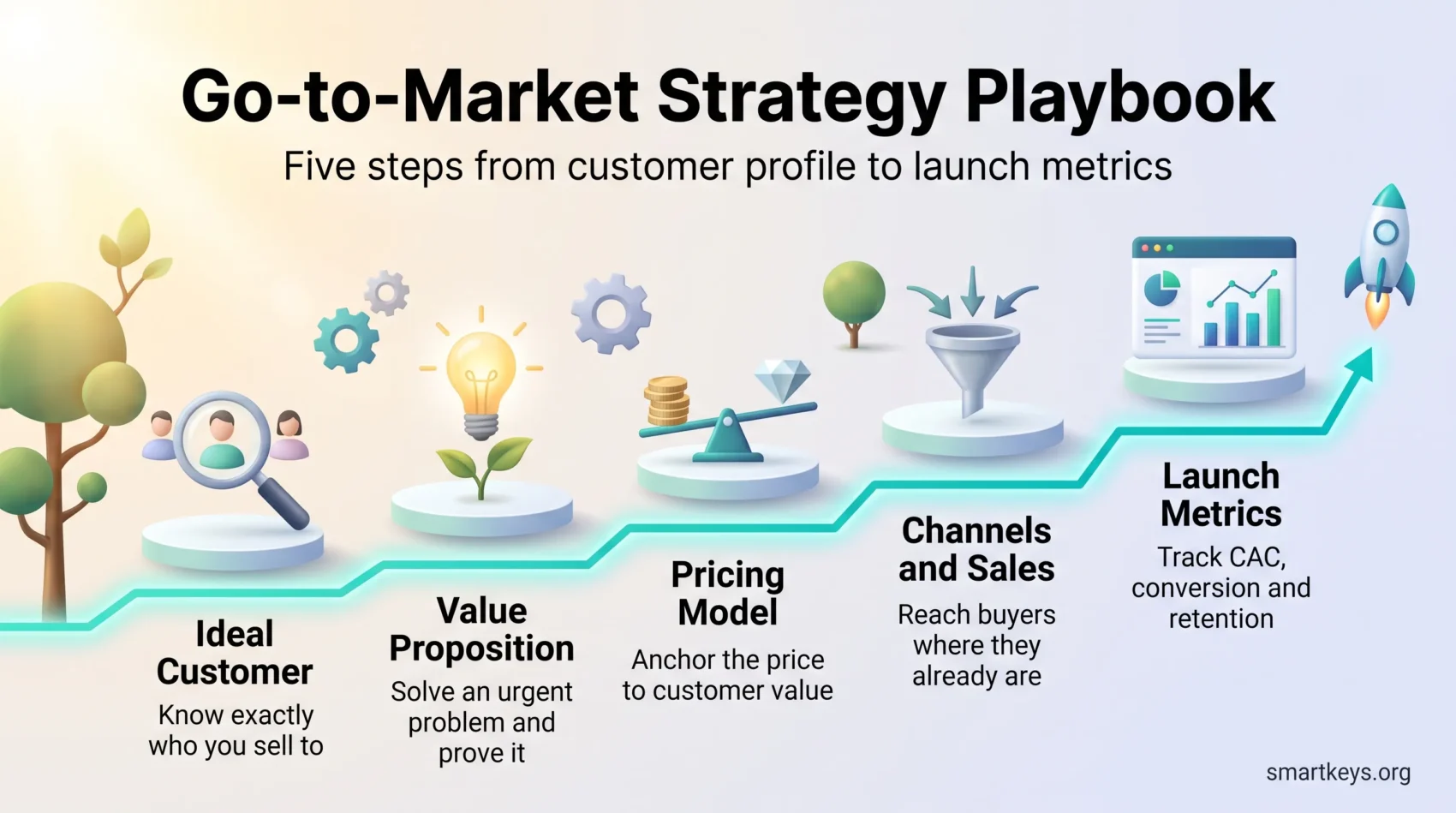
A go-to-market strategy is the plan for how a new product, service or market entry reaches paying customers. It answers three questions before you spend money: who exactly you sell to, why they should buy from you, and through which channels the sale happens.
This playbook walks through each part of that plan in the order you build it: customer profile, value proposition, pricing, channels, sales model, metrics and tools. Two real launches, Apple’s iMac in 1998 and Oatly’s US entry, show what bold positioning and smart distribution look like in practice.
The guide is written for founders, product managers, marketing leads and small business owners who need a launch plan that works. For deeper tactics on tying channels and timing together, this guide on omnichannel strategies is a useful companion.
Key Takeaways
- A go-to-market (GTM) strategy defines the target customer, the value you promise, the price, the channels and the sales model before launch. A marketing plan then runs the campaigns.
- Most B2B buyers now research on their own and use AI tools before they talk to anyone. Your website, pricing page and product trial have to sell without a rep in the room.
- Validate demand with small experiments before you scale spend. Cheap tests on messaging, pricing and channels beat expensive assumptions.
- Track a small set of numbers from day one: customer acquisition cost, conversion rate by stage, sales cycle length and retention.
- Templates, standard procedures and a shared dashboard turn a one-time plan into a repeatable launch process.
What Is a Go-to-Market Strategy?
A go-to-market strategy is a written plan that connects a product to the people who will pay for it. It covers the target market, the competition, the value proposition, the pricing model, the marketing channels, the sales approach and the distribution path. In short: who, why, how much, and through which door.
The purpose is to reduce risk. Before a company commits a budget, headcount and a launch date, the GTM plan forces it to test the assumptions behind the launch. Is the problem urgent enough that customers will switch? Do the chosen channels actually reach those customers? Does the price cover the cost of winning and serving them?
It applies to more than new products
A GTM strategy is not limited to a brand-new product. The same framework works for a new service line, a new pricing tier, an expansion into another country or a relaunch of an existing product to a different segment. What changes is the input, not the method. If you are entering a new region, the market research and local adaptation matter most; our guide to a global expansion strategy covers that case in depth.
What a finished GTM plan contains
- A definition of the target audience and an ideal customer profile.
- A positioning statement and one core message per buyer persona.
- A pricing model with the reasoning behind it.
- A channel plan for marketing and a chosen sales motion.
- Launch goals, the metrics that track them, and named owners for each part.
Go-to-Market Strategy vs. Marketing Plan
People often use the two terms interchangeably. They are not the same thing, and mixing them up is a common reason launches stall.
The GTM strategy is the company-wide blueprint. It decides pricing, distribution, positioning and how sales and marketing share the work. It is built once per launch and owned by leadership across product, marketing, sales and customer success.
The marketing plan is the operational layer. It lists campaigns, budgets, content and timelines. It usually sits inside the GTM plan, but it keeps running long after launch day, and marketing owns it with input from sales and product.
- Timing: build the GTM strategy before you enter a market or ship a product. Build the marketing plan to run and improve campaigns week by week.
- Scope: the GTM covers sales, distribution, pricing and positioning. The marketing plan covers channels, budgets and schedules.
- Ownership: the GTM belongs to the whole company. The marketing plan belongs mainly to the marketing team.
When the two interlock, the GTM sets direction and the marketing plan turns it into weekly execution. Write down the handoffs between them so messaging, content and campaigns roll out in the right order.
Why a GTM Strategy Pays Off
The benefit of a GTM plan is clarity at the start instead of a scramble at the end. That clarity shows up in four practical ways.
Faster time to market. When roles, timelines and messages are agreed early, teams stop waiting on each other. Blockers get resolved before they stall the launch date.
Lower cost per customer. A GTM plan forces you to pick the channels most likely to convert and to drop the rest. That keeps the budget focused on outcomes rather than spread thinly across every platform.
Sharper messaging. Testing positioning before launch means the story that goes public has already survived contact with real prospects. Better messaging lifts conversion across every channel at once.
Repeatability. A documented GTM process captures what each launch teaches you about buyers, pricing and channels, so the next launch starts from a better place.
When You Need a GTM Strategy
You need a GTM plan whenever you introduce something new to a market, or take something existing into a new one. Typical triggers include:
- Launching a new product, a new service tier or a pilot with uncertain demand.
- Expanding into a new region, a new industry or a new customer size segment.
- Changing pricing, rebranding or repackaging existing services.
- Responding to a market shift: a strong new competitor, longer sales cycles or rising objections.
Prioritize the effort for big bets. An enterprise product, a new category or a major pivot deserves the full playbook because both the risk and the visibility are high. A minor feature release can get by with a lighter version: a one-page brief that names the audience, the message, the channel and the metric.
Established companies benefit too. A positioning that won three years ago may underperform today, so revisit the GTM plan once a year.
What Changed for Launches in 2026
The biggest shift since the classic GTM playbooks were written is how buyers research. In a Gartner survey of 646 B2B buyers conducted in late 2025, 67% said they prefer a rep-free buying experience. In the same research, 45% reported using AI tools during a recent purchase, mainly to gather information on vendors and products. Still, 69% of buyers said they want to validate AI-generated insights with a sales rep before they commit.
Three practical consequences follow for your plan.
Your public content is now part of the sales team. Buyers form their shortlist from search results, AI answers, review sites and your pricing page. Those assets have to state the value proposition, the price range and the proof clearly. Vague “contact us for pricing” pages lose buyers before a rep ever hears about them.
Self-serve paths deserve investment. A free trial, an interactive demo or a transparent pricing calculator lets buyers do the evaluation they want to do alone. Our product-led growth playbook covers how to design that path from first login to expansion.
Reps shift from information source to validator. Buyers arrive with a view already formed. The sales conversation works best when it confirms, corrects and quantifies what the buyer has learned, rather than starting the pitch from zero. That changes the enablement material your team needs, a topic covered in our guide to sales enablement trends.
Core Components of Your GTM Framework
Start with the pieces that prove the product solves an urgent problem and that buyers will pay to solve it. Validation is the cheapest way to avoid wasted spend later.
Product-market fit and the problem you solve
Confirm demand with evidence, not enthusiasm. Usage data from a pilot, early revenue and direct customer interviews all count. If the problem is real but not urgent, buyers will agree it matters and still not switch. Pause and sharpen the offer before scaling.
Target audience: ideal customer profile and buyer personas
An ideal customer profile (ICP) describes the type of company or person that gets the most value from your product and is easiest to win and keep. Buyer personas describe the individual roles inside that customer who influence the purchase. The next section shows how to build both.
Competition and demand analysis
Map the alternatives your buyers consider, including doing nothing and building in-house. Compare pricing, packaging and positioning to find a gap you can own. This tells you whether you need a genuinely different product or simply faster and clearer execution.
Distribution and sales model
Choose the channels that match where your audience already buys: direct, partner, wholesale or retail. Then match the sales motion to the complexity of the product. A simple tool should not be sold through expensive field visits, and a complex platform should not be left to a self-serve checkout.
Early unit economics
Estimate what it will cost to win one customer (customer acquisition cost, or CAC) and what that customer is likely to be worth over time (lifetime value, or LTV). The first estimate will be rough. It still tells you which channels and sales models you can afford.
Define Your Ideal Customer Profile and Buyer Personas
A focused customer profile shapes everything downstream: messaging, channel choice, pricing and sales approach. Start by segmenting the market into three to five groups that matter for your product. Useful dimensions are industry, company size or headcount, budget signals, geography and the specific use case.
Build personas across the buying group
In most B2B purchases several people take part. Typical roles are the person who raises the need, the users, the influencers who shape the shortlist, the decision maker, the budget holder and sometimes a gatekeeper such as IT or legal. For each role, document:
- Their main pain point and the outcome they care about.
- The proof they need before they say yes (a case study, a security review, a reference call).
- Where they get information, so marketing and sales show up in the right places.
Ground the profile in real data. Customer interviews, support tickets, win and loss notes and product usage are far more reliable than assumptions. If you collect that data systematically, a first-party data strategy turns it into a lasting asset. For high-value accounts where a handful of customers decide the year, an account-based strategy focuses sales and marketing on named companies rather than broad segments.
Nail Your Value Proposition and Messaging
A value proposition is a short statement of who you help, what problem you remove and why your approach is better than the alternatives. Build it with a simple grid, often called a value matrix: one row per persona, with their top pain, the benefit your product delivers and one tight message.
Position as a painkiller, not a vitamin
Buyers pay faster to remove an urgent problem than to gain a nice-to-have improvement. Lead with the cost of the problem, then position the product as the fix. Back every claim with proof: a demo, a screenshot, a number from a pilot or a short customer quote. Our guide to brand storytelling shows how to turn that proof into a narrative buyers remember.
Keep positioning and tone consistent
Choose a clear stance on how you differ from alternatives and use it everywhere: website, ads, sales decks and onboarding emails. Use bold, plain language in headlines and calm, helpful copy in body text. Give the sales team objection-handling lines that use the same words, so the buyer hears one story from first click to signed contract.
Test messages before you scale them
Run A/B tests by persona and channel. Judge them on engagement and conversion, not on internal opinion. Then document the winning variants so every team uses the same language as campaigns grow.
Pricing Strategy That Matches Value and Market
Price anchors what buyers expect from the product and decides whether the business model works. It has to fit three things at once: your revenue goals, what customers are willing to pay, and the unit economics, meaning what it costs to deliver and support each customer.
Measure the cost to serve and set a margin target before you pick a number. Then work outward from value: what does the customer gain in time, money or risk avoided, and what share of that gain can you reasonably charge? The full method is described in our article on value-based pricing.

Competitive benchmarks and willingness to pay
Benchmark competitor prices, then test willingness to pay with small groups: short surveys, A/B tests on the pricing page and pilot deals with early customers. Aim for a price that reflects perceived value, not one that simply undercuts the market. Cheap prices attract customers who leave as soon as someone is cheaper.
Models to consider
- One-time (transactional): a single fee. Suits simple purchases and short sales cycles.
- Subscription: recurring revenue. Suits ongoing use and rewards retention.
- Usage-based: the bill grows with consumption. Increasingly common for software and AI products; see our guide to usage-based pricing for when it works.
- Freemium: a free tier with paid upgrades. It lowers the barrier to trial but only pays off if enough users upgrade; our freemium model article walks through the math.
Whatever the model, use tiers and packaging to make the choice easy, pilot the prices, and write down discount and renewal rules before launch. For a structured way to weigh these options, start with a pricing strategy framework.
Marketing Channels That Reach Your Audience
Pick the channels where your audience already spends time. That single choice shapes every campaign and every metric you track afterward.
Inbound and outbound
Inbound channels such as search, blog content, webinars and email nurture build awareness that keeps working after the launch spend stops. They are slow to start and cheap to sustain.
Outbound channels such as paid ads, cold outreach and events reach buyers with intent quickly. They are fast to start and expensive to sustain. Most launches need both: outbound for the launch window, inbound for the months after.
Match channels to funnel stages and personas
- Awareness: search content, social posts and short educational pieces that name the problem.
- Consideration: comparison guides, case studies, demos and webinars that show proof.
- Decision: free trials, pricing pages, ROI calculators and time-limited offers.
Match the message in each channel to the persona’s pain point, so sales can follow up on leads that are already qualified. Measure each channel on the quality of traffic, the conversions it produces and the time it takes a new customer to reach first value. Then shift budget to what performs.
Sales and Distribution Channels That Convert
Where buyers purchase and how the product reaches them shapes the experience they remember. Choose paths that match how your target customer shops and how your product ships.
Direct, partner, wholesale and retail
Direct sales give you control over pricing, demos and onboarding, plus fast customer feedback. Use direct for complex products or when learning speed matters most.
Partners and resellers extend reach into customers they already serve, but they need co-marketing and clear enablement to succeed. Run a partner pilot before a wide rollout. Our guide to building a partner ecosystem explains how to structure those relationships.
Retail and wholesale suit physical goods that customers want to see and touch. Plan for inventory, lead times and service levels so the company keeps its promises at scale.
Reduce friction in the buying process
- Map every step from interest to purchase and remove needless clicks, forms and approvals.
- Give the sales team channel-specific plays and one-page scripts.
- Standardize handoffs between marketing, sales and fulfillment so the customer sees one consistent process.
- Pilot small, measure conversion and cycle time, then scale the channels that prove repeatable.
Map the Buyer’s Journey from Attract to Delight
The buyer’s journey describes how someone moves from first hearing about a problem to recommending your product. The classic model has three stages: awareness, consideration and decision. Many teams now extend it into a loop of attract, engage and delight, because retained customers bring the next customers.
Attract: educational content and a clear brand story surface the product to people who have the problem.
Engage: comparison guides, case studies, demos and trials give buyers the proof they need to evaluate.
Delight: onboarding checklists, responsive support and referral prompts turn customers into advocates who expand and recommend.
From free trial to close in B2B
A focused free trial or a proof of concept lets buyers validate value themselves, which is what most of them now prefer. Pair it with a defined sales process: contact, qualification, business case, evaluation, negotiation and close. Equip each stage with the right asset, such as an ROI calculator or an implementation checklist. Measure time in each stage and conversion between stages to find the bottleneck. After the sale, customer retention strategies decide whether the launch produces lasting revenue or a one-time spike.
Set Goals, KPIs and Metrics for Launch and Beyond
Name the numbers that matter before launch so product, marketing and sales measure the same outcomes. Clear targets make trade-offs obvious and speed up decisions when something goes wrong.
The core unit economics
- Customer acquisition cost (CAC): total sales and marketing spend divided by new customers won in the period.
- Lifetime value (LTV): the revenue a typical customer brings over the time they stay.
- Conversion rate by stage: visitor to lead, lead to trial, trial to paid, and so on.
- Sales cycle length: days from first contact to signed deal.
- Retention or churn: the share of customers still active after 30, 90 and 365 days.
Tie each metric to the product stage. During a beta the question is whether anyone activates; during scaling the question is whether CAC stays below what an LTV can justify.
SMART goals and OKRs that align teams
Turn those metrics into goals that are specific, measurable, achievable, relevant and time-bound, and assign an owner to each. Objectives and key results (OKRs) do the same job at team level: one objective, three to five measurable results. Review them weekly during the launch window and monthly afterward, and use the data to refine messaging, channel mix and pricing. For the tooling side, our articles on business intelligence tools and RevOps tools for forecasting cover how to build the dashboard.
Choose a Sales Model That Fits Your Product
The sales model determines how much you spend on marketing, whether you hire reps, and how customers are supported through the purchase. Pick it based on product complexity, deal size and the cost of winning each customer.
The four common models
Self-service works when the product is simple and the price is low. The investment goes into the website, onboarding and product experience rather than into salespeople.
Inside sales fits mid-size deals where buyers want guidance. Reps qualify and close over video calls without travel.
Field sales suits enterprise deals with long cycles, pilots and several decision makers who need executive alignment.
Channel sales extends reach through partners who resell the product. It lowers acquisition cost when the partner already serves your customers, at the price of less control over the relationship.
How complexity, deal size and CAC decide
As a rule, the average contract value has to cover the cost of the sales motion. A $30-a-month tool cannot afford field sales; a six-figure platform cannot rely on a checkout page. Many software companies now combine models, using a self-serve entry point and adding reps for larger accounts. Our comparison of product-led versus sales-led growth explains how to choose. Whatever you pick, measure CAC by channel and adjust hiring and partner deals to protect margin.
Go-to-Market Strategy Examples: Apple iMac and Oatly
Two well-documented launches show different routes to the same goal: fast awareness and a clear customer benefit.
Apple iMac (1998): bold positioning and an integrated launch
Apple launched the iMac in August 1998 at $1,299. It aimed at three groups: loyal Mac users, first-time computer buyers and curious PC owners. The product itself carried the positioning. A translucent Bondi blue shell, a built-in modem and a setup that promised internet access within minutes made the computer feel modern and approachable.
Apple backed it with a campaign reported at $100 million, run by TBWA\Chiat\Day across TV, print, billboards and in-store displays, with lines such as “Chic. Not geek.” Contemporary reports put first-weekend sales at around $25 million and noted that a large share of buyers were new to Apple. The lesson: when the product and the message say the same thing, a focused launch budget compounds.
Oatly in the US (2016): winning through distribution
Oatly entered the US in 2016 and, rather than fighting for grocery shelf space first, prioritized independent coffee shops. Baristas served its Barista Edition oat milk in lattes, so customers tried the product in an expertly prepared drink recommended by someone they trusted. Coffee shops became the trial channel that advertising alone could not buy.
Demand grew faster than supply. By 2019 Oatly was in thousands of coffee shops and grocery stores, and the shortage that year became a news story in its own right. The lesson: pick one or two concentrated moves that let customers experience the value directly, and let the channel do the marketing.
Templates and Tools to Run Your GTM
A plan only produces results when someone owns each task. Replace scattered documents with a compact set of working files. The core set is a launch plan with owners and dates, a product roadmap, a sales plan, a short SWOT analysis (strengths, weaknesses, opportunities, threats) and standard operating procedures (SOPs) for tasks that repeat every launch.
Roadmaps, SOPs and cross-functional alignment
Keep a single roadmap that shows milestones, owners and blockers. Pair it with SOPs for launch tasks such as pricing-page updates, sales-deck refreshes and support briefings, so repeatable work is done the same way every time. Our guide on creating standard operating procedures shows how to write ones your team will actually use. Document approvals, change control and a risk log so decisions do not live in email threads.
Project management, CRM and analytics
Run the launch in a shared project tool so everyone sees status and dependencies. Keep customer and pipeline data in a CRM (customer relationship management system) that sales, marketing and support all use. Our overview of CRM trends explains what to expect from those systems in 2026. Then connect analytics to the launch goals so the dashboard shows CAC, conversion and pipeline without anyone compiling a report by hand.
Finally, build rituals into the calendar: a short daily standup during the launch window, a weekly metrics review and a retrospective after launch.
Common GTM Pitfalls and How to Avoid Them
Most failed launches fail for boring reasons that a few cheap tests would have caught. Watch for these.
- Skipping validation. Launching without proof of demand leaves a product stuck despite effort and spend. Confirm the problem and the willingness to pay first.
- A vague customer profile. “Small businesses” is not a segment. Document the ICP and the buying group so outreach is focused.
- Pricing that ignores value. A price set only against competitors invites avoidable objections. Anchor it to the outcome the customer gets.
- Hiding information buyers want. Missing pricing, no trial and thin product pages push self-serve buyers to competitors before your team knows they existed.
- Unclear ownership. Tasks without owners and timelines slip. SOPs and a single roadmap fix most of this.
- Forgetting the customer after the sale. Onboarding, proactive support and feedback loops decide whether launch customers stay. Customer success tools help spot at-risk accounts early.
- Measuring too late. Track conversion, CAC and sales cycle from the first week so small problems are visible before they grow.
If you are launching from a startup, resources are thin and every experiment competes with the next. Our guide to scaling strategies for startups picks up where this playbook ends.
Conclusion
A go-to-market strategy turns a launch from a series of guesses into a set of tested decisions. It defines who you sell to, what you promise, how much you charge, where you show up and how the sale happens. It also names the numbers that tell you whether it is working.
The 2026 twist is that buyers do most of the work alone, often with AI tools, before they talk to anyone. That makes your public content, pricing page and trial experience part of the sales team, and it turns reps into validators of decisions that are already half made.
Next steps: validate demand with a small experiment, then write the ICP and value matrix. Pick one pricing model and two channels to test, assign an owner to every task, and set a weekly review. Then launch, measure and refine.
Found this useful?
Make SmartKeys a preferred source on Google, and our articles will surface more often in your Top Stories, AI Overviews, and AI Mode.
Add as Preferred Source