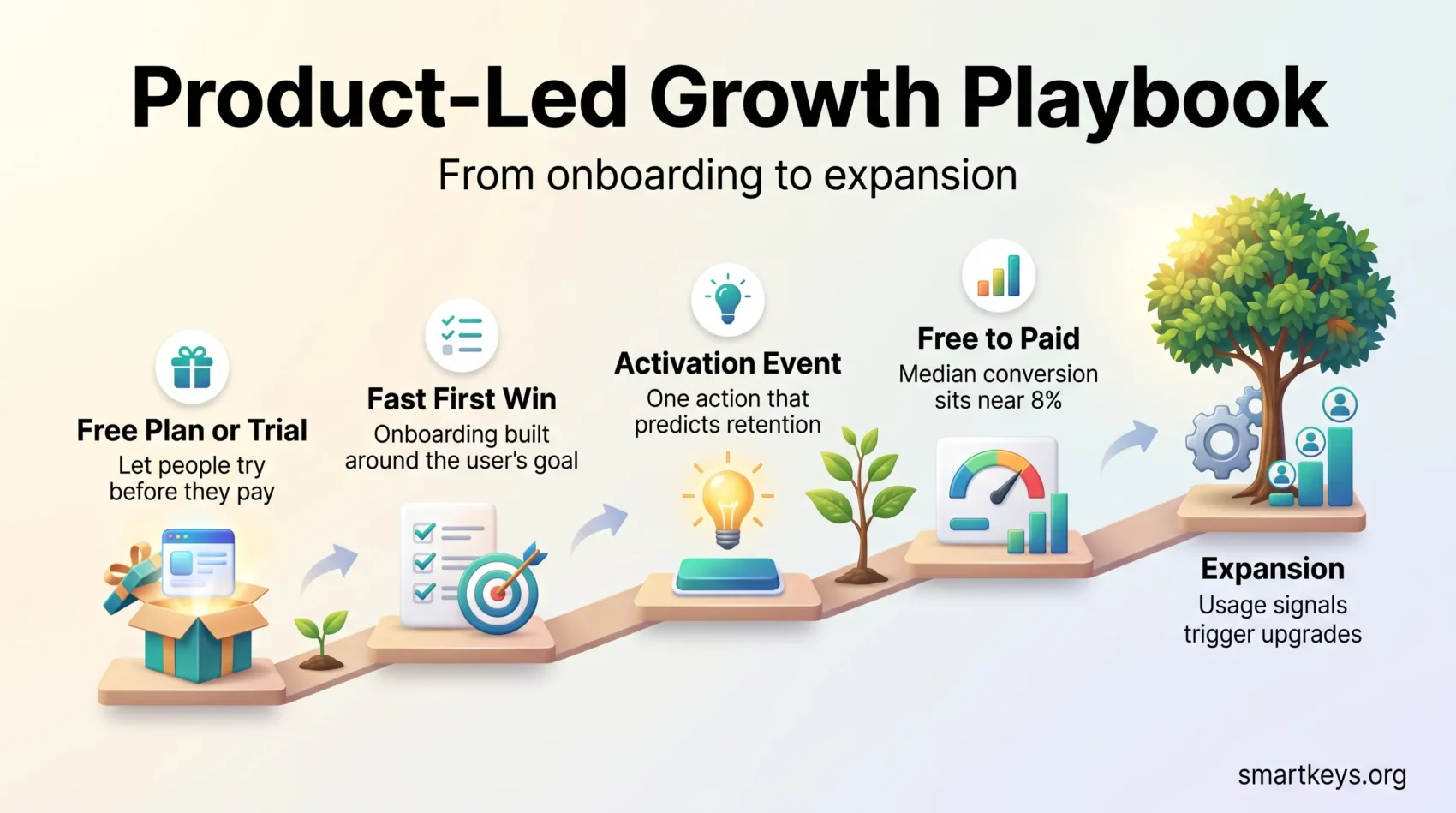
Product-led growth means your product does the selling. Instead of a demo, a quote and three follow-up calls, people sign up, use the thing, and pay once it has proved useful. This playbook walks through the whole path: how to choose between a free plan and a free trial, how to design onboarding that reaches a first win fast, which numbers to watch, and how to turn happy users into bigger accounts.
The approach fits how software is bought now. Gartner surveyed 646 B2B buyers in late 2025 and found that 67% would prefer to buy without talking to a sales rep at all, and 45% had used AI somewhere in a recent purchase. If most of your buyers want to evaluate you alone, your product has to answer their questions on its own.
You will also get the parts that usually get skipped: what a realistic conversion rate looks like, where free plans quietly destroy revenue, and when a human seller is still the faster route.
Key Takeaways
- Let people reach a real result inside the product before you ask for money.
- Pick freemium for products that get better with more users, a trial for products that need depth to impress.
- Define one activation event that predicts whether someone stays, then shorten the path to it.
- Track activation, time-to-value, free-to-paid conversion, retention and expansion. Ignore raw signups.
- Median free-to-paid conversion across B2B software sits near 8%, so plan your funnel maths around single digits.
- Bring sales in for security reviews, procurement and multi-stakeholder deals, not for routine signups.
What product-led growth actually means
In a traditional sales-led model, the order is: marketing generates a lead, a rep qualifies it, a demo shows the value, and only then does the buyer touch the product. Product-led growth reverses the last two steps. The buyer touches the product first, sees the value themselves, and the commercial conversation happens afterwards, if at all.
That reversal changes what you build. The product has to explain itself, because nobody is standing next to the user explaining it. Onboarding stops being a nice-to-have and becomes the main sales asset.
Show the value instead of describing it
The practical test is simple. Can a stranger sign up on a Tuesday afternoon and get one useful result before they lose patience? If the answer is no, no amount of marketing will fix the funnel. A design tool should produce a shareable file. A scheduling tool should produce a booked meeting. A support tool should resolve a real ticket.
How it differs from sales-led and marketing-led growth
Marketing-led growth optimises for leads: form fills, content downloads, webinar registrations. Sales-led growth optimises for meetings and pipeline. Product-led growth optimises for usage, because usage is the signal that someone found value.
The three are not mutually exclusive. Most successful companies run a blend, and the useful question is which motion owns the first 20 minutes of the relationship. If you are still deciding which motion should lead, our guide to choosing between a product-led and a sales-led go-to-market model walks through the deal size, buyer and friction signals that tip the decision.
The buyer reality behind the shift
Two thirds of B2B buyers now prefer a rep-free experience, according to Gartner’s 2025 buyer survey. That is not a rejection of salespeople so much as a rejection of gatekeeping. Buyers want to answer their own basic questions on their own schedule.
The practical consequence is that friction at the front door is expensive. Every gated demo, every mandatory sales call before trial access, every form that asks for company size before showing a price, removes a share of people who were willing to evaluate you.
Where a human still beats the product
Self-serve breaks down in predictable places. Security questionnaires, procurement processes, legal review of data-processing terms, migration from an incumbent tool, and any deal with more than three decision makers. These are not product problems, and trying to automate them usually slows the deal down.
The workable pattern is a hybrid: the product handles discovery, evaluation and small purchases; sales handles the complicated end. This is sometimes called product-led sales, and it depends on knowing which accounts are worth a human. That is what product-qualified leads are for, covered further down.
Why the economics favour it
When the product does the evaluation work, you need fewer demos, fewer discovery calls and fewer people per new customer. That lowers what each customer costs to acquire, and it raises revenue per employee because routine selling happens inside the software.
A free plan or trial also widens the top of the funnel. People meet your product early in their research, long before they would agree to a call. And because signup works the same way in every country, a self-serve product can win users in new markets before you hire anyone there. Our guide to global expansion strategy covers what changes once you do.
The caveat matters: these savings only appear if free users actually convert. A free tier that nobody upgrades from is a cost centre with good press.
Freemium or free trial: how to choose
This is the decision most teams get wrong, and it is worth taking seriously because it is expensive to reverse.
Choose freemium when your product gets better as more people use it. Collaboration tools, communication tools and anything with shared documents fit here. The free tier is not charity; it is distribution. Every free user who invites a colleague is doing acquisition work for you.
Choose a free trial when the value only becomes obvious once someone uses the full product on their real data. Analytics platforms, security tools and anything that needs configuration fit here. A crippled free version of these products makes a bad first impression, which is worse than no impression.
According to ChartMogul’s SaaS Conversion Report, which looked at 200 B2B software products in January 2026, 14 days is by far the most common trial length, used by 62% of products. Seven-day and 30-day trials are much rarer, at 14% each.
The credit card question
The same report found the single largest swing factor in trial conversion. Trials that ask for a credit card up front convert at roughly 25% to 35% for good performers, against 4% to 6% for trials that do not. That is not a fivefold improvement in your product; it is a filter. Asking for a card removes casual sign-ups, so the people who remain were already close to buying.
Which one you want depends on your goal. If you need volume at the top of the funnel, skip the card. If you need efficiency and your sales team is chasing trial users manually, ask for it.
Three ways to draw the free line
Free plans usually limit one of three things:
- Features: the free plan does the basic job, while extras the core task does not need, such as automation, admin controls or advanced integrations, are paid.
- Capacity: the full product is free up to a threshold of seats, storage, projects or usage volume.
- Support: the product is fully usable, but priority help, guided setup or guaranteed response times cost extra.
You can also mix models. A common pattern is a permanent free plan for the core product plus a short trial of the premium tier, so free users can see what they would unlock before they decide. Whichever line you draw, tie it to the moment that predicts upgrade intent.
Designing paywalls that follow value
- Put the limit where the value is, not where a timer runs out. A user who hits a cap because the product is working for them is a willing buyer.
- Restrict by scale (seats, storage, volume) rather than by usefulness. A free plan that cannot do the core job teaches people the product is weak.
- Keep the upgrade path visible before it is needed, so the price is never a surprise.
- Test the limits against real conversion data instead of guessing. Our VWO review covers the A/B testing side of this.
If you want to go deeper on the commercial side, see our guides to the freemium model, usage-based pricing and value-based pricing, plus the broader pricing strategy framework.
Mapping the path from first visit to first win
Before you improve anything, write down the actual steps a new user takes. Not the ideal steps: the real ones, including the email confirmation, the workspace name nobody knows how to fill in, and the empty dashboard at the end.
Two terms matter here. Activation is the moment a user does the thing that makes the product worth keeping. Time-to-value (TTV) is how long that takes from signup. Shortening TTV is usually the highest-return work available to a product-led team, because everything downstream depends on it.
Choosing an activation event that actually predicts retention
An activation event is only useful if users who complete it stay significantly longer than users who do not. That makes it an empirical question, not a workshop question. Pull your cohort data, test a handful of candidate events, and pick the one with the strongest link to week-four or week-twelve retention.
Common mistakes: choosing an event that everyone completes (it tells you nothing), choosing one almost nobody completes (too far down the funnel to optimise), or choosing one that simply measures enthusiasm rather than value. Teams often find that repetition matters more than a single action. One completed task predicts less than three completed tasks in the first week.
- Map discovery through to the first useful result, counting every required step.
- Segment by persona. A solo user and a team admin need different fastest paths.
- Instrument each step so you can see exactly where people stall. Behavioral analytics makes those drop-offs visible.
Onboarding that earns the second session
Design onboarding around what the user came to do, not around your feature list. A tour of the interface is not onboarding. Getting someone to a result is.
Goal-based guidance instead of generic tours
Ask, in one question, what the person is trying to achieve, then build the shortest route to that outcome. Checklists work because they show progress and make the end visible. Tooltips work when they appear at the moment of confusion and not before.
Progressive disclosure means holding back advanced options until someone needs them. It keeps a first session from feeling like a cockpit. The advanced features are not hidden forever; they surface when the user’s behaviour suggests they are ready.
Empty states deserve special attention. A blank screen is where most new users quietly give up. Fill it with a template, a sample project or a one-click example that produces something real.
Self-serve help that cuts support load
A searchable help centre with short articles, linked from inside the product at the relevant moment, prevents context switching and reduces tickets. Add a feedback widget so users can flag the steps that confused them; that is the cheapest research you will ever run. Tooling options are covered in our roundup of customer success tools and the Pendo review, which looks at in-app guides and product analytics in one place.
Measure, then iterate
Track activation rate, time-to-value and feature adoption per cohort. Run one change at a time. Lifecycle emails help, but only when they push people back toward an in-product action rather than toward more reading.
Three tool types cover most of the measurement work. Product analytics tools such as Mixpanel, Amplitude or Heap track funnels and cohorts. Session replay tools such as FullStory show you where people hesitate or give up. Feature flags let you release a change to a small group first, so a bad idea never reaches every user. In-app messaging tools such as Intercom then close the loop by reaching users inside the product when a signal appears.
Four frameworks worth knowing
Frameworks are shared vocabulary, not strategy. Use them to agree on definitions so your weekly review does not become an argument about what activation means.
AAARRR (sometimes called pirate metrics) breaks the funnel into awareness, acquisition, activation, retention, referral and revenue. For product-led companies the important edit is that activation moves ahead of revenue, because value comes before payment.
The bowtie model extends the funnel past the sale. The left side covers acquisition up to first purchase; the right side covers adoption, retention and expansion. It is a useful corrective for teams whose reporting stops at the signup.
Growth loops describe mechanisms where the output of one user’s action becomes the input for acquiring another. A shared file that requires an account to open is a loop. A referral credit is a loop. Loops compound in a way that campaigns do not, which is why they are worth designing deliberately.
The Hooked model (trigger, action, variable reward, investment) explains habit formation. Use it to understand why people return, and be careful with it: the same mechanics that build a useful habit can build a manipulative one, and users notice the difference.
The metrics that actually matter
Keep the list short. A product-led team that watches six numbers well beats one that watches thirty badly.
The core six
Activation rate: the share of new signups who reach your defined activation event, measured by cohort.
Time-to-value: how long activation takes. Watch the median rather than the average, since a few very slow users will distort the mean.
Free-to-paid conversion: the share of free users who start paying. ChartMogul’s January 2026 report put the median across 200 B2B products at 8%, with strong freemium products in the 8% to 12% range and strong card-free trials in the 10% to 15% range. The spread is enormous: the report found a roughly tenfold gap between the top and bottom fifth of self-serve products, so treat medians as orientation rather than a target.
Retention: plot the curve by cohort. A curve that flattens means you have found a durable use case. A curve that keeps falling means you have not, and no amount of acquisition will fix it.
Average revenue per user (ARPU) and lifetime value (LTV): together these tell you whether your pricing matches the value delivered.
Net revenue retention (NRR): revenue from existing customers this year against last year, including upgrades, downgrades and churn. Above 100% means your installed base grows without a single new logo.
One North Star above the six
A North Star metric is the single number that best captures the value customers get from your product. For a team tool that might be weekly active collaborators; for a project app, projects completed. The six metrics above then explain why the North Star moves.
Pick a number that rises only when users succeed, not when you spend more on ads. Then give each team a lever it owns: product works on activation, marketing on qualified signups, customer success on retention. When everyone argues about the same number, priorities get much easier to settle.
Turning metrics into expansion
- Trigger upgrade prompts from usage signals, such as approaching a seat or storage limit, rather than from the calendar.
- Segment by plan and persona so you can see which groups expand and which stall.
- Review cohorts weekly and connect each onboarding change to the conversion cohort it affected. Our guide to RevOps metrics explains ARR, NRR and lifetime value calculations in detail.
- Watch churn reasons as closely as churn rate; see our notes on customer retention strategies.
Building a product that sells itself
Two design choices do most of the work here: helpful personalisation and built-in collaboration.
Personalisation that helps rather than watches
Recommend the next action based on what the person has already done and what they told you they wanted. Explain why a suggestion appeared and make it dismissible. The line between useful and unsettling is mostly about transparency: people accept relevance they can understand and resent relevance they cannot. Explain the reasoning in one short line and the feature stops feeling like surveillance.
Collaboration as a growth loop
Products where sharing is part of doing the work spread on their own. Design the invite flow as part of the core task, not as a marketing prompt bolted on afterwards. Then make the invited person’s first experience good, because they arrive with less context than the person who invited them.
- Reduce the number of steps between intent and outcome.
- Place sharing prompts at moments of success, not moments of frustration.
- Make sure an invited collaborator can contribute something within a minute of arriving.
Aligning marketing, sales and customer success
Product-led growth fails most often as an organisational problem rather than a product one. Three teams need to watch the same usage signals.
Marketing: attract people who want to try
Content that answers a specific job-to-be-done brings in visitors who are ready to sign up rather than ready to download a whitepaper. Tutorials, comparison pages and templates map neatly onto in-product milestones. See our go-to-market strategy guide for how this fits the wider plan.
Sales: product-qualified leads instead of marketing-qualified leads
A marketing-qualified lead (MQL) is someone who showed interest. A product-qualified lead (PQL) is someone who showed value: they invited colleagues, hit a usage threshold, or used a feature that correlates with paid accounts.
Define your PQL from your own data, hand it to sales with the usage context attached, and let reps engage only when the signal is real. This is where sales and marketing alignment stops being a slogan and becomes a shared definition.
In practice, a PQL model does three jobs. Scoring blends usage depth, feature adoption and company fit into one number. Routing sends high scores to a salesperson and nudges everyone else with in-product prompts. Timing means reaching out right after a value moment, not before it. Show the score in your CRM together with the trial stage, the features used and any blockers, agree a follow-up deadline for high-intent accounts, and feed back which signals actually led to deals so the model keeps improving.
Customer success: scale the routine, staff the exceptions
In-product guides and help content handle routine onboarding. Customer success managers focus on accounts that show churn risk or expansion potential. The trigger for human involvement should be a signal in the data, not a renewal date.
The organisational shift
Cross-functional squads work better than handoffs here, because the loop from signal to change is short. Engineering, design, marketing and success need the same weekly dashboard and the same definitions of activation, PQL and expansion.
Two practical points. First, incentives have to match: if a team is paid on signups, it will produce signups, whatever the strategy deck says. Second, instrument before you optimise. Most product-led programmes stall because nobody can answer basic questions about their own funnel. Getting event tracking right is unglamorous and comes first, which is a theme in our analytics maturity model.
A staged rollout that does not break things
Phase one: foundation
Instrument analytics, define one activation event, and ship a self-serve signup that works without human help. Nothing else matters until a stranger can get started alone.
Phase two: optimisation
Attack time-to-value with small experiments. Introduce PQL scoring so sales has something better than a lead list. Expect this phase to last longer than planned.
Phase three: scale
Tune pricing and packaging for self-serve conversion. Add retention mechanics: useful notifications, collaboration hooks, integrations that make leaving costly in a fair way.
Phase four: refinement
Add predictive models that flag churn risk and suggest next actions. This is worth doing only once the first three phases are producing reliable data.
Examples worth borrowing
Zoom caps free meetings at 40 minutes, a limit still in place in 2026. It is a good example of a restriction that lets people experience the full product while giving frequent users a concrete reason to upgrade. Our Zoom versus Microsoft Teams comparison covers the current plans.
Slack built its early growth on a free tier where the product became more valuable with each colleague added, then converted teams once they depended on it daily. Details are in our Slack review.
Dropbox used referral rewards that gave both sides extra storage, turning the incentive into something users actually wanted rather than a discount. See the Dropbox Business review.
Figma made multiplayer editing the default, so inviting a colleague was part of doing the work rather than a favour to the vendor; our Figma versus Sketch comparison looks at how that changed the design tool market.
Calendly and SurveyMonkey both expose non-users to the product as part of normal use: a booking page and a survey each act as an advert seen by people who never signed up. See our Calendly versus Doodle comparison and SurveyMonkey review.
The pattern across all five is that the growth mechanism is part of the product, not part of the marketing budget.
Where product-led programmes go wrong
A free tier that is too generous. If the free plan covers the whole job for your main use case, upgrading becomes optional forever. The fix is to cap scale, not capability.
Asking for money before the first win. A paywall that blocks the core result, or a pricing page that appears before the user has seen anything work, teaches people to leave. Put the ask just after the activation event, where the value is already visible.
Vanity metrics. Signups and page views feel like progress and predict almost nothing. Activation, retention and expansion predict revenue.
No instrumentation. Teams that start optimising before they can measure end up arguing from anecdotes. Track events first.
Copying another company’s playbook. Slack’s free tier worked because of what Slack is. The mechanics that suit a collaboration tool rarely suit a compliance platform. Test in your own context.
Sales and product pulling in different directions. If reps are compensated for closing deals that self-serve would have closed anyway, the model quietly reverts to sales-led.
Treating it as a project. This is an operating model, not a quarter. Companies that survive the awkward middle phase are the ones that watch unit economics throughout rather than chasing growth first and margin later.
Where to start this week
You do not need a reorganisation to begin. Pick one activation event and check whether it actually predicts retention in your data. If it does not, find one that does. Then measure how long it currently takes a new user to get there, and remove one step.
Everything else in this playbook depends on that loop working: define value, measure the path to it, shorten the path, repeat. The frameworks, the pricing decisions and the PQL scoring all get easier once you know which moment in your product makes someone stay. Get that loop running before you worry about anything else on this page.
Found this useful?
Make SmartKeys a preferred source on Google, and our articles will surface more often in your Top Stories, AI Overviews, and AI Mode.
Add as Preferred Source