A global expansion strategy is your written plan for selling, hiring and operating in a country you are not established in yet. It answers four questions: which market, in what order, through which legal and commercial setup, and with which people.
This guide walks through that plan step by step, in the order the decisions actually arrive.
The timing matters. The World Trade Organization’s March 2026 outlook put world merchandise trade volume growth at 4.6% in 2025, then forecast a sharp slowdown to 1.9% in 2026 and a partial recovery to 2.6% in 2027. Slower trade does not close the door on expansion. It does mean the market you pick has to be chosen deliberately rather than opportunistically.
Key Takeaways
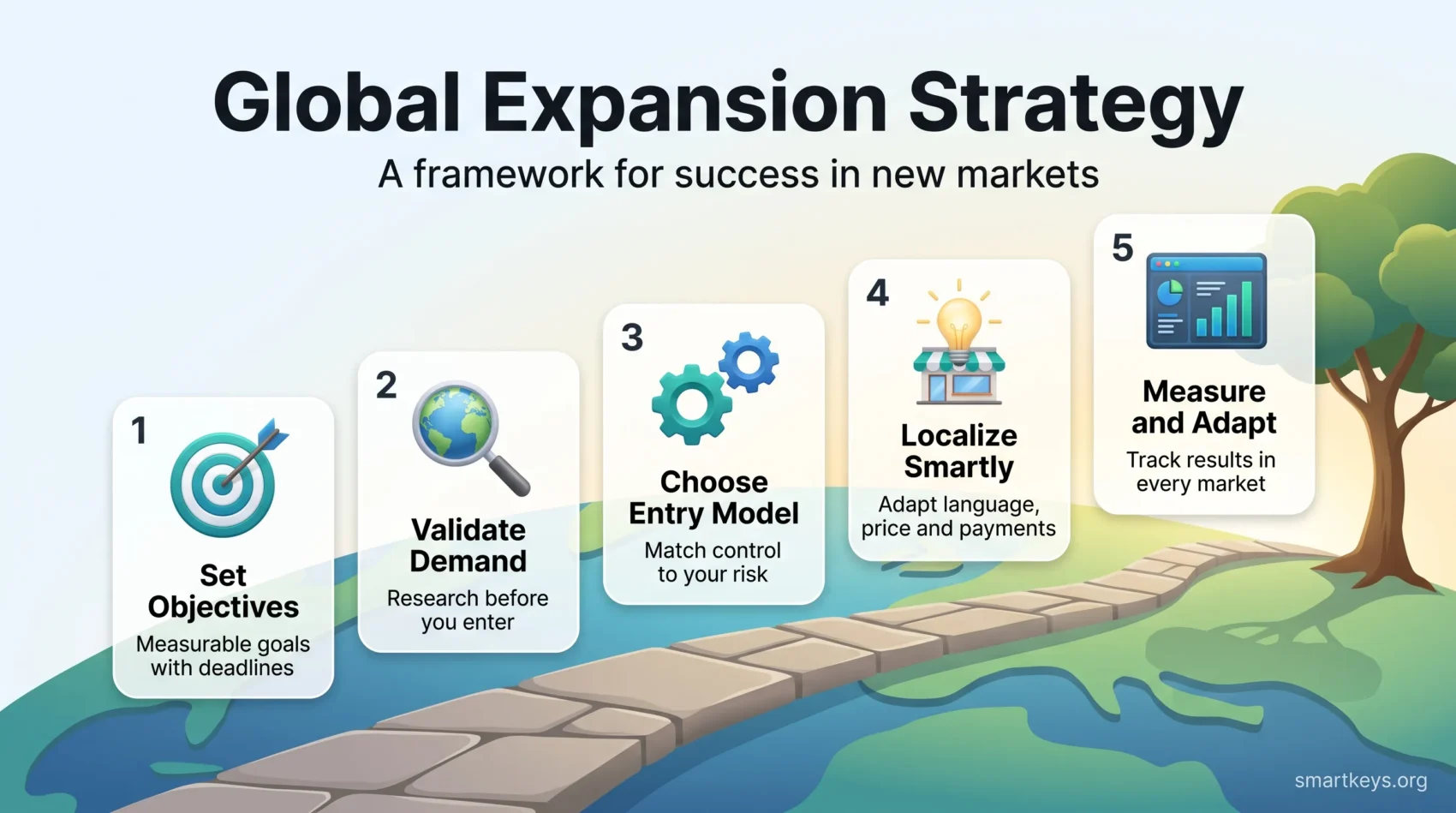
- Write down measurable objectives before you look at any country.
- Validate demand with research, not with a competitor’s press release.
- Match your entry model to how much control and risk you can carry.
- Localize what affects the buying decision, keep the rest consistent.
- Treat compliance and payroll as launch requirements, not paperwork.
What a Global Expansion Strategy Really Covers
Selling abroad is only one part of it. As soon as you hire someone in another country, you take on that country’s employment law, payroll taxes and reporting duties. As soon as you ship a product there, you take on its customs, labelling and packaging rules.
So the plan has to cover three layers at once:
- Commercial: who buys, at what price, through which channel.
- Operational: who does the work, where they sit, how they are paid.
- Legal: what you must register, file and disclose before you start.
A useful test: if you cannot say who signs the first employment contract and under which law, you have a sales plan, not an expansion plan.
The scope also changes over time. Your first entry might be a single reseller agreement. Three years later it might be a local team, a warehouse and a separate pricing structure. Deciding early which of those you are aiming for keeps you from building a structure you have to unwind.
For the day-to-day coordination side of running one team across several countries, see our guide to managing cross-border remote teams. For coordinating channels and partners as you grow, this omnichannel playbook covers the commercial side.
Why Companies Expand, and What They Realistically Gain
Expansion is usually justified with four arguments. Each one is real, and each one has a condition attached.
New revenue. A second market gives you customers who do not compete with your existing pipeline. The condition is that the new market resembles the segment you already serve well. A payroll tool built for US small businesses does not automatically fit German ones, because the underlying tax rules differ.
Risk spread. If one market slows, another may not. That protection is real only if the markets are genuinely different. Two neighbouring countries in the same currency zone tend to move together.
Access to talent. Some skills are concentrated geographically. Hiring where they sit is often faster than competing for them at home.
Lower unit costs. Higher volume can improve purchasing and shipping terms. This one usually arrives last, well after the fixed setup costs have been paid.
Before committing, put a payback period on each argument. If you cannot say roughly when the market pays back its setup cost, you are not ready to enter it. Our guide to cash flow management for scaling businesses covers how to model that without starving your existing operation.
Step 1: Set Objectives You Can Actually Measure
Vague goals like “establish a European presence” cannot be evaluated. S.M.A.R.T. objectives can. The acronym stands for specific, measurable, attainable, relevant and time-bound.
Two worked examples:
- Software company: “Reach 15% of total revenue from Germany, Austria and Switzerland within 18 months, with a customer acquisition cost no more than 30% above our domestic figure.”
- Manufacturer: “Move 20% of assembly volume to a Southeast Asian supplier within 12 months, holding defect rates at or below the current level.”
Both examples name the number, the deadline and the constraint. The constraint is what stops a team from hitting the revenue target by discounting away the margin.
From there, cascade the objective into departmental targets: pipeline for sales, localized onboarding for product, hiring milestones for HR, filing deadlines for finance. If a department cannot name its share of the goal, it will default to domestic priorities. Expansion changes how existing teams work, not only what happens in the new country, so assign each target an owner before you set the launch date.
Step 2: Validate Demand With Real Market Research
Research answers one question: will enough people there pay enough for this to cover what it costs to serve them?
Work through four areas.
Size and saturation. Estimate the addressable market and the share you could plausibly win in three years. Compare that against the fixed cost of entry. A large market you can win 0.1% of may be worse than a small one you can lead.
Customer behaviour and payment norms. Payment habits vary more than most teams expect. Invoice terms, direct debit, cards and wallets all differ by country, and the wrong default at checkout quietly costs you conversions. Check which methods a local buyer expects before you build the checkout, not after.
Competition. Map who already serves the customer, including the local incumbent that never shows up in English-language research.
Regulation. List the rules that could block a launch: labour law, tax registration, sector licensing and data rules. Where you may store and process customer data is a common surprise for software companies, and our guide to data localization laws explains which countries impose it.
Use the same template for every market you evaluate. Comparable data is what lets you rank markets instead of arguing about them.
Step 3: Choose an Entry Model That Matches Your Risk
Your entry model decides how much control you have, how fast you can move and how much you spend before you learn anything.
Exporting and distribution
Selling from your home base through a local distributor is the cheapest test. You get demand signal quickly. You give up control over pricing, positioning and the customer relationship. Our guide to modern distribution channels covers how to structure those agreements.
Licensing, franchising and joint ventures
Licensing lets a local company sell under your brand while funding its own rollout. It conserves your capital and risks your reputation, so quality standards need to be contractual rather than assumed. The modern franchise model is the most structured version of this trade-off.
A joint venture shares cost and gives you a partner who knows the market. It also creates two owners with a veto, so decision rights have to be written down before the first disagreement.
Employer of Record: the low-commitment way to hire
An Employer of Record (EOR) is a company that already has a legal entity in your target country and employs your worker on paper, while that person works for you day to day. It handles the contract, payroll, taxes and statutory benefits.
This matters because setting up your own entity typically takes months and legal fees, while an EOR can put a compliant employee in place in weeks. It is the standard way to test a market with one or two real people rather than a spreadsheet. Our comparison of global payroll solutions covers providers and pricing.
Subsidiary and acquisition
Your own subsidiary gives full control over operations, contracts and intellectual property, and full responsibility for local filings. An acquisition buys you presence immediately and hands you an integration project, which is usually the part that consumes management attention for the next two years.
Most companies do best moving in sequence: export or EOR first, entity second, acquisition only when the market is proven.
Step 4: Localize Without Losing Your Brand
Localization is not translation. It is changing the things that decide whether someone buys.
Prioritize in this order: language, price and currency, payment methods, legal disclosures, and support in local business hours. Those five affect conversion directly. Our guide to value-based pricing explains how to set a local price that reflects local willingness to pay rather than a currency conversion of your home number.
Keep the core consistent: your value proposition, your visual identity and your quality standards. Write down which elements are fixed and which local teams may adapt. Without that document, every market invents its own version of the brand within a year.
Employment norms need the same treatment. France has a statutory 35 hour working week and five weeks of paid annual leave. An offer that ignores those expectations reads as uncompetitive no matter what the salary says.
Finally, build a feedback loop. Local staff hear objections your headquarters never sees. Give them a route to change the product roadmap, not just the marketing copy. Customer retention in a new market usually fails on small local friction rather than on the product itself.
Step 5: Build a Talent Plan for Each Market
Two or three well-chosen local hires often move a market faster than a large remote team. Start with the roles that open doors: a salesperson with a network, a support person in the right time zone, someone who can read a local contract.
Budget for total employment cost, not salary. Employer social contributions vary widely by country, and they are not a rounding error. In France, employer contributions typically add roughly 40% to 45% on top of gross salary, depending on sector and pay level. Build that into the plan before you quote a headcount cost.
Decide deliberately between contractors and employees. Contractors are fast and flexible. Misclassification, however, is one of the most common and most expensive compliance failures in international hiring. Authorities in many countries judge by how the work is actually directed, not by what the contract says. Where genuinely flexible capacity is what you need, our guide to an on-demand workforce strategy covers doing it properly.
Retention deserves attention from day one. Your first local hires carry all of the market knowledge, and losing one of them resets your progress. The levers are the same as at home, applied to local expectations, and our guide to talent retention strategies covers them.
If you use automated screening to fill roles quickly, check the rules first. Several jurisdictions now regulate algorithmic hiring tools, and our guide to AI hiring bias covers what fairness testing and disclosure actually require.
Step 6: Pick Partners That Shorten Time to Market
Partners let you skip work you would otherwise learn the hard way.
Employment partners. An EOR, as described above, hires without you having an entity. A Professional Employer Organization (PEO) is different: it co-employs your staff and generally assumes you already have a local entity. Use an EOR to test, a PEO or your own payroll once you commit.
Systems partners. A human resources information system (HRIS), meaning the central database of employee records, contracts and pay, keeps multi-country data in one place. Without it, each country ends up with its own spreadsheet and no one can answer a simple headcount question.
Banking and currency. You need to receive money in local currency and move it home without losing the margin to foreign exchange (FX) spread. Multi-currency accounts and forward contracts both help, and which you need depends on how predictable your incoming volumes are.
Commercial partners. Agencies, resellers and local agents build pipeline faster than a cold start. They also shape how your brand is first understood, so brief them properly. Aligning what they promise with what you deliver is the same problem as aligning sales and marketing internally.
Run real due diligence on all of them: track record with companies your size, financial stability, and a service level agreement (SLA) that names response times and escalation paths. A cheap partner who disappears during your launch quarter is the most expensive option available.
Step 7: Set Up the Systems Before the First Hire
The point of the tooling is that a new country does not create a new set of manual processes.
Hiring and people data. An applicant tracking system (ATS) plus an HRIS covering your target countries keeps contracts, benefits and tax data consistent. Retrofitting this after three countries is painful.
Work coordination. Project tools such as Asana, Monday.com or Trello matter less than the rules you attach to them. Agree which decisions are made asynchronously, what gets written down, and how much overlap in working hours each team keeps.
Finance. You need spending controls, multi-currency reporting and an audit trail from the first transaction. Consolidating five countries retroactively at year end is a genuinely bad experience. Our guide to finance automation covers the tooling.
Equipment and access. Decide early how a new hire in another country receives a laptop and gets access to your systems securely. This is dull and it is the most common reason a new starter loses their first week.
Standardize the workflow, allow local variation only where the law or the customer requires it, and integrate the systems so leadership sees comparable numbers across markets rather than five differently formatted reports.
Step 8: Treat Compliance as an Operating Requirement
Compliance is not a legal formality you handle after launch. In several categories it decides whether you may sell at all.
Map the rules for each market across labour law, tax and VAT registration, data protection, sector licensing, and product rules such as labelling and packaging. Assign an owner to each and set review dates, because these rules change.
A concrete example: packaging rules in Germany
Anyone placing packaged goods on the German market must register in the LUCID packaging register and participate in a recycling scheme. From 12 August 2026, Germany applies the VerpackDG, its implementing law for the EU Packaging and Packaging Waste Regulation. It sets penalties of up to 200,000 euros for the most serious breaches, such as selling packaging without proper participation in a recycling system. Failures including registration and reporting carry up to 100,000 euros. Violations can also trigger a sales ban.
That is a rule most software-minded teams never think about, and it applies to the box your product ships in.
Data, AI and financial rules
Data protection duties follow your customers, not your office. Our privacy compliance framework covers building those controls once instead of rebuilding them country by country.
If your product uses artificial intelligence in ways that touch customers or staff, check the European rules early. Obligations there depend on the risk category of the use case, not on the technology itself, as our guide to EU AI Act compliance explains.
Keep a risk register with named owners, mitigation steps and triggers. It turns compliance from a series of surprises into a schedule.
Step 9: Plan Supply Chain, Logistics and Currency
If you ship anything physical, model the landed cost before you set a price. Landed cost means the total to get one unit to the customer: production, freight, duties, insurance, last mile delivery and returns. Teams that price off the factory cost discover the gap after the first month of orders.
Local distributors usually beat building your own network at the start, because they already hold the permits, the customs relationships and the last mile options. Check that their service standards match what you promise customers, particularly on returns.
Currency needs a decision, not a hope. You can price in local currency and hedge, price in your home currency and push the risk to the customer, or build an FX buffer into the margin. Each is defensible. Doing nothing is not. Our guide to supply chain resilience covers how to build that network so one disruption does not stop your deliveries.
Pilot in one region before scaling the fulfilment network. A limited pilot tells you whether your delivery promises survive contact with real customs queues.
Sequencing: Which Market First, and In What Order
The order you enter markets decides how much you learn per euro spent.
Score candidate markets on a small set of weighted criteria: demand, competitive saturation, regulatory complexity, operational fit, and language or cultural distance from what you already do. Weight them according to your own constraints. A company short on cash should weight speed to first revenue; one short on people should weight operational simplicity.
Then run a market-first pilot rather than a full launch. Hire one or two people through an EOR, sell for a quarter, and measure customer acquisition cost (CAC, what it costs you to win one customer) against lifetime value (LTV, the total margin that customer produces). Set a stage gate: a specific number that, if not met, means you pause rather than double down.
Two failure patterns are worth naming. The first is reactive expansion: entering a market because a competitor did, without checking whether their model matches yours. The second is speed over validation. Target entered Canada in March 2013, opened 124 stores within the first year, and announced in January 2015 that it would close all 133, having scaled far ahead of its supply chain and pricing readiness. Walmart’s slower, acquisition-led entries into Mexico and Canada are the counterexample.
Sequence also has a technical dimension. Markets that share a language, a currency zone, a regulatory regime or a distribution partner are cheaper as a pair than as two separate projects. For the wider context, see our overview of globalization and business trends and, for cross-border selling specifically, cross-border e-commerce.
Measure, Learn and Adapt: The KPIs That Matter
Track a small number of things well.
- Entry milestones: entity or EOR live, first hire, first signed customer, first repeat order. These show momentum before revenue does.
- Unit economics by market: CAC, LTV and sales cycle length, reported separately per country. A blended number hides the market that is losing money.
- Product adoption: activation, retention and support ticket volume, which reveal localization gaps faster than survey scores.
- Compliance health: filings made on time, open audit items, training completed. These are leading indicators of trouble.
- Revenue mix: share of revenue by country and currency, so you can see concentration building.
Review quarterly and act on the review. Reallocating budget from a stalled market to a working one is the whole point of measuring. If your process never moves money, it is reporting rather than management.
Once a market is working, the growth question changes from entry to expansion within the account base, which is where our product-led growth playbook picks up.
Conclusion
A workable global expansion strategy is short. It names the objective and the number attached to it. It names the market and why that one comes first. It names the entry model and what would make you change it, the localization you will fund, the people you will hire and what they truly cost, and the compliance duties you must clear before the first sale.
Start with one market and a small, real commitment. Measure it honestly against the gate you set. Let the first market fund the second, and expand the plan only as fast as the evidence allows.
Found this useful?
Make SmartKeys a preferred source on Google, and our articles will surface more often in your Top Stories, AI Overviews, and AI Mode.
Add as Preferred Source