Franchising lets you open a business using someone else’s brand, recipes and operating manual, in exchange for an upfront fee and a share of your sales. That trade has been around for decades. What has changed is the machinery behind it: shared data, software that tracks every location in real time, and disclosure rules the regulator has started enforcing more actively.
This guide explains how the franchise model works today, what it costs, which structure fits which owner, and what to read before you sign anything. No prior knowledge assumed.
Two ideas run through everything below. First, a franchise is a legal relationship, not just a business opportunity, so the paperwork matters more than the pitch. Second, the systems a brand gives you (training, software, dashboards) are the part that decides whether your location makes money.
Key Takeaways
- A franchise gives you a proven concept and brand in return for fees and strict operating rules.
- The Franchise Disclosure Document (FDD) is the legal fact sheet you get before signing. Read it before you read any brochure.
- Modern franchising runs on shared software: lead tracking, standard procedures and per location dashboards.
- Your ownership path (one location, several, or a whole region) should match your capital and your appetite for management.
- US regulators tightened their stance on undisclosed fees and gag clauses in 2024, which strengthens your position as a buyer.
Why Franchising Still Works, and What Changed
Franchising is a large and steady part of the US economy rather than a niche. The International Franchise Association projects about 845,000 franchise establishments in the United States in 2026, employing roughly 8.9 million people and producing around $921 billion in output. Those numbers grow in the low single digits year over year, which tells you something useful: this is a slow, compounding model, not a fast one.
The appeal for you as a buyer is simple. You get a concept that already works somewhere else, a brand customers recognize, and a manual for running it. The appeal for the brand owner is that you supply the capital and the local management, so the chain can expand without funding every location itself.
What has changed is the operating layer. Ten years ago a new owner got a binder and a phone number. Today a well run system gives you software that captures inquiries, schedules staff, tracks stock and shows head office how your location compares with the rest of the network. That visibility cuts both ways: it helps you fix problems early, and it lets the brand see your numbers.
The regulatory picture has also shifted in your favor, which the section on disclosure below covers in detail.
If you are still deciding whether to buy into a system or build something of your own, it is worth comparing the trade off against other ways to structure a business model and against the broader picture in small business trends.
How the Franchise Relationship Actually Works
Strip away the jargon and there are two parties with clearly split jobs.
Franchisor and franchisee: who does what
The franchisor is the company that owns the brand. It supplies the trademark, the operating standards, national marketing, training and ongoing support.
The franchisee is you. You put up the money, hire the staff, run the location day to day and follow the standards you agreed to.
You pay for this in two ways. An initial franchise fee buys you entry. Then an ongoing royalty, usually a percentage of your gross sales, funds the support you keep receiving. Most systems also collect a separate advertising contribution and, increasingly, a technology fee.
Trademarks, territory and brand standards
Your franchise agreement is the contract that governs all of this. It grants you the right to use the brand name and the operating procedures, and it lists what you must do in return: local marketing, approved suppliers, refurbishment schedules, opening hours.
It also defines your territory, meaning the area in which the brand agrees not to open a competing location. Territory language varies enormously between systems, so read it closely.
“The FDD discloses. The agreement governs.”
That distinction matters. The disclosure document tells you the facts. The agreement decides your legal rights. Have a franchise lawyer read both, because the two documents do not always leave the same impression.
The Main Types of Franchise
Most systems fall into one of three shapes, plus hybrids that mix them.
Business format franchise
This is the version most people picture. You get the complete package: the brand, the menu or service list, the layout, the training program and the operating manual. McDonald’s and 7-Eleven are business format systems.
The strength here is predictability. Because the model is documented and repeated, lenders can assess it, and you spend less time inventing procedures. Quick service restaurants, fitness studios and home services franchises usually work this way.
Product distribution franchise
Here you sell the brand’s products inside an agreed area, but you run your business your own way. Car dealerships and soft drink distributors are the classic examples.
Your economics depend less on operating procedure and more on supply terms: what you pay for stock, what margin the pricing allows, and how efficiently you can move goods. If you are weighing this route, the mechanics of choosing distribution channels and keeping a supply chain resilient matter more than any operating manual.
Manufacturing franchise
In this version you are licensed to produce the branded goods yourself under tight quality rules. Coca-Cola bottlers are the standard example: they make the product locally to an exact specification, then distribute it.
Capital requirements are highest here, and quality control is not negotiable, because a bad batch damages the whole brand.
Hybrid arrangements
Plenty of modern systems blend the formats. A restaurant brand might run a business format franchise for its dine-in locations while licensing a delivery-only kitchen inside someone else’s building. Retail brands increasingly mix physical locations with online fulfillment, which is the direction described in phygital retail.
Hybrids give you flexibility. They also give you more moving parts, so check carefully who is responsible for supply, quality and territory in each strand of the deal.
Ownership Structures: One Location or a Region
How many locations you sign up for changes your job description more than your job title.
Single unit
One location, usually owner-operated. Lowest capital, highest personal control, and you are in the building most days. This is where the large majority of franchisees start.
Multi-unit
Several locations under one owner. You gain buying power, you can share staff between sites, and one marketing spend covers more revenue. You also stop being an operator and become a manager of operators, which is a genuinely different skill.
Area development
An area development agreement gives you exclusive rights to open an agreed number of locations in a defined region, on a schedule. Hit the schedule and you lock in a market. Miss it and you can lose the exclusivity or pay penalties.
Treat the schedule as a financing question first. Each opening needs capital at a fixed point in time, so this structure only works if your cash flow planning is solid.
Master franchise
A master franchisee acts as the brand’s regional partner: recruiting other franchisees, training them and supporting them, while taking a share of their fees. It is closer to running a small franchisor than to running a location.
This path needs capital, an office, and real people management capability. If you are considering it, the demands look a lot like those in planning a market entry, and the leadership load resembles what the current leadership research describes for any multi-site operation.
US Regulation: The FDD, the FTC Rule and Item 19
Before you can be asked for money, US law says you must be given a document that tells you what you are buying.
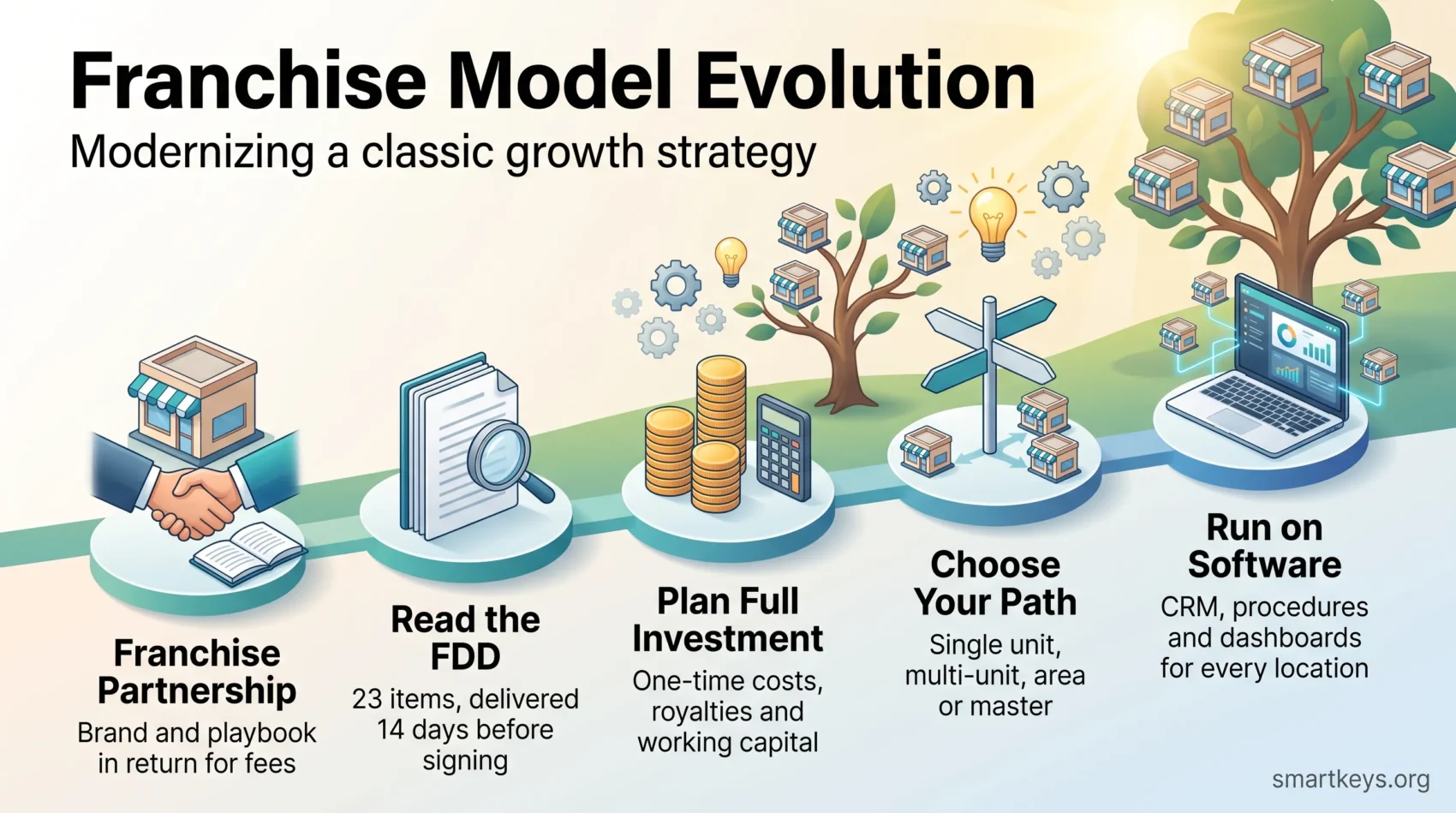
The Federal Trade Commission (FTC), the US consumer protection regulator, enforces the Franchise Rule. It requires the franchisor to hand you a Franchise Disclosure Document covering 23 specified items, at least 14 calendar days before you sign anything or pay anything. That waiting period exists so you can have the document reviewed.
The items worth reading first
Twenty three items is a lot. Start with these:
- Item 3, litigation. Past and current lawsuits involving the franchisor. A pattern of disputes with its own franchisees is a warning sign.
- Item 7, estimated initial investment. The range of what it costs to open, broken down by category.
- Item 19, financial performance. Any figures the brand chooses to publish about what existing locations earn.
- Item 20, outlet information. How many locations opened, closed, were transferred or were terminated over recent years. High closure or turnover numbers deserve an explanation.
What Item 19 does and does not tell you
Item 19 is optional. A franchisor may include a financial performance representation, or it may say nothing at all about earnings. In practice most now publish something: 84% of franchisors surveyed for Franchise Update Media’s 2026 Annual Franchise Development Report said they include one.
Read it skeptically anyway. Item 19 often reports average or median revenue rather than profit, and averages hide the spread. Ask which locations are included, whether company-owned sites are mixed in with franchised ones, and what the weakest quartile looks like. If a brand publishes no Item 19 at all, you are relying on conversations with existing franchisees and your own market research instead.
What changed in 2024
In July 2024 the FTC issued a policy statement saying that contract clauses which stop franchisees from reporting problems to government agencies, including non-disparagement and confidentiality clauses used that way, are unlawful. Alongside it, FTC staff published guidance stating that franchisors cannot lawfully charge fees that were never disclosed, naming payment processing, technology, training, marketing and property improvement charges as areas of concern.
The practical effect for you is straightforward. Fees should appear in the FDD before you sign, and you are entitled to raise problems with a regulator without fear of retaliation. Note that this was guidance and enforcement policy rather than a rewritten rule: the Franchise Rule itself still sets the same 23-item, 14-day framework.
Costs, Fees and Capital
Map every cost before you model any revenue. Total startup costs vary from tens of thousands of dollars for a home-based service franchise to several million for a restaurant with a full building fit-out. The FDD gives you the range in Item 7.
The four buckets to plan for
- One-time costs: the franchise fee, construction and fit-out, equipment, signage, opening inventory and permits.
- Ongoing fees: royalties on sales, advertising fund contributions, technology subscriptions and any support charges.
- Working capital: payroll, rent and utilities for the first three to six months, before the location reaches steady trading.
- Technology: the point of sale (POS) till system, scheduling, and the reporting tools the brand requires.
Build these into a pro forma, meaning a projected profit and loss statement for your first two or three years. Then run it again with sales 20% below your base case. If the pessimistic version still services your debt, the deal has room to breathe.
Ongoing royalties deserve particular attention, because they come off gross sales rather than profit. A location can be busy and still be tight once royalties, rent and labor are paid. Working through where profit actually comes from before you sign is time well spent, and the same discipline applies to any pricing you control locally.
Funding: in the US, Small Business Administration (SBA) backed loans are the common route, alongside private investors and partnerships. Franchises with a documented model and an Item 19 tend to be easier to finance, because the lender can see comparable results.
Judging the Support You Will Actually Get
How a brand supports you in your first ninety days is a fair predictor of how your second year goes.
Look for a defined onboarding path: an operating manual, classroom or online training before opening, a launch marketing plan, and scheduled visits from a field coach after you open.
Documented standard operating procedures matter more than they sound. A written procedure for opening the shop, counting stock or handling a complaint is what lets you train a new employee in a week instead of a month. The case for writing them down properly is set out in standard operating procedures and team productivity, and the training format that works best for shift-based staff is usually short and repeated, as described in microlearning.
Ask the franchisor concrete questions. How quickly does the support desk answer? How many locations does one field coach cover? What does the pre-opening training week actually contain? Then ask existing franchisees the same questions and compare the answers.
Onboarding your own staff is the other half of this. Brands that hand you a structured induction save you weeks, and the principles are the same ones covered in onboarding and training programs.
“Good support does not remove the learning curve. It shortens it, which is worth real money in year one.”
Territory, Location and Protecting Your Market
Confirm exactly how the brand draws territory lines, and what protection is promised in writing. Vague territory language is how a second location of your own brand ends up two miles away.
Choose the site with data rather than instinct. Look at traffic counts, competitor density, daytime population, rent per square foot and labor availability. Match the site criteria to what the brand’s model needs, because a concept built for commuter footfall behaves differently in a suburban retail park.
Where an area development agreement is involved, protection is usually tied to hitting your opening schedule. Miss the milestones and exclusivity can lapse.
- Get radius protection in writing, including how the radius is measured.
- Ask what happens if you need to relocate, and who approves it.
- Check whether the brand can sell online or through third-party delivery inside your territory.
That last point has become the common flashpoint. A protected physical radius means less if the brand ships nationally to customers in your area. Systems that also sell direct to consumers should explain how franchisees share in that revenue.
Risk and Legal Points Before You Sign
Use the disclosed facts, not the sales conversation, to judge your exposure.
Turnover, litigation and exit terms
Item 20 shows how many locations left the system and why. Item 3 shows the litigation history. Together they tell you whether owners tend to stay, and whether disputes are routine.
Then read the agreement for the terms that decide your options later: the renewal conditions, what triggers termination, whether you can sell your location and on what terms, and who pays for mandated refurbishments.
Brand control against local reality
Strong central control keeps the customer experience consistent. It can also stop you responding to your own market on pricing, promotions or opening hours. Ask where the flexibility sits before you assume you have any.
- Treat frequent litigation or high closure rates as questions to ask, not automatic disqualifiers.
- Confirm transfer rights and refurbishment obligations in writing.
- Hold cash reserves, carry proper insurance, and plan for staffing gaps.
A structured way to think about all of this is to score each risk by likelihood and impact, which is the approach outlined in building a risk management framework.
Choosing the Right Franchise for Your Goals
Start with an honest self-assessment. It prevents you from buying a business that does not match how you want to spend your week.
Skills, time and ambition
List what you are actually good at: operations, hiring, selling, or finance. Note how many hours a week you can realistically commit, and whether you want to be behind the counter or behind a desk.
Then decide your pace. One well run location and a multi-site rollout are different lives, not different sizes of the same life.
Matching the format to the market
Business format systems suit sectors where consistency is the product: quick service food, fitness, cleaning, home repair. Product distribution and manufacturing suit goods with real logistics behind them.
Check local demand before you check the brand’s national numbers. A concept can be excellent nationally and wrong for your town. The groundwork here is the same as any go to market plan, and the growth mechanics are covered in scaling a business.
A short comparison checklist
- Compare total investment, royalty rate and advertising contribution side by side.
- Ask each brand for unit economics and the detail of its training program.
- Call at least five current franchisees, including one who is struggling.
- Weigh capital needs against the growth you actually want.
The Software Layer That Makes Modern Franchising Work
A modern system runs on three tools, and the difference between having them and not having them is measurable.
The first is a customer relationship management (CRM) system, meaning software that records every inquiry and tracks what happened to it. For a franchise this matters because a missed callback is a lost sale you never find out about. What these systems now do, including the automation layer, is covered in current CRM trends.
The second is your documented procedures, held somewhere your staff will actually open rather than in a binder under the till.
The third is reporting. Dashboards that show average transaction value, conversion rate, repeat customer rate and labor as a percentage of sales let you spot a problem in week two instead of at the quarterly review. The practical side of choosing those tools is covered in business intelligence tools.
Connect them. When your till system feeds the CRM and the dashboard, your decisions use one set of numbers instead of three. Retention is usually where this pays off first, because the data shows you which customers stopped coming back and when, which is the starting point for the tactics in customer retention.
“Dashboards and written procedures turn daily work into something you can measure and improve.”
Building a Realistic Growth Plan
A roadmap keeps openings predictable and stops capital arriving late. Match the path to your resources: single unit for hands-on owners, multi-unit for operators who can delegate, area development for timed rollouts, master rights for regional leadership.
Milestones worth setting
- Give permitting, construction and hiring their own dates. Compressed schedules are where budgets break.
- Track leading indicators before opening: pre-sales, applications received, training completed.
- Release capital in phases tied to milestones rather than all at once.
- Review each location quarterly against network benchmarks, and use the brand’s field coach for that review.
Set targets you can check: an opening date, a revenue figure by month six, and a funding trigger for the next location. Vague ambition produces vague results.
Conclusion
Franchising trades independence for a working system, and the quality of that system is the whole question.
You now know what the FDD is and which items to read first, what Item 19 does and does not prove, what the 2024 FTC guidance changed about fees and gag clauses, and how the ownership structures differ.
Next step: shortlist two or three brands, request their FDDs, build a conservative pro forma for each, and speak to current franchisees before you speak to anyone in sales again. That is the work that turns a brochure into a decision.
Found this useful?
Make SmartKeys a preferred source on Google, and our articles will surface more often in your Top Stories, AI Overviews, and AI Mode.
Add as Preferred Source