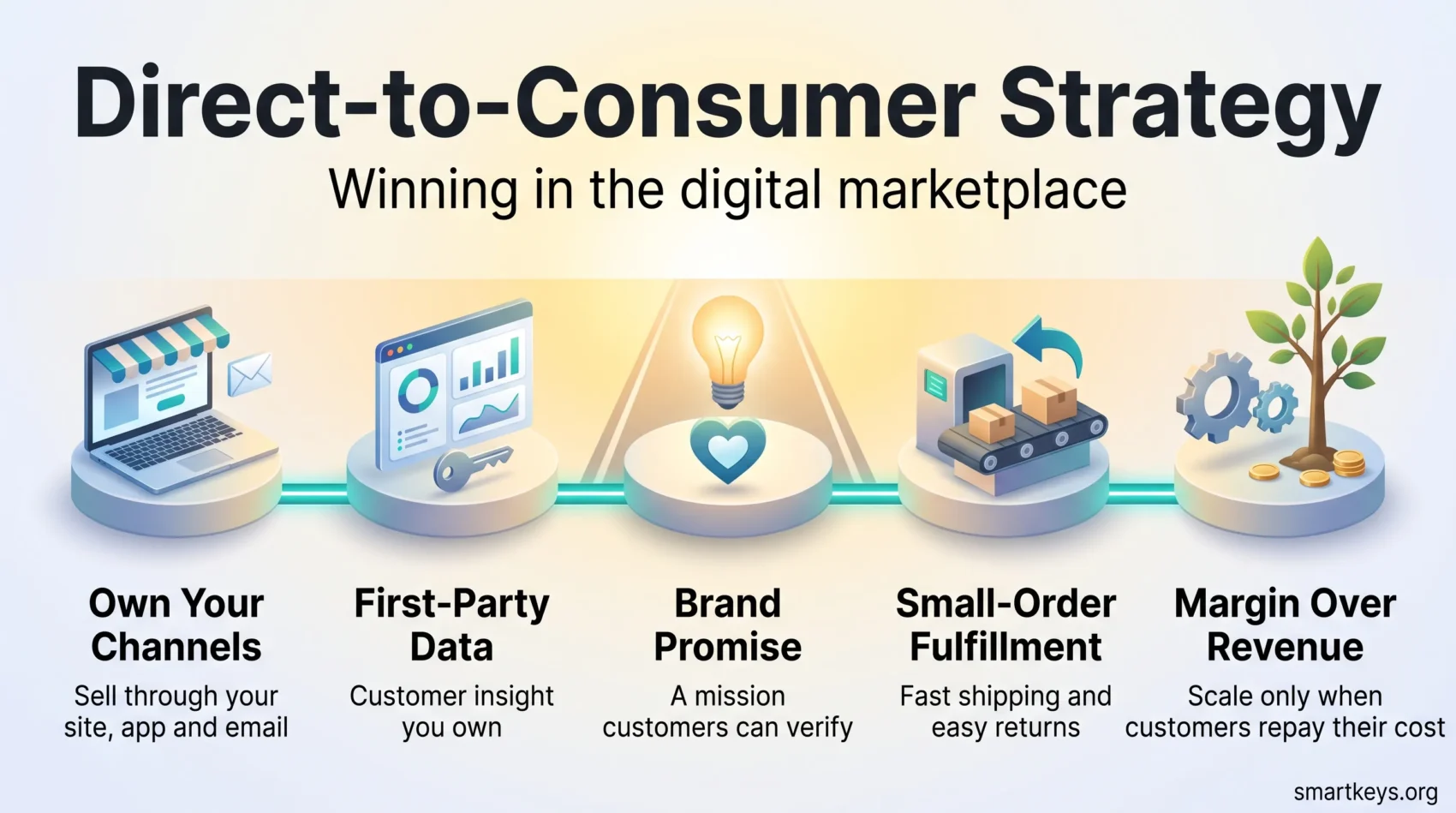
Selling direct means your company sells its products straight to shoppers through channels it controls: its own website, app and email list. Nothing goes through a wholesaler or a retail chain first. That one change hands you pricing, storytelling, customer service and, above all, the customer data.
It also hands you the work: you now pay for every visitor, pack every parcel and answer every complaint. A direct-to-consumer strategy is the plan that makes that trade worthwhile.
The backdrop in 2026 is encouraging but not effortless. US e-commerce accounted for 17.1% of total retail sales in the second quarter of 2026 and grew 12.2% year over year, against 6.7% for retail as a whole (US Census Bureau). What changed is the shape of the winners: almost none of the famous direct-to-consumer (DTC) brands stayed online-only. Glossier now sells through Sephora, and Warby Parker runs roughly 300 of its own stores. Direct selling turned out to be a strong starting point rather than a permanent destination.
This guide covers the model end to end: what you gain, what it costs, how to build the brand and data foundation behind it, and a 90-day plan to launch.
Key Takeaways
- Selling direct gives you margin, speed and customer data, and hands you acquisition, fulfillment and service in return.
- Online demand keeps growing: US e-commerce reached 17.1% of retail sales in Q2 2026 and outgrew retail overall by roughly two to one.
- Third-party cookies did not disappear, but Google shut down most of its Privacy Sandbox tools in October 2025. Your own data is still the reliable asset.
- Nearly every well-known DTC brand now sells through stores or retail partners too. Plan for that from the start.
- You get a week-by-week 90-day launch plan and the numbers that tell you whether to scale or stop.
What Direct-to-Consumer Actually Means
In a wholesale model you ship pallets to retailers, who then own the sale. They choose the shelf, set the promotion and keep the receipt data. You get volume and predictable purchase orders, and very little else.
How it differs from wholesale and retail
The first difference is who decides. A retailer decides where your product sits, what it is discounted to and which competing product sits beside it. Sell direct and you decide all three, plus when to launch.
The second is information. Retailers rarely pass on who bought what. Sell direct and you see the whole sequence: which ad brought someone in, what they browsed, what they bought, what they sent back.
What changes when you own the whole journey
That sequence is first-party data: information customers give you directly on your own site, rather than data bought from an outside broker. It makes useful personalization possible and is the foundation of any serious first-party data strategy.
- Operations: inventory, warehousing and shipping have to be rebuilt for many small orders instead of a few large ones.
- Economics: you give up wholesale volume in exchange for a higher margin on each unit, then spend part of that margin on marketing.
- Service: returns and support stop being someone else’s problem and become part of how your brand is judged.
- Commerce: your product page replaces the shelf, so photography, copy, reviews and checkout do the selling.
In short: you gain speed, data and margin, and take on the fulfillment and service work a retailer used to absorb.
Why the Model Spread, and Where It Stands in 2026
Two things made direct selling possible for small companies. Hosted e-commerce platforms bundled storefront, payments and shipping into a monthly fee, so a founder no longer needed a development team to take an order. And targeted social advertising let a brand with no distribution buy its way to an audience.
Low barriers to launch, higher barriers to grow
Launching is cheap now. Growing is not. Paid social auctions have filled up, so the cost of winning a customer keeps climbing, and a business that depends entirely on bought traffic is renting its demand. That is why owned channels and repeat purchases matter more than they did at the start of the DTC boom. Practical tactics sit in our guide to customer retention strategies.
Why pure DTC became hybrid
The direct channel rarely stays alone. Glossier, which built its following through its own blog and community, signed its first wholesale deal with Sephora and launched there in 2023. Warby Parker ended its long-running Home Try-On programme at the end of 2025, after finding most people who used it lived within half an hour of one of its roughly 300 stores.
Neither brand abandoned selling direct. Both concluded that a customer who can also find them in a shop is cheaper to reach than one bought through an ad auction. For the market picture behind that shift, our analysis of how D2C brands in retail grew and then rebalanced their channels covers the numbers and the brand case studies. Treat wholesale, marketplaces and physical stores as later chapters rather than as failures.
The Benefits and the Trade-Offs
The upside is control and margin. You decide how the brand looks, when products launch and what they cost. Nobody discounts you into a corner to clear their own shelf.
Control, margin and speed
With no buying calendar to satisfy, you can run a limited drop, test two versions of a product and scale the one that sells. A higher gross margin per unit then funds the marketing and the customer service that keep people coming back.
Owning the data compounds that advantage. Purchase history, on-site behaviour and support tickets tell you which products to make more of and which customers deserve a second offer. A customer data platform holds that in one place once volume justifies it.
The costs people underestimate
Three come up again and again.
First, awareness. Without a retailer’s footfall, every customer has to be found and paid for, and that bill arrives before the revenue.
Second, fulfillment. Picking, packing and processing returns for thousands of individual orders needs different people, systems and layouts than shipping pallets. Returns in particular can quietly eat the margin you went direct to capture.
Third, risk. Forecasting errors are yours alone: too much stock ties up cash, too little loses the sale, and a disrupted supplier lands on your books. Our guide to supply chain resilience covers the buffers worth building.
The sensible response is to add systems and headcount as order volume justifies them, and to prove the unit economics on one product line before funding the next.
Build a Brand Customers Choose
A memorable identity makes a shopper recognise you in a crowded feed. It comes from three things held steady: a clear promise, consistent visuals and a voice that matches how you behave.
A recognisable presence across channels
Start with the basics: write down your value proposition, tone and visual rules, then apply them to the site, emails, social accounts and packaging. Reusable templates let you publish a lot without the brand drifting. Our guide to brand storytelling goes deeper on the narrative side.
Back the mission with actions
A claim is only worth what it costs you to keep. Bombas built its brand on donating an item for every item sold, and reports more than 150 million items donated to date. That figure is checkable, which is exactly why customers believe it. Glossier took a different route, treating its audience as a source of product ideas rather than a mailing list, an approach closer to community-led growth.
- Tie the mission to something repeatable and countable.
- Invite customers into product decisions, then ship what they ask for.
- Judge brand health on recall, sentiment and direct traffic, not only click-through rates.
Keep the experience coherent from the first ad to the unboxing. For omnichannel playbooks, see omnichannel strategies that tie audience, content, and media together, and our guide to omnichannel marketing for the execution detail.
Make Data Your Edge: First-Party Data and Honest Measurement
Your data foundation decides whether you are reading signals or guessing. The aim is a small number of clean, consented collection points rather than a large number of messy ones.
What to collect, and how to use it
Useful signals come from site behaviour, email subscriptions, purchases, returns and support conversations. Email deserves particular attention: it is the one channel no platform can take away from you.
There is also zero-party data: things customers tell you deliberately, such as a size, a preference or a reason for buying. It is more accurate than anything inferred from browsing, and our guide to zero-party data explains how to ask for it without annoying people.
- Use clear consent forms and a preference centre so people can choose what they hear about.
- Join site, email, CRM and platform data into one customer view you can actually segment.
- Turn that view into concrete actions: reorder reminders, restock alerts, better recommendations. Our guide to AI personalization in customer experience covers what works.
Measurement after the Privacy Sandbox shutdown
This is where most older DTC advice gets it wrong. Third-party cookies were widely expected to vanish from Chrome. They did not. Google reversed the deprecation plan in April 2025, then shut down most Privacy Sandbox tools, including Topics and Attribution Reporting, in October 2025 after low adoption. Only a few pieces, such as partitioned cookies (CHIPS), remain.
That does not restore the old measurement world. Safari, Firefox and Brave still block third-party cookies, and consent rules under the GDPR and US state privacy laws apply regardless of what any browser does.
The practical answer has not changed: lean on identifiers you own, move tracking to your own server (server-side tagging, where the browser sends events to your server and your server forwards them to advertising platforms), and treat what Meta or Google reports as one input rather than the verdict. Where budget allows, run holdout tests: switch a channel off in some regions and see whether sales actually fall.
“Blend the data you own with modeled measurement and your spend becomes far more predictable.”
Direct-to-Consumer Strategy: The Core Pillars That Drive Growth
Pick a few channels, then build the systems that let you learn from them quickly. A brand running four channels well beats one running nine badly.

Social media that builds awareness and community
Social platforms are where most people meet you first. Short videos with a clear hook and one obvious next step do the work; polished brand films usually do not. Shoppable formats shorten the path from interest to checkout, which our guide to social commerce covers in detail.
Influencer collaborations to extend reach
Creators lend credibility you cannot buy with a banner. Work with people whose audience overlaps yours, give each a unique link or code so you can see what they actually sold, and put paid budget behind the posts that perform.
The channel is large and still growing: eMarketer put US influencer marketing spending at $10.52 billion in 2025, with further double-digit growth expected in 2026. For the business-to-business version of this, see our guide to B2B influencer marketing.
Email and SMS for retention
Email is the engine of repeat purchase. Four flows earn their keep before any campaign does: a welcome sequence, a cart abandonment reminder, a post-purchase follow-up and a replenishment prompt for anything people run out of.
Add SMS only for genuinely time-sensitive moments, such as a restock or a short drop. Texts interrupt in a way email does not, so high frequency costs you subscribers fast. Two-way messaging blurs into conversational commerce once customers start replying.
Offline tactics that amplify digital performance
Billboards, pop-up shops and direct mail can lift reach in one city or period. Measure them geographically: run the activity in some markets and not others, then compare online sales. And remember that subscriptions turn an occasional buyer into predictable revenue, which is why so many consumable brands push them. Our guide to subscription business models covers the trade-offs.
Design Your Channel Mix: Audience, Content and Media Together
Give every channel one job: awareness, consideration or conversion. A channel with two jobs produces numbers that mean nothing.
Mapping content to the funnel
Short entertaining video suits discovery, so TikTok, Reels and Pinterest sit at the top. Reviews and shoppable feeds support the middle. Search and retargeting catch people who have already decided. Discovery increasingly happens inside AI assistants rather than a results page, which is why generative engine optimization now sits alongside conventional SEO.
Balancing prospecting, retargeting and retention
- Prospecting: reach people who have never heard of you, with broad creative and a plain value proposition.
- Retargeting: answer the objection that stopped the first visit, usually price, fit or delivery time.
- Retention: email, SMS and on-site personalization for people who already bought. This is the cheapest revenue you will ever get, and the subject of our guide to customer loyalty.
Operations That Power DTC: Inventory, Fulfillment and Service
Shipping thousands of single orders is a different business from shipping pallets. The pick path, packing bench and carrier handover all have to be designed for it, and that design decides your cost per parcel.
Logistics and inventory rules that keep products available
Three rules do most of the work. Keep your fastest-selling items closest to the packing stations. Set buffer levels for anything with a long lead time, so a delayed container does not become a stockout. And route orders so a customer buying three items does not receive three parcels, which doubles your shipping cost.
If you sell abroad, duties, returns and local delivery expectations change the maths considerably. Our guide to cross-border e-commerce covers what to check first.
Returns and service as growth levers
Make returns boring: a prepaid label, a fast refund, and a process that returns sellable stock to the shelf the same week. Keep customers informed without being asked, with realistic delivery estimates and a help page answering the five questions your support team gets most.
- Audit your packaging for three things at once: protection, cost and how it feels to open.
- Build a fallback with a second carrier, a third-party logistics partner (3PL) and safety stock on your bestsellers.
- Treat support as marketing. A complaint handled well produces more repeat purchases than a discount code.
“Fast shipping, easy returns and clear communication turn service into an acquisition channel.”
What the Best-Known DTC Brands Actually Did
The useful lesson from these companies is not their marketing. It is that product, message and operations pointed the same way.
Glossier: community first, then retail
Glossier grew out of a beauty blog and built products from what readers said they wanted. Community got it started; the Sephora partnership gave it the distribution to scale.
Bombas: a promise that can be counted
Bombas donates an item for every item sold and reports passing 150 million items donated. The number is specific and published, so the mission reads as a commitment rather than a slogan.
Warby Parker: reducing friction, then rethinking it
Warby Parker made buying glasses online feel safe by shipping five frames to try at home for free, then retired the programme once most participants lived near a store. The lesson is not that home try-on was a mistake, but that a tactic solving a real problem can outlive the problem. Review your signature tactics every year.
Your First 90 Days: A Practical Roadmap
A tight plan turns a vague ambition into something you can judge in three months. Each step below produces the information the next one needs.
Week by week
Weeks 1 and 2: settle your positioning and brand basics. Set up analytics and conversion tracking, and write product pages that answer sizing, delivery and returns questions before anyone asks.
Weeks 3 and 4: switch on the core email flows, namely welcome, cart abandonment and post-purchase. Start capturing first-party and zero-party data from day one, because you cannot backfill it later.
Weeks 5 and 6: test paid social and two or three creators. You are testing the offer and the landing page as much as the ad.
Weeks 7 and 8: expand what worked, tighten targeting, add SMS for restocks, and start simple retention plays such as a reorder reminder.
Weeks 9 to 12: optimise for contribution margin rather than revenue. Scale what is profitable, cut what is not, and improve the pages that already get traffic.
The numbers that matter
Five figures tell you almost everything. CAC (customer acquisition cost) is what you spend to win one customer. LTV (lifetime value) is what that customer is worth in total. ROAS (return on ad spend) measures one channel, while MER (media efficiency ratio) compares total revenue with total marketing spend and is harder to flatter. Contribution margin is what is left after product, shipping, payment and marketing costs, and it decides whether growth is worth having.
Track them weekly and by cohort, meaning you follow the customers who arrived in a given month rather than mixing them with everyone else. That view shows how long a customer takes to repay what you spent acquiring them. If the answer is longer than your cash allows, scaling is the wrong move. For the wider set of measures, see our guide to behavioral analytics.
“Weekly CAC and cohort LTV tell you whether to scale or to iterate.”
Conclusion
Selling direct is a trade, not a shortcut. You take margin, speed and customer data, and take on acquisition, fulfillment and service in exchange. The brands that make it work price that trade honestly before they scale.
Build the data foundation early: it is the one asset that keeps working when an advertising platform changes its rules. Keep promise and delivery aligned. And treat wholesale, marketplaces and physical stores as options rather than defeats, since almost every direct brand worth studying ended up using them.
This is a company-wide effort. Operations, finance, service and merchandising decide the outcome as much as marketing does. Let contribution margin and cohort lifetime value, rather than revenue growth, tell you when to press.
Found this useful?
Make SmartKeys a preferred source on Google, and our articles will surface more often in your Top Stories, AI Overviews, and AI Mode.
Add as Preferred Source