A distribution channel is simply the route your product takes from your hands to the person who pays for it. That route might be one step, such as a customer buying from your website. It might be four, passing through an agent, a wholesaler and a retailer before anyone unwraps the box.
Every extra step buys you something and costs you something. Partners bring reach, local knowledge and warehouses you do not have to build. In return they take a share of the margin, and of the control over how your product is presented and priced.
This guide walks through the main types of distribution channels themselves. Who the players are, how the classic channel levels work, when direct beats partner-led, and how the choice plays out in the United States. By the end you should be able to look at your product and name the route that fits it.
Key Takeaways
- A channel is a route to the buyer. Short routes protect margin, long routes buy reach.
- Direct, indirect and hybrid structures each trade control against speed of coverage.
- Channel levels 0 to 3 describe how many parties sit between you and the customer.
- Intermediaries are worth paying for when they do something you cannot do cheaply yourself.
- Written rules on price and territory prevent channel conflict. Goodwill does not.
- Track margin and sell-through per route, never as a single blended average.
Why Your Route to Market Decides Your Growth
Where your product is available sets a hard ceiling on what you can sell. A shopper who cannot find you does not compare you with a competitor. They just buy the competitor.
The split between online and physical selling explains why most companies now run more than one route. In the second quarter of 2026, US retail e-commerce sales reached $340.2 billion, which the Census Bureau puts at 17.1 percent of all retail sales. Online grew 12.2 percent year over year while total retail grew 6.7 percent (US Census Bureau, Quarterly Retail E-Commerce Sales, Q2 2026).
Both halves of that matter. Physical retail still carries more than four fifths of US spending, so an online-only plan locks you out of the larger share. Online is growing at roughly double the pace, so treating it as a side project ages badly. Our guide to current e-commerce trends covers where the buying journey is heading.
What each extra step costs you
Say your product sells for $100 in a store. The retailer keeps a margin, the wholesaler keeps a smaller one, and freight and returns take their share, so perhaps $45 lands in your account. Sell the same item from your own site and you might keep $80, minus the cost of the site, the warehouse and the support inbox.
Neither number is automatically better. The question is whether the partner earns the difference by reaching buyers, and volumes, you could not have handled alone. Margin is not the only thing you hand over: when a retailer makes the sale, it also learns who bought and why, while you see a purchase order.
What a Distribution Channel Actually Is
Three things move along a channel, and only one of them is the product. Goods travel from producer to buyer, money travels back the other way, and data about what sold, where and how fast travels back with it.
That third flow is the one companies most often lose. If you cannot see which products sell through which route, you cannot tell a profitable partner from an expensive one.
Who does what in the chain
- Producer or manufacturer: makes the product, sets the list price and controls supply.
- Agent or broker: introduces buyers and sellers for a commission, and never owns the stock.
- Wholesaler: buys in bulk, stores it, and breaks it into smaller quantities retailers can handle.
- Retailer: displays, markets and sells to the end customer, online or in a store.
- Customer: completes the cycle with a purchase and, if you are paying attention, feedback.
A short route such as producer to reseller to customer keeps delivery fast and margin high. A long route through distributor, wholesaler and retailer reaches far more shelves and costs more at every handover.
Deciding which routes to run, and in what order, is a strategy question rather than a mechanical one. Our guide on building a distribution strategy for a new market covers how to sequence those choices and run a pilot. For a practical omnichannel primer, see omnichannel strategies.
Types of Distribution Channels: Direct, Indirect, and Hybrid
The structure you pick shapes your pricing, your reach and the experience customers remember. Most companies end up blending two of the three.
Direct: you own the whole relationship
Direct selling means the customer buys from you, through your website, your own stores or your sales team. You keep the full margin, the customer data and every decision about how the product looks and costs.
The bill arrives as fixed cost. You are now running marketing, fulfilment, payments and customer service, and those teams need volume to pay for themselves. Our direct-to-consumer strategy guide covers what that operation actually involves.
Indirect: partners carry your product
Going through wholesalers, retailers or resellers buys you shelf space and regional coverage in weeks rather than years. The partner already has the warehouse, the delivery fleet and the buyer relationships.
You accept a lower margin per unit and less say in presentation. For mass-market goods where availability drives the sale, that trade is usually worth making.
Hybrid: both at once, with rules
A hybrid setup runs your own storefront alongside retail partners and marketplaces. It captures demand wherever it appears, which is why so many brands that started online now sell in stores. The cautionary detail is that your own site can undercut the retailer who just gave you shelf space, and that retailer will stop ordering. Written pricing and assortment rules, agreed before launch, are what keep a hybrid setup from eating itself. Our look at D2C brands moving into retail covers how those brands handled the transition.
Distribution Channel Levels Explained: Level 0 to Level 3
Marketers count channel length by how many parties sit between producer and buyer. The labels are dry, but they are a fast way to describe a route.
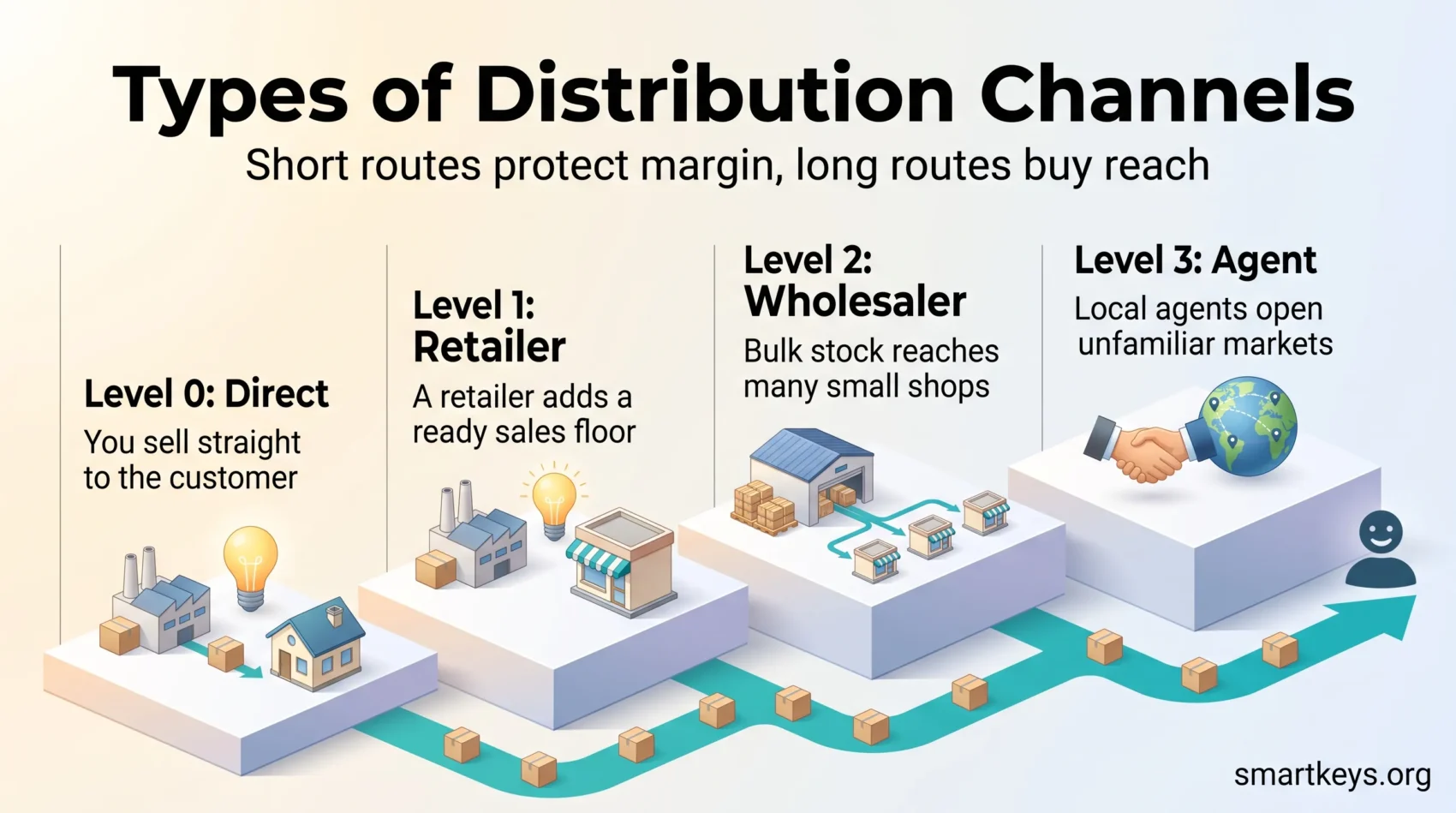
Level 0: straight to the customer
Level 0 has no intermediary at all. Your website, your stores, your field sales team, or a software subscription sold and billed by you. Margin and data are highest here, and so is the operational load.
Level 1 and Level 2: retailers and wholesalers
Level 1 adds a retailer, which gives you a sales floor without building one. Level 2 adds a wholesaler in front of the retailer. The wholesaler buys full pallets, stores them and supplies many smaller retailers, which is how a product reaches thousands of independent shops without thousands of shipments from you.
Level 3: agents for unfamiliar markets
Level 3 puts an agent or broker ahead of the wholesaler. Agents open doors: they know which distributors are solvent, which paperwork a customs office expects, and how a category is normally priced locally.
That makes Level 3 common for international entry. Check two things first. Market selection, covered in our global expansion framework and our guide to cross-border e-commerce. Then where customer records may be stored, since data residency rules differ sharply by country.
“Short routes protect margin. Long routes buy reach. Very few products want the same answer in every market.”
Matching the Route to the Product
The right channel is the one your buyer already uses, not the one that is cheapest to sign. Four product traits do most of the deciding.
- Explanation required. If a buyer needs a demo or an installer, sell direct or through a partner trained for that work.
- Purchase frequency. Everyday repeat purchases reward wide availability. A once-a-decade purchase rewards presence during research.
- Unit economics. A $12 item cannot carry the cost of individual shipping and a support call. It needs a partner who moves volume.
- Positioning. A premium product placed in a discount aisle rarely recovers its price.
How widely to place the product
Three standard options describe your reach. Intensive placement means every outlet that will take you, which suits low-price, high-volume goods. Selective placement means a chosen set of retailers that match your positioning. Exclusive placement gives one partner per market the sole right to sell, which motivates that partner strongly but leaves you no fallback.
Price and placement have to be designed together, because your list price decides which retailers can afford to carry you at all. Our pricing strategy framework covers setting that number, and our go-to-market playbook covers the launch sequence.
Working With Intermediaries and Partners
An intermediary is worth its margin when it does something you cannot do cheaply yourself. Regional warehousing, a service van network or a standing relationship with a national buyer are all hard to replicate and reasonable to pay for.
The partner types, in plain terms
- Distributor: buys your stock, holds it regionally and supplies retailers or business customers.
- VAR (value-added reseller): bundles your product with its own configuration or service work before selling it on.
- SI (systems integrator): makes your product work alongside the other systems a customer already runs.
- MSP (managed service provider): runs the product on the customer’s behalf for a monthly fee.
- OEM (original equipment manufacturer) partner: builds your component into its own finished product.
The last three matter most for software and equipment, where the buyer wants an outcome rather than a box. For how these relationships fit together, see our guide to building a partner ecosystem.
What to settle in writing
Agree territory, assortment, service levels, reporting and the lowest price a partner may advertise publicly. Set those terms before launch, while you still have leverage. Then manage the relationship with more than occasional calls: a scorecard, a quarterly review, and a named person on each side.
Incentives deserve the same discipline. Rebates and marketing funds change partner behaviour, so tie them to outcomes you want, such as sell-through or new accounts, rather than to volume shipped into a warehouse.
“Clear rules and active management turn partners into reliable extensions of your company.”
The US Playbook: Retail, Wholesale, Franchise, DTC, and Marketplaces
Each of these routes has a different entry test, and knowing the test saves months.
Retail partnerships
Retail buyers want evidence: proof of demand, a promotion plan, and packaging that works on their shelf. Coca-Cola is the textbook case of intensive retail distribution, present in supermarkets, vending machines, restaurants and petrol stations so the impulse purchase is always available. Retailers now sell advertising alongside the shelf space, a business covered in our piece on retail media networks.
Wholesale routes
Wholesale suits products with steady replenishment cycles. You ship in bulk and the wholesaler handles storage and the long tail of smaller retailers. Your margin per unit drops, and so does the cost of serving hundreds of accounts.
Franchising
Franchising licenses your operating model to local owners who fund their own outlet. McDonald’s built its global footprint this way, and the sector remains substantial. The International Franchise Association projects about 845,000 franchise establishments in 2026, supporting nearly 8.9 million jobs and $921.4 billion of output (IFA, 2026 Franchising Economic Outlook). The catch is that consistency becomes your product, which means documented procedures and real enforcement. Our guide to the franchise model covers how those agreements are structured.
Direct to consumer
DTC gives you the margin and the customer relationship, and it is rarely the whole answer any more. Warby Parker is the clearest illustration. It disrupted eyewear retail with home try-on kits and its own website, then built a large network of its own stores. Since 2025 it also sells through shop-in-shops inside Target locations. A brand that began as a pure online seller now runs three routes at once. Blending online and in-store experience is its own discipline, covered in our piece on phygital retail.
Marketplaces
Marketplaces hand you demand you did not generate. Amazon is the obvious example, and it is largely a third-party business. In the first quarter of 2026, 60 percent of units sold there came from third-party sellers rather than Amazon itself (Marketplace Pulse, based on Amazon’s disclosures).
Winning there is a discipline of its own: accurate listings, fast fulfilment, and enough reviews to survive the comparison. Two shifts are worth watching. Most marketplace browsing now happens on a phone, covered in our guide to mobile commerce trends. And AI assistants are starting to place orders for shoppers, which we examine in agentic commerce.
Digital Tools That Keep a Multi-Channel Setup Honest
Running several routes at once creates one recurring failure: the same product at two prices under two names, with stock figures nobody trusts.
A CRM system, meaning the database that holds every customer and partner interaction, is where partner performance becomes visible. It answers questions such as which distributor’s leads actually close, and which one has not logged anything for a quarter. Our overview of CRM trends covers how these systems have changed.
Inventory and product content each need one authoritative source that everything else reads from. Without it, your site promises stock the warehouse does not hold and refunds follow. Forecasting tools help you order closer to real demand, and delivery expectations keep tightening, a pressure our guide to supply chain trends examines.
Automation earns its place on the dull work: routing orders, chasing partner reports, updating listings.
Measuring Performance and Catching Channel Conflict Early
A blended average hides the route that is losing money. Report per channel or do not bother.
The short list of metrics
- Sell-through rate: is stock actually reaching customers, or just sitting with the partner?
- Net margin per channel: what you keep after fees, freight and returns, not before.
- Cost to serve: the real cost of supporting one customer through this route.
- Stock availability: how often a buyer finds your product in stock where they looked.
- Repeat purchase rate: which routes bring customers who come back.
Spotting conflict before a partner does
Channel conflict means two of your own routes competing for the same customer, usually on price. The early warnings sit in your own data: the same item advertised at different prices, promotional calendars colliding in the same week, and two partners chasing one account.
The fixes are structural. Differentiate the assortment so each route carries something the others do not, assign segments or territories, and publish minimum advertised price rules. Repairing a relationship after a retailer feels undercut is far harder than preventing it. Keep any discounting inside hard price floors, and judge a route by whether it wins customers who stay, which our guide to customer retention explores.
Conclusion
Pick the simplest route that reaches your buyer, and add a step only when a partner clearly earns its margin. Every handover you add costs money and adds a chance to disappoint someone.
Start with one or two routes rather than five, and measure margin and sell-through for each separately. Agree pricing and territory rules in writing before a partner ships an order, because that is the only moment you have real leverage.
Then keep checking. Online keeps taking share and shoppers keep moving to new places to browse, so a route that fit your product two years ago may not fit it now.
Found this useful?
Make SmartKeys a preferred source on Google, and our articles will surface more often in your Top Stories, AI Overviews, and AI Mode.
Add as Preferred Source